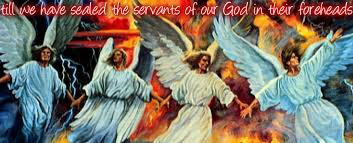
Revelation 7:4-8 “And I heard the number of those who were sealed, one hundred and forty-four thousand were sealed from every tribe of the sons of Israel. Of the tribe of Judah twelve thousand were sealed; of the tribe of Reuben, twelve thousand; of the tribe of Gad, twelve thousand; of the tribe of Asher, twelve thousand; of the tribe of Naphtali, twelve thousand; of the tribe of Manasseh, twelve thousand; of the tribe of Simeon, twelve thousand; of the tribe of Levi, twelve thousand; of the tribe of Issachar, twelve thousand; of the tribe of Zebulun, twelve thousand; of the tribe of Joseph, twelve thousand; of the tribe of Benjamin, twelve thousand.”
In John’s day, signets and seals were used to verify that someone was bearing the authority of an important person. Some seals were used to mark messengers and others so that they would be protected. As far back as the story of Cain and Abel, God placed a mark on Cain’s forehead so that nobody would kill him. The term “the mark of Cain” has generally been used in a very negative sense to indicate someone who was evil but who was being spared by God. Now God is describing placing His seal on specific numbers of people from each of the tribes of Israel with one exception: the tribe of Dan.
What do these numbers actually signify? William Barclay explains, “The number 144,000 stands, not for limitation but for completeness and perfection. It is made up of 12 multiplied by 12–the perfect square–and then rendered even more inclusive and complete by being multiplied by 1,000. This does not tell us that the number of the saved will be very small; it tells us that the number of the saved will be very great.” These numbers are not meant as a specific tally but to indicate that huge numbers of people will be saved and that God’s perfect will will be completed.
If you are familiar with the list of the tribes of Israel, you realize that the tribe of Dan is missing from these verses. Why? When Jacob was prophesying over his sons as he was dying, he said of Dan, “Dan shall be a serpent in the way, a viper by the path, that bites the horse’s heels, so that his rider falls backward” (Genesis 49:17). It was in Dan that Jeroboam set up an enormous altar along with a statue of a golden calf to compete with the temple in Jerusalem. 1 Kings 12:26 – 29 tells the story. Today if you visit the site of ancient Dan, you can see the location of that enormous altar. Some Jewish traditions even claim that the Antichrist will come from the tribe of Dan.
Revelation 7:9-10 After this I saw, and, behold, a great crowd, so great that none could count its number, drawn from every race and from all tribes and peoples and tongues, standing before the throne and before the Lamb, clothed in white robes and palms in their hands. And they shouted with a great voice: “Salvation belongs to our God, who is seated upon the throne and to the Lamb.”

Barclay comments: Here we have the beginning of the vision of the future blessedness of the martyrs.
(i) There is encouragement. There is coming upon the faithful a time of terror such as the world has never seen; and John is telling them that, if they endure to the end, the glory will be worth all the suffering. He is setting out how infinitely worthwhile it is in the long run to accept everything involved in the martyrdom which fidelity must undergo.
(ii) The number of the martyrs is beyond all counting. This may well be a memory of the promise that God made to Abraham that his descendants would one day be as the number of the stars in the heavens (Genesis 15:5), and as the sand of the seashore (Genesis 32:12); at the last the number of the true Israel will be beyond all reckoning.
(iii) John uses a phrase of which he is very fond. He says that God’s faithful ones will come from every race and tribe and people and tongue. Here is the promise that the day will come when all this motley crowd of many nations and many tongues will become the one flock of the Lord Christ.
(iv) It is in victory that the faithful finally arrive in the presence of God and of the Lamb. They appear, not weary, battered and worn, but victorious. The white robe is the sign of victory; a Roman general celebrated his triumph clothed in white. The palm is also the sign of victory. (My note: When Jesus was entering Jerusalem, the crowd waved palm branches.)
(v) The shout of the triumphant faithful ascribes salvation to God. It is God who has brought them through their trials and tribulations and distresses; and it is his glory which now they share. God is the great savior, the great deliverer of his people. And the deliverance which he gives is not the deliverance of escape but the deliverance of conquest. It is not a deliverance which saves a man from trouble but one which brings him triumphantly through trouble. It does not make life easy, but it makes life great. It is not part of the Christian hope to look for a life in which a man is saved from all trouble and distress; the Christian hope is that a man in Christ can endure any kind of trouble and distress, and remain erect all through them, and come out to glory on the other side.
PRAYER: Father God, help us to learn to know you and your Son Jesus Christ! Help us to follow hard after you all the days of our lives. And help us to be faithful, no matter the circumstances. In the mighty Name of King Jesus. Amen.
 Burunche's Blog
Leave a comment