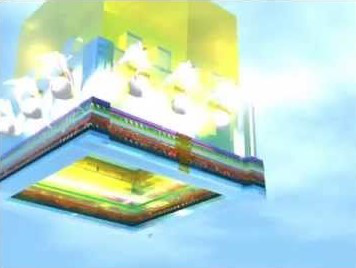
Revelation 21:15 – 17 “The angel who spoke with me had a golden measuring rod to measure the city and its gates and its walls. The city lies foursquare, with its width the same as its length. And he measured the city with the rod, and all its dimensions were equal—12,000 stadiad in length and width and height. And he measured its wall to be 144 cubits,e by the human measure the angel was using.”
It was quite common for ancient cities to be built in the shape of a square, but here is a city that is actually not a hollow square, but a cube! Why? The cube was the symbol of perfection to both the Greeks and the Jews. A man of good character was considered to be a “four square man.” In the temple, the altar of the burnt offering, the altar of the incense, and the High Priest’s breast-plate were all in the form of a cube. In Ezekiel’s visions, the New Jerusalem and the temple were cube – shaped. And in Solomon’s temple the Holy of Holies was a perfect cube. Now God is giving John proof of the holiness of the New Jerusalem, the Holy of Holies, and the dwelling place of God.
Barclay explains: We must note the city’s dimensions. Each side of the city was twelve thousand stades. A stade is very nearly a furlong; therefore, each side was 1,500 miles long, and the total area of the city was 2,250,000 square miles…a city with that area would stretch nearly from London to New York. Surely we are meant to see that in the holy city there is room for everyone…Strangely enough it is different when we come to the wall. The wall is 144 cubits high, that is, 266 feet, not very high. The wall of Babylon was 300 feet high, and the walls of the porch of Solomon’s temple were 180 feet high. There is no comparison between the height of the wall and the size of the city. Again there is symbolism here. The wall cannot be for defense, for all hostile beings, spiritual and human, have been obliterated or cast into the lake of fire. The only thing the wall can do is delimit(demarcate) the area of the city; and the fact that it is so low shows that delimitation(demarcation) is comparatively unimportant. God is much more eager to bring men in than to shut them out–and his Church must be the same.”
v. 18 – 20 “The wall was made of jasper, and the city itself of pure gold, as pure as glass. The foundations of the city walls were adorned with every kind of precious stone: The first foundation was jasper, the second sapphire, the third chalcedony, the fourth emerald, the fifth sardonyx, the sixth carnelian, the seventh chrysolite, the eighth beryl, the ninth topaz, the tenth chrysoprase, the eleventh jacinth, and the twelfth amethyst.”
John is doing his best to describe the vision as God has given it to him, but it’s tough! So John is using the most magnificent comparisons that he can think of. Gold that has truly been refined is actually as pure as glass. The foundations of the walls are inscribed with the names of the twelve apostles, indicating that their faith helps form the foundation for the Holy City. There are twelve huge precious stones that help form the foundation.
Concerning these stones, Barclay explains:”In the city of God these foundation stones were all precious stones. The jasper was not the modern opaque jasper but a translucent rock crystal, green in color. The sapphire appears in the Old Testament story as the stone of the paving on which God stood (Exodus 24:10). Again, it was not the modern sapphire. Pliny describes it as sky-blue, flecked with gold. It was most likely the stone now known as lapis lazuli. The chalcedony was a green silicate of copper, found in mines near Chalcedon. It is described as being like the sheen of green on a dove’s neck or in a peacock’s tail. The emerald was the modern emerald, which Pliny describes as the greenest of all green stones. The sardonyx was an onyx in which the white was broken by layers of red and brown; it was specially used for cameos. The sard or carnelian took its name from Sardis. It was blood-red, and was the commonest of all stones used for engraving gems. The identification of the chrysolite is uncertain. Its Hebrew name means the stone of Tarshish. Pliny describes it as shining with a golden radiance. It could be a yellow beryl or a gold-colored jasper. The beryl was like an emerald; the best stones were sea-blue or sea-green. The topaz was a transparent, greenish-gold stone, very highly valued by the Hebrews. Job speaks of the topaz of Ethiopia (Job 28:19). The jacinth is described by ancient writers as being a violet, bluish-purple stone. It is likely that it was the equivalent of the modern sapphire. The amethyst is described as being very similar to the jacinth, but more brilliant.” It is highly significant that eight of these stones were also on the priest’s breastplate.
Are these descriptions really accurate? Probably not! But what is John to do when given a heavenly vision that is almost indescribable? The most important thing about these descriptions is that the heavenly city is going to be far lovelier than anything that we can think or imagine. God really does know how to create magnificently!
PRAYER: Father God, thank you for loving us so much that you are preparing a place of indescribable beauty where your children can enjoy your love and be with you forever. Thank you that your grace, your holiness, your righteousness, and all of your other attributes are more glorious than anything that we can imagine. Create in those who read these words a hunger to know you in your fullness and in your winsome love. In the mighty Name of King Jesus. Amen.
 Burunche's Blog
Leave a comment