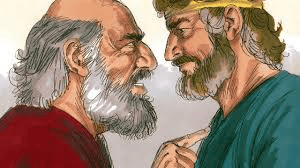
Genesis 31:22 – 25 “On the third day Laban was informed that Jacob had fled. So he took his relatives with him, pursued Jacob for seven days, and overtook him at Mount Gilead. But that night God came to Laban the Aramean in a dream and warned him, “Be careful not to say anything to Jacob, either good or bad.” Now Jacob had pitched his tent in the hill country of Gilead when Laban overtook him, and Laban and his relatives camped there as well.”
Jacob has left Paddan – aram and is returning to Canaan with his family, his livestock, and his servants. Just as they are about to leave, Rachel steals her father’s household idols without telling Jacob. (Jacob may have a relationship with the One True God; however, Rachel evidently thinks that Jacob has exclusive rights to God and therefore she needs the gods with which she grew up.) Jacob is already three days’ journey down the road when Laban finds out that Jacob has left. Laban gathers up all his male relatives and pursues Jacob. What might have happened had God not intervened, nobody knows. But God warns Laban, literally putting the fear of Him into Laban.
v. 26 – 31 “Then Laban said to Jacob, “What have you done? You have deceived me and carried off my daughters like captives of war! Why did you run away secretly and deceive me, without even telling me? I would have sent you away with joy and singing, with tambourines and harps. But you did not even let me kiss my grandchildren and daughters goodbye. Now you have done a foolish thing.
I have power to do you great harm, but last night the God of your father said to me, ‘Be careful not to say anything to Jacob, either good or bad.’ Now you have gone off because you long for your father’s house. But why have you stolen my gods?” “I was afraid,” Jacob answered, “for I thought you would take your daughters from me by force. If you find your gods with anyone here, he shall not live! In the presence of our relatives, see for yourself if anything is yours, and take it back.” For Jacob did not know that Rachel had stolen the idols.”
SAY WHAT??? Laban gets a quaver in his voice and describes an idyllic parting in which he would have sent Jacob and his family away with music and fond kisses for the grandchildren. How ridiculous! This is Laban, the same man about whom his daughters complained that he was treating them like strangers and that he had squandered their dowry money. Jacob probably has a very accurate idea of what Laban would have done, had Jacob informed Laban ahead of time that he wanted to return to Canaan. After all, God had to warn Laban in a dream to leave Jacob alone; God doesn’t give out warnings needlessly. And now we get to the heart of things: Laban is furious that Jacob has stolen Laban’s household gods. Unfortunately, in an impassioned denial, Jacob lays a death curse on anyone who has stolen the idols; that curse comes to rest on Rachel and later she dies in childbirth delivering Benjamin.
Laban searches the entire camp. Rachel has hidden the idols in a camel saddle and sits on it when her father enters her tent, telling her father that she is menstruating and needs to sit. Laban gives Rachel a wide berth because it is taboo for a man to be in the presence of a menstruating female. Obviously, Laban is NOT the only tricky member of the family!
v. 36 – 42 “Then Jacob became incensed and challenged Laban. “What is my crime?” he said. “For what sin of mine have you so hotly pursued me? You have searched all my goods! Have you found anything that belongs to you? Put it here before my brothers and yours, that they may judge between the two of us.
I have been with you for twenty years now. Your sheep and goats have not miscarried, nor have I eaten the rams of your flock. I did not bring you anything torn by wild beasts; I bore the loss myself. And you demanded payment from me for what was stolen by day or night. As it was, the heat consumed me by day and the frost by night, and sleep fled from my eyes.
Thus for twenty years I have served in your household—fourteen years for your two daughters and six years for your flocks—and you have changed my wages ten times! If the God of my father, the God of Abraham and the Fear of Isaac, had not been with me, surely by now you would have sent me away empty-handed. But God has seen my affliction and the toil of my hands, and last night He rendered judgment.”
What does this story teach about forgiveness and unforgiveness?
1. Unforgiveness: Rachel steals the household gods. Many cultures have such idols, and they are believed to bring protection and blessing to the family. Is Rachel stealing these idols so that she will be protected and blessed, or is she coldly furious with her father for the shabby manner in which he has treated her sister and her? Rachel needs to forgive her father and does not.
2. Unforgiveness: Laban has cheated and used Joseph as much as he can; yet, Laban still resents Joseph because God has blessed Joseph. Laban needs to forgive Joseph and will not.
3. Unforgiveness: Jacob needs to forgive Laban for Laban’s cheating, lying, and manipulations. Jacob has suffered for twenty years and Laban has forced him to bear losses that should have been Laban’s and has changed his wages ten times.
APPLICATION: Forgiveness is a gift you give yourself, not something based on another person’s willingness to confess their wrong. As the story continues, we will see that Laban never actually repents. If you are looking for closure by an act of contrition on the part of the other person, forget it! You might wait forever.
PRAYER: Father God, help us to forgive those who hurt us, no matter the circumstances. Thank you that you have forgiven us for far worse sins than anything someone else can do to us. Thank you for loving us and for sending Jesus to die for our sins. In the mighty Name of King Jesus. Amen.

 Burunche's Blog
Leave a comment