
Genesis 37:18 – 30 “Now Joseph’s brothers saw him in the distance, and before he arrived, they plotted to kill him. “Here comes that dreamer!” they said to one another. “Come now, let us kill him and throw him into one of the pits. We can say that a vicious animal has devoured him. Then we shall see what becomes of his dreams!”
When Reuben heard this, he tried to rescue Joseph from their hands. “Let us not take his life,” he said. “Do not shed his blood. Throw him into this pit in the wilderness, but do not lay a hand on him.” Reuben said this so that he could rescue Joseph from their hands and return him to his father.
So when Joseph came to his brothers, they stripped him of his robe—the robe of many colors he was wearing— and they took him and threw him into the pit. Now the pit was empty, with no water in it And as they sat down to eat a meal, they looked up and saw a caravan of Ishmaelites coming from Gilead. Their camels were carrying spices, balm, and myrrh on their way down to Egypt.
Then Judah said to his brothers, “What profit will we gain if we kill our brother and cover up his blood? Come, let us sell him to the Ishmaelites and not lay a hand on him; for he is our brother, our own flesh.” And they agreed. So when the Midianite traders passed by, his brothers pulled Joseph out of the pit and sold him for twenty shekels of silver to the Ishmaelites, who took him to Egypt.
When Reuben returned to the pit and saw that Joseph was not there, he tore his clothes, returned to his brothers, and said, “The boy is gone! What am I going to do?”
Joseph has really done it now! Jacob has sent Joseph out to check on his brothers who have had to wander a long way to find grazing for their animals. Remember that four of these men are already furious with Joseph for having carried tales about them to their father. Joseph has compounded the problem by recounting dreams in which all his family members have become subservient to him. It’s quite possible that while the brothers have been sitting around watching their animals graze, they have been sharing stories about Joseph to the point that now all of them despise him thoroughly.
Joseph shows up to check on his brothers. You can imagine their thoughts, “Hmph! The last time this guy carried information to Dad, four of us wound up in trouble. What’s he want now? And why do we have to put up with him?” The brothers throw Joseph into an empty pit and start mulling over their options. Reuben, the oldest, is no angel, but he cares enough for his father that he is planning to rescue Joseph. But while Reuben is off somewhere, a caravan on its way to Egypt shows up. What a great idea! Don’t kill Joseph or beat him up; after all he IS our own flesh and blood. Just sell him to the caravan and they can send him to Egypt. Problem solved permanently! Why were the brothers reluctant to kill Joseph? Perhaps there are some traditional taboos; historically, the shedding of innocent blood has been thought to bring curses on a land. Reuben returns to find Joseph gone. But does Reuben go home and tell his father what has actually happened? Reuben’s behavior here is quite strange. Reuben SOUNDS as if he really cares about Joseph and his father; but when the pressure is on, Reuben doesn’t tell the truth at all.
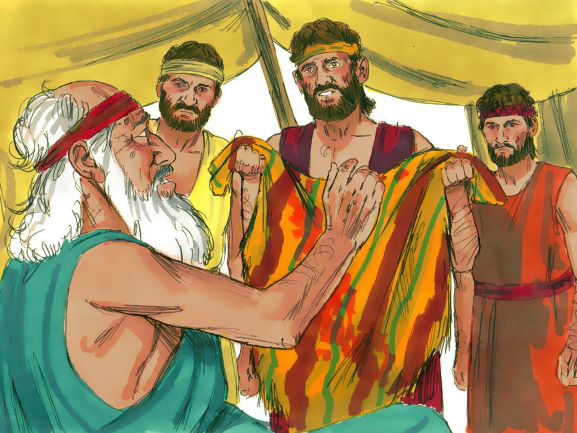
v.31- 36 “they took Joseph’s robe, slaughtered a young goat, and dipped the robe in its blood. They sent the robe of many colors to their father and said, “We found this. Examine it to see whether it is your son’s robe or not.”
His father recognized it and said, “It is my son’s robe! A vicious animal has devoured him. Joseph has surely been torn to pieces!” Then Jacob tore his clothes, put sackcloth around his waist, and mourned for his son many days. All his sons and daughters tried to comfort him, but he refused to be comforted. “No,” he said. “I will go down to Sheol mourning for my son.” So his father wept for him.
Meanwhile, the Midianites sold Joseph in Egypt to Potiphar, an officer of Pharaoh and captain of the guard.”
These are Jacob’s sons all right! Notice that they NEVER make any statements themselves; they only tell Jacob that they have found the robe and ask him if it’s Joseph’s. Jacob jumps to the natural conclusion without the need for any of the sons to lie to him. CLEVER ! But this is their father also. How can they be so cruel?
Jacob did not love his sons unconditionally or equally. Look back to the meeting with Esau; the concubines and their children came first, then Leah, and finally Rachel. There was a definite hierarchy of love in Jacob’s family. In some families, love is very conditional; each sibling feels that he must outdo the others to earn his parents’ love. Sometimes when a parent or grandparent dies, the children or grandchildren fight over the things left behind. The unspoken script is that “If I have a lot of Dad’s/Mom’s/Grandpa’s/Grandma’s things, then it means they loved me best!”
APPLICATION: How do things work in your family? If you are a parent or grandparent, do you play favorites? Do you make sure your children and grandchildren know that you love them or do you try to substitute things or activities for being with them? Don’t copy Jacob! Jacob’s failure to assure all of his sons of his love left them scrambling to prove their own importance.
What does this story have to do with forgiveness? Perhaps you were raised in a dysfunctional family; you may need to forgive your parents and grandparents and your siblings. Refusing to forgive and nourishing hurt feelings only brings more bitterness, more separation, and more loneliness. Refusing to forgive those who wronged you also may cause you to repeat the very behavior you dislike so much.
PRAYER: Father God, help us to forgive anyone in our family who has practiced conditional love. Help us to forgive our siblings, who may have also been victims just as we have. And help us to move forward and copy your unconditional love. In the mighty Name of King Jesus. Amen.
 Burunche's Blog
Leave a comment