
Genesis 40:1 – 15 “Some time later, the king’s cupbearer and baker offended their master, the king of Egypt. Pharaoh was angry with his two officers, the chief cupbearer and the chief baker, and imprisoned them in the house of the captain of the guard, the same prison where Joseph was confined. The captain of the guard assigned them to Joseph, and he became their personal attendant.
After they had been in custody for some time, both of these men—the Egyptian king’s cupbearer and baker, who were being held in the prison—had a dream on the same night, and each dream had its own meaning.
When Joseph came to them in the morning, he saw that they were distraught. So he asked Pharaoh’s officials who were in custody with him in his master’s house, “Why are your faces so downcast today?”
“We both had dreams,” they replied, “but there is no one to interpret them.”
Then Joseph said to them, “Don’t interpretations belong to God? Tell me your dreams.”
So the chief cupbearer told Joseph his dream: “In my dream there was a vine before me, and on the vine were three branches. As it budded, its blossoms opened and its clusters ripened into grapes. Pharaoh’s cup was in my hand, and I took the grapes, squeezed them into his cup, and placed the cup into his hand.”
Joseph replied, “This is the interpretation: The three branches are three days. Within three days Pharaoh will lift up your head and restore your position. You will put Pharaoh’s cup into his hand, just as you did when you were his cupbearer. But when it goes well for you, please remember me and show me kindness by mentioning me to Pharaoh, that he might bring me out of this prison. For I was kidnapped from the land of the Hebrews, and even here I have done nothing for which they should have put me in this dungeon.”
Being a chief cup bearer to a ruler was a highly important position. For one thing, the ruler might ask you to taste the wine before he himself would drink it; if you didn’t collapse and die, then the wine was safe for the ruler to drink. In the same manner, being the chief baker was also a position of great importance. In a land in which bread was a basic staple at every meal, a ruler expected only the very best. Perhaps Pharaoh was having a bad day, but both these men wound up imprisoned in the house of the captain of the guard – an early version of a white collar prison. And the captain of the guard assigned Joseph to take care of them.
Both these gentlemen had dreams on the same night. Notice that Joseph does NOT say, “Oh, I can interpret your dreams.” Instead, Joseph gives God all the credit before interpreting the dreams. When the chief cup bearer gets an encouraging interpretation, the chief baker then recounts his dream.
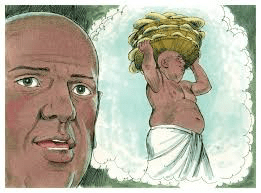
v. 16-23 “I too had a dream: There were three baskets of white bread on my head. In the top basket were all sorts of baked goods for Pharaoh, but the birds were eating them out of the basket on my head.” Joseph replied, “This is the interpretation: The three baskets are three days. Within three days Pharaoh will lift your head off of you and hang you on a tree. Then the birds will eat the flesh of your body.”
On the third day, which was Pharaoh’s birthday, he held a feast for all his officials, and in their presence he lifted up the heads of the chief cupbearer and the chief baker. Pharaoh restored the chief cupbearer to his position, so that he once again placed the cup in Pharaoh’s hand. But Pharaoh hanged the chief baker, just as Joseph had interpreted the dream to them. The chief cupbearer, however, did not remember Joseph; he forgot all about him.”
When the chief cup bearer’s dream came true, Joseph must have been ecstatic! At last he was going to get out of prison. But in the euphoria of being restored to an important position, the chief cup bearer forgot Joseph. And after all, Joseph was a Hebrew while the cup bearer was an Egyptian. As a race, the Egyptians were extremely proud of themselves; perhaps there was an element of racial prejudice at work here.
APPLICATION: Have you ever gone out on a limb to help someone, only to have them take all your efforts for granted? Perhaps you have helped someone get a better job or get a promotion. Perhaps you helped pay school fees for someone’s children, even though you had to scramble to come up with the money. It’s always frustrating and discouraging when you have gone the extra mile to help someone, only to have them forget you, ignore your efforts, or take you for granted.
What’s the lesson of forgiveness here? Sometimes people are very ungrateful and ignore whatever you have done for them. How do you handle such a situation? The best course of action is this: do what you can to help and do it to the glory of God. if people thank you, fine. If people ignore you, forgive them and move on. Don’t get bogged down in unforgiveness. Ingratitude carries its own punishment with it; you don’t have to get involved.
PRAYER: Father God, we ourselves are so ungrateful! You have given us life and health. You have given us a wonderful and beautiful world to live in and to enjoy. And most of all, you sent your son Jesus to die for our sins so that we would not bear that punishment ourselves. Help us to forgive those who are ungrateful and to press on into the glorious future you have for us. In the mighty Name of King Jesus. Amen.
 Burunche's Blog
Leave a comment