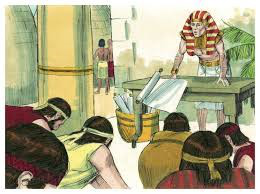
Genesis 42:1 – 7 “When Jacob learned that there was grain in Egypt, he said to his sons, “Why are you staring at one another?” “Look,” he added, “I have heard that there is grain in Egypt. Go down there and buy some for us, so that we may live and not die.” So ten of Joseph’s brothers went down to buy grain from Egypt. But Jacob did not send Joseph’s brother Benjamin with his brothers, for he said, “I am afraid that harm might befall him.”
So the sons of Israel were among those who came to buy grain, since the famine had also spread to the land of Canaan. Now Joseph was the ruler of the land; he was the one who sold grain to all its people. So when his brothers arrived, they bowed down before him with their faces to the ground.” When Joseph saw his brothers, he recognized them, but he treated them as strangers and spoke harshly to them. “Where have you come from?” he asked. “From the land of Canaan,” they replied. “We are here to buy food.”
WOW! By now, Joseph’s dream might be fifteen or twenty years in the past. The last thing Joseph has anticipated is that his brothers would show up along with others wanting to buy grain. But here are Joseph’s brothers, bowing down just as they did in his dreams. What Joseph does next doesn’t seem like an act of forgiveness. Joseph accuses his brothers of being spies, but his brothers protest that they are honest men seeking to buy food.
v.13 – 20 “But they answered, “Your servants are twelve brothers, the sons of one man in the land of Canaan. The youngest is now with our father, and one is no more.” Then Joseph said to them, “Just as I said, you are spies! And this is how you will be tested: As surely as Pharaoh lives, you shall not leave this place unless your youngest brother comes here. Send one of your number to get your brother; the rest of you will be confined so that the truth of your words may be tested. If they are untrue, then as surely as Pharaoh lives, you are spies!” So Joseph imprisoned them for three days, and on the third day he said to them, “Do this and you will live, for I fear God. If you are honest, leave one of your brothers in custody while the rest of you go and take back grain to relieve the hunger of your households. Then bring your youngest brother to me so that your words can be verified, that you may not die.” And to this they consented.”
Captured at age seventeen and freed at age thirty, Joseph was in prison for thirteen years. At first, Joseph imprisons all his brothers, but eventually he elects to keep only one of them in custody while allowing the others to return to Canaan to bring Benjamin back with them. Why does Joseph do this? First of all, Joseph must establish his persona as an Egyptian ruler. The Egyptians are a very proud people and generally feel that other races are beneath them. It’s likely that there are those around Joseph who are watching him closely. Any gentleness on Joseph’s part would be interpreted as a sign of weakness. Perhaps Joseph realizes that the famine has yet to hit full stride; he knows his family will not agree to relocate from Canaan unless they have a strong reason to do so. Joseph has to find some means of convincing his family to leave Canaan and move to Egypt.
v. 21 – 24 “Then they said to one another, “Surely we are being punished because of our brother. We saw his anguish when he pleaded with us, but we would not listen. That is why this distress has come upon us.” But Reuben replied: “Didn’t I tell you not to sin against the boy? But you would not listen. Now we must account for his blood!” They did not realize that Joseph understood them, since there was an interpreter between them. And he turned away from them and wept. When he turned back and spoke to them, he took Simeon from them and had him bound before their eyes.”
Why does Joseph keep Simeon in prison? Simeon was a son to Leah and a brother to Reuben. Perhaps Simeon was one of the ones who argued most strongly for Joseph to be sold into slavery. One thing is clear: the brothers still argue just as much as they ever did. A second thing is equally clear: Joseph still loves his brothers. As Joseph hears his brothers rehashing the old arguments about having sold him into slavery, he weeps. Perhaps Joseph weeps because he realizes that not all his brothers agreed to sell him and that some of them were trying to save him. Perhaps Joseph simply remembers the good days before his brothers became jealous.
APPLICATION: What would you do were God to give you control over someone who has hurt you? Although the beginning of this passage makes Joseph sound harsh, in reality Joseph knows that his family’s only hope of survival depends on their moving to Egypt until the famine is over. (Such moves were not unusual; see the story of Ruth.) Without a compelling reason to move, Jacob and his family might stay in Canaan until they die of hunger. Joseph is trying to save his family, including the brothers who sold him into slavery.
God tells us that vengeance is His and not ours. And Jesus told his disciples, “For if you forgive men their trespasses, your Heavenly Father will also forgive you. But if you do not forgive men their trespasses, neither will your Father forgive yours.” (Matthew 6:14-15) Let God settle things; you forgive.
PRAYER: Father God, forgiveness is HARD, especially when people have really hurt us repeatedly and severely! Help us to freely forgive and to let you settle matters for us. In the mighty Name of King Jesus. Amen.
 Burunche's Blog
Leave a comment