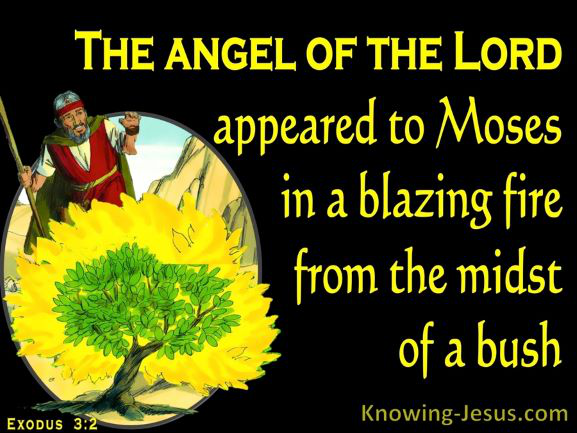
Exodus 3:1 – 10 “Meanwhile, Moses was shepherding the flock of his father-in-law Jethro, the priest of Midian. He led the flock to the far side of the wilderness and came to Horeb, the mountain of God. There the angel of the LORD appeared to him in a blazing fire from within a bush. Moses saw the bush ablaze with fire, but it was not consumed. So Moses thought, “I must go over and see this marvelous sight. Why is the bush not burning up?”
When the LORD saw that he had gone over to look, God called out to him from within the bush, “Moses, Moses!” “Here I am,” he answered. “Do not come any closer,” God said. “Take off your sandals, for the place where you are standing is holy ground.” Then He said, “I am the God of your father, the God of Abraham, the God of Isaac, and the God of Jacob.” At this, Moses hid his face, for he was afraid to look at God.
The LORD said, “I have indeed seen the affliction of My people in Egypt. I have heard them crying out because of their oppressors, and I am aware of their sufferings. I have come down to rescue them from the hand of the Egyptians and to bring them up out of that land to a good and spacious land, a land flowing with milk and honey—the home of the Canaanites, Hittites, Amorites, Perizzites, Hivites, and Jebusites. And now the cry of the Israelites has reached Me, and I have seen how severely the Egyptians are oppressing them. Therefore, go! I am sending you to Pharaoh to bring My people, the Israelites, out of Egypt.” But Moses asked God, “Who am I, that I should go to Pharaoh and bring the Israelites out of Egypt?”
By the time Moses saw that burning bush, he was eighty years old and had been herding sheep for forty years. Moses was married and had at least one son and possibly grandchildren. Egypt had become a distant if painful memory and Moses thought he would spend the rest of his life herding sheep. It wasn’t a bad life, and it certainly beat being a slave in Egypt or being in prison and being tortured. All Moses was hoping for that morning was to find a spring of water for his sheep.
Did Moses even realize that he was on the slopes of a holy mountain? Tough to know. Those who spend their lives outdoors are far more in tune with nature than those who remain inside. Perhaps Moses’s senses were already tingling, signaling that something supernatural was about to happen. At any rate, God knew that Moses had a lot of curiosity, so God caught Moses’ attention with something that shouldn’t exist: a bush that would keep burning but that was not turning to ashes.
God identified Himself and told Moses what He wanted Moses to do. Forty years ago, Moses thought that he could deliver one Israelite from a harsh Egyptian task master, but he never thought of delivering an entire nation. When God informed Moses of the task He wanted Moses to do, Moses had a very natural reaction: “Who? Me?” Moses was probably thinking, “Wait a minute, Lord! If you wanted me to do this, why didn’t you call me when I was young and strong and when I still had some friends in Egypt? Now I’m old and I’ve been away from the Egyptian court for so long that nobody knows me.”
APPLICATION: God’s timing and mercy do not depend on our personal preferences. The very things that Moses saw as drawbacks were the things God was planning to use to accomplish his purpose.
1. Moses had spent 40 years herding sheep in desert conditions. Sheep are stupid, willful, and require a lot of supervision if they are not to get into trouble. Moses needed this experience because the Israelites would behave a lot like those sheep.
2. Moses was no longer a rash middle – aged man, but an elder with experience. In a patriarchal society such as that of the Israelites, these attributes automatically gave Moses the status he would need to convince a group of Israelites that God had really spoken to him.
3. All those years in the desert had made Moses tough and resilient, qualities that he was going to need as he led the Israelites out of Egypt.
The founder of the China Inland Mission, Hudson Taylor, began his work in China but then had to return to England for nine years due to health problems before he could return. It was during those nine years that Taylor gathered others passionate about the Gospel into daily prayer meetings over a map of China. This enforced retreat gave Taylor the chance to consider the mistakes he had made as well as those he had seen other mission groups make. The China Inland Mission was truly born during those nine years of confinement. CIM was responsible for bringing in more than 800 missionaries, starting 125 schools, establishing 300 mission stations in 18 provinces, and directly resulting in 18,000 Christian conversions. CIM was a faith – based mission, depending on voluntary donations. Taylor was fond of saying “God’s work done God’s way will never lack God’s supply.”
Do you feel that you are elderly and that you have been sent to sit on the sidelines for good? Don’t count yourself out so quickly! Remember that Moses wasn’t even called into ministry until he was eighty. God’s mercies are unlimited and His plans are magnificent. No matter how severe your physical limitations, you can always pray. Many of those who gathered for the daily prayers at China Inland Mission headquarters never went to China themselves, but their prayers made the work of thousands who served with CIM possible.
PRAYER: Father God, thank you that you always have something glorious for us to do and that prayer is one of the most important works there is! Help us to open our minds to the possibilities you have for us. Thank you for your mercies that are new every morning! Thank you for your faithfulness! In the mighty Name of King Jesus. Amen.
 Burunche's Blog
Leave a comment