Archive for April, 2021

APRIL 30, 2021 MERCY 61: DOES GOD APPROVE OF SLAVERY? PART 3 WHAT ABOUT FEMALE SLAVES??

April 30, 2021

Exodus 21: 4-7 “And if a man sells his daughter to be a female slave, she shall not go out as the male slaves do. If she does not please her master, who has betrothed her to himself, then he shall let her be redeemed. He shall have no right to sell her to a foreign people, since he has dealt deceitfully with her. And if he has betrothed her to his son, he shall deal with her according to the custom of daughters. If he takes another wife, he shall not diminish her food, her clothing, and her marriage rights. And if he does not do these three for her, then she shall go out free, without paying money.”

Remember that God is having to teach the Israelites totally different ways to behave than they were used to in Egypt. In that day and age, poor families might sell their daughters to a wealthier family for various reasons. Here we are still speaking of Hebrews who are sold into slavery to other Hebrews. Why would someone willingly sell his daughter? Again we turn to the Enduring Word Commentary by David Guzik for the answers:

a. If a man sells his daughter to be a female slave: The matter described here seems to describe the selling of a young female as a slave to a family with the intention of marriage. This is why the text explained, who has betrothed her to himself.

i. “Refers to a girl who is sold by her father, not for slavery, but for marriage.” (Kaiser)

ii. “Probably the origin of the custom was the same in either case: to avoid paying a higher bride-price at a later age, and to rear the future daughter-in-law within the family, ensuring that she ‘fitted in’. Such an attitude to slaves abolishes slavery, except in name.” (Cole)

iii. In ancient societies (including sometimes among the Hebrews), a child might be sold as a slave in light of a debt or; especially in the case of a female slave, in a dowry arrangement to satisfy a debt. Such arrangements were more of what we associate with indentured servitude than slavery. Yet, these are not the circumstances regarding this particular law. b. He shall let her be redeemed: If her master did not marry her or decided not to give her to his son, the master was still obligated to respect her rights under God’s law. He had to treat her well and give her the opportunity to escape the obligation of servitude.

i. “Should the terms of marriage not be fulfilled, it is to be considered a breach of contract, and the purchaser must allow the girl to be redeemed.” (Kaiser)

ii. No right to sell her to a foreign people: “Even if he has wearied of her, he cannot sell her to another master: that would be a breach of marriage obligation to her.” (Cole)

c. He shall not diminish her food, her clothing, and her marriage rights: If the girl received into the home with the expectation of future marriage did not work out, she was not to be treated poorly. She was not to be deprived the comforts of the home; instead she must be treated according to the custom of daughters – treated like a daughter, not a slave.

i. “The word translated food should perhaps be rendered ‘meat’: it means, say the commentators, the wife’s fair share of luxuries, not mere subsistence allowance, which any slave would get.” (Cole)

d. Then she shall go out free, without paying money: If the household failed in their obligations toward the girl received into the home with the expectation of future marriage, she was granted freedom. These were remarkable protections of ones who might be disadvantaged.

i. The girl in this circumstance – out of her birth home, released by her natural parents – had no natural protector in that society. God directed the judges of Israel to be her protector.

ii. Thus, “The right of a parent to sell his daughter was carefully guarded against abuse.” (Thomas)

While these provisions might seem terrible to Western eyes, there are still many parts of the world today in which girls are given in arranged marriages. Actually, the provisions in the Mosaic Law are far more generous than the situations that prevail many times. Recently we had a premature baby boy admitted to our Newborn ICU. The mother was one of four wives and one of the other wives was assisting her to care for the infant. The husband abandoned these two women, leaving them without any money for food or other necessities. The infant weighed 1.1 kg, or barely over 2 pounds, at birth. We were forced to give the mother and her friend money to live on until the baby became big enough to leave the NICU. We were forced to discharge the baby when he weighed 3.3 pounds. Blessedly, the baby and mother are both doing well and the baby is now up to nearly 4.5 pounds. In this situation, speaking to the husband accomplished nothing; he sat and listened and then went home, leaving them penniless!

At times we have seen young girls in their teens forced to marry elderly men who may then abuse them if they fail to get pregnant quickly or if they have complications because their bodies are not yet ready for motherhood. We have seen women turned out of their homes when they developed leakage of urine from birth complications. Compared with these things, the Mosaic Law looks quite humane.

If God had simply told the Israelites “Don’t sell your daughters for any reason,” they would have ignored the command or found a way around it. As it was, God was meeting the Israelites where they were and then leading them out of the abuses they had learned in Egypt.

APPLICATION: Some people might read this and feel morally superior; after all, THEY have never sold their daughters…. or have they? There are many families who pressure their daughters to marry wealthy professionals; in fact, there are many women who do everything they can to snare wealthy professionals as husbands. And there are many men who target wealthy professional women as mates as well. But God judges hearts, not bank accounts. What standards are we using when we look for a mate? Do we ask God to pick our mate for us, or are we fixated on money or social position?

PRAYER: Father God, please help us to seek YOUR perfect will for marriage partners and not lust after money or social position. Help us to realize that you have our best interests at heart and that if we allow you to select our mate, our marriages will succeed, while if we use other criteria, we are doomed to failure and misery. In the mighty Name of King Jesus. Amen.

APRIL 29, 2021 MERCY 60: DOES GOD APPROVE OF SLAVERY? PART 2

April 29, 2021
More Important than Money Exodus 21:1-11. Micah 4:1 1 In the last days the  mountain of the LORD's temple will be established as chief among the  mountains; - ppt download

Exodus 21:1 – 6 “These are the ordinances that you are to set before them:

If you buy a Hebrew servant, he is to serve you for six years. But in the seventh year, he shall go free without paying anything. If he arrived alone, he is to leave alone; if he arrived with a wife, she is to leave with him. If his master gives him a wife and she bears him sons or daughters, the woman and her children shall belong to her master, and only the man shall go free.

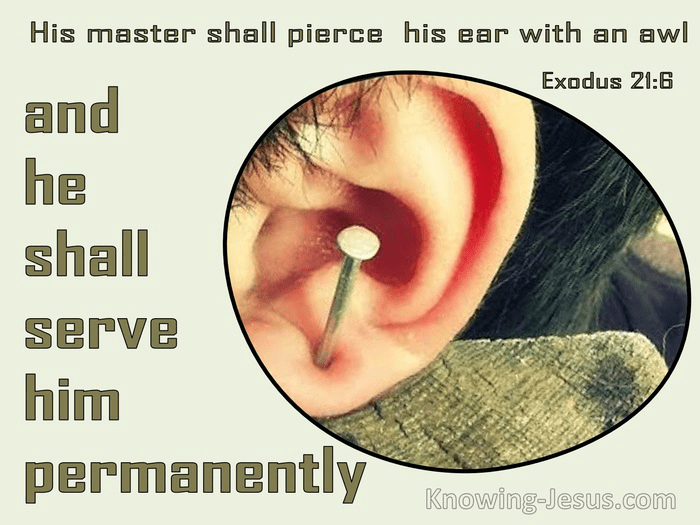
But if the servant declares, ‘I love my master and my wife and children; I do not want to go free,’ then his master is to bring him before the judges. And he shall take him to the door or doorpost and pierce his ear with an awl. Then he shall serve his master for life.”

Continuing with David Guzik’s commentary: Normally, slavery for the Israelites was:

· Chosen or mutually arranged.

· Of limited duration.

· Highly regulated.

c. He shall serve six years; and in the seventh he shall go out free and pay nothing: In all of the four above mentioned cases, the servitude was never obligated to be life-long. The Hebrew servant worked for six years and then was set free.

i. “He was, more properly an ‘indentured laborer’, bound for six years.” (Cole)

ii. “That this servitude could extend, at the utmost, only to six years; and that it was nearly the same as in some cases of apprenticeship among us.” (Clarke)

iii. G. Campbell Morgan, after looking at the laws regarding slavery, wrote: “A careful consideration of them will show that they abolished slavery, and substituted for it, covenanted labor.”

iv. “Henceforward the condition of slaves among the Hebrew people would be in marked distinction to slavery as existing among other peoples. It was the beginning of a great moral movement.” (Morgan)

d. If he comes in by himself, he shall go out by himself; if he comes in married, then his wife shall go out with him: At the end of the six years the servant went out with what he came in with. If the master provided a wife (and therefore children), the wife and children had to stay with the master until they had fulfilled their obligations or could be redeemed.

i. By himself: “Literally ‘with his back’, i.e. ‘bare back and nothing more’. The phrase is vivid and unique, but the meaning is clear. This provision may seem hard to us, but the wife was presumably a perpetual slave, and therefore the master’s own property.” (Cole)

3. (5-6) The bond-slave: a willing slave for life.

a. But if the servant plainly says, “I love my master”: If, after the six years of servitude, a servant wished to make a life-long commitment to his master – in light of the master’s goodness and his blessings for the servant – he could, through this ceremony, make a life-long commitment to his master.

i. This commitment was not motivated by debt or obligation, only by love for the master, and the good things that the master had provided for the servant.

b. His master shall bring him to the judges: This describes the public and recognized ceremony for recognizing a willing slave, one who had fulfilled his obligation yet still wanted to serve his master out of love.

i. “The ‘judges’ changed the slave’s status from temporary to permanent by a ceremony at the doorpost of the master’s house.” (Kaiser)

c. His master shall pierce his ear with an awl: In the ceremony, the servant’s ear was pierced – opened – with an awl. This was done in the presence of witnesses, and then he shall serve him forever.

i. It’s a remarkable thing to think of this ceremony being carried out. A servant said, “I know I have fulfilled my obligations to my master, and I have served what I have owed. Yet I love my master and am so grateful for what he has given that I will gladly obligate myself for life, not out of debt or shame or defeat, but out of love.”

ii. Psalm 40:6 later spoke of this ceremony taking place between the Father and the Son, where the Psalmist spoke prophetically for the Messiah: Sacrifice and offering You did not desire; my ears You have opened. Jesus was a perfect bond-slave to the Father (Philippians 2:7).

iii. “That awl represents the nail that affixed Christ to the cross, and we must expect it in every true act of consecration.” (Meyer)

d. He shall serve him forever: Jesus gave us the right to be called friends instead of servants(John 15:15). Yet the writers of the New Testament found plenty of glory in simply being considered bondservants of Jesus (Romans 1:1, James 1:1, 2 Peter 1:1, Jude 1:1).

i. Pagans had a custom of branding the slave with the name or the sign of the owner. Paul referred to himself as just such a slave in Galatians 6:17: From now on, let no one trouble me, for I bear in my body the marks of the Lord Jesus. Paul was a slave for life to Jesus.

ii. This is a picture of the sinner’s service of sin; there comes a place where the sinner, so filled with a love of his sin, seals his heart over to sin as his master.

iii. This is a picture of our service to Jesus.

· We have the power to go free if we want to.

· We must be willing to take the consequences of chosen service.

· We must be motivated by love for our Master.

APPLICATION: Today serving someone else is out of fashion! Companies that once engendered loyalty in their workers have betrayed workers, particularly older ones, forcing them out of the work force to avoid paying high benefits. One friend who headed the IRS Division for a major company went to work one day and came home pensioned and jobless at the age of 60. Workers have responded by withholding their best efforts, feeling that a company that would treat them shabbily is not worth it. But the fact remains that we are all serving someone or something.

Human beings can and will disappoint you! But Hebrews 13:5-6 says, “Keep your lives free from the love of money and be content with what you have, for God has said: “Never will I leave you, never will I forsake you.” So we say with confidence: “The Lord is my helper; I will not be afraid. What can man do to me?” God is the only One who is worth serving, the only One to Whom we can safely bond ourselves. Failing to trust only forces you to build your life on shifting sand. Why not trust the Maker of the Universe, who holds the stars in place and keeps all nature in His mighty Hand?

PRAYER: Father God, we are afraid! The people and things we have trusted to help us have failed us miserably! We long to relax and trust You, but we are fearful that You will fail us as well. Lord, give peace in the hearts of all who read this devotional and help them to completely trust You to guide them and protect them. In the mighty Name of King Jesus. Amen.

APRIL 28, 2021 MERCY 59: DOES GOD APPROVE OF SLAVERY?

April 28, 2021

Exodus 21:1 – 6 “These are the ordinances that you are to set before them:

If you buy a Hebrew servant, he is to serve you for six years. But in the seventh year, he shall go free without paying anything. If he arrived alone, he is to leave alone; if he arrived with a wife, she is to leave with him. If his master gives him a wife and she bears him sons or daughters, the woman and her children shall belong to her master, and only the man shall go free.

But if the servant declares, ‘I love my master and my wife and children; I do not want to go free,’ then his master is to bring him before the judges. And he shall take him to the door or doorpost and pierce his ear with an awl. Then he shall serve his master for life.”

Having given the Ten Commandments, God is now elaborating on the way He wants the Israelites to conduct themselves. The first issue God tackles is slavery. As soon as men began to fight wars, slavery came into being. The Israelites themselves had been slaves in Egypt and were very familiar with all the horrors of slavery. The slavery from which God delivered the Israelites was a permanent slavery with no way out. Working conditions in Egypt were steadily deteriorating and the Israelites were suffering.

Once free from Egypt and left without any guidance, the Israelites were likely to turn around and copy the Egyptian treatment of slaves, creating a moral mess. It is is this context that God is giving these ordinances.

David Guzik https://enduringword.com/bible-commentary/exodus-21/ has this to say about these verses:

a. If you buy a Hebrew servant: With ancient Israel, as in the entire ancient world, there were people who worked for others on the principle of servitude. They were slaves in some sense, though not necessarily in the brutal and degraded sense most think of slavery.

i. Some think that the Bible is responsible for slavery. The opposite is true; slavery existed long before Israel or Moses. The Bible is responsible for the elimination of slavery, not its establishment. (My Note: please remember that you can twist Scripture to support your views, but it does not mean that you have handled Scripture correctly!)

ii. “Moses did not institute slavery in any shape; the laws concerning it were made on purpose to repress it, to confine it within very narrow bounds, and ultimately to put an end to it.” (Spurgeon) [Who was Charles Haddon Spurgeon? Not only was C.H. Spurgeon one of the foremost Gospel preachers in England, but he was also a strong abolitionist who wrote articles against slavery that were published in America. Slave owners in America hated Spurgeon’s writings against slavery so much that they literally conducted special ceremonies to burn newspapers carrying his writings. Even today, Spurgeon’s writings are still studied and quoted widely.]

iii. “The Torah accepts slavery as an inevitable part of ancient society, much as Paul did, but the new humanitarian approach will ultimately be the death-knell of slavery… In any case, slavery in Israel was rural, domestic and small scale.” (Cole)

iv. It is significant that the first words of this section of law in the Book of Exodus show that God wanted Israel to respect the rights and dignity of servants. “The first words of God from Sinai had declared that He was Jehovah Who brought them out of slavery. And in this remarkable code, the first person whose rights are dealt with is the slave.” (Chadwick)

b. A Hebrew servant: There were four basic ways a Hebrew might become a slave to another Hebrew. · In extreme poverty, they might sell their liberty (Leviticus 25:39).

· A father might sell a daughter as a servant into a home with the intention that she would eventually marry into that family (Exodus 21:7).

· In the case of bankruptcy, a man might become servant to his creditors (2 Kings 4:1).

· If a thief had nothing with which to pay proper restitution (Exodus 22:3-4).

i. The ideas of man-stealing and life-long servitude – the concepts many have of slavery – simply do not apply to the practice of slavery in the Old Testament. Normally, slavery was:

· Chosen or mutually arranged.

· Of limited duration.

· Highly regulated.

APPLICATION: Today sex trafficking, kidnapping of young people of both sexes, and slavery are rampant throughout the world. Those of us who enjoy low prices for our new clothes fail to realize that the factories in which those cheap clothes were produced prey on the poor who are forced to work for a pittance under sweat shop conditions. In some cases, factory workers may actually be slaves. The question for those of us who hate such things is this: what are we doing to halt these problems? Are we even praying for God to raise up people to correct them, or are we shrugging our shoulders? Before we rush to judge the ancient Israelites, let’s look in the mirror and then ask God what we can do. GOD HATES SLAVERY! DO WE???

PRAYER: Father God, thank you that you love every one of us, no matter where we are or what we are doing. Help us to recognize our own wrong attitudes with regard to hidden slavery and then show us how we can work to bring about justice for the enslaved. In the mighty and precious Name of King Jesus. Amen.

APRIL 27, 2021 MERCY 58: DOES GOD APPROVE OF “EDIFICE COMPLEXES?”

April 27, 2021

Exodus 20:22 – 26 “Then the LORD said to Moses, “This is what you are to tell the Israelites: ‘You have seen for yourselves that I have spoken to you from heaven. You are not to make any gods alongside Me; you are not to make for yourselves gods of silver or gold. You are to make for Me an altar of earth, and sacrifice on it your burnt offerings and peace offerings, your sheep and goats and cattle. In every place where I cause My name to be remembered, I will come to you and bless you. Now if you make an altar of stones for Me, you must not build it with stones shaped by tools; for if you use a chisel on it, you will defile it. And you must not go up to My altar on steps, lest your nakedness be exposed on it.’

Ah Egypt! Land of soaring pyramids and gorgeous temples filled with huge images of the Pharaohs covered with gold and precious stones. Boy, those Egyptians really knew how to worship…. or did they? From this passage, it seems God has totally different ideas about how He is to be worshiped. WHY? What’s wrong with making temples and churches and altars as gorgeous as possible?

In Egypt, the Pharaoh was considered to be divine and therefore worthy of worship. In the book The Africans, David Lamb, the former African Bureau Chief for the Los Angeles Times, described one African country in which the dictator was hailed as a divine savior each time the national TV station began and closed operations. Unfortunately, the man in question plundered his country, sending billions of dollars to bank accounts in Switzerland and France. The only people who were saved by this individual were members of his own family or tribe.

God wants to be worshiped exclusively without any competitors. After all, who can compare to the One True Living God? But the shocking thing is the description of God’s requirements for the altars the Israelites were to build. God demands that His worshipers build an altar of earth or an altar of uncut stones. These requirements are to avoid the pitfall of someone chiseling images of the sun, moon, stars, fertility gods/goddesses, etc. Give an artisan an inch and pretty soon he’s going on about freedom of artistic expression and coming up with his own designs to show off how skillful he is.

God is not taking any chances that people are going to worship the altar rather than worshiping Him. Later on, Paul described this problem. “For although they knew God, they neither glorified Him as God nor gave thanks to Him, but they became futile in their thinking and darkened in their foolish hearts. Although they claimed to be wise, they became fools, and exchanged the glory of the immortal God for images of mortal man and birds and animals and reptiles.” Romans 1:21-23

“Fine,” you say. “But why the demand that the altar be approached by a ramp and not by steps? What is the harm in using steps?” The answer to that question lies with the pagan priests of the time and the way they flaunted themselves. Later on when God instructs Moses in the proper mode of dress for the priests, God ensures that the priests will wear trousers under their other robes. Evidently, the pagan priests may not have worn anything under their robes and may even have made sure that their genitalia were on public display with every step they took up the steps leading to an altar. God wants to be the sole object of worship; the priests are to serve and not to show off or to distract worshipers.

“But what about beautiful churches and cathedrals,” you might well ask. “Is there anything wrong with lovely houses of worship?” Good question. When the cathedrals were built in the Middle Ages, many who could not read could see Bible stories demonstrated in the stained glass windows or in bas reliefs. Today similar depictions can be seen in the old Catholic Cathedral in Navrongo, in the Upper East Region of Ghana. But remember that at the time of the Israelites, God was actually with them all the time, either as a pillar of could or as a pillar of fire. The means of worship could be extremely simple because the One who was being worshiped was obviously present. (The photo is of the Navrongo Cathedral depiction of Adam and Eve being driven out of the Garden of Eden.)

The fundamental problem with any structure built for worship comes when the structure itself becomes an object of worship. One skeptic has described this problem as “an edifice complex;” i.e., the building becomes more important than the One who is to be worshiped in that building.

APPLICATION: In speaking with the Samaritan woman at the well, Jesus advised her that “God is Spirit, and His worshipers must worship Him in spirit and in truth.” John 4:24 The question for us is this: whom are we worshiping? What are we worshiping? Are we worshiping God or have the forms of worship, the buildings, our relationships with others in the congregation or our relationship with a religious leader become more important that our relationship with God?

PRAYER: Father God, thank you for loving us and caring for us! Lord, help us to truly worship you in spirit and in truth. And help us to worship only you and not our work, our families, our vehicles, our hobbies, or anything else apart from you. In the mighty Name of King Jesus. Amen.

APRIL 26, 2021 MERCY 57: HAVE WE EVER REALLY KNOWN THE FEAR OF GOD?

April 26, 2021

Exodus 20:18 – 21 “When all the people witnessed the thunder and lightning, the sounding of the ram’s horn, and the mountain enveloped in smoke, they trembled and stood at a distance. “Speak to us yourself and we will listen,” they said to Moses. “But do not let God speak to us, or we will die.”

“Do not be afraid,” Moses replied. “For God has come to test you, so that the fear of Him may be before you, to keep you from sinning.” And the people stood at a distance as Moses approached the thick darkness where God was.

God was calling Israel to be a holy people, a nation of priests dedicated to Him. Remember that these were the same people whose ancestors had spent 400 years in Egypt, getting used to the multitude of Egyptian gods. Even though God had sent ten plagues on Egypt, including killing all of the first born humans and animals, even though God had taken the Israelites across the Red Sea on dry land, and even though God had been leading the Israelites through the wilderness by appearing as a pillar of cloud by day and a pillar of fire by night, even despite all these miracles, the Israelites STILL didn’t understand the greatness of God or His majesty and sovereignty. Putting it bluntly, God had done incredible miracles for the Israelites and they were still totally clueless. Worse and more of it, these people really didn’t want a clue either!

The thunder and lightning, the noise of the ram’s horn, and the billowing clouds of smoke encircling the mountain frightened the Israelites but did not move them to worship God or even just to bow before Him in silence.

“Speak to us yourself and we will listen,” they said to Moses. “But do not let God speak to us, or we will die.” The Israelites didn’t want a God – sized God; they wanted a man – sized god, one they could choose to listen to or to ignore as they wished. (After all, how are you going to argue with somebody who speaks with thunder and lightning and clouds of smoke?)

APPLICATION: “God has come to test you…” What is the purpose of divine testing? God is omniscient, meaning He is all – knowing. God already knows our hearts and minds; we are the ones who have little or no insight into what we actually feel and think. God tests us so that we will become aware of our need for Him to clean us up and to make us holy. We cannot clean ourselves up, but God cannot help us unless and until we give Him permission to do so. The whole universe tilts on the axis of free will’; we are free to choose to receive God or to reject Him.

1 Samuel 2:2 says, “There is no one holy like the LORD. Indeed, there is no one besides You! And there is no Rock like our God.” Hebrews 12:13 – 15 says, “Make straight paths for your feet, so that the lame may not be disabled, but rather healed. Pursue peace with everyone, as well as holiness, without which no one will see the Lord. See to it that no one falls short of the grace of God, and that no root of bitterness springs up to cause trouble and defile many.” While God is the One who has to make us holy, we must choose to allow Him to do so and we must focus on holiness. Why is holiness so important?

…so that the fear of Him may be before you, to keep you from sinning.” In the midst of all that thunder and lightning and fire and smoke, God was fully aware of every charm, every fetish, every household god the Israelites had hidden in their baggage back at the camp. Later on when the nations of Israel and Judah rejected God, God described all the heathen practices they were following in grim detail. God’s aim was for the Israelites to see His power and His majesty and His glory and to worship Him. You can’t worship someone with whom you have a casual relationship. Here God wants the Israelites to fear and respect Him so that when they are tempted to sin, that knowledge will help them turn away from the temptation.

DO WE FEAR GOD??? There is a Gospel song that starts out, ‘I have made you too small in my eyes. O Lord, forgive me! I have believed in a lie that You were unable to help me.” (“Be Magnified” by Don Moen) To fear God means that we are always conscious that God sees everything we do, every thought we think, every intention of our hearts, and therefore that we should think and do those things that please God. Most of us live to please ourselves. May God forgive us and change our hearts so that we too will fear Him!

PRAYER: “Be magnified, O Lord! You are highly exalted. And there is nothing You can’t do. O Lord, my eyes are on You! Be magnified! O Lord, be magnified!” (Borrowed from Don Moen, “Be Magnified.”)

APRIL 25, 2021 MERCY 56: YOU CAN’T PICK AND CHOOSE WHEN IT COMES TO THE COMMANDMENTS

April 25, 2021

In the Loretto Chapel in Santa Fe, New Mexico, there is a staircase described as a “miraculous staircase.” When the chapel was built, the designers failed to allot space for a staircase that would lead to the balcony. The story goes that an unknown itinerant carpenter named Joseph showed up and built this staircase. Although there is one iron rod helping fix the staircase to a pillar, there is no central post and the stairs hold each other up. After building the staircase, for which he refused to take money, the carpenter disappeared. The Sisters of Loretto always believed that it was St. Joseph who built the staircase. The Ten Commandments are very much like this staircase.

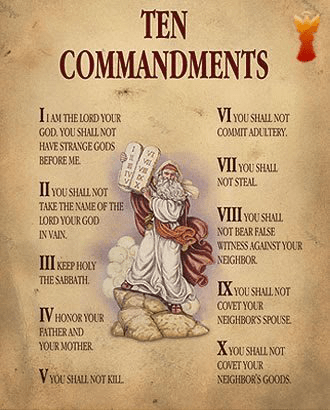
The big mistake many people make is taking each Commandment individually rather than realizing that the Commandments build on one another. God had excellent reasons for each Commandment being located where it is on the list. Let’s look at the Commandments.

1. “You shall have no other gods before me.” God wants us to know who He is and that He must be #1 in our lives. This is foundational. If we are not honoring God first in our lives, we are doomed to failure, spiritually and otherwise.

2. “You shall not make idols.” God wants to make sure that we are not worshiping anything other or less than Him. Unfortunately, we are prone to make idols out of all kinds of things – family members, pets, vehicles, houses, jobs, money – the list is endless. Keep that list in mind as we go through the rest of the Commandments.

3. “You shall not take the Name of the Lord Your God in vain.” Misusing God’s Name means that you have no respect for Him or for His Commandments. Failing to honor God opens the way for all kinds of other sins.

4. “Remember the Sabbath day by keeping it holy.” God wants us to worship Him on a regular basis. Human beings have short attention spans; that on which we spend the most time is actually the thing that we are worshiping.

5. “Honor your father and your mother.” We are to honor the parents we have been given, whether or not they are good or admirable. Our obedience opens the way to blessings for us. Notice that we are not required to make excuses for our parents or to ignore any bad behavior. But remember that by totally rejecting your parents, you are actually rejecting yourself and setting yourself up for problems.

6. “You shall not murder.” Only God can give life or take it away; that’s not our prerogative. Guard your heart so that murderous thoughts or wishes have no place to enter! What about violent movies and video games? Such things deaden your soul and predispose you to violence of your own. Watching such things is like juggling Anthrax spores without a filtration mask! You WILL become infected!

7. “You shall not commit adultery.” Adultery in a very real sense is a form of murder, the murder of the marriage relationship. God has planned that when husbands and wives come together, they become “one flesh” and share things spiritually. Adultery tears the “one flesh” apart and reduces each marital partner to the status of an individual deprived of the comfort the marriage can bring. If you really know Who God is and if you honor Him in your life, if you have honored your parents as much as you can, you will fear God and you will not choose to grieve Him. Adultery grieves God!

8. “You shall not steal.” Leave all of your neighbor’s belongings alone, including their family members, their reputations, etc. Years ago, we belonged to a church with a dynamic youth group leader. There was only one problem; this youth group leader boasted that he was closer to the kids than were their own parents. In some cases, the youth group leader tried to act as an advocate for the kids in disputes with their parents, taking the side of the kids. (The disputes under discussion were normal teen things, nothing such as overt sexual abuse or other reportable crimes.) Only God can judge hearts; however, when a leader of any group oversteps his/her boundaries, alarm bells should be going off in everybody’s heads!

At various times, churches and other religious groups have taken the place of family relationships. The most horrible example of this kind of theft was the Jim Jones cult, in which hundreds of followers moved with Jones to Belize. When the cult was in danger of being exposed, Jones had his followers drink poisoned Kool – Aid and then committed suicide himself. In this case, stealing people’s loyalties led to mass murder.

9. “You shall not bear false witness against your neighbor.” Lying about someone steals their reputation and may make it impossible for them to support themselves and their families. By spreading false rumors about someone, you are violating every one of the Commandments.

10. “You shall not covet anything that belongs to your neighbor.” Lusting for anything/anybody/any relationship/any job, etc., violates every one of the Commandments and can lead to adultery, theft, or even outright murder.

APPLICATION: “WHAT GOES AROUND, COMES AROUND!” Galatians 6:7-8 says, “Do not be deceived: God is not to be mocked. Whatever a man sows, he will reap in return. The one who sows to please his flesh, from the flesh will reap destruction; but the one who sows to please the Spirit, from the Spirit will reap eternal life.” Many times we want to blame God for our problems; meanwhile, we are the ones who refuse to follow God’s Commandments, choosing to be our own little gods instead.

PRAYER: Father God, thank you for your Commandments! Help us to write them on our hearts and to make them part of our every day lives so that we will be able to worthily serve you. In the mighty and precious Name of King Jesus. Amen.

APRIL 24, 2021 MERCY 55: IS ENVY EATING YOU???

April 24, 2021

Exodus 20:17 “You shall not covet your neighbor’s house. You shall not covet your neighbor’s wife, or his manservant or maidservant, or his ox or donkey, or anything that belongs to your neighbor.”

Hebrews 13:5 – 6 “Keep your lives free from the love of money and be content with what you have, for God has said: “Never will I leave you, never will I forsake you.”

So we say with confidence: “The Lord is my helper; I will not be afraid. What can man do to me?”

What does “covet” mean? These days, that word seems outmoded, until we learn its definition. “To covet” means “to yearn to possess.” You can admire something someone else has, but when you begin to yearn to possess that same thing for yourself, you have begun to covet. What’s so wrong about coveting something or someone? And what about this weird list of things? How many people have servants or oxen or donkeys?

The Message re-states this passage as “You shall not lust….” Many famous writers have quoted the phrase ”Comparisons are odious.” No matter how much money, how many possessions, how many things we have or how many people we control, unless we have learned to be satisfied, we will always lust for more. And if we lust sufficiently, we will eventually convince ourselves that we have the right to take the objects of our lust, no matter the consequences.

What drives this lust to possess things and people? Blaise Paschal, a famous Christian philosopher and mathematician of the 1600’s, is quoted as having said, “There is a God – shaped vacuum in the heart of every man that cannot be filled by any created thing, but only by God the Creator, made known through Jesus.” Unless we are willing to allow God to completely fill that vacuum, we are still going to try to fill it with other things.

You can’t covet what you already own, provided you are satisfied with your possessions. Comparisons really are odious/abominable!

APPLICATION: What drives our lusts? Sometimes we use the excuse of a childhood spent in poverty. We work in a part of rural Ghana in which flip flops are the most common form of footwear. Farmers, school children, ladies walking miles to market carrying head loads – they are all wearing flip flops. Sometimes people who have come out of such a background are likely to collect shoes just to assure themselves that they will never have to wear flip flops in public again. Others may collect clothing or build luxurious homes, all in an effort to compensate for their early poverty. Using the same line of reasoning, others who walked long distances to market may now go in for fancy vehicles if they have the means.

What about the proscriptions against envying someone else’s servants or their animals? In those days, servants did much of the work in the household; today the equivalent might be envying someone’s fancy household appliances. The animals were used for transportation and for working on farms. The modern equivalent would be envying someone’s vehicles or their farm equipment or even their fancy lawn equipment and their sporting goods.

What about lusting after someone else’s spouse? The Seventh Commandment has already ordered us not to commit adultery. Most of us don’t set out to commit adultery; however, we don’t guard our hearts properly. Living with someone naturally allows you to see your spouse when he/she is sick or unhappy or grouchy or running around the house in old ratty clothes. When we go out in public, most of us try to look and behave our best, and that is true for our neighbors as well.

One pitfall for Christian leaders is the counseling situation. Many experienced pastors involve their wives any time they are counseling someone. Involving one’s spouse ensures a higher level of transparency and also makes it far less likely that the counselee will attempt to manipulate the pastor into a compromising situation. Pastors who counsel without their spouses may be tempted to comfort attractive members of the opposite sex with disastrous results!

It’s always a mistake to envy others because we have no idea of their actual situation.

Consider the poem “Richard Cory” by Edward Arlington Robinson:

“Whenever Richard Cory went down town,

We people on the pavement looked at him:

He was a gentleman from sole to crown,

Clean favored, and imperially slim.

And he was always quietly arrayed,

And he was always human when he talked;

But still he fluttered pulses when he said,

“Good-morning,” and he glittered when he walked.

And he was rich—yes, richer than a king—

And admirably schooled in every grace:

In fine, we thought that he was everything

To make us wish that we were in his place.

So on we worked, and waited for the light,

And went without the meat, and cursed the bread;

And Richard Cory, one calm summer night,

Went home and put a bullet through his head.”

PRAYER: Father God, thank you that you can give us everything we need to serve you! Help us to trust that you will bring good things into our lives when we need them and that you will withhold them when they would only become distractions. Please come into our hearts and fill that vacuum that only you can fill. In the mighty and precious Name of King Jesus. Amen.

APRIL 23, 2021 MERCY 54: NO LIES ABOUT YOUR NEIGHBOR! DON’T THROW SOMEBODY UNDER THE BUS!

April 23, 2021

Exodus 20:16 “You shall not bear false witness against your neighbor.” (Berean Study Bible)

“NO LIES ABOUT YOUR NEIGHBOR!” (The Message)

Most of us assume that this commandment really applies when we are giving testimony in court. We might remember the false witnesses the high priests produced against Jesus when they were trying to justify his crucifixion. Surely WE would NEVER give a false testimony….or would we?

In the musical “The Music Man,” there is a wonderful song where the neighborhood gossips have gotten together to dish dirt about Marian, the young librarian. The refrain of the song goes, “Pick a little, talk a little, pick a little, talk a little, pick! pick! pick! talk a lot! pick a little more!” All the time these ladies who consider themselves pillars of the community are talking, they are tearing down Marian’s reputation.

Before the days of radio, TV, and the internet and social media, talking about the neighbors was one of the most common forms of entertainment, and the wilder the story the better. These days social media has merely carried that practice to new heights…or lows. This practice can be murderous. Teens have been cyber – bullied into suicide by peers who have spread pornographic photos or wild rumors about them on social media. There is nothing innocent about gossip and lies! And remember that anything leading to murder is also against the will of God. “Do not commit murder” applies to cyber – bullying as well as to anything else leading to the death of someone.

Pontius Pilate asked Jesus, “What is truth?” Manipulation of the news has become so rampant that it is difficult to know where the truth really lies. Some firms make a business of clearing the reputations of people or businesses who have had their good names trashed via the internet on sites such as Facebook and Yelp. Hackers even hack into corporate websites to spread misinformation.

APPLICATION: What does God think about all this? Good question! GOD HATES IT!!! Consider what you are doing if you lie about someone:

1. Lies steal reputations, businesses, jobs, and even families. Those who study advertising have found that people are 5 times as likely to lodge a complaint as they are to praise a business. By extension, that means that people are 5 times as likely to believe a lie about you as they are to believe the truth. Remember God already commanded us not to steal.

2. Lies can lead to murder or to a living death in prison. We have already mentioned cyber – bullying. In recent years, there are those who have suffered in prison for years for crimes that they never committed in the first place. In some cases, the District Attorney may have been running for office and wanted a quick conviction. In other cases, the others being accused might have been politically influential while the one convicted had nobody to speak up for him/her. The advent of DNA analysis and other advanced techniques, plus interested parties who refused to give up, have resulted in reversal of sentences for some who were accused unjustly in the first place. Remember God already commanded us not to murder.

3. Once spoken, lies are difficult or impossible to reverse! The story is told of a pastor who was counseling a church member who was a habitual gossip. The pastor had this person bring in a small feather pillow and then asked his church member to rip the pillow open in the middle of a high wind. Naturally, the feathers went all over the place. “Now,” said the pastor, “collect all the feather.”

“But that’s impossible,” replied the gossiping church member.

“Yes,” said the pastor, “and that’s what happens when you gossip. Once the wild story has gone out, nobody can stop it.”

We must search our own hearts! How many of us enjoy a “good story” about someone else? How many of us are prepared to share wild videos, memes, or other forms of social media accusing people, whether or not the accusation is just? How many of us, if we are found doing something wrong, will try to throw a family member or a coworker under the bus, i.e., shift the blame onto another person, rather than owning up to our failings? Remember that as far as God is concerned, there are no “little sins.” God does not grade on a curve. Sin is sin, and the very fact that you are attempting to find excuses for yourself may indicate that the problem is far bigger and worse than you realize.

PRAYER: Father God, please shine your light on our hearts and help us to see all the different ways in which we have been lying about others. Cause us to be ashamed of those lies and to repent from ever uttering them. And Lord, please heal the situations in which we have lied and help us to stop lying forever. In the mighty and precious Name of King Jesus. Amen.

APRIL 22, 2021 MERCY 53: “EVERYBODY CHOPS A LITTLE FROM WHERE THEY WORK”

April 22, 2021

Exodus 20:15 “You shall not steal.”

God has delivered the Israelites from slavery in Egypt; however, they have a long way to go before they will become a holy nation. While adultery was very common in Egypt and was frequently overlooked, theft, on the other hand, was considered a major crime. According to an article on the National Geographic web site entitled “Power flowed from the pharaoh in the ancient Egyptian legal system,” the ancient Egyptians recognized theft as a serious crime. The article states, “When people were convicted of crimes, the penalties depended both on the severity of the offense and their level of involvement. The typical penalty for stealing was returning the stolen object and paying its rightful owner double or triple its value. If someone stole from a temple, however, the punishment was more severe: it could include paying a hundred times the value of the object, corporal punishment, or even death.”

If the Egyptians recognized theft as a major crime, then why is God making a specific commandment about it? Consider the fact that the Egyptians gradually turned the Israelites into slaves. At that point, the Israelites may have felt that stealing things from the Egyptians was a form of guerrilla warfare, of subtly getting revenge on the Egyptians. By the time the Israelites left Egypt, they may have been stealing on a wholesale basis. Once the Israelites began stealing from the Egyptians, they may also have begun stealing from one another as well. God has to put a stop to theft somehow, and this is His opening statement. Later on, God gives far more specific commands regarding theft and its consequences.

APPLICATION: Ask most of us if we are honest and we will immediately answer, “Of course! I’m no thief!” But is that really true? One lady who was coaching a kid’s swimming team told of an irate mother who called her up, complaining that someone had stolen the child’s towel at swim practice. When asked for a description of the towel, the mother had stated that the towel said “Holiday Inn” on it, indicating that this family had stolen the towel during a stay in that hotel!

Businesses that supply pens, paper clips, and other office supplies for their workers find that many of these supplies take legs and walk away. Frequently, workers excuse themselves on the basis that they are underpaid or under – valued and therefore somehow they are justified in taking small things.

Some people commit shoplifting on a large scale. When my husband was working as a security guard in a department store in Memphis, one elderly lady entered in a wheel chair being pushed by her daughter. It rapidly became apparent that the wheelchair and the large bag hanging from it were only a means to stealing as much as possible, while the afghan covering the lady’s legs was also covering a variety of stolen goods!

What harm is there in stealing? Actually, theft hurts the thief and society as a whole. People steal for a variety of reasons, but the underlying principle is that they refuse to trust that God will help them and so they are going to help themselves. The more you steal, the more you diminish yourself.

Theft obviously damages society. In recent years, politicians receiving adequate salaries have found their names on the lists of millionaires and billionaires. In many cases this money has come from political kickbacks, pay-offs, or other unsavory practices. “Public service” has become a bitter joke.

It’s all very well to point fingers at others, but what are you doing? As I write this, I am cringing at the memory of having drunk cans of Ensure from a hospital refrigerator when I was a resident on call many years ago. At the time I saw nothing wrong; now I realize that someone had to account for that and that I was stealing. Ask God to show you if there are places where you have been stealing and have made excuses for yourself. And then ask God’s forgiveness and help to stop doing those things.

PRAYER: Father God, thank you for your commandments! Thank you for loving us so much that you don’t want us to wallow in sin like a pig in mud. Open our eyes to see the places where we have stolen – whether time, money, resources, or anything else. And help us to change so that our actions will please you. In the mighty Name of King Jesus. Amen.

APRIL 21, 2021 MERCY 52: SLEEPING AROUND IS A BAD IDEA!

April 21, 2021

Exodus 20: 14 “You shall not commit adultery.”

The Israelites have just escaped from Egypt, but they have had 400 years in which to copy the Egyptians and they are still carrying most of the things they learned in Egypt with them.

Charlotte Booth has described marriage practices in ancient Egypt in an article entitled “Love, Sex and Marriage in Ancient Egypt” on the HistoryExtra BBC website. Basically, the Egyptians had all kinds of relationships, but formal marriage was not necessarily common. In general, men and women who wanted to be married simply moved in together. There were trial marriages that only lasted for a year.

Booth continues, “Marriages however, dissolved for a number of reasons, with the most common being lack of children or adultery….. Both men and women committed adultery, and both men and women were able to instigate a divorce due to this… Both men and women could divorce the other, with the man simply saying: ‘I throw you out,’ or the woman saying to him: ‘I am leaving,’ or either spouse claiming: ‘I divorce you.’ The divorce was generally as simple as a wedding, and the woman would move out of her husband’s house, either returning to her father’s home or even to a home of her own. Being divorced held no social stigma and both men and women remarried and many went on to have large families.”

Having just come out of Egypt, the Israelites are undoubtedly still practicing the loose relationships that they observed there. But God wants to mold Israel into a holy nation. Widespread adultery and weak marriages have no place in God’s plan. God wants the Israelites to have strong family units, something that is impossible if adultery is always an option. Spouses need to be able to trust each other and children need a stable environment if they are to grow up feeling secure and loved.

What actually takes place when a couple comes together to have sex? Not only is there an exchange of body fluids, but there is also a spiritual exchange as well. One Christian who was previously caught up in witchcraft testified that his coven concentrated on luring young people into having sex with coven members, knowing that in this way these young people would then become open to joining the coven.

Twenty – six years ago, there was a young man in the community in which we were working who was a faithful Christian and a worship leader in one of the local churches. Our friend was bright and intelligent and we hoped for great things for him. But subsequently this man had several affairs with women from fetish families. Today our friend is possessed by vagabond spirits; he cannot concentrate on anything for more than a few minutes and those who work with him find themselves frustrated.

APPLICATION: Many years later, God warned his people about the dangers of adultery in the 5th chapter of Proverbs.

Proverbs 5:15 – 23 “Drink water from your own cistern, and running water from your own well. Why should your springs flow in the streets, your streams of water in the public squares? Let them be yours alone, never to be shared with strangers. May your fountain be blessed, and may you rejoice in the wife of your youth: A loving doe, a graceful fawn— may her breasts satisfy you always; may you be captivated by her love forever. Why be captivated, my son, by an adulteress, or embrace the bosom of a stranger? For a man’s ways are before the eyes of the LORD, and the LORD examines all his paths. The iniquities of a wicked man entrap him; the cords of his sin entangle him. He dies for lack of discipline, led astray by his own great folly.”

Sadly, these days, adultery is common and those who speak out against it are considered spoilsports, intolerant, or even wicked. But God’s purposes for His people have not changed. Israel was to be a holy nation, not just for itself, but to show the rest of the world what holiness looked like. Sadly, the Israelites failed repeatedly; however, that does not diminish the importance of God’s Commandments.

Families fractured by adultery wind up in trouble. Children may find themselves caught in a tug of war between two parents. Child abuse by a live – in boyfriend or girlfriend can even be fatal. Committing adultery is akin to taking a sledge hammer to a foundation and beating it until it crumbles. Once the foundation is gone, nothing else can stand. And all the time we are trying to find excuses for our behavior, God is watching and sadly shaking His head.

PRAYER: Father God, thank you for loving us so much that you refuse to give up on us, even when we ignore your commandments and try to work around them. Thank you for your Word which has stood for all these years and which continues to act as a standard and as a guide. Lord, help us to examine our lives and to see where we have compromised and then help us to repent. In the mighty Name of King Jesus. Amen.