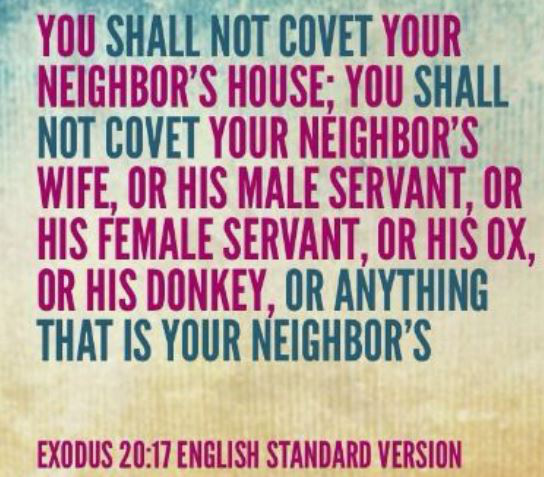
Exodus 20:17 “You shall not covet your neighbor’s house. You shall not covet your neighbor’s wife, or his manservant or maidservant, or his ox or donkey, or anything that belongs to your neighbor.”
Hebrews 13:5 – 6 “Keep your lives free from the love of money and be content with what you have, for God has said: “Never will I leave you, never will I forsake you.”
So we say with confidence: “The Lord is my helper; I will not be afraid. What can man do to me?”
What does “covet” mean? These days, that word seems outmoded, until we learn its definition. “To covet” means “to yearn to possess.” You can admire something someone else has, but when you begin to yearn to possess that same thing for yourself, you have begun to covet. What’s so wrong about coveting something or someone? And what about this weird list of things? How many people have servants or oxen or donkeys?
The Message re-states this passage as “You shall not lust….” Many famous writers have quoted the phrase ”Comparisons are odious.” No matter how much money, how many possessions, how many things we have or how many people we control, unless we have learned to be satisfied, we will always lust for more. And if we lust sufficiently, we will eventually convince ourselves that we have the right to take the objects of our lust, no matter the consequences.
What drives this lust to possess things and people? Blaise Paschal, a famous Christian philosopher and mathematician of the 1600’s, is quoted as having said, “There is a God – shaped vacuum in the heart of every man that cannot be filled by any created thing, but only by God the Creator, made known through Jesus.” Unless we are willing to allow God to completely fill that vacuum, we are still going to try to fill it with other things.
You can’t covet what you already own, provided you are satisfied with your possessions. Comparisons really are odious/abominable!
APPLICATION: What drives our lusts? Sometimes we use the excuse of a childhood spent in poverty. We work in a part of rural Ghana in which flip flops are the most common form of footwear. Farmers, school children, ladies walking miles to market carrying head loads – they are all wearing flip flops. Sometimes people who have come out of such a background are likely to collect shoes just to assure themselves that they will never have to wear flip flops in public again. Others may collect clothing or build luxurious homes, all in an effort to compensate for their early poverty. Using the same line of reasoning, others who walked long distances to market may now go in for fancy vehicles if they have the means.
What about the proscriptions against envying someone else’s servants or their animals? In those days, servants did much of the work in the household; today the equivalent might be envying someone’s fancy household appliances. The animals were used for transportation and for working on farms. The modern equivalent would be envying someone’s vehicles or their farm equipment or even their fancy lawn equipment and their sporting goods.
What about lusting after someone else’s spouse? The Seventh Commandment has already ordered us not to commit adultery. Most of us don’t set out to commit adultery; however, we don’t guard our hearts properly. Living with someone naturally allows you to see your spouse when he/she is sick or unhappy or grouchy or running around the house in old ratty clothes. When we go out in public, most of us try to look and behave our best, and that is true for our neighbors as well.
One pitfall for Christian leaders is the counseling situation. Many experienced pastors involve their wives any time they are counseling someone. Involving one’s spouse ensures a higher level of transparency and also makes it far less likely that the counselee will attempt to manipulate the pastor into a compromising situation. Pastors who counsel without their spouses may be tempted to comfort attractive members of the opposite sex with disastrous results!
It’s always a mistake to envy others because we have no idea of their actual situation.
Consider the poem “Richard Cory” by Edward Arlington Robinson:
“Whenever Richard Cory went down town,
We people on the pavement looked at him:
He was a gentleman from sole to crown,
Clean favored, and imperially slim.
And he was always quietly arrayed,
And he was always human when he talked;
But still he fluttered pulses when he said,
“Good-morning,” and he glittered when he walked.
And he was rich—yes, richer than a king—
And admirably schooled in every grace:
In fine, we thought that he was everything
To make us wish that we were in his place.
So on we worked, and waited for the light,
And went without the meat, and cursed the bread;
And Richard Cory, one calm summer night,
Went home and put a bullet through his head.”
PRAYER: Father God, thank you that you can give us everything we need to serve you! Help us to trust that you will bring good things into our lives when we need them and that you will withhold them when they would only become distractions. Please come into our hearts and fill that vacuum that only you can fill. In the mighty and precious Name of King Jesus. Amen.
 Burunche's Blog
Leave a comment