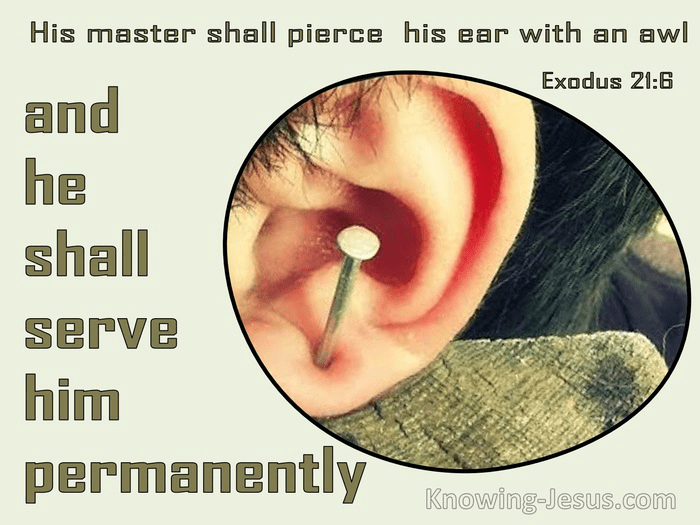
Exodus 21:1 – 6 “These are the ordinances that you are to set before them:
If you buy a Hebrew servant, he is to serve you for six years. But in the seventh year, he shall go free without paying anything. If he arrived alone, he is to leave alone; if he arrived with a wife, she is to leave with him. If his master gives him a wife and she bears him sons or daughters, the woman and her children shall belong to her master, and only the man shall go free.
But if the servant declares, ‘I love my master and my wife and children; I do not want to go free,’ then his master is to bring him before the judges. And he shall take him to the door or doorpost and pierce his ear with an awl. Then he shall serve his master for life.”
Having given the Ten Commandments, God is now elaborating on the way He wants the Israelites to conduct themselves. The first issue God tackles is slavery. As soon as men began to fight wars, slavery came into being. The Israelites themselves had been slaves in Egypt and were very familiar with all the horrors of slavery. The slavery from which God delivered the Israelites was a permanent slavery with no way out. Working conditions in Egypt were steadily deteriorating and the Israelites were suffering.
Once free from Egypt and left without any guidance, the Israelites were likely to turn around and copy the Egyptian treatment of slaves, creating a moral mess. It is is this context that God is giving these ordinances.
David Guzik https://enduringword.com/bible-commentary/exodus-21/ has this to say about these verses:
a. If you buy a Hebrew servant: With ancient Israel, as in the entire ancient world, there were people who worked for others on the principle of servitude. They were slaves in some sense, though not necessarily in the brutal and degraded sense most think of slavery.
i. Some think that the Bible is responsible for slavery. The opposite is true; slavery existed long before Israel or Moses. The Bible is responsible for the elimination of slavery, not its establishment. (My Note: please remember that you can twist Scripture to support your views, but it does not mean that you have handled Scripture correctly!)
ii. “Moses did not institute slavery in any shape; the laws concerning it were made on purpose to repress it, to confine it within very narrow bounds, and ultimately to put an end to it.” (Spurgeon) [Who was Charles Haddon Spurgeon? Not only was C.H. Spurgeon one of the foremost Gospel preachers in England, but he was also a strong abolitionist who wrote articles against slavery that were published in America. Slave owners in America hated Spurgeon’s writings against slavery so much that they literally conducted special ceremonies to burn newspapers carrying his writings. Even today, Spurgeon’s writings are still studied and quoted widely.]
iii. “The Torah accepts slavery as an inevitable part of ancient society, much as Paul did, but the new humanitarian approach will ultimately be the death-knell of slavery… In any case, slavery in Israel was rural, domestic and small scale.” (Cole)
iv. It is significant that the first words of this section of law in the Book of Exodus show that God wanted Israel to respect the rights and dignity of servants. “The first words of God from Sinai had declared that He was Jehovah Who brought them out of slavery. And in this remarkable code, the first person whose rights are dealt with is the slave.” (Chadwick)
b. A Hebrew servant: There were four basic ways a Hebrew might become a slave to another Hebrew. · In extreme poverty, they might sell their liberty (Leviticus 25:39).
· A father might sell a daughter as a servant into a home with the intention that she would eventually marry into that family (Exodus 21:7).
· In the case of bankruptcy, a man might become servant to his creditors (2 Kings 4:1).
· If a thief had nothing with which to pay proper restitution (Exodus 22:3-4).
i. The ideas of man-stealing and life-long servitude – the concepts many have of slavery – simply do not apply to the practice of slavery in the Old Testament. Normally, slavery was:
· Chosen or mutually arranged.
· Of limited duration.
· Highly regulated.
APPLICATION: Today sex trafficking, kidnapping of young people of both sexes, and slavery are rampant throughout the world. Those of us who enjoy low prices for our new clothes fail to realize that the factories in which those cheap clothes were produced prey on the poor who are forced to work for a pittance under sweat shop conditions. In some cases, factory workers may actually be slaves. The question for those of us who hate such things is this: what are we doing to halt these problems? Are we even praying for God to raise up people to correct them, or are we shrugging our shoulders? Before we rush to judge the ancient Israelites, let’s look in the mirror and then ask God what we can do. GOD HATES SLAVERY! DO WE???
PRAYER: Father God, thank you that you love every one of us, no matter where we are or what we are doing. Help us to recognize our own wrong attitudes with regard to hidden slavery and then show us how we can work to bring about justice for the enslaved. In the mighty and precious Name of King Jesus. Amen.
 Burunche's Blog
Leave a comment