Archive for May, 2021

MAY 31, 2021 MERCY 92: WHY AN ETERNAL FLAME???

May 31, 2021

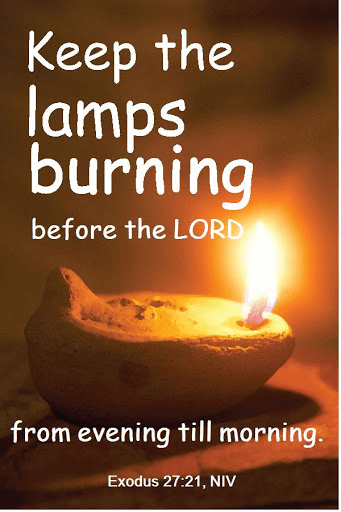
Exodus 27:20 – 21 “And you are to command the Israelites to bring you pure oil of pressed olives for the light, to keep the lamps burning continually. In the Tent of Meeting, outside the veil that is in front of the Testimony, Aaron and his sons are to tend the lamps before the LORD from evening until morning. This is to be a perpetual statute for the Israelites for the generations to come.”

Up to now, all the commands regarding the tabernacle are one – time commands. But now the language changes, indicating that this command is one that will repeat for all time. The Israelites are to continually bring pure oil of pressed olives to keep the lamps burning continually. What does this mean?

The original language should be properly translated “pure olive oil beaten.” Barnes’ Notes on the Bible says, “Pure oil olive beaten – The oil was to be of the best kind. It is called beaten, because it was obtained by merely bruising the olives in a mortar or mill, without the application of heat. The finest oil is now thus obtained from young fruit freshly gathered. The inferior kind is pressed from unselected fruit under stronger pressure, and with the application of heat.” Once the olives had been bruised, they were put into a basket and the oil filtered in this fashion would be collected. This oil was ultra – pure and would give a bright and constant light without any sputtering or spitting of sparks from impurities.

The Holy Place and the Holy of Holies would be in darkness if not for light from the golden lampstand that God commanded to be fabricated and placed in the Holy Place. The priests were to use this ultra – pure oil in that lampstand.

By continually offering pure oil for the lamp in the Holy Place, the Israelites were also making a perpetual offering to the Lord. Prager observes, “To this day, synagogues throughout the world have a constantly burning light known as an “eternal lamp.” This is the only commanded practice associated with the ancient Tabernacle that is still with us.” (Dennis Prager, The Rational Bible: Exodus)

APPLICATION: This devotional is being published on Memorial Day, 2021. The maintenance of a perpetual flame has long been a symbol of gratitude to the memory of those who have gone before us, particularly those who have shed their blood or have laid down their lives for our sakes.

Matthew Henry says, “The pure oil signified the gifts and graces of the Spirit, which all believers receive from Christ, the good Olive, and without which our light cannot shine before men. The priests were to light the lamps, and tend them. It is the work of ministers, by preaching and expounding the Scriptures, which are as a lamp, to enlighten the church, God’s tabernacle upon earth. Blessed be God, this light is not now confined to the Jewish tabernacle, but is a light to lighten the gentiles, and for salvation unto the ends of the earth.”

How pure are our offerings to the Lord? Are we giving God the best that we have, the purest olive oil, without any sediment, or are we giving God the dregs, the left – overs of our lives? I have spent three quarters of my life as a health worker. In that time, I have seen colleagues who have gone above and beyond the call of duty to render extraordinary services. On the other hand, I have also seen those who have begrudged their patients even the smallest of attention.

The law of the spirit world is that the measure we give out is the measure we will receive. I have cared for the relatives of others, trusting that God will then make sure my relatives are cared for properly. But if I refuse to give of my best where I am, why should someone working somewhere else do any better?

PRAYER: Father God, help us to give you the purest olive oil of our lives – our love, our service, our devotion. Thank you for those who have laid down their lives on our behalf. Help us to be worthy to carry on to serve others as you want us to, to be your hands and your feet. In the mighty and precious Name of King Jesus. Amen.

MAY 30, 2021 MERCY 91: 450 FEET OF CURTAINS??? IT’S ONLY A COURTYARD. WHY TAKE SO MUCH TROUBLE?

May 30, 2021

WALLS MADE FROM TWISTED FINE LINEN, NOT GOAT’S HAIR. WALLS ARE 150 feet or 45.7 meters X 75 feet or 22.9 meters. EACH CURTAIN IS 22.5 feet or 6.9 METERS LONG AND 7.5 feet or 2.3 meters HIGH. THE GATE IS 30 feet or 9.1 METERS.

Exodus 27:9 – 19 “You are also to make a courtyard for the tabernacle. On the south side of the courtyard make curtains of finely spun linen, a hundred cubits long on one side, with twenty posts and twenty bronze bases, and silver hooks and bands on the posts. Likewise there are to be curtains on the north side, a hundred cubits long, with twenty posts and twenty bronze bases, and with silver hooks and bands on the posts. The curtains on the west side of the courtyard shall be fifty cubits wide, with ten posts and ten bases. The east side of the courtyard, toward the sunrise, is to be fifty cubits wide. Make the curtains on one side fifteen cubits long, with three posts and three bases, and the curtains on the other side fifteen cubits long, with three posts and three bases. The gate of the courtyard shall be twenty cubits long, with a curtain embroidered with blue, purple, and scarlet yarn, and finely spun linen. It shall have four posts and four bases. All the posts around the courtyard shall have silver bands, silver hooks, and bronze bases. The entire courtyard shall be a hundred cubits long and fifty cubits wide, with curtains of finely spun linen five cubits high, and with bronze bases. All the utensils of the tabernacle for every use, including all its tent pegs and the tent pegs of the courtyard, shall be made of bronze.

While we can understand that the actual place of worship itself would be made of costly materials, it is mind – boggling to realize that God is demanding that even the courtyard be enclosed in “fine twisted linen,” NOT goat’s hair as the artist who designed this diagram has erroneously indicated. (Dennis Prager, quoting the Jewish Torah, also indicates that the curtains are linen and NOT goat’s hair.)

The posts are to be made of acacia wood with bronze bases, bands of silver around the posts, and silver hooks to fasten the curtains. The curtains for the gate are to be woven in the same fashion as the innermost layer of the curtains covering the Holy Place and the Most Holy Place. The gates are fashioned so that anybody entering realizes that they are entering a holy place and will not barge in without thinking. All the utensils and even the tent pegs must be cast from bronze, a durable metal that will stand up under long years of abuse.

When the Israelites saw these fine linen curtains gleaming in the mornign sun, they must have had a vision of the purity and beauty of God. The material for the courtyard curtains is far nicer than anything the Israelites were wearing.

One matter on which God does not give instructions is the housekeeping challenges: what happens when these curtains get dirty? The Israelites are in an area with blowing sand, high winds, and lots of dirt. The white linen curtains are made partially to indicate the precious nature of a relationship with God and partially to indicated God’s purety and His holiness. The white linen curtains also symbolizes the need for men to confess their sins and to repent before worshiping God. But how white will these curtains be after being carried around the wilderness for some time? Each curtain is 22.5 feet long by 7.5 feet high. That’s 168.75 square feet for each of the large curtains! There is no mention of women entering any part of the enclosure. Do they have to go down the line with basins of soap and water?

Those caring for linen today recommend washing with soap and cold water and drying in the sun or tumble drying it. So even though the water supply can be a challenge at times, those curtains have to be washed regularly. Later on, God orders Moses to nake fine linen garments for the priests, adding more to the wash day challenges.

APPLICATION: How much effort are you willing to make to worship God? In 2 Samuel 24:24 King David said, “I will not sacrifice to the Lord my God burnt offerings that cost me nothing.” As we study the tabernacle, one thing becomes exceedingly clear: this structure took a great deal of care to maintain it! There must have been times when some of the linen wore out and had to be repaired or completely re – woven. Every time the Israelites moved, certain groups were tasked with carrying specific items however far they would walk that day. And there was a continual need for oil, for incense, for animals for sacrifices, etc.

Compare all the things the Israelites did with what we do today. As a result of the recent pandemic, many churches now have online services; however, these churches have found that people may watch their services but feel no need to donate money so those services can continue.

Am I urging that people invest all their time in buildings? Far from it! My husband and I have been members of several groups that met in homes or schools, using their money to help those in need. In such cases, giving becomes a form of worship. But sitting comfortably before a TV or a computer, tablet, or phone screen means very little if your heart remains unchanged at the end of the program. Electronic media allow us to distance our selves to an alarming rate! May God help us to find new ways of worshiping Him and serving Him!

PRAYER: Father God, we confess that we are LAZY! Bone lazy! Impossibly lazy! Lord, set our hearts on fire for you so that we will find new means of loving you and serving you. In the matchless Name of King Jesus. Amen.

MAY 29, 2021 MERCY 90: WHAT’S A TRUE SACRIFICE??

May 29, 2021

Exodus 27:1 – 8 “You are to build an altar of acacia wood. The altar must be square, five cubits long, five cubits wide, and three cubits high. (The altar was approximately 7.5 feet in length and width, and 4.5 feet high (2.3 meters in length and width, and 1.4 meters high) Make a horn on each of its four corners, so that the horns are of one piece, and overlay it with bronze.

Make all its utensils of bronze—its pots for removing ashes, its shovels, its sprinkling bowls, its meat forks, and its firepans. Construct for it a grate of bronze mesh, and make a bronze ring at each of the four corners of the mesh. Set the grate beneath the ledge of the altar, so that the mesh comes halfway up the altar. Additionally, make poles of acacia wood for the altar and overlay them with bronze. The poles are to be inserted into the rings so that the poles are on two sides of the altar when it is carried.

Construct the altar with boards so that it is hollow. It is to be made just as you were shown on the mountain.

The first recorded animal sacrifice in the Bible was made by Abel, who brought “the best portions of the firstborn of his flock.” When men wanted to “cut covenant” with one another, they would slaughter animals, split the carcasses, and then walk around the carcasses, proclaiming that something similar should happen to them, should they violate the covenant. But in the ancient world, human sacrifice was also universal.

Human sacrifice was practiced for a variety of reasons – building a new city, gaining success in war, etc. But the biggest need for sacrifices was already built into human nature: Sin. Blood sacrifices were necessary to make atonement for the sins of the people.

According to Dennis Prager, there are several important things to notice about the biblical sacrifices:

1. Only certain portions of the animals were actually used in the burnt offerings. The rest of the meat was eaten by human beings; they were, essentially public religious slaughtering.

2. In the world of the Torah, the killing and eating of animals was taken extremely seriously and imbued with sanctity. Moreover, the animals sacrificed were not subjected to the cruelties of modern slaughterhouses or factory farming, the fate of the large majority of animals eaten in our time.

3. Animal sacrifice was, of course, an immeasurable moral advance over human sacrifice, which was universal in the ancient world – another example of how the Torah changed the world.

4. The Torah repeatedly prohibits human sacrifice, which God declares a moral abomination.

5. Unlike meat – eating generally, sacrifices were performed for noble goals: to atone for sins and to come closer to a moral God. The Hebrew word for sacrifice, korban, comes from the Hebrew word for “close” (karov). The sacrificial system is predicated on the notion we must give up – sacrifice – something precious as a way of getting closer to God. The giving up of an animal , and not just any animal, but a very fine one – the best of one’s herd, or the best specimen one could buy, which had a significant practical and financial value – constituted such a sacrifice.

APPLICATION: Nothing worthwhile comes without sacrifice! Nobody knows this better than the sleep – deprived parents of small children. Mothers who formerly prided themselves on being fashionable find tee shirts and knit pants with drawstrings have now become their favorite outfits. Fathers learn quickly to drape towels over their shoulders when burping their babies or face the prospect of wearing baby spit – up to work.

Husbands and wives routinely make sacrifices for each other and find that as they do so, their relationships become far richer and deeper. In February 2008 my husband Bob required heart surgery. As the stretcher on which Bob was lying was being pushed into the operating room, Bob’s last words to me were, “I love you! If I die during the operation, go back to Saboba!” I have nursed Bob through several operations, and I don’t regret a bit of it! By the same token, Bob has had to run drip fluid (IV’s) on me and give me injections when I have suffered with typhoid. Bob’s scariest moments came when I contracted cholera from infected water at a chop bar and he had to cope with the vomiting, diarrhea, and dehydration that ensued.

It is ironic that while we will give up all kinds of things for friends and family, we hesitate to sacrifice our time and talents and lives to God. As Creator and Lord of the Universe, God deserves our highest praise and our highest honor. There is no greater honor that we can pay God than to give our lives to Him and to continually seek to do His will.

PRAYER: Father God, thank you for loving us and caring for us. Help us to realize that no sacrifice is too great to make for you because you always repay us with far more than we have given in the first place. Thank you that because of Jesus’s death and resurrection, we no longer have to slaughter animals to atone for our sins. Help us to fully give our lives to you. In the matchless Name of King Jesus. Amen.

MAY 28, 2021 MERCY 89: NOW THAT YOU HAVE ALL THOSE CURTAINS, WHAT WILL YOU USE TO SUPPORT THEM?

May 28, 2021

Exodus 26:15 – 17 “You are to construct upright frames of acacia wood for the tabernacle. Each frame is to be ten cubits long and a cubit and a half wide. Two tenons must be connected to each other for each frame. Make all the frames of the tabernacle in this way.”

What good is a set of tents without a framework? Now God goes into extensive detail about the framework for the tabernacle. All the boards are acacia wood with silver bases to support them. It’s helpful to remember that at this point in history, iron was not readily available. God wants His sanctuary to be truly beautiful. The acacia supports will also be gold – covered. Some traditional Jewish sources feel that God selected acacia wood because the acacia tree does not bear fruit. Throughout the Torah, God orders the Israelites to preserve fruit trees because they nourish people. This idea demonstrates the concern God has for everything in His creation. Perhaps acacia wood is also very fine – grained and very durable. Many kinds of fruit wood are soft and will stand less strain.

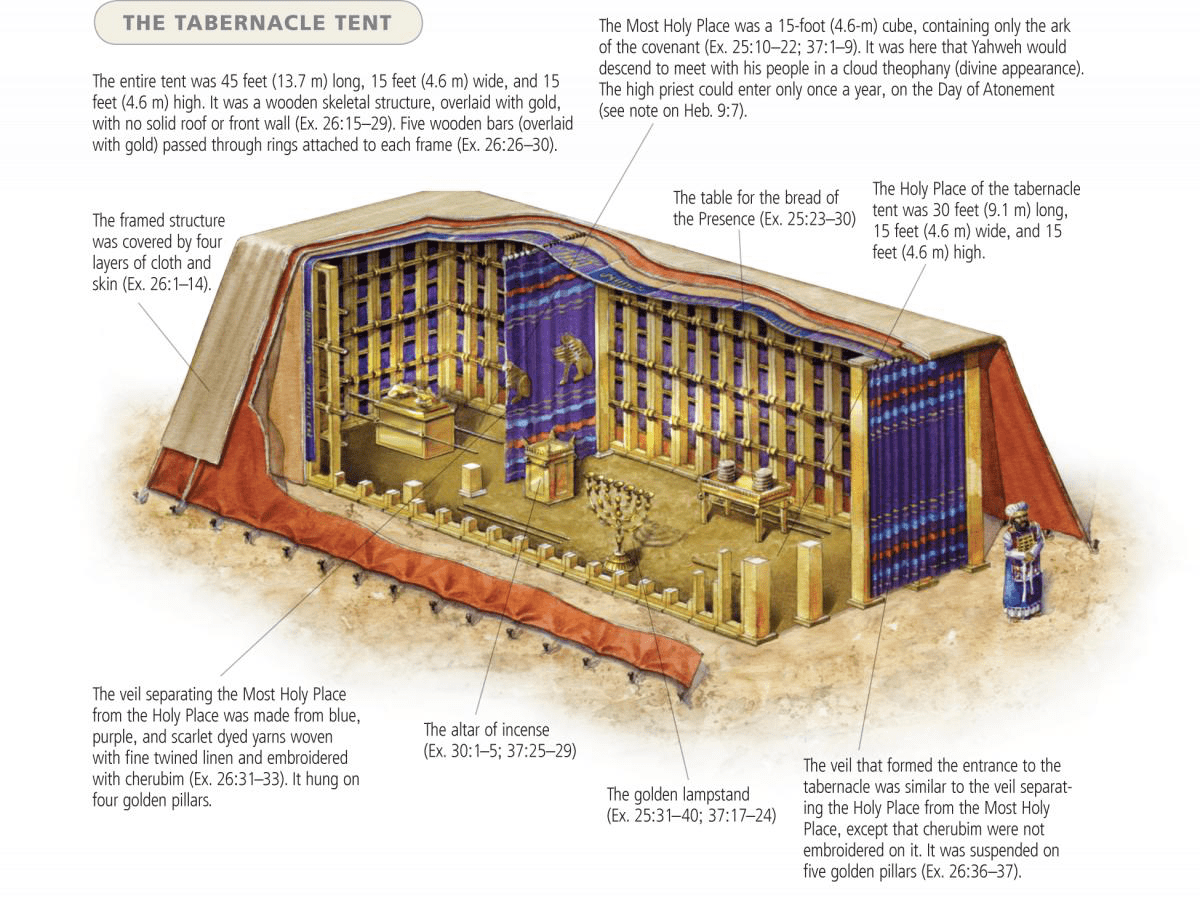
Exodus 26:31 “Make a veil of blue, purple, and scarlet yarn, and finely spun linen, with cherubim skillfully worked into it. Hang it with gold hooks on four posts of acacia wood, overlaid with gold and standing on four silver bases. And hang the veil from the clasps and place the ark of the Testimony behind the veil. So the veil will separate the Holy Place from the Most Holy Place. (the Holy of Holies) Put the mercy seat on the ark of the Testimony in the Most Holy Place. And place the table outside the veil on the north side of the tabernacle, and put the lampstand opposite the table, on the south side.”

The diagram illustrates the veil/curtain that separates the Most Holy Place from the Holy Place. The ark is placed in the Most Holy Place because that is where God’s presence dwells. The table of the Bread of the Presence and the lampstand occupy the Holy Place. Only Moses routinely enters beyond this screen. Later on, the priests are allowed to enter into the Most Holy Place once a year, carrying the blood of sacrifices.

v. 36 – 37 “For the entrance to the tent, you are to make a curtain embroidered with blue, purple, and scarlet yarn, and finely spun linen. Make five posts of acacia wood for the curtain, overlay them with gold hooks, and cast five bronze bases for them.”

This screen separates the tent from the courtyard. This screen is supported by five acacia wood posts overlayed with god and having sockets of copper. Perhaps copper was used here because it might be more durable when exposed to heat and dust. Only priests could enter beyond this screen.

APPLICATION: Are our lives totally open to others, or are there “most holy places” where we meet alone with God? In the movie “The War Room,” the elderly lady prayer warrior has converted one of her closets to a prayer room and trains her younger friend to do the same. These rooms become sacred places where these women cry out to God on behalf of their families and their communities.

Prayer warriors have all kinds of “holy places.” One friend has a special chair in a corner where she can sit and pray. Another friend has converted a large closet into a prayer chamber with purple hangings and cushions. Personally, my messy office is my prayer chamber. Years ago, I used to commute from Memphis, Tennessee up to Blytheville, Arkansas, to work in a hospital ER. The seventy – five mile commute gave me an hour and a half of prayer time coming and going, with my car serving as my prayer chamber.

The most important thing about your “holy place” is that it should be a place where you can feel God’s presence. Ask God to show you where He wants to meet you. You might be surprised!

PRAYER: Father God, it amazes us that you actually want to meet with us and to share your thoughts with us. We are overwhelmed when we think about your goodness and your mercy. Lord, show each person who reads this the place where you want to meet them and make those places special to them. In the matchless Name of King Jesus. Amen.

MAY 27, 2021 MERCY 88: PROTECTING THE HOLY – WHEN YOU HAVE TO CARRY A TABERNACLE ON YOUR TRAVELS

May 27, 2021

Exodus 26:1 – 6 “You are to construct the tabernacle itself with ten curtains of finely spun linen, each with blue, purple, and scarlet yarn, and cherubim skillfully worked into them. Each curtain shall be twenty-eight cubits long and four cubits wide —all curtains the same size. (Each of the ten curtains was approximately 42 feet long and 6 feet wide (12.8 meters long and 1.8 meters wide.)

 Five of the curtains are to be joined together, and the other five joined as well. Make loops of blue material on the edge of the end curtain in the first set, and do the same for the end curtain in the second set. Make fifty loops on one curtain and fifty loops on the end curtain of the second set, so that the loops line up opposite one another. Make fifty gold clasps as well, and join the curtains together with the clasps, so that the tabernacle will be a unit.

How can you create a mobile temple and then protect it from the heat and dust of the desert? Everything about the tabernacle must be portable because the Israelites never know when that pillar of cloud and fire is going to move and they will set off for someplace else. God wants the place of His worship to be both beautiful and practical. To that end, the first covering for the tabernacle is fine linen with patterns in blue, purple, and scarlet yarn. “The blue represents the heavens and the creation of the world; purple represents royalty (the high cost of purple dye due to its rare source generally meant only the wealthiest individuals, usually royalty, owned purple garments); and crimson represents sin, as reflected in Isaiah’s statement: “Be your sins like crimson, they can turn snow – white:(i.e, if you repent; Isaiah 1:18.) These colors represent the major themes Israelites were supposed to think about during worship: God’s creation, God’s kingship, and God’s acceptance of atonement for sin.” (Dennis Prager, The Rational Bible: Exodus) Again, God is directing the construction of the tabernacle precisely, leaving no room for shortcuts or slip – ups.

The Israelites probably learned about finely spun linen in Egypt; however, it’s doubtful that most of them actually got to wear any of it. Finely spun linen was for royalty; slaves would have made do with coarser material. To make these curtains, the Israelites would either have had to bring flax or linen cloth that had already been woven when they left Egypt.

Exodus 26:7 – 14 “You are to make curtains of goat hair for the tent over the tabernacle—eleven curtains in all. Each of the eleven curtains is to be the same size—thirty cubits long and four cubits wide. (Each of the eleven curtains was approximately 45 feet long and 6 feet wide (13.7 meters long and 1.8 meters wide). Join five of the curtains into one set and the other six into another. Then fold the sixth curtain over double at the front of the tent. Make fifty loops along the edge of the end curtain in the first set, and fifty loops along the edge of the corresponding curtain in the second set. Make fifty bronze clasps and put them through the loops to join the tent together as a unit. As for the overlap that remains of the tent curtains, the half curtain that is left over shall hang down over the back of the tabernacle. And the tent curtains will be a cubit longer on either side, and the excess will hang over the sides of the tabernacle to cover it.

When God mentions goat hair, the Israelites are probably heaving sighs of relief! At last, something familiar! Goat hair tents have been in use for hundreds of years; however, these rolls of goat hair are far larger than anything the weavers have ever attempted before!

Also make a covering for the tent out of ram skins dyed red, and over that a covering of fine leather. (Some sources suggest these were badger skins and others dolphin skins. At any rate, these skins would be extremely durable. Unless the Israelites collected dolphin skins before leaving Egypt, they probably used badger skins.)

APPLICATION: At first, all these details about the coverings for the tabernacle seem pretty tedious. OK, so God is involved in every detail, but reading these verses somehow feels a bit like looking at a whole album of photos of someone else’s kids on Facebook – B*O*R*I*N*G! But the question these passages raise is this:Is there anything in our lives that we truly consider as holy? How careful are we to protect the images of holiness God has placed in our lives?

One of the problems facing those of us who have grown up in dysfunctional families is the challenge of setting boundaries. If you have been raised by parents or grandparents who routinely violated your emotional boundaries when you were a child, you can find it difficult to set reasonable boundaries as an adult. A lack of boundaries leaves you open to all kinds of exploitation at work or in the community, or even at home. You may find yourself loaded with responsibilities that should have been delegated to others, simply because you don’t know how to say, “No.”

Susanna Wesley was the mother of John and Charles Wesley, the founders of the Methodist Church. Facing the challenges of caring for nineteen children in a small house, Susanna had a unique way of carving out time for herself. At some point in the day, she would go sit in a corner and throw her apron up over her head. Susanna’s family knew that this action was a signal that Susanna was praying and that they should leave her alone. Once Susanna completed her prayers, she would uncover her head and return to her daily activities.

Time for your family, time for yourself, time to be quiet with God – all these things are vitally important. If you don’t take sufficient time to rest and to pray, you will find yourself exhausted and sick. You can always find some means of carving out time to pray – even if you have to copy Susanna Wesley’s example.

PRAYER: Father God, thank you for the care that you took in instructing Moses about the making of the tabernacle. Thank you that you love us and long to meet with us. Help us to create holy spaces in our lives so that we can meet you in the stillness. In the mighty Name of King Jesus. Amen.

MAY 26, 2021 MERCY 87: WHAT’S SO SPECIAL ABOUT ALMOND BLOSSOM AND WHY ARE THEY ON THE FIRST MENORAH?

May 26, 2021
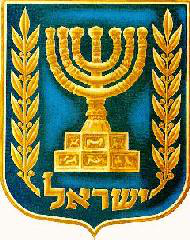
THE FIRST MENORAH                       
 THE COAT OF ARMS OF THE STATE OF ISRAEL


Exodus 25:31 – 40 “Then you are to make a lampstand of pure, hammered gold. It shall be made of one piece, including its base and shaft, its cups, and its buds and petals. Six branches are to extend from the sides of the lampstand—three on one side and three on the other. There are to be three cups shaped like almond blossoms on the first branch, each with buds and petals, three on the next branch, and the same for all six branches that extend from the lampstand. And on the lampstand there shall be four cups shaped like almond blossoms with buds and petals. For the six branches that extend from the lampstand, a bud must be under the first pair of branches, a bud under the second pair, and a bud under the third pair. The buds and branches are to be all of one piece with the lampstand, hammered out of pure gold. Make seven lamps and set them up on the lampstand so that they illuminate the area in front of it. The wick trimmers and their trays must be of pure gold. The lampstand and all these utensils shall be made from a talent of pure gold.” See to it that you make everything according to the pattern shown you on the mountain.”

God wants a lampstand for His tabernacle, and what a lampstand! The craftsmen are to start with a solid block of gold and then hammer the entire thing from that. The only part of the lampstand that is to be separate is the seven lamps that will sit on top of the branches of the lampstand. To make this lampstand and all its utensils, the craftsmen are to start with a talent of pure gold. (A talent is approximately 75.4 pounds or 34.2 kilograms of gold.) God is not about to tolerate any shoddy work!

Why hammer the lampstand out of the block of gold? Not only will the lampstand be stronger, but this restriction also removes the temptation for someone to carve something out of wood, overlay it with gold, and to keep the rest of the gold for themselves.

When we first came to Ghana in 1988, we lived in Kumasi in the Ashante Region, with a Ghanaian family. The father was a wealthy local businessman and to maintain his standing in the community we had to attend many functions with him. The Ashantes LOVE funerals! While we lived with this family, every Saturday we would be hauled off to three or four elaborate Ashante funerals. One feature of these funerals was the traditional bands with their dancers dressed in Kente cloth and wearing heavy gold bracelets. We soon learned that much of this gold jewelry was not solid gold, but rather carved wood overlayed with gold.

God is not interested in half – measures. The lampstand and everything used to care for the lights is to be pure gold and nothing less! But why the use of almond buds, flowers, and calyces? Dennis Prager tells us, “The almond tree is the earliest spring plant to flower in the Land of Israel, and its blossom is used here as a symbol of renewed and sustained life. The combination of blossoms, petals, and calyx renders the menorah like a tree , and in the Bible a tree symbolizes life…in the Jewish liturgy, the Torah…is described as a Tree of Life [etz chaim]).

In Jeremiah 1:11 – 12, God uses the almond tree as a symbol for His watch – care over His Word. “And the word of the LORD came to me, asking, “Jeremiah, what do you see?” “I see a branch of an almond tree,” I replied. “You have observed correctly,” said the LORD, “for I am watching over My word to accomplish it.” (The Hebrew word for “watching” sounds like the Hebrew word for “almond tree.”)

Those of us familiar with the menorahs used at Hanukkah will realize that this menorah has seven lamps, rather than nine. Hanukkah menorahs have eight branches representing the eight days of the holiday with one that holds the candle to light the others. In the menorah that God is describing here, the central lamp represents the Sabbath, while the other six branches represent the days of the rest of the week. God repeats the number seven throughout the Scriptures to emphasize He is the Creator who brought the world into existence in six days and then rested on the seventh, thus instituting the concept of Sabbath rest.

APPLICATION: How seriously do we take God’s commandments? Here God is ordering Moses to use a huge amount of gold to create the lampstand and its tools. We have no idea how much more gold was left in the Israelite camp. It is possible that by the time the craftsmen completed their work on the tabernacle, there might not have been any gold left in the Israelite camp at all. God is ordering the Israelites to lay down their most precious possessions for His tabernacle. The Israelites have no idea how long they will be traveling or the problems they might encounter on the way. The prudent thing to do would be to save some of that gold for later.

Sometimes God calls us to make magnificent sacrifices for Him. Such a call is daunting – what if we go into a risky situation and are killed? What if we go to another country to serve as missionaries and we die of some deadly disease such as Ebola? What if we get caught in a tribal conflict? The “what ifs?” can be endless. The bottom line is this: God is not interested in your “what ifs!” 1 Samuel 15:22 tells us, “Behold, obedience is better than sacrifice, and attentiveness is better than the fat of rams.”

Jim Elliot was a missionary martyred by the remote Indian tribe he was trying to reach with the Gospel. Of the sacrifices he had already made, Elliot said, “He is no fool who gives what he cannot keep to gain that which he cannot lose.” The death of Elliot and those with him paved the way for that tribe to come to know Jesus and for many Christians to enter missions. God has already given us our lives and has sent His Son Jesus Christ to shed His Blood for our sins. Since God has already made such magnificent sacrifices, why should we hold back?

The ancient Israelites carefully created everything for the tabernacle just as God had instructed Moses. Later on, the Israelites wavered; however, in the beginning, they gave their most precious treasures. How far are you willing to go for God? How much are you willing to give up for Him?

PRAYER: Father God, many of us are clinging to all kinds of stuff! We want to serve you, but we don’t want to let go of our stuff either. Help us to freely give you our hearts and our lives. Be Lord over all of our possessions. Please help us to hold things lightly so that if you ask us to give something to you, we will do it readily. In the matchless Name of King Jesus. Amen.

MAY 25, 2021 MERCY 86: WHY PUT OUT BREAD IF GOD ISN’T GOING TO EAT IT?

May 25, 2021

Exodus 25:23 – 30 “You are also to make a table of acacia wood two cubits long, a cubit wide, and a cubit and a half high. Overlay it with pure gold and make a gold molding around it. Also make a rim around it a handbreadth wide and put a gold molding on the rim. Make four gold rings for the table and fasten them to the four corners at its four legs. The rings are to be close to the rim, to serve as holders for the poles used to carry the table. Make the poles of acacia wood and overlay them with gold, so that the table may be carried with them. You are also to make the plates and dishes, as well as the pitchers and bowls for pouring drink offerings. Make them out of pure gold. And place the Bread of the Presence on the table before Me at all times.”

When we lived in one town in northern Ghana, we began noticing that on certain days, there were large numbers of buzzards hovering over one part of the town. Puzzled, we sought information from our local friends, only to learn that those were the days on which fetish worshipers would leave food offerings for their gods in traditionally designated places. All the buzzards had to do was to watch and wait and presto! they got a free lunch!

Making food offerings to idols was quite common in the ancient world. But in the Israelite sanctuary, the parts of the sacrifices designated “for God” were burned in the sanctuary courtyard. This table played no role in the sacrifices but had enormous symbolism. The “Bread of the Presence” has also been referred to as the “Bread of Display” because it was left on the table for an entire week. When the week was completed, the priests were then allowed to eat from God’s table in an action completely opposite of the pagan ones. While pagan gods demanded that their followers feed them, the One True Living God wanted to demonstrate that it was He who was feeding His people and who was the Source of all nourishment. The Bread of the Presence was also left to indicate that God was not limited by a physical body and therefore did not need food from his followers.

The construction of the table was similar to the construction of the ark. The table was obviously designed in such a way that it could easily be carried as the Israelites traveled. But what about the pitchers and bowls? In the Israelite temple, these vessels were empty. Why?

When we first came to Ghana, one of the rituals we observed repeatedly was the pouring of libation to the gods. This ceremony was done regularly at funerals and at public ceremonies. There was – and still is – great controversy within the Christian community as to whether or not Christians should pour libation. Those supporting the pouring of libation tried to defend it as merely a way of honoring the ancestors. But those opposing the pouring of libation emphasized that this act was a form of sacrifice to unknown gods and therefore spiritually dangerous. Most deeply committed Christians we knew refused to take part in pouring of libation.

The vessels in the Israelite temple remained empty because God had – and has – no need for any kind of drink offerings. God wants our love and our devotion. The only time the Bible mentions a drink offering positively is when David expressed a longing for water from the well at Bethlehem while the Philistines were controlling it. Three of David’s best warriors broke through the Philistine defenses and brought back water from that well for David. David was so overwhelmed that he poured it out to God, feeling that water represented the life blood of his friends. (2 Samuel 23:13-17) At that moment, that water was the most precious thing David possessed and he wanted to offer it to God to honor Him.

APPLICATION: The message of the table of the Bread of the Presence is this:

Today, God is not demanding sacrifices of animals or of bread from us. But just as in the time of the Israelites, God is still the Source of life and of all nourishment. Jesus told the Samaritan woman at the well that “God is a spirit, and they who worship Him must worship in spirit and in truth.” (John 4:24)

Liturgical worship is a form of worship that involves a set pattern with certain statements that are repeated each time worship takes place. There are those who criticize liturgical worship because they feel that it is too easy to just go through the motions. On the other hand, those who want to have worship with very little form may find themselves wandering off on tangents. Forms of worship are very important because they allow us to approach God as a group in an orderly fashion. I have experience with a wide variety of worship services. Countless times, I have begun the Confession of Sins in a liturgical church, only to have those well – worn words pull me up short and force me to confront my own spiritual failures.

The best worship is a blend of both forms, but no matter how you choose to worship, one thing is clear: your heart must be open to God for you to be able to worship Him. If you attempt to approach a Holy God with sin in your heart and without confessing that sin, you are going to feel as if there is an impenetrable wall between you and God. That is why confession must be part of the preparation for worship, whether you do it privately at home or in a congregation.

PRAYER: Father God, thank you for loving us! Thank you for being the Source of all light and life, of all nourishment, of the flow of the water of life. Lord, help us to open our hearts to you and to worship you in spirit and in truth. In the mighty Name of King Jesus. Amen.

MAY 24, 2021 MERCY 85: WHY MAKE A MERCY SEAT IF NOBODY IS GOING TO SIT ON IT???

May 24, 2021

Exodus 25:17 – 22 “And you are to construct a mercy seat of pure gold, two and a half cubits long and a cubit and a half wide. Make two cherubim of hammered gold at the ends of the mercy seat, one cherub on one end and one on the other, all made from one piece of gold. And the cherubim are to have wings that spread upward, overshadowing the mercy seat. The cherubim are to face one another, looking toward the mercy seat. Set the mercy seat atop the ark, and put the Testimony that I will give you into the ark. And I will meet with you there above the mercy seat, between the two cherubim that are over the ark of the Testimony; I will speak with you about all that I command you regarding the Israelites.”

God has already ordered the Israelites to construct an ark, a special wooden chest overlayed with gold, into which the tablets containing the Ten Commandments are to be placed. Of this arrangement, Dennis Prager comments “There is a powerful message in the placing of the Ten Commandments – the core document of ethical monotheism – in the ark, which is in the holiest part of the Tabernacle. It is a physical representation of a major Torah teaching: the holy protects the ethical. Ever since the French Enlightenment, Western man has believed ethics can survive without the holy, meaning without God. But the “death of God” along with the death of the holy inevitably leads to a moral collapse. It is an open question whether Western societies will survive “the death of God” (Nietzsche, 1882) and if those societies die, there is no reason to believe they will be replaced by something morally superior – and a great deal of reason to believe they will not.” (Dennis Prager, The Rational Bible: Exodus)

The mercy seat might be one of the most confusing objects in the entire tabernacle. Certainly, when Moses passed these instructions on to the artisans who were fabricating things, they must have said, “HUH???” The Israelites were used to Egyptian temples with huge statues of the Pharaoh or of an Egyptian god sitting on a special throne, but the mercy seat was something on which no person or statue was to physically sit.

Verse 17 in the Jewish Torah reads “You shall make a cover of pure gold,” rather than mentioning a “mercy seat.” Prager explains: “The Hebrew word for cover, kaporet, comes from the same root as the Hebrew word for atonement, kippur.” Later on in Leviticus 16, God commands Aaron as the first of the high priests on the rituals needed for atonement, both for himself and for his family and also for all the people.

Leviticus 16:1 “Now the LORD spoke to Moses after the death of two of Aaron’s sons when they approached the presence of the LORD. And the LORD said to Moses: “Tell your brother Aaron not to enter freely into the Most Holy Place behind the veil in front of the mercy seat on the ark, or else he will die, because I appear in the cloud above the mercy seat.”

God commands the Israelites to make annual sacrifices for the atonement of their sins and to sprinkle some of the blood of the bull and the goat offered as sin offerings on the mercy seat. Leviticus 16:11-16 describes what the High Priest is to do with the blood. Verse 16 says, “So he(Aaron, the high priest) shall make atonement for the Most Holy Place because of the impurities and rebellious acts of the Israelites in regard to all their sins. He is to do the same for the Tent of Meeting which abides among them, because it is surrounded by their impurities.”

God instituted a system of sacrifices for the Israelites; however, the blood of animals could never permanently pay for the sins of men. Those sacrifices had to be repeated each year. Only the blood of a sinless man who freely offered himself could serve as a sacrifice that did not need to be repeated. Jesus Christ came as the Son of God, born of a virgin woman, to offer himself as the sacrifice for the sins of the whole world. In so doing, Jesus made the ultimate sacrifice.

There was a heavy curtain placed at the entrance of the Holy of Holies to keep casual onlookers out; however, at the exact time Jesus was dying on the cross, the curtain in the huge temple in Jerusalem was torn from top to bottom. God tore that curtain; no human hands could have done so. God was demonstrating that Jesus had made a way to Him for all mankind by sacrificing himself.

The ark was to be placed in the Holy of Holies, and nobody was to approach the Holy of Holies casually. But God promised Moses that once the ark and the mercy seat were placed in the Holy of Holies, He would meet Moses there and instruct him. Moses met with God regularly, coming out each time with his face shining so brightly that he had to wear a veil over his face.

APPLICATION: Because of the life, death, and resurrection of Jesus Christ, we no longer need to sacrifice animals to make atonement for our sins. But we do need to meet with God regularly and we do need to allow the Holy Spirit to show us our sins. Once we realize where we have sinned, we need to seek God’s forgiveness. How can we do this?

PRAYER: Father God, we realize that we are sinners and that none of us can earn our way into heaven. Lord, please show us our sins. Help us to repent, to turn away from those sins and to learn your will for our lives. In the matchless Name of King Jesus. Amen.

MAY 23, 2021 MERCY 84: WHY DID INDIANA JONES SEARCH FOR THE LOST ARK?

May 23, 2021

Exodus 25:10 – 16 “And they are to construct an ark of acacia wood, two and a half cubits long, a cubit and a half wide, and a cubit and a half high. Overlay it with pure gold both inside and out, and make a gold molding around it. Cast four gold rings for it and fasten them to its four feet, two rings on one side and two on the other. And make poles of acacia wood and overlay them with gold. Insert the poles into the rings on the sides of the ark, in order to carry it. The poles are to remain in the rings of the ark; they must not be removed. And put into the ark the Testimony, which I will give you.”

It was June 12, 1981, and a new adventure movie was being released in more than a thousand theaters across America. When the movie “Indiana Jones and the Raiders of the Lost Ark” hit the screens, it immediately became wildly popular. The movie had everything going for it – lots of action, exhilarating music, and a fascinating plot. The movie was based around Indiana Jones, a mild – mannered college professor who was actually a rock’em sock’em treasure hunter. The story claimed to take place in the 1930’s during the rise of Hitler at a time when the Germans were searching for any means possible to gain power, including spiritual power. The Ark of the Covenant had been lost when the temple of Jerusalem was destroyed; however, it had been hidden for centuries. Now the race was on to find the Ark and to keep it, assuming that whoever had the Ark would be able to tap into the power of God. But what was the Ark in the first place?

When God gave instructions to Moses as to how to construct the Ark, He was extremely specific. The Ark was to become the symbol of God’s Presence with His people; therefore, the Ark needed to be beautifully made. Acacia was one of the trees that grew in the desert. The wood was quite hard and durable. Today, a standard cubit is generally considered to be 18 inches. The dimensions of the Ark would then be 45 inches long by 27 inches wide by 27 inches high.

Overlay it with pure gold both inside and out, and make a gold molding around it.” That Egyptian gold was put to good use. Historically, gold was a symbol of royalty and of purity because it had to be refined in a fire to be of any use.

“Cast four gold rings for it and fasten them to its four feet, two rings on one side and two on the other. And make poles of acacia wood and overlay them with gold. The poles are to remain in the rings of the ark; they must not be removed.”

God wanted the Israelites to understand that the Ark was so holy that nobody was to touch it and nobody was to become curious and to peek into it. (When curious people in the movie open the Ark, they immediately age and disintegrate into ashes.) The Ark was always to be carried using these poles so that nobody had to touch the Ark. Notice that even the carrying poles were to be overlaid with pure gold.

Later in King David’s time, the Ark had been carried away by the Philistines, and then was subsequently sent back. A man named Abinadab kept the Ark at his house. David ordered the Ark to be returned to Jerusalem; however, it was loaded onto a cart, rather than being carried by the priests as it should have been. When the oxen pulling the cart stumbled, one man named Uzzah was struck dead when he touched the Ark with his hand. (2 Samuel 6:3-8) It was only when David later ordered the priests to carry the Ark setting the poles on their shoulders that the Ark was brought safely to Jerusalem.

And put into the ark the Testimony, which I will give you.” God was about to give Moses the Ten Commandments on tablets of stone that would be permanent records of His Law. Throughout the Middle East it was quite common for important laws to be chiseled into stone. God wanted to make sure that His people would realize just how valuable and how important His commands were.

APPLICATION: Indiana Jones wanted to save the Ark from falling into the wrong hands, both because it was precious and also because it was holy. (Incidentally, the concept of the movie was not that far – fetched. During the build – up to World War II, the Germans really were looking for any sources of spiritual power possible.) Those searching for the Ark did not realize that God’s power still resided in the Ark just as it had in the time of King David. The evil doers who were trying to capture the Ark had no idea that they could not possibly use the Ark for their own schemes.

1 Samuel 5 tells the story of what happened to the Philistines when they captured the Ark. The Philistines brought the Ark to the temple of Dagon in Ashdod. The next morning, the statue of Dagon had fallen forward on its face in worship towards the Ark. When the Philistines set the statue of Dagon back up, the following day, the statue had fallen again. This time the head and hands of the statue lay broken on the threshold of the temple while only the torso remained. Then God sent plagues on the Philistines as they moved the Ark from one city to the next. (This might have truly been bubonic plague.) Finally, the Philistines placed the Ark on a new cart with two milk cows whose calves remained tied up. In the cart the Philistines placed golden images of 5 rats and 5 “tumors” (huge masses of lymphatic tissue in the groin) to signify the plague that had attacked them. When the cows were set free, they headed straight to Israel, lowing as they went, but obviously compelled by God to leave their calves and to head for a strange place.

The Ark was to be the symbol of God’s presence with His people. We are not supposed to worship idols; however, there are those things that symbolize God that help remind us of His Holiness and His Worthiness to be worshiped. Each of us may honor God a little differently; however, we must find ways to acknowledge him as Lord of our lives. Ask God how He would have you honor Him in your own life.

PRAYER: Father God, please give us such a vision of Your Holiness that we will honor You at all times. Thank you for loving us and for caring for us. We bless Your mighty Name. And help us to follow hard after You all the days of our lives. In the matchless Name of King Jesus. Amen.

MAY 22, 2021 MERCY 83: “GOD, WE’LL BUILD YOU A TABERNACLE, BUT WHY ARE YOU SO PICKY?”

May 22, 2021

Exodus 25:1-8 “Then the LORD said to Moses, “Tell the Israelites to bring Me an offering. You are to receive My offering from every man whose heart compels him. This is the offering you are to accept from them: gold, silver, and bronze; blue, purple, and scarlet yarn; fine linen and goat hair; ram skins dyed red and fine leather; acacia wood; olive oil for the light; spices for the anointing oil and for the fragrant incense; and onyx stones and gemstones to be mounted on the ephod and breastpiece. And they are to make a sanctuary for Me, so that I may dwell among them. You must make the tabernacle and design all its furnishings according to the pattern I show you.”

The rest of the Book of Exodus is mostly God’s instructions regarding the construction of a tabernacle, a portable sanctuary, along with all the furnishings necessary, the garments for the priests, the conduct of the priests, etc. Up until now, the Israelites had seen graphic demonstrations of God and His power; however, they had no place in which to worship God, nowhere that would serve as a central focus for their worship. Now God is establishing a portable temple plus the forms of worship He wants from His people.

There are a number of things to notice here:

1. The Israelites are to give offerings, but only those who are really willing, “whose hearts compel them” are to bring things. These instructions are the basis for the idea of “free will offerings,” a concept that is frequently abused today. Offering something to God is an act of worship; however, it’s not worship when someone is twisting your arm! When making offerings becomes a form of showing off, this is no longer an act of worship, but merely competition to see who can be admired the most.

2. In case you were laboring under the misconception that the Israelites were these poor little ex – slaves wandering around in the desert with no resources, think again! Remember that the Israelites were instructed to ask for precious things from their Egyptian neighbors before they left Egypt. Terrorized by the deaths of the first – born people and animals, the Egyptians literally loaded the Israelites up with as much booty as they could carry. Now God wants to put those things to good use.

3. The list of potential offerings is extensive and specific. Why shouldn’t God know the details? He watched as the Egyptians gave those things to the Israelites in the first place. It’s even possible that some of the Israelites have been scratching their heads ever since they left Egypt, wondering things like, “Dyed ram skins? Acacia wood? Gemstones? Why are we carrying this stuff around out here in the wilderness anyway?”

4. The sanctuary that is to be constructed will be a visible form of God’s presence. God promises to dwell among them.

5. “You must make the tabernacle and design all its furnishings according to the pattern I show you.” God is going to give specific instructions so that everything will be done properly. God doesn’t want to leave any opportunity for someone to cut corners or for someone to make money off the tabernacle construction. God knows the human heart, and God knows the thoughts and intentions of every one of those Israelites!

5. God knows that this tabernacle will serve as a model for places of worship to Him for the rest of human existence. If the model is not correct, the resulting copies will veer further and further away from God’s will for His place of worship.

APPLICATION: Many times you may hear someone say, “Oh, I like to worship God in nature; and anyway, God is everywhere. Why do I need to go to church?”

There is nothing wrong in worshiping God when we are outdoors; however, worship is too important to be limited to just one setting. If we are truly following God, we will worship him in our homes, in our schools, in our workplaces, and wherever we go.

Worshiping God with others is very important; it is there that we can be encouraged that others love God as we do. Singing hymns and worship songs together can encourage us and build us up. Listening as others pray can be both a humbling and an enlightening experience. Coming together to praise and worship God changes our hearts and our minds to desire Him more.

“But,” you say, “my church is nothing like that! The people in my church are hyper – critical and supercilious. The pastor’s sermons are lukewarm and leave me feeling that I could have gotten as much inspiration from taking a hot shower. Each Sunday (or Sabbath) I leave church feeling empty. If these sentiments are yours, I have a word of advice: LEAVE!!!

One of the benefits of COVID is that a number of excellent churches are live – streaming their services or televising them, giving you the opportunity to find the congregation and the pastor who most speak to your needs. God wants to meet with you in worship. If you will pray and ask God, He will show you where to go and how to find a group with whom you can truly worship Him. The one thing you should NOT do is to stop worshiping God or stop praying.

PRAYER: Father God, thank you for loving us so much that you want to meet with us! Thank you for caring about every detail of our lives, including the way we worship you. Help us to find places where we can truly express our love for you and where you can speak to our hearts. In the matchless Name of King Jesus. Amen.