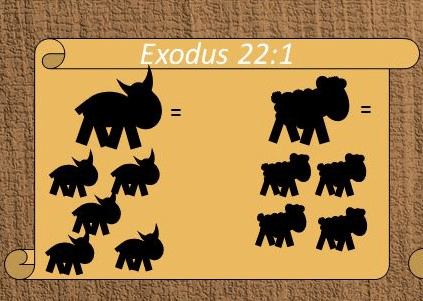
Exodus 22: 1“If a man steals an ox (or a bull or a cow) or a sheep and slaughters or sells it, he must repay five oxen for an ox and four sheep for a sheep.
Many of us hit this part of Exodus and begin to yawn! After all the excitement of the deliverance from Pharaoh and the fire and smoke at Mount Sinai, now we are stuck reading through a bunch of rules. BO*R*I*N*G!!! OR IS IT?
When the Israelites were living in Egypt, they had no laws of their own but were under Egyptian law. But God is trying to form a new nation with new laws. And Moses has a few million people to worry about; if there are no laws, Moses and his judges are going to go crazy settling disputes.
The complete loss of an animal, either by sale or by slaughter, leaves the owner bereft not only of that animal but also of any byproducts of that animal such as wool or milk and also of the potential offspring of that animal. Cows can live for several years and produce a calf each year, multiplying their value. Sheep may have more than one lamb at a time, bringing income to the owner. Cows, bulls, and oxen are more valuable than sheep, hence the rule of replacing the cattle 5:1 and sheep 4:1. The thief is to replace the animals he stole with several animals rather than just one as a deterrent to stealing again. After all, if a thief only had to return the animal, he might be willing to take the risk that he would not be caught and would profit from his theft.

“If a thief is caught breaking in and is beaten to death, no one shall be guilty of bloodshed. But if it happens after sunrise, there is guilt for his bloodshed. A thief must make full restitution; if he has nothing, he himself shall be sold for his theft. If what was stolen is actually found alive in his possession—whether ox or donkey or sheep—he must pay back double.”
What’s the difference between a nighttime theft and a theft in the daytime? At night, the family will all be in the house; therefore, any thief attacking at night is likely prepared to defend himself and to kill if challenged. The householder is allowed to defend his family and himself from such a deadly threat.
In the daytime, most of the family will be away from the home, leaving the house unguarded. Thieves coming at this time are likely to be unarmed; therefore, killing a daytime thief amounts to murder. The Talmud states,”If it is as clear to you as the sun is shining that the burglar is not a physical threat to you, then you will bear guilt for killing him.” But if a daytime intruder is armed and prepared to kill, the householder still has the right to defend himself and to kill if necessary.
Once caught, a thief must pay back double the value of what he has stolen. If the thief cannot make restitution, he may be sold into slavery/indentured servanthood to work off his debt.

v. 5 “If a man grazes his livestock in a field or vineyard and allows them to stray so that they graze in someone else’s field,(And so allows a field of vineyard to be grazed bare) he must make restitution from the best of his own field or vineyard.” Neighbors might make arrangements so that their livestock can share grazing lands; however, if no permission is given, then the livestock owner must make restitution from the best that he has.
Those familiar with the history of the Western United States may remember the Johnson County Range War that took place between cattle ranchers and shepherds more than 100 years ago in Wyoming. Left alone, sheep will nibble grass right down to the ground, leaving nothing for cattle. In Ghana today there are continual clashes between nomadic Fulani cattle herdsmen and farmers. Sometimes huge herds of cattle may descend on an area, running rough – shod over crops and completely destroying farms in the process. Lives have been lost in these conflicts.

Exodus 22: 6 “If a fire breaks out and spreads to thornbushes so that it consumes stacked or standing grain, or the whole field, the one who started the fire must make full restitution. Fires don’t just suddenly break out. Here in Ghana in the dry season farmers burn the bush, partially to scare out any wild animals and partially to destroy any foliage that might contain harmful insects. (At this point, the hunters are lucky if they get bush rats!)
Unfortunately, once lit, these fires can race for miles, destroying crops and villages. Several years ago, two ladies who had been caught in a bush fire were brought to our hospital with nearly 100 % burns. One lady was already dead, but the second was alive and pleading for water to drink. Sadly, there was nothing we could do and the second lady died as well.
The interesting thing about verse 6 is that it recognizes the possibility that the fire was not set deliberately, but that this was an accidental catastrophe. Dennis Prager comments “One byproduct is the Torah;s opposition to assessing blame where there is none.” (Dennis Prager, The Rational Bible: Exodus)
APPLICATION: Why consider these passages? The laws that govern us are based on these passages. Another reason to consider these passages is this: the “God of the Old Testament” has frequently gotten a bum rap. Some Christians want to ignore most of the Old Testament, failing to understand that you cannot parcel up God and that Jesus’s teachings build on those of the Old Testament but do not negate them.
PRAYER: Father God, thank you for your Word. Thank you for the grace and mercy you have demonstrated and for the way you have tried to lead us and guide us. Help us to treasure your Word and to see you in it. In the mighty Name of King Jesus. Amen.
 Burunche's Blog
Leave a comment