
Archive for May, 2021

MAY 11, 2021 MERCY 72: YOU’RE GOD’S CHILD; ACT LIKE IT!

May 11, 2021

Exodus 22: 31 “You must not blaspheme God or curse the ruler of your people. You must not hold back offerings from your granaries or vats. You are to give Me the firstborn of your sons. You shall do likewise with your cattle and your sheep. Let them stay with their mothers for seven days, but on the eighth day you are to give them to Me. You are to be My holy people. You must not eat the meat of a mauled animal found in the field; you are to throw it to the dogs.”

When I was growing up, there were many times that I wanted to do the same things other kids were doing; sometimes my mom did not agree. At that point Mom would tell me, “You’re not just anybody’s kid. You’re MY kid, and I want you to behave better than that!” In these verses, God is telling the Israelites the same thing Mom used to tell me. The Israelites are GOD’S people, and He wants them to maintain high standards.

1. Don’t blaspheme (curse) God. We blame God for so many things. We blame God for bad weather. We blame God when our families misbehave. We blame God for natural catastrophes such as tornadoes or floods. And worst of all, we blame God when we make stupid mistakes! We can’t even manage our lives properly, but that does not keep us from cursing God, even thought God is the One who has given us life and who can end our lives at any moment.

Dennis Prager points out that “In this verse, the word normally reserved for God, Elohim, means “judges,” as it does on a number of occasions. Consequently, the verse should read, “You shall not revile [curse] judges, nor put a curse upon a chieftain among your people.” Read in this fashion, the two parts of the verse make better sense. Prager also notes that “God does not refer to Himself in the third person anywhere in this section.” The Torah is commanding us to treat leaders with the respect due to their offices. We do not have to agree with them.

You must not hold back offerings from your granaries or vats.” The Israelites were commanded to offer the best of the first results of their harvest to God. Offering the first fruits is a scary thing; what if that’s all that you get? You might wind up with nothing! God wanted His people to trust Him so much that they would make this offering, trusting that He would bless them abundantly. Remember that Cain’s first sin was to offer God whatever he felt like, not the best of the first of his produce.”

“You are to give Me the firstborn of your sons. You shall do likewise with your cattle and your sheep. Let them stay with their mothers for seven days, but on the eighth day you are to give them to Me.” WHOA, GOD! ARE YOU DEMANDING CHILD SACRIFICE? No. In fact, God is actually asking for the Israelites to present their firstborn sons to Him as an act of consecration. God loathes child sacrifice and there are many commands against it. God wants the Israelites to set aside their first – born sons to him as holy, an act that would deter them from later offering that same son as a burnt offering to Molech or one of the other demons. Child sacrifices were common among the other tribes, and in the days of wicked King Ahab, when things had deteriorated morally in Israel, Hiel of Bethel began rebuilding Jericho by sacrificing his oldest son. (1 Kings 16:34)

What about the cattle and the sheep? Once the animals have reached the age of 8 days, they are eligible to be sacrificed. Offering the first – born of a cow or a sheep is a daunting prospect. What if that is the only calf or lamb an animal bears in its lifetime? Making such an offering is just as scary as walking through the Red Sea with those towering pillars of water on either side.

You are to be My holy people. You must not eat the meat of a mauled animal found in the field; you are to throw it to the dogs.” Evidently, this was a common practice in those days – hey! fresh meat! ….or was it? God wanted His people to eat fresh meat slaughtered in a specific clean fashion and to bless Him as they ate. The meat from a mauled animal would definitely be contaminated with the bacteria from the animal’s intestinal tract. Such meat would be infected and consumption might even lead to death. In addition, God wanted His people to distance themselves from animals as well as from the pagan idol worshipers around them. “You are MY people! Just because the tribes around you are behaving badly is no excuse for you doing so as well!”

APPLICATION: How holy is our behavior? How much do we trust God? Do we curse leaders and judges with whom we do not agree, or do we pray earnestly for them? Are we willing to offer God our first fruits, trusting that He will supply our needs; or are we holding back, giving token amounts in case something bad happens? Do we dedicate our children to the Lord and then pray for them daily, or do we let them go through a baby dedication as a social convention, without any concern for following up on the promises we make during that ritual?

Those around us need prayer! Our families need prayer! Our leaders need prayer! Our children need prayer, now more than ever before. God has designated us to be the ones providing the prayer covering. God speaks every language, so there is no worry about using King James English. Tell God your worries and concerns and ask for His help.

PRAYER: Father God, help everyone who reads this devotional to know how much You love them and care for them. Help us to realize and understand that You want good things for our lives and that You want us to be holy. We confess that our lives are full of dirt; please help us clean up! In the matchless Name of King Jesus. Amen.

MAY 10, 2021 MERCY 71: PROTECTING THE VULNERABLE

May 10, 2021

Exodus 22:21 – 27 “You must not exploit or oppress a foreign resident, for you yourselves were foreigners in the land of Egypt. You must not mistreat any widow or orphan. If you do mistreat them, and they cry out to Me in distress, I will surely hear their cry. My anger will be kindled, and I will kill you with the sword; then your wives will become widows and your children will be fatherless. If you lend money to one of My people among you who is poor, you must not act as a creditor to him; you are not to charge him any interest. If you take your neighbor’s cloak as collateral, return it to him by sunset, because his cloak is the only covering he has for his body. What else will he sleep in? And if he cries out to Me, I will hear, for I am compassionate.”

God cares about vulnerable groups! Here God gives explicit instructions about how to treat foreigners, widows, orphans, and poor people. Notice that God also promises, “If you do mistreat them, and they cry out to Me in distress, I will surely hear their cry. My anger will be kindled, and I will kill you with the sword; then your wives will become widows and your children will be fatherless.” (v. 22- 24) Dennis Prager states “These verses underscore the moral need for ethical monotheism, with the emphasis on ethical as much as on monotheism. Unless we recognize there is a God above us, and His primary demand of human beings is ethical behavior, and a moral God will judges us all, there is nothing to prevent us from oppressing those who are too weak to stop us.”

FOREIGNERS: How to handle immigrants has become an increasingly thorny problem in the last several months as immigration restrictions have been relaxed. It is not the purpose of this particular study to tackle the problem of controlling immigration. But here the Scripture is talking about foreigners who have already settled in the community. Interestingly enough, Prager quotes several authorities on the Torah who indicate that these instructions about foreigners come immediately after the warnings against witchcraft, bestiality, and idol worship. The challenge is to bring a stranger into the Torah’s value system while protecting him because he is a human being.

WIDOWS AND ORPHANS: In Israelite society, husbands and fathers protected their wives and children. If these protectors died, it was possible that nobody else might feel a need to help. Quite recently here in northeastern Ghana, we have been assisting a ten year old girl whose father died a few years ago, leaving her mother and three children. Although there were other relatives in the village, they did nothing to help this girl’s mother, forcing her to send the girl to live with extended family in a remote village. We suspect this orphaned girl was used as a child slave; all we know is that she suffered several catastrophic injuries that have since required two orthopedic operations. The family involved are fetish worshipers who obviously have felt no need to help this woman and her children.

v.23-24 “If you do mistreat them, and they cry out to Me in distress, I will surely hear their cry. My anger will be kindled, and I will kill you with the sword; then your wives will become widows and your children will be fatherless.” God is a God of justice; the way we treat others determines what may happen to us.

THE POOR: The Torah draws a line between poor people who must borrow to keep themselves alive and those who are borrowing money to do business. The idea here is to assist the poor so that they will not be forced to sell themselves into indentured servanthood to pay debts. At the same time, a poor man might have to leave his only cloak as collateral. It gets cold after the sun goes down, so the debtor is allowed to collect back his cloak so that he will have something warm to sleep in.

v. 27 ’…And if he cries out to Me, I will hear, for I am compassionate.” Every tribal language in Ghana has a phrase that means “God is there” or “God sees.” As we deal with the poor, we must remember that at any time, we could find ourselves in a similar situation and we should remember that God sees everything we do. If we fail to be compassionate with others, why should we expect someone else to be compassionate with us?

APPLICATION: The COVID crisis has caused well – established businesses to fail over night. Any of us can suffer a sudden change of fortune. One friend’s son is struggling with the aftermath of a stroke incurred after an immunization. Suddenly this middle – aged computer expert is finding simple daily activities challenging. There are many women throughout the world who have found themselves as widows with their orphaned children after their husbands have died from the pandemic. God cares for widows and orphans, the stranger, and the poor. So must we!

PRAYER: Father God, help us to have hearts of compassion! Help us to be ever – mindful of your commands regarding the most vulnerable in society. And help us to have wisdom, so that our help will be effective and not disabling. In the mighty and precious Name of King Jesus. Amen.

MAY 9, 2021 MERCY 70: “BROAD MINDEDNESS” CAN DESTROY SOCIETY!

May 9, 2021

Exodus 22: 18 – 20 “You must not allow a sorceress to live. Whoever lies with an animal must surely be put to death. If anyone sacrifices to any god other than the LORD alone, he must be set apart for destruction.”

Witchcraft/magic, bestiality, and idolatry – Dennis Prager comments that these three practices are regarded as so destructive to moral civilization that the Torah teaches they merit the death penalty. Today there are many people who choose to believe that such things are “really not so bad.” Why is God being so narrow – minded?

Witchcraft – Control and rebellion are the two sides of the witchcraft coin. All witchcraft is focused on controlling something or somebody – people, events, the weather, one’s own future, etc. etc. In the 1960’s in America, there were two popular TV programs promoting witchcraft; one was “I Dream of Genie,”and the second was “Bewitched.” The central character in “I Dream of Genie” was a gorgeous young lady with blond hair who was a magic spirit living in a lamp, a la Aladdin’s lamp, and who had supernatural powers. All Genie had to do was to blink her eyes and all kinds of things happened. The main character in “Bewitched” was a “good witch” named Samantha who had magical powers which. of course, she only used to do GOOD things. What was downplayed in both programs was the harm done when someone uses magic to interfere in people’s lives. And of course, neither Genie nor Samantha had any relationship at all to the One True Living God. Viewers were invited to believe that there was such a thing as “white magic,” which could be used for good purposes.

Magic/witchcraft/sorcery all encourage those practicing such arts to depend on themselves and to set themselves up as their own gods. But God has already told us in the Ten Commandments that “You will have no other gods before me.” No matter how appealing witchcraft might be, it will lead us away from God.

Several years ago, we had an acquaintance who was an ordained minister in a major denomination. Our friend was also a cultural anthropologist and chose to be trained as a traditional diviner in an African religion to complete his doctoral thesis. My first conversation with this man only lasted 5 minutes before he was arguing that there were “neutral spirits” in the spirit world. But the Bible is clear that there is no such thing as spiritual neutrality; we are either serving God or serving Satan. This man’s training as a diviner had led him away from the truths of the Bible. Witchcraft and magic are nothing to play with!

Bestiality – Those who practice sex with animals “have reduced themselves to the level of an animal, blurring the distinction between humans and animals – just as sorcery blurs the distinction between humans and God.” (Dennis Prager The Rational Bible: Exodus) Prager continues, ”…blurring the distinctions between man and animal, God and man, good and evil,holy and profane, man and woman, life and death undermines the order of the universe as designed by God.”

Idolatry:If anyone sacrifices to any god other than the LORD alone, he must be set apart for destruction.” The Israelites were used to all the gods of Egypt and while they might have been worshiping the God of Abraham, Jacob, and Isaac, it’s quite likely that they were also worshiping some other gods on the side, hedging their spiritual bets. But God wants to form Israel into a holy nation, and that means the Israelites must worship Him exclusively. Making sacrifices is the ultimate form of worship. Prager points out that “in general, the Torah legislates behavior rather than belief or thought. One reason is the Torah is not totalitarian – it leaves the mind free. It recognizes it is bad behavior, not bad thoughts, that does the most damage in life. And it recognizes that once certain behaviors end,the thoughts leading people to engage in those behaviors will likely end as well. If people stop bringing sacrifices to other gods, they will eventually stop believing in them.”

APPLICATION: While most of us would shy away from overt witchcraft, we should ask ourselves this question: How many times have we tried to manipulate people and situations to suit our own purposes? If we pray, are we asking God for HIS WILL to be done, or for ours? And are we trying to dictate to God how He should run things?

Sex with animals sounds abhorrent; however, as Prager points out, “In an increasingly secular world, indifferent to divine prohibitions, many people find themselves easily bored and seek ever – increasing excitement and novelty….the only argument against bestiality theses days is that since we cannot know whether animals enjoy it or not, it is a violation of animal rights. The biblical prohibition, which is unequivocal, is no longer powerful enough to withstand the ‘why not?’ of secular humanist inquiry.”

In many places, animal sacrifices have gone out of fashion; but what about sacrifices of time? God has commanded us to remember the Sabbath Day to keep it holy, but how many children’s sporting, dance, and other competitions now take place on Sunday mornings? We sacrifice our time to those things we deem most important.

PRAYER: Father God, forgive us! We have flirted with magic thinking and with attempting to control our lives, failing to trust You. We are so worried about being politically correct that we have abandoned Your standards. And we sacrifice our time, money, and talents to things that count nothing towards eternity. Lord, open our eyes to see where we have transgressed Your commands. Clean up our hearts and help us to trust You and to worship only You. In the matchless Name of King Jesus. Amen.
MAY 8, 2021 MERCY 69: MUST A WOMAN MARRY HER SEDUCER ???

May 8, 2021

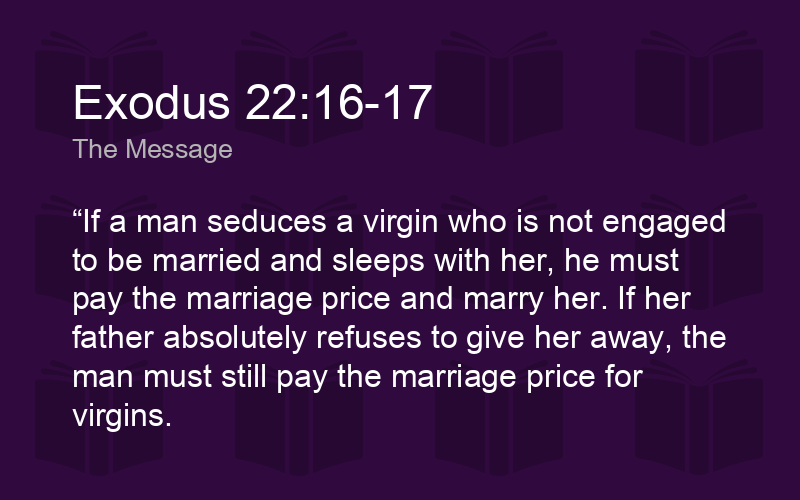
Exodus 22:16 “If a man seduces a virgin who is not pledged in marriage and sleeps with her, he must pay the full dowry for her to be his wife. If her father absolutely refuses to give her to him, the man still must pay an amount comparable to the bridal price of a virgin.”

It’s an old story. Handsome guy meets shy girl with little dating experience. A few kisses quickly escalate into something far more serious. And the guy murmurs, “I really love you! If you really love me, why not show me?”

Little has changed in the world since the days of ancient Israel. But what happens after the sexual act? Despite the loosening of morals in some parts of the world, in others, virginity is still highly prized. Once a girl is no longer a virgin, her chances of securing a husband are very slim. It is ironic that the same men who will seduce or even rape a girl, stealing her virginity, will then attempt to refuse to marry her because she is no longer a virgin. God knew all this, and this is why He gave this command. (Please note that these verses are talking about consensual sex and not about rape; that is a totally different matter and covered elsewhere.)

Consider the woman forced to marry her seducer: In this situation, the woman has no rights and may likely be forced into a loveless marriage. If the husband becomes tired of the woman, he may discard her, leaving her and any children without any means of support. No longer a virgin, the girl may never be able to enjoy the affection of a loving husband and a secure marriage and may struggle to support her children and herself.

Dennis Prager in his book The Rational Bible explains the position of the Torah this way: (This verse) is primarily concerned with protecting the woman, specifically her ability to marry, by protecting the worth of her virginity, which was an extremely important consideration throughout history – and remains so in traditional societies. For this reason, the Torah does not deal with a man seducing an unmarried woman who is not a virgin…

Assuming the family (and the woman in those cases where the family takes her desires into account) is in favor of the marriage, the man who seduced the virgin is obligated to marry her and to pay the bride – price. A man, therefore, must be very careful before sleeping with a virgin, even when the act is consensual, because she and her family can insist he marry her…. the Torah nevertheless considers sexual intercourse to be an act of great significance whose only rightful place is within marriage.

Whether the sexual act has been consensual or forced, the family of the woman can insist that the man marry her and pay the bride price. But sometimes the woman’s family might not agree. Perhaps the man is a known drunkard, a ne’re – do – well, who is likely to beat his wife and to leave her penniless. Fathers are to protect their daughters and to ensure that any man a daughter might marry would be good to her. In such a case, the family is still allowed to collect the bride – price without giving their daughter away.

Bride prices are costly! Here in Ghana, men becoming engaged may find themselves buying large amounts of clothing, material, shoes, jewelry, and other items. The restriction about the bride price was to discourage men from flitting from one virgin to another. We have attended engagement ceremonies in which the groom has had to present several large suitcases full of goods to the bride, in addition to paying the family money, presenting drinks, etc.

APPLICATION: What is so sad when we consider these verses is the number of young women from broken families with absent or disinterested fathers. The Biblical view of women is that their fathers and husbands should protect them. Sadly, many women find themselves having to defend themselves for lack of any backup from relatives. Forced to rely on themselves from an early age, such women may find it quite difficult to trust anybody and may have very low expectations for their husband if they do marry.

It is a proven fact that men and women coming from broken homes with fathers who have failed them find it very difficult to grasp the idea that God is a good Father. How can you believe something about God when you have never experienced it in your own life?

PRAYER: Father God, we call you that but for many of us, we really don’t understand what it means to have fathers who will protect us, guide us, and lead us into right paths. Lord, please help all who read this devotional to have such a vivid experience of your love, your mercy, and your grace, that they will realize YOU are far better and far more than the earthly fathers who have failed them. In the matchless Name of King Jesus. Amen.

MAY 7, 2021 MERCY 68: TAKE CARE OF YOUR NEIGHBOR’S STUFF OR PAY THE PRICE!

May 7, 2021

Exodus 22:7 – 8 “If a man gives his neighbor money or goods for safekeeping and they are stolen from the neighbor’s house, the thief, if caught, must pay back double. If the thief is not found, the owner of the house must appear before the judges to determine whether he has taken his neighbor’s property. “

At first, this hardly seems fair! After all, nobody has control over whether or not a thief breaks into your house. By the time you discover the theft, the thief might be far away. But notice that in addition to requiring the thief to pay back double if he is caught, the home owner may appear in court and swear before God that he has neither used nor stolen his neighbor’s property. Keeping something for your neighbor does not mean that you begin using his possessions as you choose. Several years ago, we stored some things with a relative while we were overseas. When we returned, we found that the relative had actually given my bicycle away to someone outside the family. I felt violated! Had I known what would happen, I would have rented a storage shed.

Dennis Prager notes, “If the guardian refuses to take such an oath, he has to make restitution for the stolen item.” Prager goes on to point out that, “In ancient Israel, the fear of God was so great an oath invoking God was regarded as sufficient to end a trial.” Recently, some courts in the U.S. have eliminated “so help me, God” from the oath that a witness is required to swear; however, this is a sorry mistake! If someone giving testimony does not wish God to stand as assurance for the truth of his/her statements, how far can we trust what the person is about to say? Yes, people have lied under oath before; but none of us know how God has handled that person afterwards.

v.9 “In all cases of illegal possession of an ox, a donkey, a sheep, a garment, or any lost item that someone claims, ‘This is mine,’ both parties shall bring their cases before the judges. The one whom the judges find guilty must pay back double to his neighbor.” Here, the meaning is quite clear: once the judges reach a decision, a thief must pay back double. If my neighbor is traveling and asks me to keep his ox for him, I might decide to hide the ox someplace and claim that it was stolen. But when my treachery is discovered, I must return the animal, plus an additional animal. If on the other hand, I am honest and the animal really has been stolen, Prager states that “if the witnesses are found to have lied, they pay double to the guardian.” WOW! Bearing false witness in court can get expensive in a hurry! (Dennis Prager “The Rational Bible: Exodus”)

v. 10 – 13 “If a man gives a donkey, an ox, a sheep, or any other animal to be cared for by his neighbor, but it dies or is injured or stolen while no one is watching, an oath before the LORD shall be made between the parties to determine whether or not the man has taken his neighbor’s property. The owner must accept the oath and require no restitution. But if the animal was actually stolen from the neighbor, he must make restitution to the owner. If it was torn to pieces, he shall bring it as evidence; he need not make restitution for the torn carcass.”

The big question here is this: are you being paid to watch the animal, or are you only watching it as a favor to your neighbor? If you are just doing your neighbor a favor and the animal dies or is injured or stolen, you must swear before God that you were not responsible for the theft, injury, or death. But if your neighbor has hired you to care for his possessions and the animal is stolen, you must make restitution because you have failed to fulfill your agreement. But what happens if a wild animal attacks the animals you are being paid to watch? In that case, you must bring the torn carcass as evidence that you did not steal the animal. Nobody can reasonably expect you to fight off wild beasts.

At this point, you might be asking what is to keep someone from killing an animal, faking the marks of a wild animal attack, and having a barbecue? But the guardian is expected to bring in the torn carcass. If the steaks are missing, somebody is definitely going to get suspicious! And the guardian is going to have to swear before God as to what happened.

v. 14 “If a man borrows an animal from his neighbor and it is injured or dies while its owner is not present, he must make full restitution. If the owner was present, no restitution is required. If the animal was rented, the fee covers the loss.” Poor Shmuel the Fool! Shmuel borrowed his neighbor’s ox; however, Shmuel wasn’t careful, and the ox stepped in a hole and broke its leg! Now Shmuel must make full restitution (Two animals or their price.) But if Obed, the owner of the ox, was with Shmuel, then it is assumed that Obed had control of his animal and Shmuel is off the hook. If Abram rents Obed’s ox and something happens to the ox, Abram is safe because he has paid a rental fee.

APPLICATION: We look at these laws and wonder if they still apply to us. But consider this: we frequently refer to our possessions as our “valuables.” Nobody wants to work for years to have a nice vehicle, only to have it stolen or wrecked. If your neighbor’s teen age son borrows your new car without your permission and brings it back with a big dent in one fender, you will be furious! Your subsequent discussions about repairing the vehicle will actually have their roots in the verses we have just studied. If the matter goes to court, the laws on which the judge’s decision are based also began with these verses.

PRAYER: Father God, thank you for knowing us better than we know ourselves. Thank you that you want all of us to live in peace with our neighbors. Help us to treasure your Word and to be grateful for your boundless love. In the matchless Name of King Jesus. Amen.
MAY 6, 2021 MERCY 67: DON’T STEAL AN OX. STEAL A SHEEP. IT’S CHEAPER!

May 6, 2021

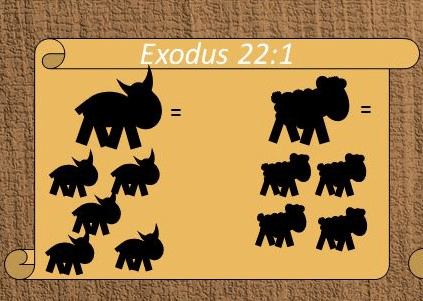
Exodus 22: 1“If a man steals an ox (or a bull or a cow) or a sheep and slaughters or sells it, he must repay five oxen for an ox and four sheep for a sheep.

Many of us hit this part of Exodus and begin to yawn! After all the excitement of the deliverance from Pharaoh and the fire and smoke at Mount Sinai, now we are stuck reading through a bunch of rules. BO*R*I*N*G!!! OR IS IT?

When the Israelites were living in Egypt, they had no laws of their own but were under Egyptian law. But God is trying to form a new nation with new laws. And Moses has a few million people to worry about; if there are no laws, Moses and his judges are going to go crazy settling disputes.

The complete loss of an animal, either by sale or by slaughter, leaves the owner bereft not only of that animal but also of any byproducts of that animal such as wool or milk and also of the potential offspring of that animal. Cows can live for several years and produce a calf each year, multiplying their value. Sheep may have more than one lamb at a time, bringing income to the owner. Cows, bulls, and oxen are more valuable than sheep, hence the rule of replacing the cattle 5:1 and sheep 4:1. The thief is to replace the animals he stole with several animals rather than just one as a deterrent to stealing again. After all, if a thief only had to return the animal, he might be willing to take the risk that he would not be caught and would profit from his theft.

“If a thief is caught breaking in and is beaten to death, no one shall be guilty of bloodshed. But if it happens after sunrise, there is guilt for his bloodshed. A thief must make full restitution; if he has nothing, he himself shall be sold for his theft. If what was stolen is actually found alive in his possession—whether ox or donkey or sheep—he must pay back double.

What’s the difference between a nighttime theft and a theft in the daytime? At night, the family will all be in the house; therefore, any thief attacking at night is likely prepared to defend himself and to kill if challenged. The householder is allowed to defend his family and himself from such a deadly threat.

In the daytime, most of the family will be away from the home, leaving the house unguarded. Thieves coming at this time are likely to be unarmed; therefore, killing a daytime thief amounts to murder. The Talmud states,”If it is as clear to you as the sun is shining that the burglar is not a physical threat to you, then you will bear guilt for killing him.” But if a daytime intruder is armed and prepared to kill, the householder still has the right to defend himself and to kill if necessary.

Once caught, a thief must pay back double the value of what he has stolen. If the thief cannot make restitution, he may be sold into slavery/indentured servanthood to work off his debt.

v. 5 “If a man grazes his livestock in a field or vineyard and allows them to stray so that they graze in someone else’s field,(And so allows a field of vineyard to be grazed bare) he must make restitution from the best of his own field or vineyard.” Neighbors might make arrangements so that their livestock can share grazing lands; however, if no permission is given, then the livestock owner must make restitution from the best that he has.

Those familiar with the history of the Western United States may remember the Johnson County Range War that took place between cattle ranchers and shepherds more than 100 years ago in Wyoming. Left alone, sheep will nibble grass right down to the ground, leaving nothing for cattle. In Ghana today there are continual clashes between nomadic Fulani cattle herdsmen and farmers. Sometimes huge herds of cattle may descend on an area, running rough – shod over crops and completely destroying farms in the process. Lives have been lost in these conflicts.

Exodus 22: 6 “If a fire breaks out and spreads to thornbushes so that it consumes stacked or standing grain, or the whole field, the one who started the fire must make full restitution. Fires don’t just suddenly break out. Here in Ghana in the dry season farmers burn the bush, partially to scare out any wild animals and partially to destroy any foliage that might contain harmful insects. (At this point, the hunters are lucky if they get bush rats!)

Unfortunately, once lit, these fires can race for miles, destroying crops and villages. Several years ago, two ladies who had been caught in a bush fire were brought to our hospital with nearly 100 % burns. One lady was already dead, but the second was alive and pleading for water to drink. Sadly, there was nothing we could do and the second lady died as well.

The interesting thing about verse 6 is that it recognizes the possibility that the fire was not set deliberately, but that this was an accidental catastrophe. Dennis Prager comments “One byproduct is the Torah;s opposition to assessing blame where there is none.” (Dennis Prager, The Rational Bible: Exodus)

APPLICATION: Why consider these passages? The laws that govern us are based on these passages. Another reason to consider these passages is this: the “God of the Old Testament” has frequently gotten a bum rap. Some Christians want to ignore most of the Old Testament, failing to understand that you cannot parcel up God and that Jesus’s teachings build on those of the Old Testament but do not negate them.

PRAYER: Father God, thank you for your Word. Thank you for the grace and mercy you have demonstrated and for the way you have tried to lead us and guide us. Help us to treasure your Word and to see you in it. In the mighty Name of King Jesus. Amen.

MAY 5, 2021 MERCY 66: YOUR OPEN PIT – YOUR RESPONSIBILITY!

May 5, 2021

Exodus 21: 28 – 32 “If an ox gores a man or woman to death, the ox must surely be stoned, and its meat must not be eaten. But the owner of the ox shall not be held responsible. But if the ox has a habit of goring, and its owner has been warned yet does not restrain it, and it kills a man or woman, then the ox must be stoned and its owner must also be put to death. If payment is demanded of him instead, he may redeem his life by paying the full amount demanded of him. If the ox gores a son or a daughter, it shall be done to him according to the same rule. If the ox gores a manservant or maidservant, the owner must pay thirty shekels of silver to the master of that servant, and the ox must be stoned.

When the Israelites left Egypt, the only animals they had with them were probably cattle, sheep, goats, and donkeys, plus possibly poultry. Of these animals, the only dangerous ones likely to attack people were the cattle because they were larger, stronger, could kick from any angle, and had horns. Strictly speaking, oxen are castrated male cattle and therefore unable to breed and to reproduce. It’s possible that the term “ox” here refers to any bovine, whether male or female.

God is trying to teach the Israelites that they must be responsible not only for their own actions but for the actions of their animals. There are several questions:

1. Does the animal have a reputation for having attacked people in the past? If this is the first time the animal has gored someone and killed them, the owner is not responsible; however, the animal will be killed and the owner cannot benefit by selling the meat for food.

2. If the animal is known to be vicious and the owner has been warned but has failed to adequately control the animal, the owner may pay with his life or else pay a heavy fine and he still loses the animal completely.

3. If the animal kills a child, the same rules still apply; the child has a right to life just as an adult does.

4. If the animal kills a servant, the animal must be put to death and the owner must pay blood money to the master of the dead servant. Servants are recognized as people of worth, and the death of a servant still demands payment of blood – guilt.

v. 33 – 34 “If a man opens or digs a pit and fails to cover it, and an ox or a donkey falls into it, the owner of the pit shall make restitution; he must pay its owner, and the dead animal will be his.

They called him “Shmuel the Fool.” Nobody cared to guess why Shmuel was digging pits in the desert. Was he looking for water? Was he trying to bury rubbish? Was he planning to store grain there? All anybody knew was that in the afternoon they saw Shmuel digging a hole, and the following morning one of the donkeys was missing. When they went to look for the donkey, it had fallen into the hole Shmuel had and had dug and had left open. The donkey had broken its neck! What a disaster! Now Shmuel was out the cost of a live donkey and he was also stuck with the body of a dead one! The modern equivalent might be someone who has a swimming pool but who fails to build a high enough fence with a locked gate around the pool.

v. 35-36 “If a man’s ox injures his neighbor’s ox and it dies, they must sell the live one and divide the proceeds; they also must divide the dead animal. But if it was known that the ox had a habit of goring, yet its owner failed to restrain it, he shall pay full compensation, ox for ox, and the dead animal will be his.” For farmers in those days, owning an ox was like owning a tractor and it was a major investment. To lose an ox could prove to be the financial undoing of an entire family, forcing them to sell themselves into slavery/servitude to survive. The principles at work here were those of fairness and justice, with judges trying to determine intent and negligence.

APPLICATION: Although it’s likely that none of us have ever owned an ox or a donkey, the principles of fairness and responsibility remain the same. God is trying to teach the Israelites that they are responsible for one another and must care for one another.

In the last year many major cities have been convulsed by violent demonstrations. Many times entire neighborhoods have been devastated, leaving local businesses in ruins and depriving the local citizens of basic services such as clinics, drug stores, grocery stores, banks, etc. Ironically, these demonstrators have claimed to care about the very groups whose businesses they have carelessly destroyed. The violent actions of these groups belie their assertions. While it is easy to criticize, we must ask ourselves how much do we really care about our neighbors? Do we really have their best interests at heart?

PRAYER: Father God, help us to care about those around us and to take responsibility for our actions. Help us to assess the potential damage we or our children or our pets might do to others and to be careful to act in the best interests of those around us. In the mighty and precious Name of King Jesus. Amen.

MAY 4, 2021 MERCY 65: WHY DOES “AN EYE FOR AN EYE” SUPPORT THE EQUALITY OF ALL INDIVIDUALS?

May 4, 2021

Exodus 21:22 – 32 “If men who are fighting strike a pregnant woman and her child is born prematurely, but there is no further injury, he shall surely be fined as the woman’s husband demands and as the court allows. But if a serious injury results, then you must require a life for a life— eye for eye, tooth for tooth, hand for hand, foot for foot, burn for burn, wound for wound, and stripe for stripe.

If a man strikes and blinds the eye of his manservant or maidservant, he must let the servant go free as compensation for the eye. And if he knocks out the tooth of his manservant or maidservant, he must let the servant go free as compensation for the tooth.

If an ox gores a man or woman to death, the ox must surely be stoned, and its meat must not be eaten. But the owner of the ox shall not be held responsible. But if the ox has a habit of goring, and its owner has been warned yet does not restrain it, and it kills a man or woman, then the ox must be stoned and its owner must also be put to death. If payment is demanded of him instead, he may redeem his life by paying the full amount demanded of him. If the ox gores a son or a daughter, it shall be done to him according to the same rule. If the ox gores a manservant or maidservant, the owner must pay thirty shekels of silver to the master of that servant, and the ox must be stoned.”

There’s a popular meme that says “An eye for an eye means everyone can go blind,” but this statement actually quotes a popular misinterpretation of these verses. Dennis Prager conducts an excellent discussion of Lex Talionis, the Law of Compensation, that was established in these verses.

First, it is important to know the practices that prevailed prior to God giving these commandments. Prager summarizes it this way:

1. The Babylonian Code of Hammurabi dictated that the eye of a noble was far more precious than the eye of a servant or a slave. Now God is stating emphatically that all eyes are equally precious.

2. Previously, if someone killed a member of your family, say, your daughter, then you might seek revenge by killing that man’s daughter. But under Lex Talionis, only the guilty party suffers for his crime. This restriction prohibits unjust revenge and feuds and vendettas.

3. These commands also ensure that there will be appropriate compensation. No two injuries would be exactly alike, so inflicting a matching injury on someone is not possible. The idea here is that the judges will determine how the injured party is to be compensated. The punishment also must fit the crime and not be excessive.

What about the pregnant lady who accidentally gets hurt while two men are fighting and who gives birth prematurely? If mother and baby (babies) survive and are all right, compensation will be determined by a court with the husband making his appeals. But if the woman dies, it will be considered as murder.

What about the verses about the ox that attacks people? The big question here is whether or not the owner has already known the ox to be foul – tempered and likely to gore people. Anyone watching veterinarian shows such as Dr. Pol knows that cows and bulls are very dangerous animals and can injure or kill in an instant. Jan Pol even entitled his autobiography Never Turn Your Back on an Angus Cow. The idea in these verses is that the owner of a vicious animal has a public responsibility to destroy the animal himself before he has to pay the ultimate price. The Israelites are still out in the desert and there are no fences. Keeping a large animal tied up might be really tough. No wonder the punishment for keeping an animal known to be vicious is so extreme!

APPLICATION: Those who wish to serve their own ends will always twist Scripture, and the passage about “an eye for an eye and a tooth for a tooth” has been misquoted many times to justify revenge.

Jesus said of himself in Matthew 5:17, “Do not think that I have come to abolish the Law or the Prophets. I have not come to abolish them, but to fulfill them.” But Jesus also told His disciples, “You have heard that it was said, ‘Eye for eye and tooth for tooth.’ But I tell you not to resist an evil person. If someone slaps you on your right cheek, turn to him the other also…” (Matthew 5:38 – 39) Jesus was not setting aside the idea of just compensation but was adding the concepts of mercy and forgiveness for those who had offended or injured.

Very few of us keep oxen anymore; however, do any of us keep bad – tempered dogs or other pets that might attack the innocent? And how many of us at one time or another have quoted the terrible sentiment that “revenge is a dish best served cold,” indicating that we are nursing grudges and waiting for the day when we can take our revenge on those who have hurt us? Romans 12:19 warns us, “Do not avenge yourselves, beloved, but leave room for God’s wrath. For it is written: “Vengeance is Mine; I will repay, says the Lord.”

PRAYER: Father God, thank you for your Word! Thank you, that you have recognized the equal worth of every individual and that they are all precious in your sight. Lord, help us to realize that your commands have been established to protect and not as excuses for revenge and plotted attacks. Help us to forgive those who have hurt us and to leave them to you. In the mighty Name of King Jesus. Amen.

MAY 3, 2021 MERCY 64: GOD’S LAWS OF COMPENSATION

May 3, 2021

Exodus 21:18 – 19 “If men are quarreling and one strikes the other with a stone or a fist, and he does not die but is confined to bed, then the one who struck him shall go unpunished, as long as the other can get up and walk around outside with his staff. Nevertheless, he must compensate the man for his lost work and see that he is completely healed.

Remember that the Israelites have just come out of Egypt. In Egypt, if you were a commoner, you were in trouble. Priests and nobles could get away with all kinds of abuses. But God has removed the Israelites from Egypt and now He must work to remove Egypt from the Israelites. God wants Israel to be a holy people, so all their social interactions must be placed on the foundations of grace and mercy, not offense and revenge.

If two men fight and one kills the other, this act counts as premeditated murder and the murderer would pay with his life. But now God is introducing a new concept: compensation if a victim is only injured and not killed outright. The man inflicting the injury must not only compensate his victim for working time lost but also must care for him until he is COMPLETELY healed. This law indicates that if the victim never fully recovers, the one inflicting the injury might have to care for him for the rest of his life.

When I was in General Surgery residency, one of our nurses was working in her flower garden next to her house when a drunk driver missed a turn and struck the nurse, pinning her to the wall of the house. This poor lady lost one leg below the knee and one leg above the knee. Because the drunk driver was politically influential, he was not held accountable for this horrific injury but only was fined and had his driving license revoked for a few months. The victim, now a double amputee, suffered through several operations and months of hospitalization and rehabilitation. Although there probably was some compensation from insurance, this driver got off far more lightly than he would have under Mosaic law!

v. 20 – 21 “If a man strikes his manservant or maidservant with a rod, and the servant dies by his hand, he shall surely be punished. However, if the servant gets up after a day or two, the owner shall not be punished, since the servant is his property.” (Berean Study Bible)

At first, this provision may seem cruel; however, it actually represents a giant step forward in the treatment of servants and slaves. This provision recognizes the servant or slave as a person for whose death a master can be punished. Previously, masters could kill their servants or slaves without fear of any retribution, but here it indicates that the master himself can be punished.

Some translations of verse 21 state “If he remains alive a day or two,” indicating that the slave might eventually die from the wounds inflicted by the master. This paints quite a different picture from that of a slave who has received a beating as discipline but who recovers within a few days. Those of us who hate slavery passionately would still blame the master; after all, had he not beaten the slave severely, this death would not have occurred. Some commentators argue that the death of a slave represents an economic loss to the master, thereby punishing the master. But what price can you put on a human life?

APPLICATION: Why should we care about these verses? While there were many reasons for the American Civil War, one of the major issues was slavery and its consequences. Abolitionists used these verses to condemn slave owners while slave owners used the same verses to justify slavery itself and their inhumane treatment of their slaves. Anyone choosing to justify evil can always twist Scripture to suit themselves, but that does not make it right. God will not hold us guiltless if we mishandle His Word.

 Did God love slaves? Certainly! God loved the Israelite slaves so much that He delivered them from Egypt. We have already studied God’s commandments to the Israelites that those who kidnap human beings, presumably to enslave them, deserve the death penalty. (Historically, those supporting slavery conveniently overlooked the command regarding kidnapping!) Today, God loves those who are working in Third World factories under horrible conditions for tiny amounts of money. Slavery of any kind is not God’s will for people.

PRAYER: Father God, thank you for loving each and everyone of us! Thank you for making provisions so that all people are regarded as persons of worth, fully deserving of your mercy and your grace. Thank you for sending Jesus to die for the sins of the whole world, including the sins we commit each day. Please help us to respect your Word and to handle it carefully, not twisting it to support our prejudices. In the mighty Name of King Jesus. Amen.

MAY 2, 2021 MERCY 63: GOD HATES ELDER ABUSE IN ANY FORM!!!

May 2, 2021

Exodus 21: “Anyone who curses his father or mother must surely be put to death.”

Yesterday we concentrated on God’s punishments for murder, including the murder or attempted murder of parents. But why does God also demand the death penalty for anyone who curses his father or his mother?

We live and work in West Africa, where curses are taken very seriously. Several years ago, one prominent politician was accused of giving another politician a “dirty slap,” that is, a slap that would transfer a curse of death to that individual. Later the man who received the dirty slap died from injuries suffered in a traffic accident. In another incident, members of a large denomination who were fed up with the head of the denomination tried to hire a fetish priest to curse their denominational head so that he would have a stroke and die. On market days in our area, it is quite common to see a calabash gourd at a crossroads containing elements placed there in hopes of cursing passers – by.

Curses exist throughout the world. It is a well – known fact that parents who continually browbeat their children, telling them they are stupid, lazy, or unable to accomplish anything positive, are speaking self – fulfilling prophecies over their children. Thanks to the grace of God, many people have come out of these situations and have still achieved a great deal; yet, the memories of those words continue to echo painfully in their hearts.

The Enduring Word Commentary explains this statute this way: The idea was of an adult child who threatened their parent. Though this law was severe, it preserved a critical foundation for civilized society: respect between generations.

i. The idea of the curse here is more like what we would think of as a death threat. “Since to curse was to will and pray the downfall of the other with all one’s heart, it represented the attitude from which sprang acts like striking or murder.” (Cole)

ii. The Law of Moses also had a built-in protection for the rights of the child, according to Deuteronomy 21:18-21. This passage states that the parent did not have the right to carry out this punishment, but they were required to bring the accused child before the elders and judges of the city. This meant that the parent – against all contemporary custom – did not have the absolute power of life and death over their children. As a practical matter, the judges of Israel rarely if ever administered the death penalty in such cases, yet the child was held accountable.

iii. Yet the law discouraging conflict between generations is important. Each elder generation, as they grow older, is at the mercy of the younger generation. If the younger generation is allowed to carry on open warfare with the older generation, the very foundations of society are shaken – as reflected in the Fourth Commandment. Some modern laws – including developing laws regarding euthanasia – may lead to the easy murder of the older generation by the younger.”

Enduring Word Bible Commentary Exodus Chapter 21 https://enduringword.com/bible-commentary/exodus-21/ 13/20

APPLICATION: The shedding of innocent blood brings curses on a land! Just as the shedding of the blood of innocent children offered to Molech brought curses on ancient Israel and Judah, so the murder of infants also will bring those curses. But what of the elderly? Elder abuses that lead to death also constitute the shedding of innocent blood.

Isaiah 46:4 (The Voice Translation) says: And when you are old, I will still be there, carrying you. When your limbs grow tired, your eyes are weak, And your hair a silvery gray, I will carry you as I always have. I will carry you and save you.The righteousness of a society is judged on the basis of how it treats its most vulnerable members. Galatians 6:7 says, “Do not be deceived; God is not to be mocked. Whatever a man sows, he will reap in return.” My mother was fond of saying, “Be careful when your chickens come home to roost; they might turn out to be turkey buzzards!” 

PRAYER: Father God, help all those who read this devotional to realize that one day they will be elderly and vulnerable. Help each of us to defend those whose lives are in danger, simply because they are an inconvenience to someone. Thank you for loving us and caring for us so much that Jesus willingly gave up HIS innocent blood on the cross for all of us! In the mighty Name of King Jesus. Amen.