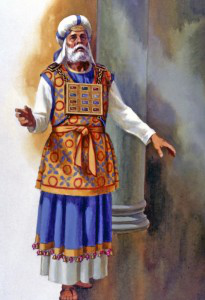
Exodus 28:3-5 “You are to instruct all the skilled craftsmen, whom I have filled with a spirit of wisdom, to make garments for Aaron’s consecration, so that he may serve Me as priest. These are the garments that they shall make: a breastpiece, an ephod, a robe, a woven tunic, a turban, and a sash. They are to make these holy garments for your brother Aaron and his sons, so that they may serve Me as priests. They shall use gold, along with blue, purple, and scarlet yarn, and fine linen.”
God is about to give Moses very specific instructions as to the garments His priests are to wear. Why is God being so picky?
Although Moses might not realize it, God is giving instructions that will be carried out for hundreds of years. God does not want these instructions diluted or perverted!
We live and work in a town in northern Ghana. Ours is a bargaining economy; nobody pays the “first price” for anything in the market, unless it is a common item whose price everybody knows. This mentality carries over into health care; if I want someone to avoid heavy work for at least six weeks after a hernia operation, I tell them three months, knowing that they are going to reduce the time as much as possible. If I want a mother to give Oral Rehydration Salts to her child with diarrhea at least ten times a day, I will tell her fifteen or even twenty. (This has done wonders for my ability to quote numbers in local languages!)
The bargaining mentality existed in Moses’ day as well. God wants to set an absolute standard for priestly garments, one that is not to be tampered with. Priests of some kind existed long before God gave Moses these instructions. The Egyptians had all kinds of priests, as did all the other pagan religions. The dress of many of these priests was little short of scandalous, especially priests serving fertility cults. Those priests were expected to have sex with temple prostitutes as part of their rituals, so exposing their genitalia may have been part of the prelude.
But why have priests anyway? Dennis Prager writes in “The Role of the Priest” (The Rational Bible: Exodus): The welfare of Israel depended on both Moses and Aaron. Moses served as the prophet, the sublime ethical voice conveying God’s word to the people, while Aaron served as the priest, the ritual leader responsible for helping people connect individually to God. Both are necessary for a meaningful religious life.
The priest had four major duties:
1. the priest dedicated himself to living a holy life and helping other Jews come closer to God through Jewish ritual…
2. The priest treated physical ailments such as disease and plague, which were thought to be not only physiological phenomena but also sometimes embodiments of spiritual imperfections.
3. The priest judged disputes.
4. The High Priest, by wearing an object known as the “Urim and Thummim: on his breastplate, provided the medium through which God would communicate positive or negative responses to major national questions.
APPLICATION: Consider the Israelites for a moment. What a religiously ragtag bunch! Over here, you have Miriam who is hauling around a fertility image in hopes that it will help her have lots of healthy children. Over there, you have Saul, who is carrying Egyptian amulets given him by a former business partner. At this point, there are probably very few Israelites who are actually worshiping the One True Living God. If God is going to convince these people that monotheism is the way to go, He really has His work cut out for Him!
There is a principal in development that encourages you to start with people’s current beliefs and then to build on the good ones and to gradually eliminate the bad ones. By instituting the priesthood, God is doing precisely that. Egyptian society was priest – ridden because there were so many various gods, each with their own priests. The Israelites are used to priests, but now God has to educate them as to His expectations for His priests. The Israelites really have no idea what it means to be holy, and they have very little idea of true worship. God starts with concrete instructions because this is something that people can understand. Once these instructions are completed, God can move on to something else.
God knows us better than we know ourselves. God sees the times we try to honor Him and the times when we turn away. God knows that sometimes we are not turning away from Him but are simply worn out from the battles we have been facing. The finest form of worship is the approach of a little child to a loving Father. We can turn to God and simply say, “Help me! I don’t love you as I should, but I do love you. Help me to love you more.”
PRAYER: Father God, none of us love you as we should; however, you are always ready to help us love you more. Please let loving you and serving you be the most important thing in our lives. In the matchless Name of King Jesus. Amen.
 Burunche's Blog
Leave a comment