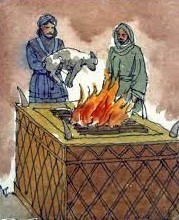
Exodus 29: 22 – 25 “Take the fat from the ram, the fat tail, the fat covering the entrails, the lobe of the liver, both kidneys with the fat on them, and the right thigh (since this is a ram for ordination), along with one loaf of bread, one cake of bread made with oil, and one wafer from the basket of unleavened bread that is before the LORD. Put all these into the hands of Aaron and his sons and wave them before the LORD as a wave offering. Then take them from their hands and burn them on the altar atop the burnt offering as a pleasing aroma before the LORD; it is an offering made by fire to the LORD.
These verses are the first time God mentions wave offerings, but by no means the last. Generally, a wave offering was something that the priest was to elevate in his hands and wave before the Lord. The contents of the wave offering then became the property of the priest. But in verses 22 – 25, Aaron is to make the first wave offering and then that offering is to be burned. Why?
Perhaps this wave offering represents the “first fruits” of the priesthood. From now on, the priests will be given certain parts of offerings, some of which they alone may eat and some which can be consumed by their families as well. Part of this first offering comes from the parts of the ram that might normally be used for divination; it makes sense that those parts would be burned. But the right thigh, one loaf of bread, one cake of bread made with oil, and one wafer from the basket of unleavened bread can only be interpreted as a first fruits offering on the part of the priests. Remember that offering first fruits is an act of faith, trusting God to give more as needed.
V. 26 – 30 “Take the breast of the ram of Aaron’s ordination and wave it before the LORD as a wave offering, and it will be your portion. Consecrate for Aaron and his sons the breast of the wave offering that is waved and the thigh of the heave offering that is lifted up from the ram of ordination. This will belong to Aaron and his sons as a regular portion from the Israelites, for it is the heave offering the Israelites will make to the LORD from their peace offerings.
God is assuring that his priests will have meat from the offerings. But the priests need to be careful to observe the rituals correctly. Later on, in the time of Samuel, the sons of Levi, the high priest refuse to wait for their portions of meat and want to take as much as possible as soon as possible. (Spoiler alert: they die!)
WHATS THE DIFFERENCE BETWEEN A WAVE OFFERING AND A HEAVE OFFERING?
“The Heave Offering receives its name from the motion used in its presentation where the priest used an up and down motion–lifting it up to the Lord and receiving it back from Him. Likewise, the Wave Offering receives its name from the motion used when the priest presented the Wave Offering in a waving type motion. The sacrifice was held in the offerer’s hands, with the priest’s hands underneath the offerer’s, and it was waved forward toward the altar and then backward from the altar–giving it to the Lord and then receiving it back from Him as a gift to the priest.
The right shoulder, better translated right thigh, of the sacrificial animal was a Heave Offering and the breast-piece was a Wave Offering. Both of these pieces were given to the priest to eat, and the rest of the flesh was given to the offerer to eat, sharing it with his family and friends in the presence of the Lord in His sanctuary.
The Heave and Wave Offerings were part of the Peace Offering, which was one of the five Offerings we read about in the book of Leviticus. (The five types of Levitical Offerings were the Burnt Offering, the Meat Offering, the Peace Offering, the Sin Offering, and the Trespass Offering.)
The Peace Offering was the only offering in which the donor received back a portion of the sacrifice to eat himself. Furthermore, it was the only animal sacrifice that did not deal with making atonement for sin. The Meal Offering was the only Offering of the five that did not involve an animal sacrifice–it was a Meal or Cereal Offering instead of an animal sacrifice. sacrifice. ( What difference between heave-offering and wave-offering? – Biblical Hermeneutics Stack Exchange)
v. 29 -30 “The holy garments that belong to Aaron will belong to his sons after him, so they can be anointed and ordained in them. The son who succeeds him as priest and enters the Tent of Meeting to minister in the Holy Place must wear them for seven days.” God keeps repeating the number seven because it refers back to the creation of the world and to God as Creator. Prager comments, “Acknowledging God as the Creator is to acknowedge, among many other things, that life is ultimately meaningful; it is not a haphazard series of coincidences, which is all life is if there is no Creator.”
APPLICATION: When we first came to Ghana, we learned Twi from a teacher who later became chief of a small town. We quickly learned that there was a very rigorous protocol when one was going to greet a chief and his elders, a protocol that had to be followed on every occasion. Chiefs and visitors would both have “Kyeames,” spokesmen who would speak on their behalf. (“Kyeame” is pronounced Chee – AH – me.)The visitors would tell their Kyeame what they wanted to say, the Kyeame would put it into proper Twi, and then the chief would respond through his Kyeame. The use of Kyeames came about because there were certain phrases and words that were never to be used in front of a chief. Someone making a major verbal blunder might even pay with his life; hence, the need for a Kyeame. As strangers, we might be given a little leeway; however, demonstrating a knowledge of the rituals made a big impression on the chiefs whom we greeted.
There is nothing wrong with rituals as long as you understand the meaning of them; in fact, rituals may save you from frustration and despair. Many of the ritual prayers that began with Moses and Aaron still form part of Jewish worship today. The Catholic Church and many Protestant churches use some form of the Mass because it gives a framework for worship. As worship moves in an orderly fashion, those in attendance can find that a phrase they have taken for granted for years suddenly becomes energized and speaks to them in a completely new way.
Personally, my husband and I recite two prayers from Mark Bubeck’s classic book The Adversary. The two prayers are the “Daily Affirmation of Faith” and the “Spiritual Warfare Prayer.” These prayers are packed with helpful Scripture and can make a big difference in your spiritual life. Both can be downloaded as a PDF from cru.org/content/dam/cru/legacy/2012/02/ Spiritual_Warfare_Prayer.pdf
PRAYER: Father God, thank you for loving us so much that you have given us forms of worship we can follow to bring us closer to you. Help us to find those practices that will keep us growing spiritually. In the mighty Name of King Jesus. Amen.
 Burunche's Blog
Leave a comment