Archive for July, 2021

JULY 31, 2021 MERCY 153: DO YOU ONLY WANT TO WORK IF CONDITIONS ARE PERFECT?

July 31, 2021

Exodus 39:32 – 43 “So all the work for the tabernacle, the Tent of Meeting, was completed. The Israelites did everything just as the LORD had commanded Moses. Then they brought the tabernacle to Moses: the tent with all its furnishings, its clasps, its frames, its crossbars, and its posts and bases; the covering of ram skins dyed red, the covering of fine leather,e and the veil of the covering; the ark of the Testimony with its poles and the mercy seat; the table with all its utensils and the Bread of the Presence; the pure gold lampstand with its row of lamps and all its utensils, as well as the oil for the light; the gold altar, the anointing oil, the fragrant incense, and the curtain for the entrance to the tent; the bronze altar with its bronze grating, its poles, and all its utensils; the basin with its stand; the curtains of the courtyard with its posts and bases; the curtain for the gate of the courtyard, its ropes and tent pegs, and all the equipment for the service of the tabernacle, the Tent of Meeting; and the woven garments for ministering in the sanctuary, both the sacred garments for Aaron the priest and the garments for his sons to serve as priests. The Israelites had done all the work just as the LORD had commanded Moses. And Moses inspected all the work and saw that they had accomplished it just as the LORD had commanded. So Moses blessed them.”

400 years! 400 years! For most of four hundred years, the Israelites had served as Egyptian slaves. All that time the Egyptians were building pyramids and monuments and all kinds of things. Needless to say, somebody would have to keep track of the work. It stands to reason that the Egyptians would train some Israelites as construction foremen and bookkeepers rather than remain out on a dusty dirty job site. But if you were a bookkeeper and made any inaccurate entries, watch out! The Egyptians would be on your neck very quickly! And toting up figures in the shade was a lot better than toiling out in the hot sun, moving those huge blocks of stone around.

At the time, it’s more than likely that those Israelites who became accountants and bookkeepers complained about the pressures of their work. But when the time came to construct a Tabernacle in the middle of the wilderness, Somebody more powerful than the Egyptians was watching! Fire, smoke, earthquakes, the unearthly sound of trumpets – all these things probably had thrown the fear of God into many of the Israelites.

Now comes the wrap – up. As the bookkeepers check off their lists, you can imagine the conversation. “Hey, Avram! How many tent pegs did we use? How many pieces of linen?” The accounting would have taken days. But the job is completed, and the craftsmen and bookkeepers and accountants come to Moses. “Hey, boss! We’ve finished the job!” And Moses inspects, approves, signs off on the work, and gives all the workmen and women his blessing.

When we read this account, it’s easy to forget that the Israelites are sitting out there in the wilderness at the base of Mount Sinai. The photo at the beginning of this devotional is one view of that area. Unlike Egypt, where there was water and shade and appealing food, the area around Mount Sinai was bleak. The only reason that the Israelites had the necessary materials with which to construct the Tabernacle was because the Egyptians had piled those things on the Israelites as they fled from Egypt. Working conditions were probably harsh. If you didn’t do most of your work early in the morning or later in the afternoon, the midday sun would scorch you. On the other hand, what else did the Israelites have to do, apart from tending their animals? Perhaps this isolation was necessary for the Tabernacle to be completed; otherwise, the Israelites might have become distracted and the work might have been left half – done.

APPLICATION: My husband and I have spent most of our married lives in Northern Ghana working in small mission hospitals. For much of that time, we have had to make do with whatever resources were available. I have performed countless surgeries with instruments that had already been discarded in America or Europe, only to be shipped to us. At one point, a friend was sending us left over suture material from her hospital, and we were glad to have it. I have also worn surgical gloves in sizes so small that my fingertips have turned numb and in sizes so large that I had to be careful not to tie the fingertips into the surgical knots. I started a hospital laboratory with a gas fridge, a Bunsen burner, a few test tubes, and 2 bathroom tiles and some reagents. (Today our laboratory is fully functional and we even run PCR tests.)

One of our continual frustrations has been training nurses in specialties only to have some of them return and complain because we didn’t already have a complete setup for their specialty. Sometimes you have to start with the resources you have, trusting that God will give you more.

Back in Exodus 3 during the burning bush interview, God asked Moses, “What is that in your hand?” So many times we refuse to look at what God has already given us to work with because we have preconceived ideas of what we “absolutely need” before we can do God’s work. What’s the answer? Make a start! Use whatever God has given you. And as you go on, you will find that God will continue to furnish what you need, little by little. Who knows? You might wind up building a Tabernacle in a wilderness!

PRAYER: Father God, thank you for loving us and caring for us. Thank you that if you call us to do something, you furnish what we need to start with. Help us not to sit down and whine but to go forward, trusting that you will provide where you are guiding us. In the mighty and precious Name of King Jesus. Amen.
JULY 30, 2021 MERCY 152: WHY SHOULD WE GUARD OUR THOUGHTS?

July 30, 2021

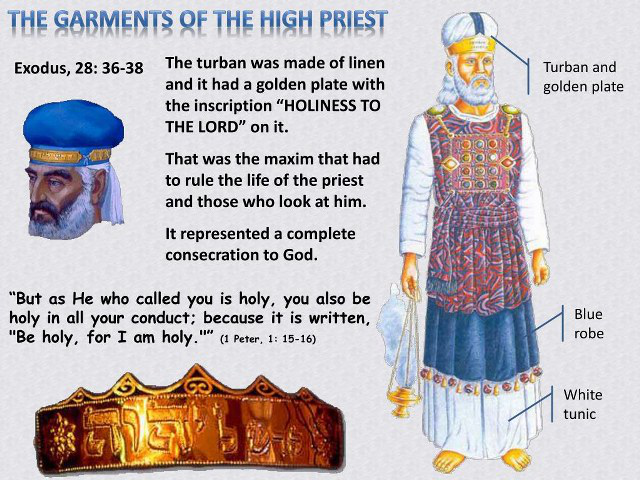
Exodus 39:27 – 31 ”For Aaron and his sons they made tunics of fine linen, the work of a weaver, as well as the turban of fine linen, the ornate headbands and undergarments of finely spun linen, and the sash of finely spun linen, embroidered with blue, purple, and scarlet yarn, just as the LORD had commanded Moses. They also made the plate of the holy crown of pure gold, and they engraved on it, like an inscription on a seal: HOLY TO THE LORD. Then they fastened to it a blue cord to mount it on the turban, just as the LORD had commanded Moses.”

Aaron and his sons were to wear turbans of gleaming white linen adorned with ornate headbands. Wikipedia gives the following information: The high priest was also to wear “the holy crown of pure gold” along with a small separate plate that bore the inscription ‘Holiness to the Lord.” This engraved plate was called the “Tziytz” in Hebrew. The Tziytz was a small rectangular plate of solid gold, engraved in Hebrew letters with “HOLINESS TO THE LORD,” and having holes drilled in each of the four corners through which blue cords were threaded which held the tiara onto the High Priest’s priestly turban. (https://www.mechon-amre.org/p/pt/pt0239.htm#31) Traditionally, it is understood that one set of cords went around the High Priest’s head at the base of the tiara, and the other went over the forehead, all meeting at the back of the head to hold the tiara in place.

According to the Talmud, the wearing of the golden frontlet atoned for the sin of arrogance on the part of the Children of Israel…The Talmud in Shabbat 63b describes the tziytz as encircling the High Priest’s forehead “from one ear to the other.” Rabbi Abraham Isaac Kook suggested that this emphasis on the High Priest’s ears — organs for listening — indicates that he needed to be particularly “receptive to the inner voice of elevated thought.” (Priestly golden head plate – Wikipedia)

APPLICATION: There’s a children’s Sunday School song that goes, “Oh be careful, little eyes, what you see! Oh be careful, little eyes, what you see! For the Father up above is looking down in love, so be careful, little eyes, what you see!” The song goes through several different parts of the body, including ears, mouth, hands, and feet. Although the song never mentions “Oh be careful, little brain, what you think,” this would have been a great addition.

Until the rise of the internet with online pornography and violent videos and violent video games, the only violence to which many people were exposed was on the nightly news. Sadly, that situation has now changed. Now anybody with an internet connection can access incredible amounts of filth. Parental controls may work on a home computer, but what happens when the child visits a friend whose parents are not as careful? And adults are not immune either! We have a close pastor friend who has since gone to be with Jesus who became addicted to online pornography. This addiction nearly cost our friend his ministry and his marriage and may have weakened his body’s immune system, allowing cancer to attack him.

Yesterday we discussed the concept of lashon hara, evil speech/slander/gossip. Proverbs 4:23 says, “Guard your heart with all diligence, for from it flow springs of life.” Proverbs 23:7 says, “As a man thinks in his heart, so is he.”

When computer programming was in its infancy, there was a phrase “GIGO.” “GIGO” stands for “garbage in/garbage out. Computers have no moral sense whatsoever and can only receive whatever information one feeds to them. If wrong information is given during a computation, the computer will give a wrong answer. When it comes to the things that absorb our attention, GIGO still holds true. If we allow evil things to obsess us, we will concentrate on evil.

While there are various descriptions of the “golden tiara” or the “golden crown” or frontlet, it was obviously worn across the forehead, protecting the brain, the seat of thought. Talmudic tradition claims that the priest wore this frontlet to atone for the sins of arrogance committed by the Children of Israel. Certainly, the Israelites were arrogant, rebelling against God and Moses many times, complaining after God had miraculously delivered them, etc. If indeed this golden band stretched from ear to ear, it would remind worshipers that they along with the priests were to listen to the Voice of God.

What’s playing on the video screens of your mind? Centuries after Moses, Paul warned the Philippians, Finally, brothers, whatever is true, whatever is honorable, whatever is right, whatever is pure, whatever is lovely, whatever is admirable—if anything is excellent or praiseworthy—think on these things. Whatever you have learned or received or heard from me, or seen in me, put into practice. And the God of peace will be with you.” (Philippians 4:8 – 9)

Do you want peace? Concentrate on those virtues that will bring peace. Memorize Paul’s check list; then if something comes up that doesn’t match that list, refuse to dwell on it! We should not be ostriches hiding our heads in the sand and waving our bottoms in the air; however, we can choose what to feed our brains. Remember, GIGO!

PRAYER: Father God, thank You for loving us and caring for us. Help us to focus on Your holiness, Your righteousness, and Your purity. Help us to be careful about our thoughts as well as our words. In the mighty and precious Name of King Jesus. Amen.
JULY 29, 2021 MERCY 151: WHAT’S LASHON HARA AND WHY SHOULD WE CARE?

July 29, 2021

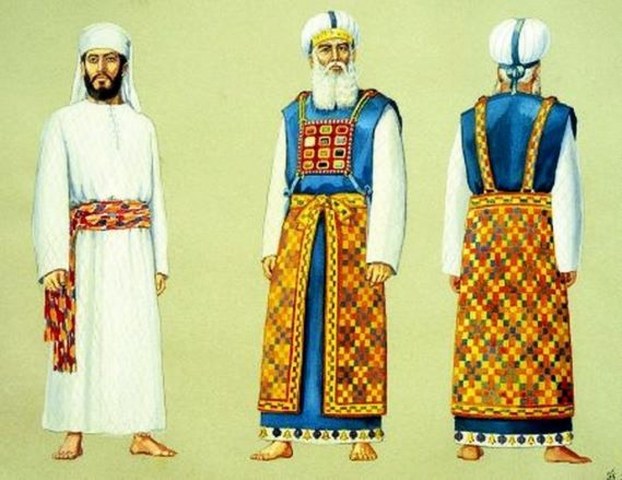
Exodus 39:22 – 27 “They made the robe of the ephod entirely of blue cloth, the work of a weaver, with an opening in the center of the robe like that of a garment, (possibly, like the opening in a coat of mail) with a collar around the opening so that it would not tear.

They made pomegranates of blue, purple, and scarlet yarn and finely spun linen on the lower hem of the robe. They also made bells of pure gold and attached them around the hem between the pomegranates, alternating the bells and pomegranates around the lower hem of the robe to be worn for ministry, just as the LORD had commanded Moses.

For Aaron and his sons they made tunics of fine linen, the work of a weaver, as well as the turban of fine linen, the ornate headbands and undergarments of finely spun linen, and the sash of finely spun linen, embroidered with blue, purple, and scarlet yarn, just as the LORD had commanded Moses.”

When God sets things in place, He does it right! God is the Creator who has divided darkness from light and who has forbidden the use of yeast (leaven) for the bread of the Tabernacle because leaven was developed in Egypt and was a reminder of Egyptian practices. Now God is making a sharp break with the manner in which priests are to dress as well.

How did priests dress in Egypt? Priests were generally only permitted to wear linen clothing and white papyrus sandals when tending a god (neither leather nor wool were were considered to be ritually pure). (Information from: Clothing | Ancient Egypt Online) An ancient Egyptian tomb painting depicts a priest naked to the waist and wearing a white linen kilt. Is it possible that priests with good muscle development might have shown off their physiques? Well, why not? Were there “temple groupies” who were attracted to these Egyptian priests? Possibly.

But now God is creating a totally different kind of priesthood and with it an entirely different approach to priestly garments. While the point of the Egyptian priests’ garments might have been display of the priests’ bodies, every aspect of the Jewish priests’ garments is calculated to point people toward God and away from the priest himself.

The first garments the priests would put on would be linen breeches, followed by fine white linen tunics, white being the color of purity. Next, the priests would put on sleeveless tunics of blue, with the blue of the tunic reminding people of heaven. These tunics were woven in a single piece with a woven neck opening so that nothing could fray or tear. At the bottom of this tunic were bells alternating with pomegranate – shaped tassels made of turquoise, red, and purple yarn. The golden bells were to continually ring as the high priest moved around the holy of holies during the Feast of Atonement. If the bells stopped ringing, it might mean that God had struck the high priest dead!

There were also turbans of pure white fine linen with brightly woven headbands. Completing this part of the priestly garments would have been sashes of fine linen embroidered with blue, purple and scarlet.

Wikipedia gives the following explanation:

In traditional Rabbinical teaching, each of the priestly robes is intended to atone for a particular sin on the part of the Children of Israel. The eminent sage Rashi points out in his commentary on the Talmud that the robe was fashioned to atone for the sin of an evil tongue, speaking poorly about someone else. As the High Priest, adorned with the priestly garments, walked, the bells noisily announced his presence, and because the noise emanated from the robe, it served as a reminder for people to refrain from gossip. The Talmud also states that the tassels between each bell on the robe were made of three materials:turquoise, purple, and scarlet wool. These three materials signify to the three people who are injured when lashon hara is spoken: the speaker, the listener, and the one who is spoken about. (Lashon hara in Hebrew is derogatory speech about a person which emotionally or financially damages them or lowers them in the estimation of others. Lashon hara may include truthful speech as well as lies.)

APPLICATION: For the Israelites, worship was a very serious business. Psalm 24:3-6 says, “Who may ascend the hill of the LORD? Who may stand in His holy place? He who has clean hands and a pure heart, who does not lift up his soul to an idol or swear deceitfully. He shall receive blessing from the LORD, and vindication from the God of his salvation. Such is the generation of those who seek Him, who seek Your face, O God of Jacob.”

Each part of the priests’ garments served as a visual reminder to those watching to be careful in their thoughts and in their speech. The question for those of us who are believers is this: how careful are we in our thoughts and our speech?

There’s a sad story making the rounds on Face book about a man who accidentally failed to silence his cell phone in church. The ushers humiliated this man and made him feel unwanted. The whole church experience that morning was terrible. That night he went to a local bar where all the workers were kind to him. Guess where the man is now a regular? I am personally aware of several sad situations in which vicious – minded gossips who were church members drove people away from their churches. Their speeches would have served as perfect examples for lashon hara.

When we approach God knowing that we are sinners and confessing our sins, He is faithful and just to forgive us our sins and to cleanse us from all unrighteousness. (1 John 1:8-9) God can handle sinners; it’s hypocrites that are a major problem.

When the priests ministered, they were always mindful that they were appearing before a holy God. But how many of us realize that the same holy God is present throughout our days? May God help us to continue to look to Him, so that our thoughts and our speech will please Him!

PRAYER: Father God, we confess that we are sinners and that without You, we have no hope. Help us to confess our sins so that You can forgive us and clean us up. Help us to watch what we say, so that we will never be guilty of the sin of lashon hara. In the matchless Name of King Jesus. Amen.

JULY 28, 2021 MERCY 150: CARRYING THE NAMES OF FRIENDS AND LOVED ONES OVER YOUR HEART IN PRAYER

July 28, 2021

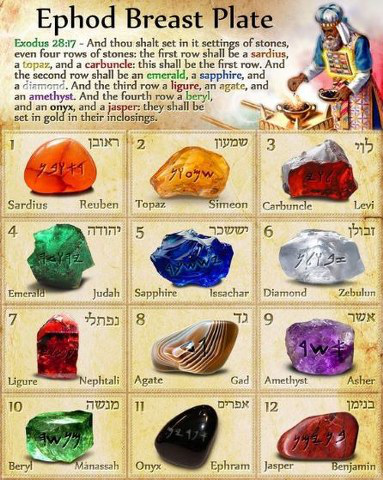
Exodus 39:8 – 21 “He also made the breastpiece with the same workmanship as the ephod, with gold, with blue, purple, and scarlet yarn, and with finely spun linen. It was square when folded over double, a span long and a span wide. (The breastpiece, when folded over, was approximately 9 inches or 22.86 centimeters in both length and width.)

And they mounted on it four rows of gemstones:

The first row had a sardius, a topaz, and an emerald; the second row had a turquoise, a sapphire, and a diamond; the third row had a jacinth, an agate, and an amethyst;

and the fourth row had a beryl, an onyx, and a jasper. These stones were mounted in gold filigree settings. The twelve stones corresponded to the names of the sons of Israel. Each stone was engraved like a seal with the name of one of the twelve tribes.

For the breastpiece they made braided chains like cords of pure gold. They also made two gold filigree settings and two gold rings, and fastened the two rings to the two corners of the breastpiece. Then they fastened the two gold chains to the two gold rings at the corners of the breastpiece, and they fastened the other ends of the two chains to the two filigree settings, attaching them to the shoulder pieces of the ephod at the front. They made two more gold rings and attached them to the other two corners of the breastpiece, on the inside edge next to the ephod. They made two additional gold rings and attached them to the bottom of the two shoulder pieces of the ephod, on its front, near the seam just above its woven waistband. Then they tied the rings of the breastpiece to the rings of the ephod with a cord of blue yarn, so that the breastpiece was above the waistband of the ephod and would not swing out from the ephod, just as the LORD had commanded Moses.”

Yesterday we discussed the creation of the woven ephod with its engraved onyx stones on the shoulder pieces. Today we consider the breast piece. Understanding the design of the breast plate is not difficult; however, the actual identity of the stones that were used is in considerable doubt. If you compare the verses as recorded above with the illustration, you rapidly realize that they don’t match. But as it turns out, these few verses have generated enormous amounts of disagreement over the years. Some of the stones are mentioned by modern names. It’s possible that some of the stones that were used have no modern equivalent or are unknown in the modern world. The order in which the tribes of Israel has been a subject of intense argument.

While the identity of the stones is a matter of dissension, the principle remains: God wanted the high priest to bear the names of each of the twelve tribes into the holy of holies, both on his shoulders as well as on his breast plate. And the breast plate was to be attached in such a way that it would move with the high priest and not swing around.

APPLICATION: What is the significance of a breast plate? Breast plates protect the heart, lungs, and bone marrow in the breast bone. If your heart and lungs fail or if your body stops making blood cells, you die. At the same time, wearing a breast plate close to your heart indicates concern for the people represented by that garment. The stones in the breast plate represented the twelve tribes of Israel. God wanted to make sure that when the high priest entered the holy of holies, he would have all of Israel close to his heart, so that he could represent them and also pray for them.

What does an ancient priest’s garment have to do with us today? Those of us who are believers have been called to be intercessors and pray for others. Oswald Chambers tells us that intercession is the only ministry with no drawbacks. Although we may not wear a garment carrying the names of those for whom we are praying, each time we pray for someone, it is as if we are carrying people into the presence of God. Some people post photos of those for whom they are praying on a wall or on a web site. Others simply keep lists. Some people belong to online prayer groups where needs are posted.

“But I don’t know how to pray!” you cry. No problem! God knows all languages, including the language of the heart. Sometimes the most eloquent prayers are not those we speak out but those that spring from our passion. However you pray, be assured that your Heavenly Father is listening. And just as the high priest carried the names of the tribes of Israel into God’s presence, so God already has written your name in His heart. Go to Him in prayer!

PRAYER: Father God, thank You for your Word! Thank You that You want to meet us in prayer. Help us to come to You bearing those around us on our hearts. Thank You that You not only hear but also answer. In the mighty Name of King Jesus.

JULY 27, 2021 MERCY 149: BEARING NAMES INTO THE PRESENCE OF GOD

July 27, 2021

Exodus 39:1 – 7 “From the blue, purple, and scarlet yarn they made specially woven garments for ministry in the sanctuary, as well as the holy garments for Aaron, just as the LORD had commanded Moses. He made the ephod of finely spun linen embroidered with gold, and with blue, purple, and scarlet yarn. They hammered out thin sheets of gold and cut threads from them to interweave with the blue, purple, and scarlet yarn, and fine linen—the work of a skilled craftsman. They made shoulder pieces for the ephod, which were attached at two of its corners, so it could be fastened. And the skillfully woven waistband of the ephod was of one piece with the ephod, of the same workmanship—with gold, with blue, purple, and scarlet yarn, and with finely spun linen, just as the LORD had commanded Moses.

They mounted the onyx stones in gold filigree settings, engraved like a seal with the names of the sons of Israel. Then they fastened them on the shoulder pieces of the ephod as memorial stones for the sons of Israel, as the LORD had commanded Moses.”

God has already given Moses the instructions, but now Bezalel and Oholiab are creating one of the most important parts of the high priest’s garments, the breast plate. Although we might think that these stones were set in a flat inflexible plate of gold with settings for the stones, this garment was more cleverly designed than that.

The first part of the ephod or breast plate was created using finely spun linen embroidered with gold and with blue, purple, and scarlet yarn. The color blue represented heaven, while purple was the color of royalty, and red was the color of the blood of the sacrifices, particularly the lambs sacrificed at Passover. Gold also represented the royalty of God and His eternal nature. The gold threads were cut from thinly hammered sheets of gold. To hold the ephod in place, there were shoulder pieces as well as a waist band. These attachments allowed the ephod to move as the priest moved. The priest would pull this garment over his head and then tie the waist band.

Once this heavily embroidered linen material was created, gold filigree settings were created and attached to the material. Then twelve onyx stones representing the twelve tribes of Israel were mounted in these settings. When completed, the ephod proved to be a highly durable and flexible garment that would last for centuries.

APPLICATION: When we first came to Ghana, one set of friends were a wonderful Christian Lebanese couple who ran a fantastic goldsmith’s business. A visit to this place of delights immediately demonstrated why craftsmen from the Middle East have been renowned for their ability to handle delicate filaments of gold and silver for thousands of years. Reading the description of the ephod reminds me of those visits.

 When reading the account of the high priest’s garments, there are two different places where engraved stones representing the tribes of Israel are located. The first part of the garment was an ephod, a garment that was pulled over the priest’s head and tied with a waist band. Engraved stones representing the twelve tribes of Israel were mounted on each of the shoulder pieces. We will consider the actual breast plate tomorrow.

What is the significance of the stones mounted on the shoulder pieces? Throughout the Bible, there are references to God bearing Israel on His shoulders. In Isaiah 9:6, we read of the Messiah that “the government will be upon his shoulders.” For the high priest, the weight of those shoulder pieces would serve as a reminder of his responsibility for those whom he was representing.

Do you feel as if God has abandoned you? Do you feel your situation is hopeless? Take heart! Just as the high priest would bear the names of the tribes of Israel before the Lord, so God is carrying you on His shoulders. Turn to God and allow Him to speak to your heart. Take courage! You are very precious to God!

PRAYER: Father God, there are many of us who have been betrayed by their earthly fathers and who feel there is nobody to support them. Please help all who read this devotional to know that You love them, that You care for them, and that You will never leave them or forsake them. In the matchless Name of King Jesus. Amen.

JULY 26, 2021 MERCY 148: THE BEAN COUNTERS HELP WRITE THE BIBLE!

July 26, 2021
  ANCIENT EGYPTIAN ACCOUNTANT

JULY 26, 2021 MERCY 148: THE BEAN COUNTERS HELP WRITE THE BIBLE!

Exodus 38:21 – 31 “This is the inventory for the tabernacle, the tabernacle of the Testimony, as recorded at Moses’ command by the Levites under the direction of Ithamar son of Aaron the priest. Bezalel son of Uri, the son of Hur, of the tribe of Judah, made everything that the LORD had commanded Moses. With him was Oholiab son of Ahisamach, of the tribe of Dan, an engraver, designer, and embroiderer in blue, purple, and scarlet yarn and fine linen.

All the gold from the wave offering used for the work on the sanctuary totaled 29 talents and 730 shekels, according to the sanctuary shekel. (The total weight of the gold was approximately 1.1 tons or 2200 lb./1000 kg.)

The silver from those numbered among the congregation totaled 100 talents and 1,775 shekels, according to the sanctuary shekel— a beka per person, that is, half a shekel,i according to the sanctuary shekel, from everyone twenty years of age or older who had crossed over to be numbered, a total of 603,550 men. (A beka is half a shekel, or approximately 0.2 ounce or 5.7 grams.)

The hundred talents of silver were used to cast the bases of the sanctuary and the bases of the curtain—100 bases from the 100 talents, one talent per base. (100 talents is approximately 3.77 tons or 3.42 metric tons of silver (7,540 lb./4,420 kg.)

With the 1,775 shekels of silver, he made the hooks for the posts, overlaid their tops, and supplied bands for them. (1,775 shekels is approximately 44.6 pounds or 20.2 kilograms of silver.)

The bronze from the wave offering totaled 70 talents and 2,400 shekels. He used it to make the bases for the entrance to the Tent of Meeting, the bronze altar and its bronze grating, all the utensils for the altar, the bases for the surrounding courtyard and the gate of the courtyard, and all the tent pegs for the tabernacle and the surrounding courtyard. (The total weight of the bronze was approximately 2.67 tons or 2.42 metric tons, 5,340 lb./2,420 kg.)

When we read the account of the Exodus in the Bible, the description of the Egyptians forcing their most cherished treasures on the Israelites doesn’t make much of an impression…. until you start reading the eye – popping amounts of gold, silver, and bronze that were used in the construction of the Tabernacle. Then there were also the huge amounts of fine linen and specially dyed yarns. Really, those Israelites practically STAGGERED out of Egypt, loaded down by all the jewelry, material, etc., their Egyptian neighbors had given them!

Just as remarkable as the huge amounts of treasure available is the detailed record keeping involved in these accounts. Reading this list, you realize that the ancient bean counters kept track of everything down to the last beka! (A beka is half a shekel, or approximately 0.2 ounce or 5.7 grams.)

Who were these ancient accountants who kept such accurate records? For the answer, we need to return to ancient Egypt again. When the Egyptians were selecting slave labor, it’s entirely possible that they may have trained a whole group of accountants. The Egyptians were dedicated record keepers as indicated by the scene from an Egyptian monument. Once the Israelites were traveling, these trained accountants were ready to practice their skills.

APPLICATION: Considering the accountants of the construction of the Tabernacle, it’s very easy to get mired down in the statistics and fail to realize the miracles hidden in these accounts. Consider the following:

1. God moved the Egyptians to donate everything that would later be required to construct the Tabernacle.

2. God protected those donated items so that they remained available when they were needed.

3. Not only did God equip Bazalel and Oholiab with skills, but He also equipped many other men and women who did much of the grunt work to create the Tabernacle furnishings.

4. When record keeping became necessary, God had trained accountants ready and waiting to exercise their skills. (One wonders which language they used to keep their records.)

We have a friend who is an accountants’ accountant. Those called to be accountants have a divinely – given need to make sure that columns of numbers add up, that statistics are accurately generated and reported, and that all accounts balance completely. For those with such gifts, reports that are clear, understandable, honest and correct are soul – satisfying.

Sometimes we wonder if God knows our names or even cares about us. We plod through our daily work, feeling that we are occupying endless ruts. But God views us differently. God gives different gifts and does not use a cookie cutter to create people. Each of us is completely unique and each of us has talents that God has built into us.

While Moses gets much of the attention in these passages, never overlook the little people! In God’s sight, the little people are just as important as the iconic leaders.

What gifts has God given you? Perhaps you are a hard worker or a compassionate care giver or a gifted artist. No matter what you think of yourself, remember that God has loved you so much that He has created you to delight in Him.

PRAYER: Father God, thank You that You have created people with diverse gifts and talents. Help us to see ourselves as You do, as people created for You to love. And help everyone who reads this devotional to accept Your gift of salvation in Jesus Christ. In the matchless Name of King Jesus. Amen.

JULY 25, 2021 MERCY 147: WHY USE RICH MEN’S CLOTH FOR A FENCE???

July 25, 2021

Exodus 38: – 20 “Then he constructed the courtyard. The south side of the courtyard was a hundred cubits long and had curtains of finely spun linen, with twenty posts and twenty bronze bases, and with silver hooks and bands on the posts. The north side was also a hundred cubits long, with twenty posts and twenty bronze bases. The hooks and bands of the posts were silver. The west side was fifty cubits long and had curtains, with ten posts and ten bases. The hooks and bands of the posts were silver. And the east side, toward the sunrise, was also fifty cubits long. (The courtyard was 150 feet long by 75 feet wide.)

The curtains of the one side of the entrance were fifteen cubits long, with three posts and three bases. (15 cubits is approximately 22.5 feet or 6.9 meters.)And the curtains for the other side were also fifteen cubits long, with three posts and three bases as well. All the curtains around the courtyard were made of finely spun linen. The bases for the posts were bronze, the hooks and bands were silver, and the plating for the tops of the posts was silver. So all the posts of the courtyard were banded with silver.

The curtain for the entrance to the courtyard was embroidered with blue, purple, and scarlet yarn, and finely spun linen. It was twenty cubits long and, like the curtains of the courtyard, five cubits high, with four posts and four bronze bases. Their hooks were silver, as well as the bands and the plating of their tops. All the tent pegs for the tabernacle and for the surrounding courtyard were bronze.”

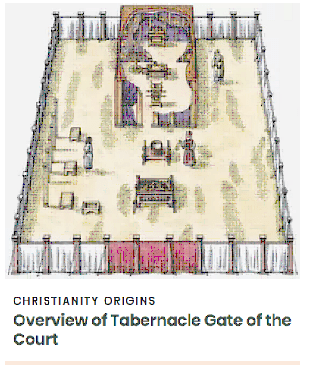
Reading these descriptions for the first time, you might be excused if you get lost in the details. Basically, the Tabernacle courtyard was 75 feet wide by 150 feet long, The courtyard was enclosed with curtains of fine linen 7.5 feet wide, supported by acacia wood posts. The bases of the posts were bronze, the plating of the tops of the posts was done in silver, and the hooks for holding the guy wires were silver. The tent pegs holding the guy wires in place were bronze.

The reasons for a courtyard fence are many and obvious:

1. Keep out stray livestock 2. Keep out the curious who merely wanted to observe the religious rituals. 3. Emphasize the fact that this was God’s Tabernacle and access was to be restricted to those men presenting sacrifices and to the priests..

Why use linen and where did the linen come from in the first place? While linen was strong, it was also costly. Why not just whip up some goat hair curtains and call it quits? Of course, goat hair would be far darker, but it might resist animals better.

Linen was the cloth worn by Egyptian nobles and rich people. Made from the flax plant, linen production took lots of time and effort. The best linen was so fine that it could pass through a signet ring. It is possible that this linen was part of the spoils collected by the Israelites on their way out of Egypt. At its best, linen was a glistening white material. At a distance, the Tabernacle courtyard fence with its linen curtains and silver inlays on the posts must have been an awe – inspiring sight. Why use such costly materials? God wanted the Israelites to know that He really was the One True Living God and that His worship was no joke! Think about it; even at night, those courtyard walls would have gleamed as a reminder that God was still with His people.

APPLICATION: Jack Zavada points out the fact that the gleaming white walls of the courtyard would have illustrated the righteousness of God, while the dust and dirt surrounding the courtyard would have represented the filthiness of our sins when we try to live without Jesus Christ. (Zavada, Jack. “Courtyard Fence of the Tabernacle.” Learn Religions, Feb. 8, 2021, learnreligions.com/courtyard-fence-of-the-tabernacle-700102

For me, this passage raises all kinds of questions:

How did the Israelites keep that linen clean? Did they have a big enough stock of the linen that if some of the curtains became dirty or stained, those curtains could be exchanged for new ones? What if a passing dog or even a passing ox or camel chose to urinate on the curtains? Perhaps those serving ladies had to quickly mobilize and do spot cleaning. Did the Israelites employ young boys to keep track of their livestock so that nothing strayed too close to the Tabernacle courtyard? (As I am writing this, I can hear somebody’s cows making noises as they trample past our house. We deal with animal problems all the time.)

Silver is a relatively soft metal. Why use silver to plate the tops of the posts and to make the hooks for the guy wires? Again, if you were simply going for durability, bronze would seem to have been a better choice.

Many years ago, I was in a high school physics class with a wonderful teacher. Whenever a student asked a question for which our teacher had no answer, he simply replied, “Because God wants it that way.” The only appropriate answer to the questions I have raised is “Because God wants it that way.” God did NOT want an ugly dark brown enclosure; He wanted a gleaming courtyard that would inspire the Israelites to worship even before they reached the Tabernacle. God was NOT interested in economy or cutting corners on this job! Really, God was watching when each of those Egyptians hauled their most precious items out and pressed them on the Israelites. God had a complete inventory of the materials available when it was time to construct the Tabernacle.

Is there a place for “plain Jane” worship centers with utilitarian architecture? Of course. If God shows up during worship, the architecture doesn’t matter and if God does not show up, no amount of fancy buildings or furnishings will substitute for the presence of the Holy Spirit. But God was establishing an entire religion; many of the Egyptian temples were dark and mysterious. God wanted the courtyard of His Tabernacle to be open to His glorious light and to reflect that light.

With the revival of the Star Wars movies, the phrase “the dark side” has come back into use. Sadly, there is a dark side. There is no such thing as spiritual neutrality; you are either serving God or Satan. And if you are not serving God, by default, you ARE serving Satan. In Joshua 24:15, Joshua challenged the Israelites to choose which god they were going to serve. But Joshua firmly stated that he and his household would serve the Lord.

PRAYER: Father God, help! We want to serve You but sometimes we don’t know how. Let everyone who reads this devotional stop and ask you to show them Your perfect Will for their lives. In the matchless Name of King Jesus. Amen.

JULY 24, 2021 MERCY 146: WHEN GOD ASKS YOU TO GIVE YOUR DEAREST TREASURE, WILL YOU DO IT?

July 24, 2021

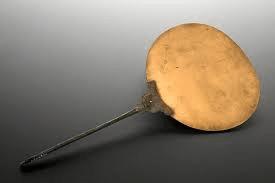
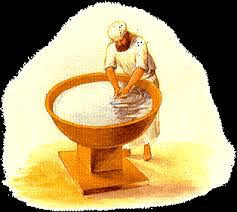
Exodus 38:8 “Next, he made the bronze basin and its stand from the mirrors of the women who served at the entrance to the Tent of Meeting.”

In this age of plenty, it’s difficult to realize that mirrors were once highly prized objects that only belonged to rich women. The picture at the top is of an actual ancient Egyptian hand mirror very similar to the kind that were used to make the bronze basin and stand. But where did these mirrors come from in the first place?

When the Israelites were leaving Egypt, the Egyptians were in a panic and were literally forcing their prized possessions on the Israelites. “Here, take my jewelry! Take my best linens! Take my hand mirrors! Take anything you want, but just take it and LEAVE!!!

Up to this point, those Israelite ladies might never have had hand mirrors. After all, such things were for upper class Egyptian ladies with lots of maid servants, not for Israelite slave women! It’s quite likely that these mirrors became one of the choicest possessions of the lucky Israelite women.

Who were these women who served at the entrance to the Tent of Meeting? There have been all kinds of speculations given by various scholars. Perhaps these women were from the priestly families or were merely others who were spiritually sensitive and who hungered to be in God’s presence. Someone has suggested that these women might have been intercessors, praying with those who were coming. Perhaps these women served in a secretarial role, coordinating those who were bringing sacrifices, making sure nobody was overlooked, keeping things running smoothly. Perhaps these women also made sure that the area around the Tent of meeting was freshly swept each morning so that those coming to the Tent would not encounter leaves, sticks, etc., up against the entrance. Someone had to take the soiled linen garments discarded by the priests and turn them into wicks for the great lampstand in the Holy Place. And who would bring the water that would be used for sacramental washing of hands and feet? Certainly, in that culture the women were the ones who fetched water. These ladies were busy, busy, busy!

APPLICATION: As we grow older, many of us have come to realize that our dearest treasures are not the big showy possessions, but the small ones that mean the most. Once these ladies gave up their mirrors, it was an irrevocable decision; they were in the midst of a wilderness without any chance to replace them. Did these ladies ever have regrets when they went throughout the rest of the camp and saw other women admiring themselves in Egyptian mirrors?

Were the ladies forced to donate their mirrors or did they do so willingly? Working as these women did so close to the Tent of Meeting, they were probably under the influence of the Holy Spirit. I strongly believe that these women met among themselves and then came as a group to Moses with their mirrors.

We know very little about these women. All that we know is that these women were willing to serve and willing to sacrifice something precious when called on to do so. The question for us from this brief passage is this: is God asking you to give up something precious?

In Luke 12:32-34, Jesus told His disciples, “Do not be afraid, little flock, for your Father is pleased to give you the kingdom. Sell your possessions and give to the poor. Provide yourselves with purses that will not wear out, an inexhaustible treasure in heaven, where no thief approaches and no moth destroys. For where your treasure is, there your heart will be also.

We have spent most of the last 33 years on the mission field in Ghana. We have always served with faith missions, depending on donations. During that time, we have sometimes had very little money but have never lacked anything. God has allowed us to educate many students and to continue to help the hospital where we work. What have we given up? Does a list matter? The important thing is that we have tried to remain as stewards of whatever God has given us and channels of His grace to those around us. Are we concerned about providing for our old age? Well, God has gotten us this far, and we trust that God will not drop us.

Nobody knows the names of those ladies who gave up their mirrors… but God knows. Nothing you give up for God will ever be wasted.

PRAYER: Father God, thank you for the example of these women who gave their treasures freely. Help us to hold whatever you give us with open hands, ready to pass it on to the next person when you tell us to do so. In the matchless Name of King Jesus. Amen.

JULY 23, 2021 MERCY 145: HOW DO YOU MAKE A PORTABLE ALTAR WHEN YOU’VE NEVER SEEN ONE BEFORE?

July 23, 2021

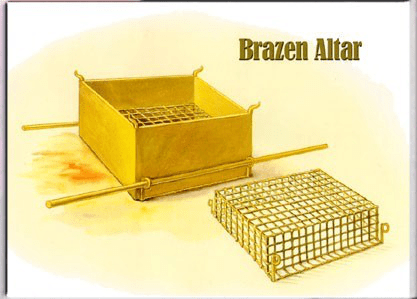
Exodus 38:1 – 7 “He constructed the altar of burnt offering from acacia wood. It was square, five cubits long, five cubits wide, and three cubits high. The altar was approximately 7.5 feet in length and width, and 4.5 feet high (2.3 meters in length and width, and 1.4 meters high) He made a horn at each of its four corners, so that the horns and altar were of one piece, and he overlaid the altar with bronze. He made all the altar’s utensils of bronze—its pots, shovels, sprinkling bowls, meat forks, and firepans. He made a grate of bronze mesh for the altar under its ledge, halfway up from the bottom. At the four corners of the bronze grate he cast four rings as holders for the poles. And he made the poles of acacia wood and overlaid them with bronze. Then he inserted the poles into the rings on the sides of the altar for carrying it. He made the altar with boards so that it was hollow.”

One of the most amazing things about the Tabernacle is the fact that these people had never seen most of the equipment God ordered them to construct. What did the altars in Egyptian temples look like? The answers come from the Global Egyptian Museum web site: http://www.globalegyptianmuseum.org/glossary.aspx?id=50

“There were two types of altar in Egyptian temples:

Small, portable stands on which different tops could be placed, depending on the kind of offering: a flat table top for food, flowers, etc., a bowl for libations, and a dish for burning incense. These altars were probably stored in the temple magazines and could be placed wherever they were needed.

Stone altars, sometimes very large. They were usually not much more than enlarged offering tables. Some altars of this type are made from one piece of stone, others are constructed of smaller stones. The larger altars often had a small stair or slope on the western side, so that the priest climbing the altar to make an offering was facing east. Not very many of these stone altars have been found. They are mainly known from sun temples, where offerings to the sun were made directly under the open sky.”

Reading these descriptions, one realizes that nothing in Egyptian religious practice had prepared the Israelite craftsmen for the task facing them. And God wanted to make sure that everything was done according to His plans. The Tabernacle and all its furnishings with all its tools was going to travel for forty years; God wanted to make sure every thing would hold up properly. Some people feel that the Altar of Sacrifice was situated on two large mounds of earth with a ramp of earth and stones leading up to the altar. This would have allowed a space underneath so that wood could be placed inside to help burn the sacrifices while ashes could also be removed. Some people feel that there might have been earth inside the altar below the grate. The most important aspect of the ramp and the earth would have been the fact that the stones were not chiseled and the earth was obtained from the site where the Tabernacle was set up.

APPLICATION: “Look at that dog’s head on that post!” It was several years ago, and my husband and I were returning from buying supplies for our hospital in rural northern Ghana. Passing a near – by village, we were shocked to see the freshly severed head of a dog placed on a post. Our friends later informed us that this grisly sight was an offering to the traditional gods of our area to help a notable hunter succeed in the hunt. The dog who died was the man’s best hunting dog. This poor man might have been misguided; however, he understood the need to make the best offering he could.

Throughout the Old Testament, God makes the matter of acceptable offerings quite clear. Any animal for sacrifice was to be perfect without any blemishes whatsoever. At a time of moral dissolution, the prophet Malachi takes the Jews to task, “A son honors his father, and a servant his master. But if I am a father, where is My honor? And if I am a master, where is your fear of Me?” says the LORD of Hosts to you priests who despise My name. “But you ask, ‘How have we despised Your name?’ By presenting defiled food on My altar. But you ask, ‘How have we defiled You?’ By saying that the table of the LORD is contemptible.” “When you offer blind animals for sacrifice, is it not wrong? And when you present the lame and sick ones, is it not wrong? Why not offer them to your governor! Would he be pleased with you or show you favor?” asks the LORD of Hosts.” (Malachi 1:6-8)

These days, the concept of sacrifice has gone out of fashion; in fact, there are many Christians in industrialized countries who choose to believe that Jesus has already made the ultimate Sacrifice, so there is no need for them to do anything. But this belief has no basis in Scripture. A Bible teacher in an earlier generation was fond of saying that “it isn’t a sacrifice until you don’t feel like it.” That same wise man also advised his students that “Many sacrifices of praise have to be pushed out between clenched teeth.” The Bible speaks of the sacrifices of praise, of the sacrifices of time and talents, and the sacrifice of obedience. For most of us, obedience is the most difficult sacrifice to make.

Many Christians in other countries already know the meaning of sacrifice. Some entire churches have paid with their lives at the hands of terrorists rather than abandon the Gospel.

James Russell Lowell was an American poet, art critic, magazine editor, professor, and statesman of the nineteenth century. An ardent abolitionist, Lowell spoke out strongly against slavery and its evils. Lowell wrote this poem which was later turned into a hymn:

1 Once to every man and nation 
Comes the moment to decide, 
In the strife of truth with falsehood, 
For the good or evil side; 
Some great cause, God’s new Messiah, 
Offering each the bloom or blight, 
And the choice goes by forever 
Twixt that darkness and that light. 

2 Then to side with truth is noble, 
When we share her wretched crust, 
Ere her cause bring fame and profit, 
And ’tis prosperous to be just; 
Then it is the brave man chooses 
While the coward stands aside, 
Till the multitude make virtue 
Of the faith they had denied. 

3 By the light of burning martyrs, 
Christ, Thy bleeding feet we track, 
Toiling up new Calvaries ever 
With the cross that turns not back; 
New occasions teach new duties, 
Time makes ancient good uncouth;
They must upward still and onward, 
Who would keep abreast of truth. 

4 Though the cause of evil prosper, 
Yet ’tis truth alone is strong; 
Though her portion be the scaffold, 
And upon the throne be wrong: 
Yet that scaffold sways the future, 
And, behind the dim unknown, 
Standeth God within the shadow, 
Keeping watch above His own.

PRAYER: Father God, help us to follow you, no matter how much the sacrifices might cost us! In the mighty and precious Name of King Jesus. Amen.
JULY 22, 2021 MERCY 144: INCENSE AND PEPPERMINTS…. OR SOMETHING MORE?

July 22, 2021

Exodus 37:25 – 29 “He made the altar of incense out of acacia wood. It was square, a cubit long, a cubit wide, and two cubits high. (The altar was approximately 1.5 feet in length and width, and 3 feet high (45.7 centimeters in length and width, and 91.4 centimeters high) Its horns were of one piece. And he overlaid with pure gold the top and all the sides and horns. Then he made a molding of gold around it. He made two gold rings below the molding on opposite sides to hold the poles used to carry it. And he made the poles of acacia wood and overlaid them with gold. He also made the sacred anointing oil and the pure, fragrant incense, the work of a perfumer.

The altar of incense was to stand very close to the thick curtain that separated the holy place from the holy of holies. Aaron was instructed to burn incense on the altar each morning and at twilight, every day, as a regular offering to the Lord (Exodus 30:7–8). God gave the recipe for making the incense and stipulated that no other incense ever be burned on the altar (verses 34–38). The fire used to burn the incense was always taken from the altar of burnt offering outside the sanctuary (Leviticus 16:12). Never was the altar of incense to be used for a burnt offering, a grain offering, or a drink offering (Exodus 30:9). Once a year, on the Day of Atonement, the high priest was to put blood on the horns of the altar of incense to cleanse it. The altar of incense was called “most holy to the Lord”. (Information from What was the significance of the altar of incense? | GotQuestions.org)

APPLICATION:

“Incense, peppermints
Incense, peppermints”

Who cares what games we choose
Little to win, but nothing to lose

The year was 1967, and this refrain from a popular song was one of the anthems of disgruntled youth. Why were we disgruntled? We were young and afraid. The Vietnam War was heating up, and many of us were being jerked out of our daily lives, handed guns, and dumped in Southeast Asian rice paddies. Why the mention of incense and peppermints together? Perhaps it was because of the rhyme, but it might also have been because people who were smoking pot would burn incense to cover the smell and suck on peppermints afterwards to sweeten their breath. Many of us danced to this tune and felt B*A*A*D!!! but really, we were only S*A*A*D!!!! (P.S. I learned that I was actually allergic to the scent of marijuana; I never smoked the stuff. It was my neighbors down the dormitory corridor who were burning the incense!)

While many of us have had little exposure to the use of incense, incense actually has a long and honorable history. Throughout the Bible, incense is associated with worship and with prayer. King David said in Psalm 141:2 “May my prayer be set before You like incense, my uplifted hands like the evening offering.” The idea was that our prayers would give God just as much pleasure as would the scent of the incense specially compounded for use only on the altar of incense.

Why were Aaron and the other priests commanded to burn incense twice a day? There is a great deal of value in repetition of worship. While many people feel that worship should always be spontaneous, a framework is still a good idea. Throughout our lives we have worshiped in churches with set forms of worship and churches that claim not to have any form. But even those churches claiming to eschew set forms of worship continue to follow some kind of pattern.

When God spoke the world into existence, He spoke it out of chaos, not into chaos. Seasons change, the earth revolves around the sun, and plants and animals grow, produce, and live according to internal time clocks. There is nothing wrong with order so long as it does not become a stranglehold to free will.

We all need sacred spaces in our lives, times and places where we can be alone with God. Your sacred space might be your office or your recliner or even just a corner of one room. Perhaps you live in such crowded conditions that you must copy Susanna Wesley. Susanna was not only the mother of Charles and John Wesley, but also of seventeen more children. (Yes, she had 19 kids in a small house!) Susanna retreated to be with God by sitting and throwing her long apron over her head, covering her face. The children knew that when their mother had her head covered, she was speaking with God and they should leave her alone.

Does God value your prayers? Oh yes! A thousand times yes! “But,” you say, ” I can’t pray long eloquent prayers.” No worries! God loves plain language and hates phonies. One Christian comedian described his frantic attempts to appear holy just after he got saved. This young man adapted as many mannerisms of the popular evangelists of that time as he could. The results were so ridiculous that God told him to stop, that He did not call this man to be an imitation Billy Graham. (Mr. Graham himself never forgot that he was the son of a dairy farmer from rural North Carolina. Graham never tried to be anything apart from what he was: a sinner saved by grace.)

Find a quiet place and then ask God to join you. In the stillness you will feel His pleasure.

PRAYER: Father God, thank You for loving us so much that you honor our prayers, even the short stammering ones. Thank You that You have promised to be with us forever. Help us to offer sincere prayers from the depths of our hearts, knowing that You will hear and respond. In the matchless Name of King Jesus. Amen.