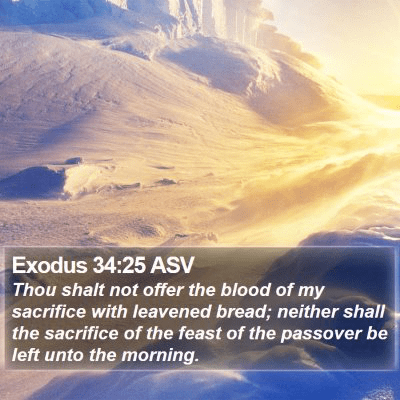
Exodus 34:25 “Do not offer the blood of a sacrifice to Me along with anything leavened, and do not let any of the sacrifice from the Passover Feast remain until morning.”
Reading Exodus for the first time, you might wonder, “What’s the big problem with leaven? Why is God so obsessed with leaven and why does He keep making such a point about avoiding it?” Leaven is also known as yeast, and yeast is used in fermentation, a process invented by the Egyptians. The Israelites left Canaan and moved to Egypt to escape a terrible famine. Joseph was able to secure some of the best land for his family, so the Israelites remained in Egypt for 400 years. But the Israelites had no strong worship practices and only a vague memory of the God of Abraham, Isaac, and Jacob. 400 years is plenty long enough for the Israelites to adapt all kinds of religious practices, many of them horrible.
The Egyptians had a culture that was obsessed with death and the after life. Those who died were mummified in an involved process, and the higher the social status of the deceased, the more involved the process was. God repeatedly uses leaven as a symbol of the Egyptian culture to encourage the Israelites to completely repudiate those religious practices that they have learned in Egypt. God demands purity without compromise.
God has instituted the blood sacrifices made at Passover and at other times. But the Egyptian religions have strongly emphasized making sacrifices of food to gods and even placing food in tombs so that the dead would be nourished in the afterlife. Knowing how strongly the Israelites have been influenced by the culture they have just left, God wants there to be no mingling of religious rituals.
Why blood offerings? Blood is necessary to make atonement for sin. The Egyptians had no such concept. The Egyptians had a strong sense of right and wrong; however, they seemed to feel that if they could convince the gods of their innocence, everything would be fine. Siegfried H. Horn, Ph.D., is dean and professor of archeology and history of antiquity, emeritus, Andrews University Theological Seminary, Berrien Springs, Michigan. According to Dr. Horn, “the Egyptians were so sure that they could convince the gods of their innocence that they had a whole list of statements written in the ancient Egyptian Book of the Dead, a document that describes the experiences that the deceased would have upon reaching the underworld. It also contains the formulas to use in facing one’s judges upon entering the underworld. The following are examples:
“I have not blasphemed a god.
“I have not done violence to a poor man.
“I have not done that which the gods abominate.
“I have not killed.
“I have neither increased nor diminished the grain-measure.
“I have not added to the weight of the balance.
“I have not committed evil.
“I have not stolen.
“I have not been covetous.
“I have not told lies.
“I have not committed adultery.” (Dr. Siegfried H. Horn, “Sin and Judgement among the ancient Babylonians and Egyptians, Ministry Magazine)
Notice that the Egyptians evidently felt that the gods could be fooled as long as the deceased could tell a convincing enough story! But there was a problem with the Egyptian belief system: sin. The Egyptians were depending on their own efforts to be good enough to cancel their own sin, a total impossibility!
APPLICATION: In the Old West there was a saying that a self – made man had “pulled himself up by his own bootstraps;” in other words, that he had succeeded without any outside assistance. But when it comes to our dealing with our own sin, we are all in trouble! Nothing any of us can do is good enough to make up for even one tiny sin such as telling a white lie, let alone all the other wrong things we do throughout our lives.
The reason God instituted regular blood sacrifices was to emphasize that only the shedding of blood can bring forgiveness for sin. But how can the blood of a lesser creature such as a lamb or a bull pay for the sins of even one human? Only the blood of a perfect sinless man who willingly gives up his life will pay the price for human sin. And that is what Jesus Christ, the Son of God, did when he died for the sins of all of us on the cross at Calvary. 1 John 1:8 – 9 tells us, “If we say we have no sin, we deceive ourselves and the truth is not in us. If we confess our sins, He (God) is faithful and just to forgive us our sins and to cleanse us from all unrighteousness.”
The One True Living God is all – knowing and all – seeing. You can’t fool God; He knows you better than you know yourself. Why not let God be the Ruler and Guide for your life? What do you have to lose?
PRAYER: Father God, help everyone who reads this devotional to seriously consider Your claims on their lives. Help them to realize how much You love them and how much You care about them. And help them to realize how much better their lives are when they follow You, their Creator. In the matchless Name of King Jesus. Amen.
 Burunche's Blog
Leave a comment