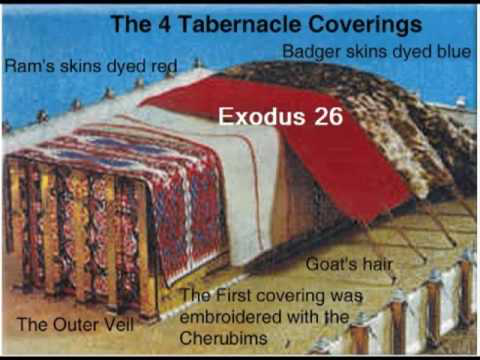
The Ten Curtains for the Tabernacle
Exodus 36:8 – 13 “All the skilled craftsmen among the workmen made the ten curtains for the tabernacle. They were made of finely spun linen, as well as blue, purple, and scarlet yarn, with cherubim skillfully worked into them. Each curtain was twenty-eight cubits long and four cubits wide; all the curtains were the same size. And he joined five of the curtains together, and the other five he joined as well. (Each of the ten curtains was approximately 42 feet long and 6 feet wide (12.8 meters long and 1.8 meters wide) He made loops of blue material on the edge of the end curtain in the first set, and also on the end curtain in the second set. He made fifty loops on one curtain and fifty loops on the end curtain of the second set, so that the loops lined up opposite one another. He also made fifty gold clasps to join the curtains together, so that the tabernacle was a unit.
The Eleven Curtains of Goat Hair
v.14 – 19 “He then made curtains of goat hair for the tent over the tabernacle—eleven curtains in all. Each of the eleven curtains was the same size—thirty cubits long and four cubits wide. (Each of the eleven curtains was approximately 45 feet long and 6 feet wide (13.7 meters long and 1.8 meters wide). He joined five of the curtains into one set and the other six into another. He made fifty loops along the edge of the end curtain in the first set, and fifty loops along the edge of the corresponding curtain in the second set. He also made fifty bronze clasps to join the tent together as a unit. Additionally, he made for the tent a covering of ram skins dyed red, and over that a covering of fine leather.”
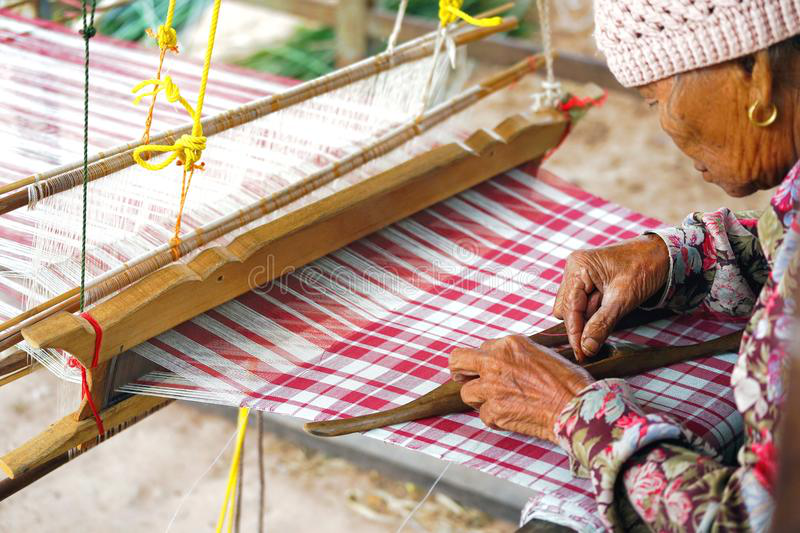
Reading this list of materials can get pretty tedious! But stop and think for a moment! Here in Ghana, traditional weavers generally weave cloth in 4 inch wide strips. There are some looms that will allow the weaver to weave strips up to 15 inches wide, but that’s generally the upper limit. Now we have a description of curtains that are 6 feet wide and 42 feet long! There is no indication that these curtains were woven in strips, so someone must have set up a large loom that would create a six foot wide strip. That would mean that there would be assistants on each side of the loom passing shuttles while the master weaver would have to make sure that the material was tightly woven and that the patterns of cherubim were incorporated into the inner curtains. Other assistants would have to help collect the cloth once it had been woven. Just creating these curtains would have been a gargantuan task! The tents that the Israelites were using were probably a great deal smaller than the tabernacle. My guess is once that Bezalel looked at Oholiab and Oholiab looked at Bezalel, and the two of them shrugged their shoulders and said, “Okay! All we can do is to try!”
APPLICATION: Have you ever found yourself in a position in which it was either sink or swim and you felt that you still needed flotation devices? That’s how we felt in January 1993. I am a general and pediatric surgeon. Prior to coming to Saboba, Northern Region, I had always worked in well – equipped American hospitals where somebody else worried about ordering supplies, instruments, etc. All I had to do was to be a doctor. Hah!
Once we landed in Saboba, I suddenly found myself having to be a doctor, a store keeper, an administrator, a laboratory technician, and all kinds of other stuff in between. Fortunately, I had worked in hospital labs in the past; however, nothing had prepared me for working in a small clinic with no electricity, no running water, and no anesthetist. I had to learn to do operations under local anesthesia with ketamine for general anesthesia. I had to learn to do grouping and cross matching using reagents and bathroom tiles. Our only means of sterilizing instruments and theater packs was a large pressure cooker heated by a coal pot on the verandah. In the beginning, we didn’t even have IV cannulas, making do with hypodermic needles instead. Our first NG tubes were lengths of IV tubing cut appropriately. And there were some times when we had to use high test nylon fish line and reusable free needles to do suturing.
When our one hospital driver was sick and my husband nearly fractured his leg, I was the one who had to drive the hospital vehicle to Yendi 35 miles away to get an x – ray. I had to learn to dress wounds using hydrogen peroxide and sugar. And I had to learn to take free hand skin grafts using razor blades.
We stuffed 37 beds into a small health center size building. Blessedly, God allowed us to save many lives. Subsequently, the hospital got several other buildings to help accommodate patients. These days we have qualified laboratory technicians and anesthetists and I can concentrate on operating.
Do you feel like a little kid who has been sent to do a job requiring a Navy Seal? The only real question is this: Has God called you? If God has called you, then make a start and see what God will do with your willingness.
PRAYER: Father God, thank You that You are sufficient, no matter how insufficient we are! Thank You that when You call us to do great works, You are already in the future, leading the way and providing the energy and the resources. Help us to trust You every day of our lives. In the mighty and precious Name of King Jesus. Amen.
 Burunche's Blog
Leave a comment