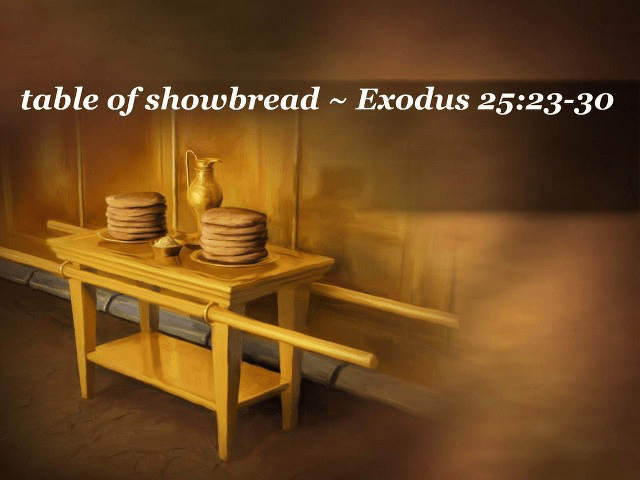
Exodus 37:10 – 16 “He made the table of acacia wood two cubits long, a cubit wide, and a cubit and a half high. (The table was approximately 3 feet long, 1.5 feet wide, and 2.25 feet high (91.4 centimeters long, 45.7 centimeters wide, and 68.6 centimeters high) He overlaid it with pure gold and made a gold molding around it. He also made a rim around it a handbreadth wide and put a gold molding on the rim.
He cast four gold rings for the table and fastened them to the four corners at its four legs. The rings were placed close to the rim, to serve as holders for the poles used to carry the table. He made the poles of acacia wood for carrying the table and overlaid them with gold. He also made the utensils for the table out of pure gold: its plates and dishes, as well as its bowls and pitchers for pouring drink offerings.“
Today’s discussion comes from an article by Mary Fairchild. (Fairchild, Mary. “Table of Showbread.” Learn Religions, Aug. 28, 2020, learnreligions.com/table-of-showbread-700114.)
Many times we feel that the repetition of the descriptions of the furnishings of the Tabernacle are too boring and tedious! But think about it: why would God force His priests to eat bread that was a week old?
Ms. Fairchild writes: The table of showbread, also known as the “table of shewbread” (KJV), was an important piece of furniture inside the Holy Place of the tabernacle. It was situated on the north side of the Holy Place, a private chamber where only priests were allowed to enter and perform daily rituals of worship as representatives for the people....
Atop the table of showbread on pure gold plates, Aaron and his sons placed 12 loaves of bread made from fine flour. Also called “bread of the presence,” the loaves were arranged in two rows or piles of six, with frankincense sprinkled on each row. The loaves of bread were considered holy, an offering before the presence of God, and could be eaten only by the priests. Each week on the Sabbath, the priests consumed the old bread and replaced it with fresh loaves and frankincense supplied by the people.
Significance of the Table of Showbread
The table of showbread was a constant reminder of God’s everlasting covenant with his people and his provision for the 12 tribes of Israel, represented by the 12 loaves. In John 6:35, Jesus said, “I am the bread of life. Whoever comes to me will never go hungry, and whoever believes in me will never be thirsty.” (NLT) Later, in verse 51, he said, “I am the living bread that came down from heaven. Whoever eats this bread will live forever. This bread is my flesh, which I will give for the life of the world.” Today, Christians observe communion, partaking of consecrated bread to remember the sacrifice of Jesus Christ on the cross. The table of showbread in Israel’s worship pointed forward to the future Messiah and his fulfillment of the covenant. The practice of communion in worship today points backward in remembrance of Christ’s victory over death on the cross.
Hebrews 8:6 says, “But now Jesus, our High Priest, has been given a ministry that is far superior to the old priesthood, for he is the one who mediates for us a far better covenant with God, based on better promises.” (NLT)As believers under this new and better covenant, our sins are forgiven and paid for by Jesus. There is no longer a need to offer sacrifices. Our daily provision is now the living Word of God.” (Fairchild, Mary. “Table of Showbread.” Learn Religions, Aug. 28, 2020, learnreligions.com/table-of-showbread-700114.)
APPLICATION: There is an old saying that “Bread is the staff of life,” meaning that many people around the world depend on bread as the main staple of their diet. This idea has become so ingrained in our culture that one expression for earning one’s living is to “earn one’s daily bread.”
At the beginning, we asked the question regarding old bread. The bread placed on the table of showbread was considered holy; it could only be consumed by those who were also considered holy, that is, by males among the priests. There is only one recorded instance when someone other than the priests ate the showbread; when David and his men were fleeing King Saul. At that time, the priests made sure that the young men were ritually clean before releasing the old showbread to David.
To be allowed to consume the showbread was a privilege. How did this bread taste? Did the frankincense that was sprinkled on it help preserve it? This bread was unleavened and therefore less likely to go bad than bread baked with leaven. We don’t know; all we do know is that nobody has recorded instances where a priest refused to eat the bread.
2020 – 2021 has been a rough time for people all over the world! Many have lost family members or jobs or businesses in the wake of the ongoing pandemic. Current information indicates that in Myanmar, India, Nepal, and other areas, the devastation continues to burgeon. Many believers find themselves asking, “Where is God in the midst of all this?” Recently, friends in India who run a whole series of orphanages and training schools for disadvantaged students had to watch as their beloved son died in his thirties from COVID. This man had played a critical part in the ministry and was slated to take over as head; now his parents and his wife and children were bereft. This family might well have asked, “Where is God in the midst of our tragedy” and yet, they have not. Instead, this family has repeatedly praised God for His provision, for His comfort, and for His watch – care.
Those who teach a prosperity Gospel choose to proclaim that God will never allow us to lack anything physically; yet, many of God’s greatest saints have suffered deprivation. Yes, God can supply our needs; however, sometimes we demand physical help when God wants to give us something far better: spiritual help and deliverance. That man who died in India knew Jesus Christ as his Savior and had a close personal walk with God. The manner in which the family handled this man’s death left no doubt in the minds of all around them that their hope was not in present physical things but rather in the promises of eternal life through Jesus Christ.
When Jesus stated that He was the Bread of Life and that anyone who came to Him would never be hungry or thirsty, he was speaking of spiritual hunger and thirst. Countless millionaires and billionaires can witness that no matter how much they have, their riches do not satisfy them but only drive them to want more. The hunger these men and women are feeling is spiritual and cannot be assuaged by wealth or fame. The only answer to spiritual hunger is Jesus Christ.
PRAYER: Father God, thank You for sending Jesus to die for our sins! We freely admit that we are sinners and that it is only through the sacrifices that Jesus Christ has made for us that we can be freed from our sins. Thank You for loving us so much that You have sent Jesus and that You continue to lead us to faith in Him. In the matchless Name of King Jesus. Amen.
 Burunche's Blog
Leave a comment