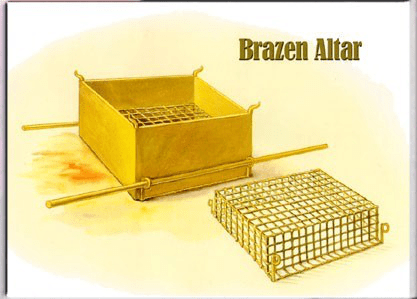
Exodus 38:1 – 7 “He constructed the altar of burnt offering from acacia wood. It was square, five cubits long, five cubits wide, and three cubits high. The altar was approximately 7.5 feet in length and width, and 4.5 feet high (2.3 meters in length and width, and 1.4 meters high) He made a horn at each of its four corners, so that the horns and altar were of one piece, and he overlaid the altar with bronze. He made all the altar’s utensils of bronze—its pots, shovels, sprinkling bowls, meat forks, and firepans. He made a grate of bronze mesh for the altar under its ledge, halfway up from the bottom. At the four corners of the bronze grate he cast four rings as holders for the poles. And he made the poles of acacia wood and overlaid them with bronze. Then he inserted the poles into the rings on the sides of the altar for carrying it. He made the altar with boards so that it was hollow.”
One of the most amazing things about the Tabernacle is the fact that these people had never seen most of the equipment God ordered them to construct. What did the altars in Egyptian temples look like? The answers come from the Global Egyptian Museum web site: http://www.globalegyptianmuseum.org/glossary.aspx?id=50
“There were two types of altar in Egyptian temples:
Small, portable stands on which different tops could be placed, depending on the kind of offering: a flat table top for food, flowers, etc., a bowl for libations, and a dish for burning incense. These altars were probably stored in the temple magazines and could be placed wherever they were needed.
Stone altars, sometimes very large. They were usually not much more than enlarged offering tables. Some altars of this type are made from one piece of stone, others are constructed of smaller stones. The larger altars often had a small stair or slope on the western side, so that the priest climbing the altar to make an offering was facing east. Not very many of these stone altars have been found. They are mainly known from sun temples, where offerings to the sun were made directly under the open sky.”
Reading these descriptions, one realizes that nothing in Egyptian religious practice had prepared the Israelite craftsmen for the task facing them. And God wanted to make sure that everything was done according to His plans. The Tabernacle and all its furnishings with all its tools was going to travel for forty years; God wanted to make sure every thing would hold up properly. Some people feel that the Altar of Sacrifice was situated on two large mounds of earth with a ramp of earth and stones leading up to the altar. This would have allowed a space underneath so that wood could be placed inside to help burn the sacrifices while ashes could also be removed. Some people feel that there might have been earth inside the altar below the grate. The most important aspect of the ramp and the earth would have been the fact that the stones were not chiseled and the earth was obtained from the site where the Tabernacle was set up.
APPLICATION: “Look at that dog’s head on that post!” It was several years ago, and my husband and I were returning from buying supplies for our hospital in rural northern Ghana. Passing a near – by village, we were shocked to see the freshly severed head of a dog placed on a post. Our friends later informed us that this grisly sight was an offering to the traditional gods of our area to help a notable hunter succeed in the hunt. The dog who died was the man’s best hunting dog. This poor man might have been misguided; however, he understood the need to make the best offering he could.
Throughout the Old Testament, God makes the matter of acceptable offerings quite clear. Any animal for sacrifice was to be perfect without any blemishes whatsoever. At a time of moral dissolution, the prophet Malachi takes the Jews to task, “A son honors his father, and a servant his master. But if I am a father, where is My honor? And if I am a master, where is your fear of Me?” says the LORD of Hosts to you priests who despise My name. “But you ask, ‘How have we despised Your name?’ By presenting defiled food on My altar. But you ask, ‘How have we defiled You?’ By saying that the table of the LORD is contemptible.” “When you offer blind animals for sacrifice, is it not wrong? And when you present the lame and sick ones, is it not wrong? Why not offer them to your governor! Would he be pleased with you or show you favor?” asks the LORD of Hosts.” (Malachi 1:6-8)
These days, the concept of sacrifice has gone out of fashion; in fact, there are many Christians in industrialized countries who choose to believe that Jesus has already made the ultimate Sacrifice, so there is no need for them to do anything. But this belief has no basis in Scripture. A Bible teacher in an earlier generation was fond of saying that “it isn’t a sacrifice until you don’t feel like it.” That same wise man also advised his students that “Many sacrifices of praise have to be pushed out between clenched teeth.” The Bible speaks of the sacrifices of praise, of the sacrifices of time and talents, and the sacrifice of obedience. For most of us, obedience is the most difficult sacrifice to make.
Many Christians in other countries already know the meaning of sacrifice. Some entire churches have paid with their lives at the hands of terrorists rather than abandon the Gospel.
James Russell Lowell was an American poet, art critic, magazine editor, professor, and statesman of the nineteenth century. An ardent abolitionist, Lowell spoke out strongly against slavery and its evils. Lowell wrote this poem which was later turned into a hymn:
1 Once to every man and nation
Comes the moment to decide,
In the strife of truth with falsehood,
For the good or evil side;
Some great cause, God’s new Messiah,
Offering each the bloom or blight,
And the choice goes by forever
Twixt that darkness and that light.
2 Then to side with truth is noble,
When we share her wretched crust,
Ere her cause bring fame and profit,
And ’tis prosperous to be just;
Then it is the brave man chooses
While the coward stands aside,
Till the multitude make virtue
Of the faith they had denied.
3 By the light of burning martyrs,
Christ, Thy bleeding feet we track,
Toiling up new Calvaries ever
With the cross that turns not back;
New occasions teach new duties,
Time makes ancient good uncouth;
They must upward still and onward,
Who would keep abreast of truth.
4 Though the cause of evil prosper,
Yet ’tis truth alone is strong;
Though her portion be the scaffold,
And upon the throne be wrong:
Yet that scaffold sways the future,
And, behind the dim unknown,
Standeth God within the shadow,
Keeping watch above His own.
PRAYER: Father God, help us to follow you, no matter how much the sacrifices might cost us! In the mighty and precious Name of King Jesus. Amen.
 Burunche's Blog
Leave a comment