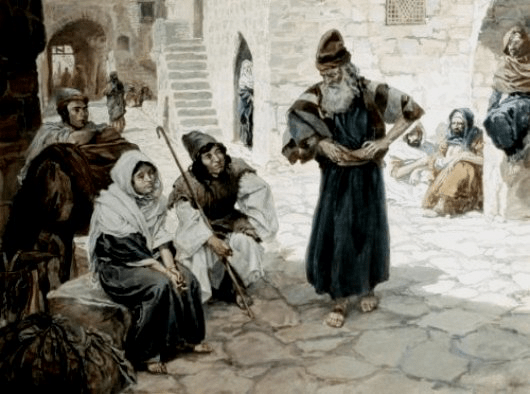
Judges 19:1 – 21 “And in those days, when there was no king in Israel, a Levite who lived in the remote hill country of Ephraim took for himself a concubine from Bethlehem in Judah. But she was unfaithful to him and left him to return to her father’s house in Bethlehem in Judah. After she had been there four months, her husband got up and went after her to speak kindly to her and bring her back, taking his servant and a pair of donkeys. So the girl brought him into her father’s house, and when her father saw him, he gladly welcomed him. His father-in-law, the girl’s father, persuaded him to stay, so he remained with him three days, eating, drinking, and lodging there.
On the fourth day, they got up early in the morning and prepared to depart, but the girl’s father said to his son-in-law, “Refresh your heart with a morsel of bread, and then you can go.” So they sat down and the two of them ate and drank together. Then the girl’s father said to the man, “Please agree to stay overnight and let your heart be merry.” The man got up to depart, but his father-in-law persuaded him, so he stayed there that night.
On the fifth day, he got up early in the morning to depart, but the girl’s father said, “Please refresh your heart.” So they waited until late afternoon and the two of them ate. When the man got up to depart with his concubine and his servant, his father-in-law, the girl’s father, said to him, “Look, the day is drawing to a close. Please spend the night. See, the day is almost over. Spend the night here, that your heart may be merry. Then you can get up early tomorrow for your journey home.”
But the man was unwilling to spend the night. He got up and departed, and arrived opposite Jebus (that is, Jerusalem), with his two saddled donkeys and his concubine. When they were near Jebus and the day was almost gone, the servant said to his master, “Please, let us stop at this Jebusite city and spend the night here.”
But his master replied, “We will not turn aside to the city of foreigners, where there are no Israelites. We will go on to Gibeah.” He continued, “Come, let us try to reach one of these towns to spend the night in Gibeah or Ramah.” So they continued on their journey, and the sun set as they neared Gibeah in Benjamin. They stopped to go in and lodge in Gibeah. The Levite went in and sat down in the city square, but no one would take them into his home for the night. (The distance between Bethlehem and Gibeah is 12 miles or 19 km.)
That evening an old man from the hill country of Ephraim, who was residing in Gibeah (the men of that place were Benjamites) came in from his work in the field. When he looked up and saw the traveler in the city square, the old man asked, “Where are you going, and where have you come from?” The Levite replied, “We are traveling from Bethlehem in Judah to the remote hill country of Ephraim, where I am from. I went to Bethlehem in Judah, and now I am going to the house of the LORD; but no one has taken me into his home, even though there is both straw and feed for our donkeys, and bread and wine for me and the maidservant and young man with me. There is nothing that we, your servants, lack.” “Peace to you,” said the old man. “Let me supply everything you need. Only do not spend the night in the square.” So he brought him to his house and fed his donkeys. And they washed their feet and ate and drank.”
At first this seems like a strange story to stick in the middle of the Bible, but it is there for a reason. This story marks the final degradation to which the Israelites have descended. This young man from the remote hill country of Ephraim somehow found a young lady from Bethlehem to be his concubine. Wikipedia tells us, “The position of the concubine was generally inferior to that of the wife. Although a concubine could produce heirs, her children would be inferior in social status to a wife’s children, although they were of higher status than illegitimate children.” The advantage for the young man was that he did not have to pay a high bride price, although he might pay some money to the girl’s family. The girl ran back to her family in Bethlehem, perhaps because she was homesick. The girl’s father was naturally anxious to keep the couple with him as long as possible; however, after several delays, the young man insisted on leaving late in the afternoon. The distance between Jerusalem and Bethlehem was only a few miles, but the sun was already setting as they neared Jerusalem. This stubborn fellow refused to stay in Jerusalem but insisted on pushing on a few more miles to the Israelite city of Gibeah.
Traditionally, strangers who entered a city would come to the city square and one of the local citizens would readily take the strangers into their home and care for them. The first indication that staying in Gibeah was a bad idea was that the local people totally ignored the young man, his concubine, and his servant. This was particularly perplexing since the strangers had all their provisions and only needed a place to shelter for the night. Finally an old man who was from the same area as the young Levite offered them hospitality.
APPLICATION: One of the indications that a culture is breaking down is the deterioration of common courtesy. Throughout the ancient world, hospitality to strangers was practiced as a matter of course. There are many horrifying details in this story, but one of the earliest is the failure of the citizens of Gibeah to welcome these strangers. It is ironic but likely true that had this small band stopped in Jerusalem, the Jebusites might have been kinder to them. Finally an elderly man steeped in the culture invites them into his home for the night. Little does he know that the citizens of Gibeah are about to riot at his doorstep.
As we become more dependent on cell phones, tablets, and computers, the opportunities for direct face to face interactions are steadily decreasing. The less contact we have with other people, the less able we are to interact with them and the less compassion we may have. Kindergarten and primary school teachers are complaining that children who have been using electronic media for several hours a day don’t know how to play with other children or to even relate to them. One teacher testified on Facebook that when she gave her high school class five minutes in which to chat directly with one another rather than messaging, many of the students had no idea what to do and simply put their heads down on their desks.
We may criticize the people of Gibeah, but how many times do we actually recognize the people around us as individuals, or more importantly, as children of God? Cell phones and tablets allow us to distance ourselves so that we can control our social interactions, but in so doing we are losing our ability to converse or to extend common courtesy. May God help us to lay down our electronic media, get earbuds or bluetooth devices out of our ears, and to appreciate the people around us!
PRAYER: Father God, help! We have been taken captive by our cell phones and tablets and no longer practice kindness and courtesy! Help us to remember that You have created people as individuals and to appreciate those around us and show them Your love. In the mighty Name of King Jesus. Amen.
 Burunche's Blog
Leave a comment