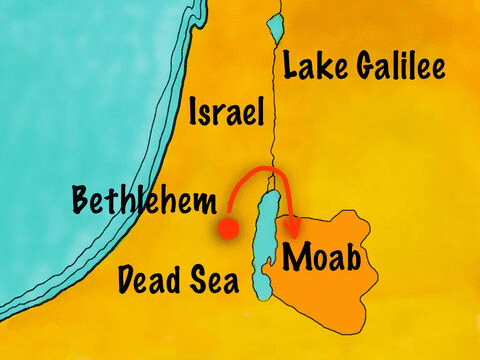
Ruth 1: 1 – 5 “In the days when the judges ruled, there was a famine in the land. And a certain man from Bethlehem in Judah, with his wife and two sons, went to reside in the land of Moab. The man’s name was Elimelech, his wife’s name was Naomi, and the names of his two sons were Mahlon and Chilion. They were Ephrathites from Bethlehem in Judah, and they entered the land of Moab and settled there.
Then Naomi’s husband Elimelech died, and she was left with her two sons, who took Moabite women as their wives, one named Orpah and the other named Ruth. And after they had lived in Moab about ten years, both Mahlon and Chilion also died, and Naomi was left without her two sons and without her husband.”
WHAT’S IN A NAME? The name “Bethlehem” literally means “house of bread,” indicating that the area was fertile. “Elimelech” means “my God is king,” while “Naomi” means “pleasant.” But when famine came, Elimelech failed to live up to his name and chose to move to Moab where the people worshiped Chemosh and Astarte. (Astarte was the fertility goddess and her rites always included sexual orgies.)
Why would Elimelech move when others did not? Some people have speculated that Elimelech was originally very wealthy and that he moved to Moab to avoid disgrace. (https://baptistbulletin.org/the-baptist-bulletin-magazine/may-06-issue/moving-to-moab-was-elimelech-wrong/)
Whatever the reason, this move turned out to be disastrous. Elimelech died – perhaps soon after the family had settled in Moab. Naomi’s two sons married Moabite women, something God had forbidden the Israelites to do. There is no mention of any children being born to either of these two men. Ten years after the move, both Mahlon and Chilion died, leaving Naomi alone. The name “Mahlon” can mean “a dance,” indicating something joyful; however, it can also mean “sickness.” “Chilion” can mean “completion;” however, it can also mean “destruction or wasting.” Traditionally, many Jews have believed that the negative meanings of these names indicate the failings of these two men that led to their untimely deaths. Mahlon is suspected of having committed acts of profanation by worshiping his wife’s god Chemosh. Chilion might have also fallen into idolatry, bringing condemnation upon himself.
APPLICATION: Many times, we are confused about which way to go and we are tempted to choose the course that is most expedient. We don’t intend to stay in a questionable situation for very long; we only want to be there temporarily while we wait for things to work out somewhere else.
In some accounts of this story, Elimelech and his family are described as intending to “sojourn” in Moab, that is, to stay there only for a short time and then to return to Bethlehem. But temporary measures have a way of becoming permanent. As the months turned into years, the family became less and less interested in returning to Bethlehem. If the family were to survive, Elimelech would have to start some kind of business; he might have been required to make routine sacrifices to the local gods to do business in Moab. The sons probably made friends with the young people in their new location; certainly, they married Moabite girls. Was Naomi was able to find some women her own age with whom she could socialize, or was she the sole person in the family who longed to return to Bethlehem?
At any rate, the move to Moab proved to be a disaster! Elimelech evidently died shortly after the move. Ten years later, Mahlon and Chilion both died as well, leaving Naomi bereaved and penniless. Naomi’s only remaining relatives were Orpah and Ruth, her two daughters – in – law. Now Naomi was a stranger, an outsider with nobody to care for her or to support her. In a culture in which family was paramount, Naomi had lost her support system; her only viable option was to return to Bethlehem.
What lessons can we take from this part of the story? Each of us needs to search our hearts, our minds, and our lives to see where we have compromised. What “temporary” solutions have we allowed to become permanent? Are we trapped in a living situation that has become toxic? Are we trapped in a profession that has become a burden but that we fear to leave? Have we allowed a family problem to fester when we should have addressed it long ago? Have we settled for less than God’s best for our lives and the lives of our family members because we are afraid to make a change? May God help us to ask ourselves the tough questions and then to make necessary changes!
PRAYER: Father God, thank You that You are infinitely capable and that You have only the best for us in mind! Open our eyes to see where we have compromised and then to return to Your plans for our lives. In the mighty and precious Name of King Jesus. Amen.
 Burunche's Blog
Leave a comment