Archive for February, 2022

FEBRUARY 28, 2022 BE STRONG! BE COURAGEOUS! JOSHUA 13: 1 -14 WHAT WILL YOU DO TO EARN YOUR INHERITANCE???

February 28, 2022

Joshua 13:1 – 14 “Now Joshua was old and well along in years, and the LORD said to him, “You are old and well along in years, but very much of the land remains to be possessed. This is the land that remains: All the territory of the Philistines and the Geshurites, from the Shihor east of Egypt to the territory of Ekron on the north (considered to be Canaanite territory)—that of the five Philistine rulers of Gaza, Ashdod, Ashkelon, Gath, and Ekron, as well as the Avvites; to the south, all the land of the Canaanites, from Mearaha of the Sidonians to Aphek, as far as the border of the Amorites; the land of the Gebalites; and all Lebanon to the east, from Baal-gad below Mount Hermon to Lebo-hamath. All the inhabitants of the hill country from Lebanon to Misrephoth-maim—all the Sidonians—I Myself will drive out before the Israelites. Be sure to divide it by lot as an inheritance to Israel, as I have commanded you. Now therefore divide this land as an inheritance to the nine tribes and the half-tribe of Manasseh.” The other half of Manasseh, along with the Reubenites and Gadites, had received the inheritance Moses had given them beyond the Jordan to the east, just as Moses the servant of the LORD had assigned to them:

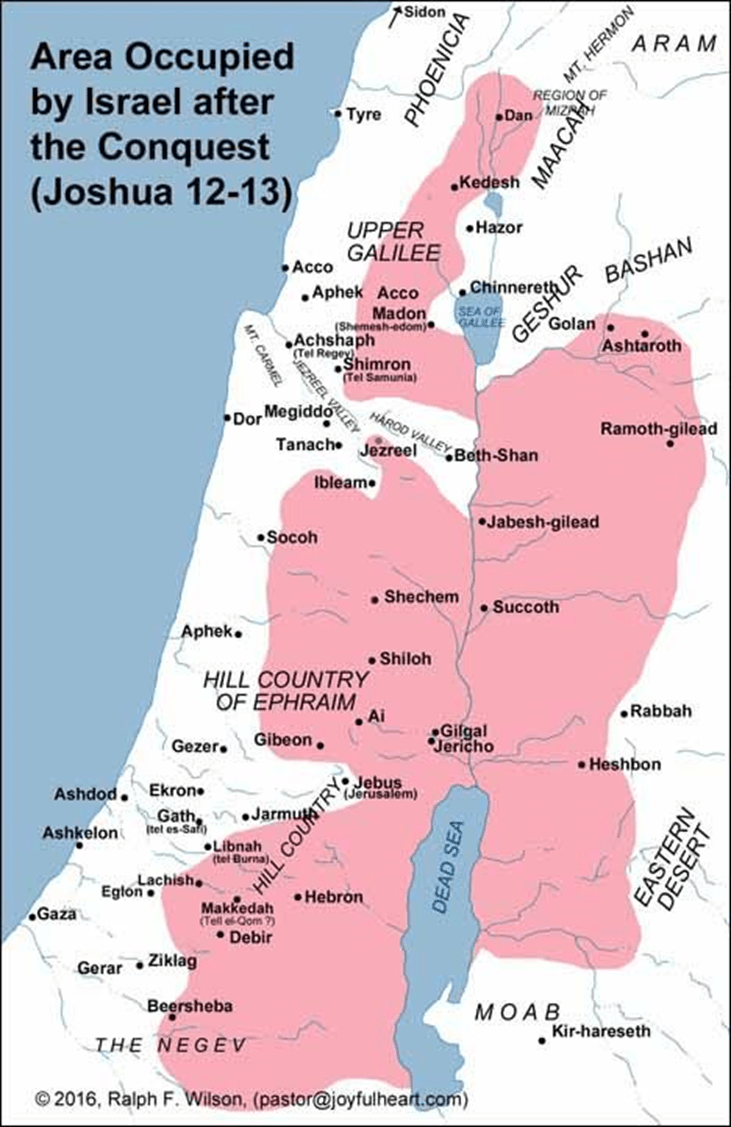
The area from Aroer on the rim of the Arnon Valley, along with the city in the middle of the valley, the whole plateau of Medeba as far as Dibon, and all the cities of Sihon king of the Amorites who reigned in Heshbon, as far as the border of the Ammonites; also Gilead and the territory of the Geshurites and Maacathites, all of Mount Hermon, and all Bashan as far as Salecah— the whole kingdom of Og in Bashan, who had reigned in Ashtaroth and Edrei and had remained as a remnant of the Rephaim.

Moses struck them down and dispossessed them, but the Israelites did not drive out the Geshurites or the Maacathites. So Geshur and Maacath dwell among the Israelites to this day. To the tribe of Levi, however, Moses had given no inheritance. The offerings made by fire to the LORD, the God of Israel, are their inheritance, just as He had promised them.

God wanted to give the Israelites a large amount of land; however, the Israelites had to go in and conquer the people who were already living there. As long as Joshua was strong enough to lead the Israelites, they continued to conquer, but now Joshua was elderly and could no longer fight as well as he once did. Unfortunately, the Israelites were adequate followers but without a strong physically vigorous leader, they were more than willing to sit in the cities they had already taken. One commentator notes that the Israelites would get all the land on which they would set their feet. Overall, the Israelites eventually wound up with only about one third of the land they could have had.

Now God is ordering Joshua to divide up the land. Once the land has been allotted, it will be up to the Israelites to conquer the land and to annihilate the occupants. Now there’s a problem. There’s still a large amount of territory to be conquered, but the Israelites don’t appear to be very worried about it. It’s almost as if the Israelites are hoping that God is just going to hand them land without any struggle on their part.

APPLICATION: “NO PAIN, NO GAIN!” Anyone who wants to get into shape knows that there’s no way you can exercise without having some aches and pains. But if you will continue to exercise properly, the aches and pains will eventually get better.

The problem for the Israelites throughout the Book of Joshua was that once Joshua was no longer able to lead effectively, the Israelites didn’t want to take any initiative. It’s as if the Israelites thought that God was just going to drop the Promised Land into their laps without any efforts on their part. Moses had already warned the Israelites that they would have to fight for the land, but they weren’t paying attention. While we might want to criticize the Israelites, the question is, what do we do when faced with a challenge? Those of us who work in other cultures continually find ourselves limited by our command of local languages. In our hospital, we can easily go through five or six different tribal languages in the course of a day in the consulting room. I find myself continually recording new phrases in my efforts to communicate better with my patients and their families. While I do have workers who can translate for me, patients and their families are much happier when I can communicate with them directly. (One of the most useful phrases to learn is “Don’t laugh at me; I’m doing the best that I can!”)

Spiritually, there are lots of temptations to relax once we have reached a certain point; however, our standard is not ourselves but Jesus Christ. Hebrews 12:2 tells us, “Let us fix our eyes on Jesus, the author and perfecter of our faith, who for the joy set before Him endured the cross, scorning its shame, and sat down at the right hand of the throne of God. Although conventional wisdom tells us to compare us with ourselves, Jesus is the perfect Example. May we never give up and may we continue to look to Jesus!

PRAYER: Father God, thank You for loving us and for caring for us. Help us to look to Jesus and not to ourselves or to our friends or colleagues as examples. In the mighty and precious Name of King Jesus. Amen.

FEBRUARY 27, 2022 BE STRONG! BE COURAGEOUS! JOSHUA 12:1 – 24 JOSHUA – THE MAN WHO DIDN’T QUIT!

February 27, 2022

Joshua 12:1 – 24 “Now these are the kings of the land whom the Israelites struck down and whose lands they took beyond the Jordan to the east, from the Arnon Valley to Mount Hermon, including all the Arabah eastward:

Sihon king of the Amorites, who lived in Heshbon. He ruled from Aroer on the rim of the Arnon Valley, along the middle of the valley, up to the Jabbok River (the border of the Ammonites), that is, half of Gilead as well as the Arabah east of the Sea of Chinnereth to the Sea of the Arabah (the Salt Sea), eastward through Beth-jeshimoth and southward below the slopes of Pisgah. Og king of Bashan, one of the remnant of the Rephaim, who lived in Ashtaroth and Edrei. He ruled over Mount Hermon, Salecah, all of Bashan up to the border of the Geshurites and Maacathites, and half of Gilead to the border of Sihon king of Heshbon.

Moses, the servant of the LORD, and the Israelites had struck them down and given their land as an inheritance to the Reubenites, the Gadites, and the half-tribe of Manasseh.

And these are the kings of the land that Joshua and the Israelites conquered beyond the Jordan to the west, from Baal-gad in the Valley of Lebanon to Mount Halak, which rises toward Seir (according to the allotments to the tribes of Israel, Joshua gave them as an inheritance the hill country, the foothills, the Arabah, the slopes, the wilderness, and the Negev—the lands of the Hittites, Amorites, Canaanites, Perizzites, Hivites, and Jebusites): the king of Jericho, one; the king of Ai, which is near Bethel, one; the king of Jerusalem, one; the king of Hebron, one; the king of Jarmuth, one; the king of Lachish, one; the king of Eglon, one; the king of Gezer, one; the king of Debi; the king of Libnah, one; the king of Adullam, one; the king of Makkedah, one; the king of Bethel, one; the king of Tappuah, one; the king of Hepher, one; the king of Aphek, one; the king of Lasharon, one; the king oMadon, one; the king of Hazor, one; the king of Shimron-meron, one; the king of Achshaph, one; the king of Taanach, one; the king of Megiddo, one; the king of Kedesh, one; the king of Jokneam in Carmel, one; the king of Dor in Naphath-dor, one; the king of Goiim in Gilgal, one; and the king of Tirzah, one. So, there were thirty-one kings in all.”

Reading this list is a bit tedious, but Joshua wanted to make sure that his people knew exactly how many kings he had conquered. We know for sure that Og King of Bashan and Sihon king of the Amorites definitely fell to the Israelites because it was their land that Moses gave to the tribes of Gad, Reuben, and the half – tribe of Manasseh.  But Joshua didn’t take over leadership until the Israelites were crossing the Jordan.

The big question is this: did Joshua actually defeat all those thirty – one kings? Certainly, Ai, Bethel, and Jericho fell before Joshua and his men. We really can’t be sure about some of these other kings because later the Israelites had to fight battles in several of those places, Hebron being a prime example. Did Joshua really conquer all these kings, or is this another example of a stylized conquest account?

Perhaps Joshua really did conquer these kings; however, if the people under these kings were not totally annihilated, they may have survived to plague the Israelites later. Perhaps Joshua conquered some leaders but left others. In addition, while some cities may have been conquered, others might later have come into prominence. The important thing is that Joshua never quit, even when he was quite elderly.

APPLICATION: One of the biggest temptations as one ages is to relax and stop working or learning new things. But is this God’s plan for our lives or ours? God allows us to live so that we will learn and gain experience and go on to use what we have learned to help others. Retirement is NOT in the Bible! Deuteronomy 34:7 describes Moses this way: Moses was a hundred and twenty years old when he died, yet his eyes were not weak nor his strength gone.” In the New Testament, the Apostle John was probably in his nineties when he was exiled to Patmos and recorded the visions captured in the Book of Revelation.

Even if Joshua was in his twenties when the Exodus took place, he was at least in his sixties by the time the Israelites crossed the Jordan. Add another twenty years to conquer these thirty – one kings, and Joshua is probably now in his eighties. What can we learn from Joshua?

  1. Joshua did everything he could to fulfill God’s purpose for his life, often against overwhelming odds.
  2. Joshua made every effort to get the Israelites to carry out God’s plans for the conquest of Canaan, even when the Israelites weren’t as enthusiastic.
  3. Joshua never quit.

As we age, we may need to re – invent ourselves; however, this does not mean that we must back off and quit. Some of the healthiest older patients I have cared for as a doctor were those who have been passionately involved in all kinds of activities. One of my favorite stories concerns my grandmother. When my grandmother was in her middle eighties, she was still living out on the farm, maintaining her flower garden, and caring for her chickens, selling free – range eggs to a long list of regular customers. Grandma regularly drove herself into town to the Senior Citizens meetings. Was she a member? Are you kidding! Grandma didn’t consider herself a senior citizen; she was going in to town to play the piano “to cheer up the old folks.” Some of the “old folks” to whom Grandma was referring were thirty years younger than she was! As we age, may we remember Moses and Joshua and may we continue to find ways to be helpful and useful.

PRAYER: Father God, help us to follow hard after You all the days of our lives. Help us to continue to look for new ways to be helpful and useful. In the mighty and precious Name of King Jesus. Amen.

FEBRUARY 26, 2022 BE STRONG! BE COURAGEOUS! JOSHUA 11:16 – 23 WHO DOESN’T WANT REST???

February 26, 2022

Joshua 11:16 – 23 “So Joshua took this entire region: the hill country, all the Negev, all the land of Goshen, the western foothills, the Arabah, and the mountains of Israel and their foothills, from Mount Halak, which rises toward Seir, as far as Baal-gad in the Valley of Lebanon at the foot of Mount Hermon. He captured all their kings and struck them down, putting them to death.

Joshua waged war against all these kings for a long period of time. No city made peace with the Israelites except the Hivites living in Gibeon; all others were taken in battle. For it was of the LORD to harden their hearts to engage Israel in battle, so that they would be set apart for destruction and would receive no mercy, being annihilated as the LORD had commanded Moses.

At that time Joshua proceeded to eliminate the Anakim from the hill country of Hebron, Debir, and Anab, and from all the hill country of Judah and of Israel. Joshua devoted them to destruction, along with their cities. No Anakim were left in the land of the Israelites; only in Gaza, Gath, and Ashdod did any survive.

So, Joshua took the entire land, in keeping with all that the LORD had spoken to Moses. And Joshua gave it as an inheritance to Israel according to the allotments to their tribes. Then the land had rest from war.”

“REST FROM WAR!” What a wonderful idea! Joshua is promising his people that one day they will complete the conquest of Canaan and there will be rest from war. But did Joshua really eliminate the Anakim, the giants? Actually, no. Joshua 13:1 tells us, “Now Joshua was old and well along in years, and the LORD said to him, “You are old and well along in years, but very much of the land remains to be possessed.” This passage from Joshua 11 would seem to indicate that Joshua had completely conquered Hebron with its giants, and yet in Joshua 14:10 – 12 Caleb says this: “Now behold, as the LORD promised, He has kept me alive these forty-five years since He spoke this word to Moses, while Israel wandered in the wilderness. So here I am today, eighty-five years old, 11still as strong today as I was the day Moses sent me out. As my strength was then, so it is now for war, for going out, and for coming in. Now therefore give me this hill country that the LORD promised me on that day, for you yourself heard then that the Anakim were there, with great and fortified cities. Perhaps with the LORD’s help I will drive them out, as the LORD has spoken.”

HUH??? What’s going on here? At the end of Joshua 11, Joshua claims to have ELIMINATED the Anakim “from the hill country of Hebron, Debir, and Anab, and from all the hill country of Judah and of Israel. Joshua devoted them to destruction, along with their cities. No Anakim were left in the land of the Israelites; only in Gaza, Gath, and Ashdod did any survive.” Now we see that there are still giants in Hebron and that it has yet to be conquered. Once again it would seem that Joshua is continuing to follow the conquest account formula. Perhaps Joshua was hoping that by publishing this account, the Israelites would actually go on to conquer all of the land. (Eventually they only conquered one third of the land God had promised them.) Even in the midst of this stylized account, there are still glimmers of truth. “Joshua waged war against all these kings for a long period of time.”  That is undoubtedly a true statement.

What is most important here is the final sentence. “Then the land had rest from war.” Who doesn’t want rest? It’s likely that Joshua concluded this account with that statement, both as an assurance and as a hope. In Joshua 13, Caleb mentions that he is 85 years old; Joshua is likely about that same age or even slightly older. Although Caleb affirms that he is still in good shape, Joshua makes no such statements. Joshua knows that he is aging and that there is still a lot left to do if the Promised Land is going to be thoroughly conquered. Joshua is doing everything he can to encourage those who come after him that if they will follow God’s plan, they will get God’s results, peace.

APPLICATION: Few things are more frustrating than to be a pioneer with high hopes, only to watch others coming after you who have failed to catch the same vision that has inspired you. One perfect example of this is the Walmart corporation. When Bill Walton began the company, he boasted that everything sold was made in America. At that time, Walmart workers enjoyed great benefits and even sponsorship for further education. Once Bill Walton died, everything changed. Go to a Walmart these days, and you will be lucky to find a few human clerks at the checkout counters! Most of the things sold are made outside America. Bill Walton’s dream has turned into a nightmare for thousands if not millions of small businesses who have closed because they cannot compete with the low prices at Walmart.

Joshua did the best he could with the people he had and the circumstances he faced. If the reality failed to match up to the ideals expressed in Joshua’s conquest account, it was not through any fault of Joshua’s.

There’s an old hymn that sums up the feelings of many of us.

There is rest for the weary,
There is rest for you.
On the other side of Jordan,
In the sweet fields of Eden,
Where the tree of life is blooming,
There is rest for you.”

As I am writing this, Russia is attacking Ukraine and Christians all over the world are praying intensely for Ukraine. There are religious conflicts in various parts of the world. Economies and families are in trouble as a result of COVID.

The Rolling Stones had a song entitled “Give Me Shelter!” At this point, many of us can identify with that sentiment!

Where can we find true shelter?

Matthew 11:28 – 30 gives us the answer. “Come to me, all you who are weary and burdened, and I will give you rest. Take my yoke upon you and learn from me, for I am gentle and humble in heart, and you will find rest for your souls. For my yoke is easy and my burden is light.” Jesus also told his disciples on the night before he was betrayed, I have told you these things, so that in me you may have peace. In this world you will have trouble. But take heart! I have overcome the world.” (John 16:33)

True peace is found in knowing Jesus Christ as Savior from our sins and Lord of our lives. When we try to run things ourselves, sooner or later, we will end up in a mess. When we confess our sins and ask Jesus to organize our lives for us, we will know true peace, even when things are falling apart. Those Ukrainian Christians who are praying for their country are in agony because they want peace for their country; however, they themselves do have peace because they know Jesus, who is the Prince of Peace.

PRAYER: Father God, thank You for Your promises of peace throughout Your Word. Lord, help all who read this to put their trust in You, so that they can find true and lasting peace. In the mighty Name of King Jesus. Amen.

FEBRUARY 25, 2022 BE STRONG! BE COURAGEOUS! JOSHUA 11:1 – 15 JOSHUA’S NORTHERN CAMPAIGN BLITZKRIEG

February 25, 2022

FEBRUARY 25, 2022 BE STRONG! BE COURAGEOUS! JOSHUA 11:1 – 15 JOSHUA’S NORTHERN CAMPAIGN

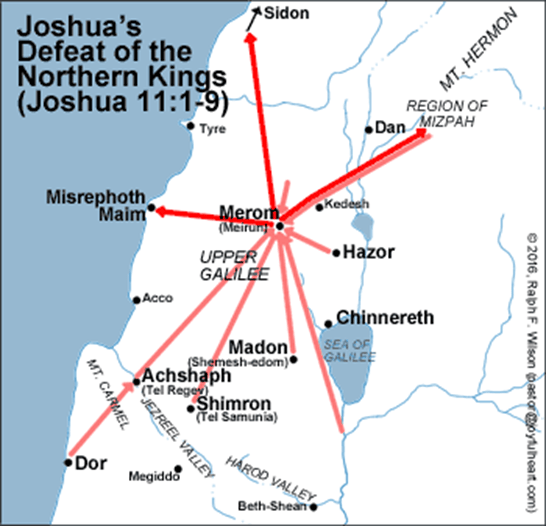
Joshua 11:1 – 15 “Now when Jabin king of Hazor heard about these things, he sent word to Jobab king of Madon, to the kings of Shimron and Achshaph, to the kings of the north in the mountains, in the Arabah south of Chinnereth, in the foothills, and on the slopes of Dor to the west, to the Canaanites in the east and west, to the Amorites, Hittites, Perizzites, and Jebusites in the hill country, and to the Hivites at the foot of Hermon in the land of Mizpah.

So, these kings came out with all their armies, a multitude as numerous as the sand on the seashore, along with a great number of horses and chariots. All these kings joined forces and encamped at the waters of Merom to fight against Israel.

Then the LORD said to Joshua, “Do not be afraid of them, for by this time tomorrow I will deliver all of them slain before Israel. You shall hamstring their horses and burn up their chariots.” So, by the waters of Merom, Joshua and his whole army came upon them suddenly and attacked them, 8and the LORD delivered them into the hand of Israel, who struck them down and pursued them all the way to Greater Sidon and Misrephoth-maim, and eastward as far as the Valley of Mizpeh. They struck them down, leaving no survivors. Joshua treated them as the LORD had told him; he hamstrung their horses and burned up their chariots.

At that time Joshua turned back and captured Hazor and struck down its king with the sword, because Hazor was formerly the head of all these kingdoms. The Israelites struck down everyone in Hazor with the sword, devoting them to destruction. Nothing that breathed remained, and Joshua burned down Hazor itself.

Joshua captured all these kings and their cities and struck them down with the sword. He devoted them to destruction, as Moses the LORD’s servant had commanded. Yet Israel did not burn any of the cities built on their mounds, except Hazor, which Joshua burned.

The Israelites took for themselves all the plunder and livestock of these cities, but they struck down all the people with the sword until they had completely destroyed them, not sparing anyone who breathed. As the LORD had commanded His servant Moses, so Moses commanded Joshua. That is what Joshua did, leaving nothing undone of all that the LORD had commanded Moses.”

Yesterday we discussed the possibility that Joshua 10 and 11 actually represent ancient conquest accounts and are not totally factual but idealized accounts that were intended to encourage the Israelites. Such accounts were common throughout the ancient world and included language of annihilation, repetitive and redundant language, hyperbole, common narrative structure, and focus on the leader. If you examine these verses from Joshua 11, you can see the same elements. The opposing forces are described as being “as numerous as the sand on the seashore.” These verses describe complete destruction of the enemy armies, as well as all of the people in their cities, “not sparing anyone who breathed.” Joshua and his men supposedly traveled extremely long distances over rugged terrain with multiple changes in altitude to complete the conquest. Joshua burned all the chariots and hamstrung all the horses.

Did Joshua actually fight the enemies described in these verses? Most certainly! Did God help Joshua? Yes! But when archaeologists have excavated in the tells representing many of these cities, they have not uncovered a uniform level of destruction for a given time period; instead, the cities evidently were destroyed over a period of up to 200 years.

These accounts give us an insight into the heart of Joshua. Most Talmudic scholars believe that Joshua did write most of the book, right up to the part describing his death. If Joshua wrote Chapters 10 and 11, this might explain the reasons behind the idealized descriptions of the campaigns. Joshua was a military leader, and military leaders commonly generated conquest accounts describing their victories in the most glowing terms. One of the things that sets Joshua’s accounts apart from those of the Egyptians and the Babylonians is that Joshua gives credit to God for guiding and strengthening the Israelites. Joshua also may have written these accounts in the hopes of encouraging those who would succeed him. Conquest accounts were also written to encourage the general public that the leader was bringing order and peace to a situation. Joshua wanted to make sure that the Israelites remembered that God was on their side.

APPLICATION: Joshua truly was a man of great faith and great accomplishments, a man whom God used mightily. Nobody else could have possibly taken over leadership from Moses. Joshua had served Moses and had been mentored by him for most of the forty years in the wilderness. There is no doubt that Joshua did win many great battles against enormous odds. There is also the possibility that new archeological discoveries may yet further substantiate Joshua’s accounts.

What lessons should we take from Joshua’s descriptions of his campaigns? Joshua emphasized the need for persistently combating evil. Many times, we only confront evil when it is convenient or we know we are unlikely to suffer; however, the real test of character comes when our stand for righteousness may cost us our jobs, our homes, or even our lives. God has allowed Joshua’s accounts of his campaigns to remain as part of His Word as an encouragement, not only to the ancient Israelites, but to everyone who stands for righteousness. In some parts of Africa, Asia, and India, Christians are being tortured or dying for their faith. Certainly, remembering Joshua’s descriptions of God’s watch care can strengthen one’s resolve.        

Before judging Joshua too harshly for exaggerating, let’s think about the times when we have said such things as “Wow! I was DYING out in that heat today!” “I thought this day would NEVER end!” “I have no idea how my boss thinks I can possibly get through all this work!” We weren’t really dying; we were uncomfortable. All days end sooner or later. And many times, our problems with our work load involve our refusal to tackle things promptly and thoroughly. Joshua’s story should encourage each of us to realize that when God has called us to do something, He will give us the strength and the guidance to make it.

PRAYER: Father God, thank You for loving us and for caring for us. Thank You for the example of Joshua, who pursued his enemies, carrying out Your plans and who never wavered. Help us to be faithful as we follow You. In the matchless Name of Jesus. Amen.

FEBRUARY 24, 2022 BE STRONG! BE COURAGEOUS! JOSHUA 10:28 – 43 DID JOSHUA REALLY MOP UP? THE CAMPAIGNS THAT NEVER REALLY HAPPENED!

February 24, 2022

Joshua 10:28 – 43 “On that day Joshua captured Makkedah and struck it down with the sword, along with its king. He devoted to destruction everyone in the city, leaving no survivors. So he did to the king of Makkedah as he had done to the king of Jericho.

Then Joshua and all Israel with him moved on from Makkedah to Libnah and fought against Libnah. And the LORD also delivered that city and its king into the hands of Israel, and Joshua struck down all the people with the sword, leaving no survivors. And he did to the king of Libnah as he had done to the king of Jericho.

And Joshua and all Israel with him moved on from Libnah to Lachish. They laid siege to it and fought against it. And the LORD delivered Lachish into the hands of Israel, and Joshua captured it on the second day. He struck down all the people with the sword, just as he had done to Libnah.

At that time Horam king of Gezer went to help Lachish, but Joshua struck him down along with his people, leaving no survivors.

So Joshua moved on from Lachish to Eglon, and all Israel with him. They laid siege to it and fought against it. That day they captured Eglon and struck it down with the sword, and Joshua devoted to destruction everyone in the city, just as he had done to Lachish.

Then Joshua and all Israel with him went up from Eglon to Hebron and fought against it. They captured it and struck down with the sword its king, all its villages, and all the people. Joshua left no survivors, just as he had done at Eglon; he devoted to destruction Hebron and everyone in it.

Finally Joshua and all Israel with him turned toward Debir and fought against it. And they captured Debir, its king, and all its villages. They struck them down with the sword and devoted to destruction everyone in the city, leaving no survivors. Joshua did to Debir and its king as he had done to Hebron and as he had done to Libnah and its king.

So Joshua conquered the whole region—the hill country, the Negev, the foothills, and the slopes, together with all their kings—leaving no survivors. He devoted to destruction everything that breathed, just as the LORD, the God of Israel, had commanded. Joshua conquered the area from Kadesh-barnea to Gaza, and the whole region of Goshen as far as Gibeon.

And because the LORD, the God of Israel, fought for Israel, Joshua captured all these kings and their land in one campaign. Then Joshua returned with all Israel to the camp at Gilgal.”

While a few fighting men from the five royal cities might have escaped the original battle, allegedly, nobody escaped Joshua’s subsequent campaigns. But did these campaigns really happen as described in these two chapters? Probably not.

In a series of fascinating analytical articles, the web site https://biblicalhistoricalcontext.com/ raises a number of questions and points out the fact that the descriptions of the Southern Campaign and the Northern Campaign in Joshua 10 and 11 are not actually historical descriptions of what happened, but instead are a perfect example of “Ancient Conquest Accounts.” Such accounts were common throughout the ancient world and included language of annihilation, repetitive and redundant language, hyperbole, common narrative structure, and focus on the leader. The ancient Egyptians, for example, recorded numerous such claims on various stone pillars called steles. These accounts were not intended to be factual but rather to indicate that a leader had restored order out of chaos. In one fascinating example, Ramses III claimed to have annihilated the “Peleset,” the Sea People, when he actually used them as mercenaries and then settled them in the cities of Gaza, Ashkelon, and Ashdod. (The Peleset became the Philistines.) (The series is too long to quote everything here; however, I highly recommend that you read the whole series of articles on https://biblicalhistoricalcontext.com/).

Archaeologists attempting to prove the veracity of the “blitzkrieg” campaigns of Joshua have been unable to do so. While many ancient cities were destroyed, they were not all destroyed in the same time period, but rather over the space of roughly 200 years. Later on, the Book of Judges points out that at Joshua’s death, there was still a great deal of land to be conquered; if the Canaanites had actually been wiped out completely, there shouldn’t have been anything left to conquer. There are also the physical challenges represented by the narrative. Again, biblicalhistoricalcontext.com makes the following points:

“This would be a journey of 44.5 miles/71.5 km. And the record tells us that it happened in one day. Bear in mind a few things: 1. They began the journey at Gilgal, which is around 400 m. below sea level, they went up to Gibeon, which is around 770 m. above sea level., and then down the Ascent of Beth – horon to Azekah, which is around 250 m. above sea level. So the Israelite army had altitude changes of almost 1.7 km, just over a mile. 2. They would have had to carry supplies of food and water. 3. Over the course of that one day the Israelites started with a forced early morning march from one of the lowest places on earth to one of the highest in Canaan. When they arrived, they fought a battle against a coalition of 5 armies. They chased those who’d retreated down a long and steep canyon and continued picking them off over a distance of many miles of Canaanite country to Azekah.” Anyone who has ever been to Israel knows that there are practically no flat spots and that the terrain is rugged, making it nearly impossible for these events to have occurred in this fashion.

When you look at the accounts in both Joshua 10 and 11, you realize that they appear to be following a formula and that they are emphasizing the importance of the leader. Why write this way? Ancient conquest accounts were propaganda intended to encourage people that their divinely appointed ruler had everything under control. Remember that the Israelites, including Joshua, came out of Egypt, where they had undoubtedly encountered such writing. The purposes of such writing was to “demonstrate the leader’s prowess in battle, to list off their achievements, and to claim divine favour.” Even the account of Joshua’s prayer to God to stop the sun follows the leader – focused formula.

If these two chapters are actually some kind of propaganda, why did God allow them to be included in the Book of Joshua? God always meets people where they are and as they are. The ancient Israelites were people of their time, and these two chapters represent one of the ways by which they encouraged themselves. These two chapters represent the hopes the Israelites had for a quick conquest and their attempts to remind themselves that they had a divinely – appointed leader. These two chapters are a snapshot into the minds and hearts of the Israelites. After these two chapters, the Book of Joshua returns to historical narrative.

APPLICATION: It’s tempting to sneer at the ancient Israelites and their conquest literature, but history is always written by the victors, not by the defeated. Watch any kind of sport and listen to the announcers and you can hear “conquest accounts” being developed right on the air! It is a human tendency to emphasize our successes and to put ignore our failures as much as possible. But what happens if you begin believing your own propaganda? At that point, you are in danger of becoming a legend in your own mind and your own little god.

When the ancient Romans held triumphal marches in Rome, there was one individual whose job it was to walk alongside the conqueror and continually whisper in his ear, “Remember, Caesar, you too are mortal!” Each of us needs to realize that we continue to exist only by the grace and mercy of Almighty God, who loves us even when we are fooling ourselves about our own importance.

PRAYER: Father God, thank You for loving us and for caring for us. Thank You for preserving accounts so that we can better understand the hopes and dreams of those who came before us. In the mighty and precious Name of King Jesus. Amen.
FEBRUARY 23, 2022 BE STRONG! BE COURAGEOUS! JOSHUA 10:16 – 27 EVIL THAT IS NOT COMPLETELY DEFEATED WILL ALWAYS RETURN!

February 23, 2022

Joshua 10:16 – 27 Now the five kings had fled and hidden in the cave at Makkedah. When Joshua was told that the five kings had been found hiding in the cave at Makkedah, he said, “Roll large rocks up to the mouth of the cave, and post some men there to guard it. But don’t stop; pursue your enemies! Attack them from the rear and don’t let them reach their cities, for the Lord your God has given them into your hand.”

So Joshua and the Israelites defeated them completely, but a few survivors managed to reach their fortified cities. The whole army then returned safely to Joshua in the camp at Makkedah, and no one uttered a word against the Israelites. Joshua said, “Open the mouth of the cave and bring those five kings out to me.” So they brought the five kings out of the cave—the kings of Jerusalem, Hebron, Jarmuth, Lachish and Eglon. When they had brought these kings to Joshua, he summoned all the men of Israel and said to the army commanders who had come with him, “Come here and put your feet on the necks of these kings.” So they came forward and placed their feet on their necks.

 Joshua said to them, “Do not be afraid; do not be discouraged. Be strong and courageous. This is what the Lord will do to all the enemies you are going to fight.” Then Joshua put the kings to death and exposed their bodies on five poles, and they were left hanging on the poles until evening. At sunset Joshua gave the order and they took them down from the poles and threw them into the cave where they had been hiding. At the mouth of the cave they placed large rocks, which are there to this day.

During that extra – long day, Joshua and the Israelites cleanly defeated the Amorites and captured the kings of all five major cities Jerusalem, Hebron, Jarmuth, Lachish and Eglon. Relatively speaking, Joshua and his men covered a lot of territory! Joshua commanded his men to make a complete end of the Amorite forces; nevertheless, “a few survivors managed to reach their fortified cities.” The people of those cities must have been terrified! All five cities were royal cities with large armies. Now only a handful of men were returning to describe the fighting and the monster hailstones that had rained down on them. Why were there any survivors?

It’s likely that once the five kings were captured, many of Joshua’s men wanted to sit down and rest. After all, with the commanders in that cave, what could the rest of these armies do? But Joshua knew that God wanted to make a complete end of the Amorites; that’s why he said, “Roll large rocks up to the mouth of the cave, and post some men there to guard it. But don’t stop; pursue your enemies! Attack them from the rear and don’t let them reach their cities, for the Lord your God has given them into your hand.” Back in Genesis 15, God told Abraham that “the iniquity of the Amorites was not yet complete.” At that point, there were still honorable men left among the Amorites; however, now was the day of destruction that God had assigned for them. It’s possible that had Joshua’s men not tried to rest, they might have completely wiped out the armies of all five cities.

The symbolism of putting one’s feet on the necks of the enemies is a powerful one. Joshua wanted the army commanders to carry out this act so that they would remember how victory felt the next time they engaged in battle. Given a taste of success, these men would be far more likely to move forward, even in the face of overwhelming opposition.

APPLICATION: Evil that is not dealt with COMPLETELY will always return! There is a line from the movie “Hook.” An aging Peter Pan, played by Robin Williams, has settled in London, where he has become a lawyer and has forgotten his dreams…. Until a night of horror in which his children are kidnapped and carried off to Never Never Land by his old arch – enemy Captain Hook. An over – weight, out of shape Peter Pan must return to Never Never Land to defeat Captain Hook once and for all. At one point, Hook threatens Peter, “Peter. I swear to you wherever you go, wherever you are, I vow there will always be daggers buried in notes signed James Hook. They will be flung into doors of your children’s children’s children, do you hear me?” Hook goes on to tell Peter that if he does not kill Hook now, Hook will come back for Peter’s grandchildren. Peter does kill Hook, thus saving his descendants from the particular evil that Hook represents.

Joshua’s armies did well; however, they did not completely wipe out the fighting men from the five cities. Eventually, they had to attack each of these cities separately and the conquest was difficult.

One of the temptations of aging is to retire from moral battles, giving the excuse that others who are younger should lead the fight. But many times, only age and experience can adequately prepare one for seeing the evil in apparently innocuous situations without descending into paranoia. Recently, our mission hospital had the chance to participate in a program funded from overseas donors. In the beginning, the program appeared excellent; however, as we explored the processes involved in applying for the second round of funding, we realized that the conditions for accepting these monies would compromise our stance as a mission institution. Once committed, we would not only be caught ourselves, but our further participation might be used as an example for others.

There is a saying, “As the twig is bent, so is the tree inclined.” Early influences are critically important. By encouraging the Israelites to totally annihilate their enemies, Joshua was trying to set the tone for the rest of the conquest of Canaan. Those army commanders would always remember the day they set their feet on the necks of the five enemy kings and then watched them be hanged.

PRAYER: Father God, help us to realize that with Your help, we can make a complete conquest of those situations that confront us. Help us also to remember that successful endings only come from proper beginnings. We must begin as we mean to go on. Help us always to look to You, for without Your guidance, we might easily be duped by the Evil One. In the matchless Name of King Jesus. Amen.

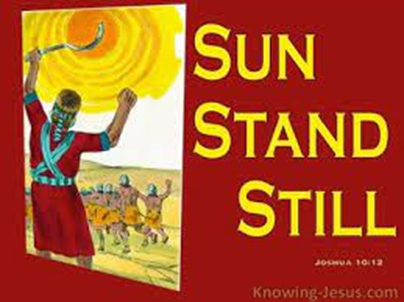
FEBRUARY 22, 2022 BE STRONG! BE COURAGEOUS! JOSHUA 10:1 – 15 GOD CAN EVEN MAKE THE SUN STAND STILL WHEN NECESSARY!

February 22, 2022

Joshua 10:1 – 15 “Now Adoni-Zedek king of Jerusalem heard that Joshua had taken Ai and totally destroyed it, doing to Ai and its king as he had done to Jericho and its king, and that the people of Gibeon had made a treaty of peace with Israel and had become their allies. He and his people were very much alarmed at this, because Gibeon was an important city, like one of the royal cities; it was larger than Ai, and all its men were good fighters. So Adoni-Zedek king of Jerusalem appealed to Hoham king of Hebron, Piram king of Jarmuth, Japhia king of Lachish and Debir king of Eglon.  “Come up and help me attack Gibeon,” he said, “because it has made peace with Joshua and the Israelites.”

Then the five kings of the Amorites—the kings of Jerusalem, Hebron, Jarmuth, Lachish and Eglon—joined forces. They moved up with all their troops and took up positions against Gibeon and attacked it. The Gibeonites then sent word to Joshua in the camp at Gilgal: “Do not abandon your servants. Come up to us quickly and save us! Help us, because all the Amorite kings from the hill country have joined forces against us.”

So Joshua marched up from Gilgal with his entire army, including all the best fighting men. The Lord said to Joshua, “Do not be afraid of them; I have given them into your hand. Not one of them will be able to withstand you.”

After an all-night march from Gilgal, Joshua took them by surprise.  The Lord threw them into confusion before Israel, so Joshua and the Israelites defeated them completely at Gibeon. Israel pursued them along the road going up to Beth Horon and cut them down all the way to Azekah and Makkedah.  As they fled before Israel on the road down from Beth Horon to Azekah, the Lord hurled large hailstones down on them, and more of them died from the hail than were killed by the swords of the Israelites.  On the day the Lord gave the Amorites over to Israel, Joshua said to the Lord in the presence of Israel:

“Sun, stand still over Gibeon, and you, moon, over the Valley of Aijalon.”  So the sun stood still, and the moon stopped, till the nation avenged itself on its enemies, as it is written in the Book of Jashar. The sun stopped in the middle of the sky and delayed going down about a full day. There has never been a day like it before or since, a day when the Lord listened to a human being. Surely the Lord was fighting for Israel!  Then Joshua returned with all Israel to the camp at Gilgal.”

The Gibeonites made peace with Israel; however, the other Amorite cities had already been calling for a coordinated attack on the Israelites. When the word went out that Gibeon had caved in and made a treaty, the other Amorite groups were incensed and terrified at the same time. Five Amorite kings banded together to deal with Gibeon, following which they intended to attack the Israelites. The Gibeonites now appealed to Joshua to honor his treaty and deliver them from this attack. While Joshua had been hasty in his treaty – making, God was using this as an opportunity to conclusively deal with the Amorites. It is possible that had the Amorites not mounted an attack, Joshua might have dithered about attacking them. But now Joshua had no choice, and God was about to do more miracles. Two major weather events happened nearly simultaneously: one of the earliest recorded solar eclipses and a fierce hailstorm.

Did the sun really stand still? The Times of Israel says this: “Cambridge researchers announced Monday that they have pinpointed the date of the biblical account of Joshua stopping the sun — which they claim is the day of the oldest eclipse ever recorded — to October 30, 1207 BCE, exactly 3,224 years ago. https://www.timesofisrael.com/3224-years-later-scientists-see-first-ever-recorded-eclipse-in-joshuas-battle/ But if this was a solar eclipse, it would have to have been an abnormally lengthy one, since most eclipses last only a few minutes. Joshua ordered the sun to stand over Gibeon to the east while the moon stood over the Valley of Aijalon, to the west. Personally, I feel God did miracles. This is the same God who parted the Red Sea and dammed up the Jordan River when it was in flood. What’s one or two more miracles after those events?

APPLICATION: God is our Redeemer, and many times He redeems our mistakes by arranging events. Even though Joshua had made a major mistake in making a treaty with the Gibeonites, God still used that treaty to impel Joshua to fight the Amorites. God did not reject Joshua for that mistake but honored him for fulfilling his commitment to the people of Gibeon. God also did miracles for Joshua and the Israelites.

Three of God’s most amazing qualities are His mercy, His grace, and His faithfulness in keeping promises. We don’t deserve any of the good things that God provides for us daily, but yet He gives us life and breath and blessings to enjoy. Joshua and the Israelites didn’t deserve God’s mercy and His grace; however, just as Joshua had promised to protect the Gibeonites, God also had promised Joshua that He would be with Joshua wherever Joshua went. God promised Joshua that as He had been with Moses, so He would be with Joshua. When Joshua needed more daylight and more assistance, God gave it.

Do you feel as if you are trapped in a corner with no way out? Perhaps a work situation has turned sour. Perhaps friends have failed you. Perhaps you were counting on someone to help you, only to find that they now have changed their minds. There is no doubt that sooner or later, people will fail you because they are only human. But God will never fail you. Ask God to show you what He wants you to do in your situation. Perhaps God has already designed a way out, and you have only to ask Him for Him to show you.

PRAYER: Father God, help! Many of us feel caught in situations that we never anticipated. We don’t know which way to turn. We may not have anybody we can trust. Lord, You know our needs. Come to our aid and help us to see Your Perfect Will for our lives. In the matchless Name of King Jesus. Amen.

FEBRUARY 21, 2022 BE STRONG! BE COURAGEOUS! JOSHUA 9:16 – 27 ACT IN HASTE, REPENT IN LEISURE – ONE WRONG DECISION CAN ECHO FOR CENTURIES

February 21, 2022

Joshua 9:16 – 27 “Three days after they had made the treaty with the Gibeonites, the Israelites learned that they were neighbors, living among them. So the Israelites set out and on the third day arrived at their cities—Gibeon, Chephirah, Beeroth, and Kiriath-jearim. But the Israelites did not attack them, because the leaders of the congregation had sworn an oath to them by the LORD, the God of Israel. And the whole congregation grumbled against the leaders. All the leaders answered, “We have sworn an oath to them by the LORD, the God of Israel, and now we cannot touch them. This is how we will treat them: We will let them live, so that no wrath will fall on us because of the oath we swore to them.” They continued, “Let them live, but let them be woodcutters and water carriers for the whole congregation.” So the leaders kept their promise.

THE GIBEONITES FOOL JOSHUA AND THE ELDERS

Then Joshua summoned the Gibeonites and said, “Why did you deceive us by telling us you live far away from us, when in fact you live among us? Now therefore you are under a curse and will perpetually serve as woodcutters and water carriers for the house of my God.”

The Gibeonites answered, “Your servants were told clearly that the LORD your God had commanded His servant Moses to give you all the land and wipe out all its inhabitants before you. So we greatly feared for our lives because of you, and that is why we have done this. Now we are in your hands. Do to us as it seems good and right to you.”

So Joshua did this and delivered them from the hands of the Israelites, and they did not kill the Gibeonites. On that day he made them woodcutters and water carriers, as they are to this day, for the congregation of the LORD and for the altar at the place He would choose.”

Joshua and the elders of Israel have created a terrible mess! When the Gibeonites showed up, fawning on the elders and describing the long journey they had taken and offering moldy bread as evidence of that journey, NONE of the elders or Joshua thought to ask the Lord if these people were telling the truth. Now it’s three days later, and the Israelites have just learned that the Gibeonites are near neighbors and should have been annihilated along with the other Amorite tribes.

This is not Joshua’s finest hour; his people are thoroughly disgusted. But a treaty has already been made, and Joshua and the elders must abide by that treaty. All they can do is to subjugate the Gibeonites and make them servants. The Gibeonites are vastly relieved; they have feared that Joshua would go back on his word and they would be wiped out. Centuries later, there are still Gibeonites living around Jerusalem as a result of this hastily – conceived treaty.

The story of Joshua’s hasty treaty with the Gibeonites is surprising, given the fact that Joshua generally did seek God’s will. But this story illustrates the fact that any one of us can make a major mistake, no matter how devout we are.

One of the amazing things is that the Gibeonite clearly had heard all about God’s commands to the Israelites. The word had evidently gone out throughout Canaan that God had marked the Canaanites for destruction. Once more, we realize that the pagans demonstrated more respect for God than did the Israelites. Throughout the forty years of wandering in the Wilderness, the Israelites came to take things for granted; meanwhile, the pagans watched as God delivered the Israelites from the Egyptian army and then miraculously supplied them with manna, water, and meat. The Gibeonites were wise enough to realize that they couldn’t possibly win against such a God, and the only way they could save themselves was by deception. Far better to be a servant to Israelites than to die.

Joshua was a man of his word. Having once made a treaty with the Gibeonites, Joshua and most of the subsequent leaders stuck to that treaty. The exception was King Saul, who attacked the Gibeonites in an attempt to protect Israel. The circumstances are only alluded to in 2 Samuel 21; however, Saul’s failure to honor this covenant eventually brought about a three – year drought that was only assuaged when King David delivered seven of Saul’s descendants to the Gibeonites for them to hang in an act of sacrificial revenge.

APPLICATION: There is an old saying, “Act in haste. Repent at leisure.” Many times, we choose to believe that we are only acting for ourselves, forgetting that our decisions today can have repercussions that echo down centuries. The biggest mistake Joshua made was not asking God about the Gibeonites; on the other hand, the Gibeonites were coming begging for peace and that was a powerful request.

Parents, group leaders, heads of institutions – we can all take decisions that seem so simple at the time but that can result in major complications. One of the challenges of working in poorly – resourced situations is sustainability. Aid groups may offer to pay supplements for workers in deprived areas for a certain number of years; however, the underlying assumption is that during that period of time, the institution will find alternate sources of funding. Unfortunately, this assumption is frequently erroneous! What happens if, at the end of the stated period, the institution has no more sources of funding than it did in the beginning? Now there is a new problem, because workers have gotten used to the extra money. When the grant ends and the money stops, the workers may strike, refuse to work properly, or even leave.

Parents who grant one child special privileges at an early age rapidly realize this is a mistake when their other children demand the same privileges, regardless of the circumstances. Owners of companies may enter into agreements, counting on the good will of their fellow establishment. But what happens if the paperwork is not handled properly and new owners take over the second company? At that point, those in charge of the first company may find themselves in danger of bankruptcy. Gentlemen’s agreements only work as long as both parties remain gentlemen!

How do we avoid the kind of mess that Joshua created for the Israelites and himself? God promises that if we ask Him, he will give us wisdom. Sometimes the very decisions we think are “no – brainers” are the ones for which we need the most divine guidance!

PRAYER: Father God, help us to ask You for Your guidance, even when we are sure that we know what we are about. Help us to listen and then to obey, rather than trusting only to our own judgement. In the mighty and precious Name of King Jesus. Amen.
FEBRUARY 20, 2022 BE STRONG! BE COURAGEOUS! JOSHUA 9:1 – 15 DON’T LET FLATTERY CLOUD YOUR JUDGMENT!

February 20, 2022

Joshua 9:1 – 15 “Now when news of this reached all the kings west of the Jordan—those in the hill country, the foothills, and all along the coast of the Great Sea toward Lebanon (the Hittites, Amorites, Canaanites, Perizzites, Hivites, and Jebusites)— they came together to wage war against Joshua and Israel.

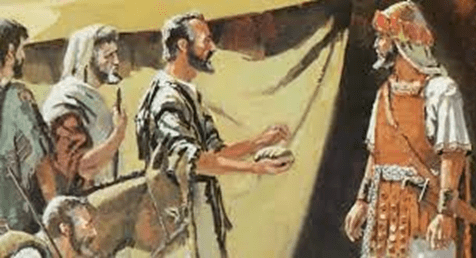
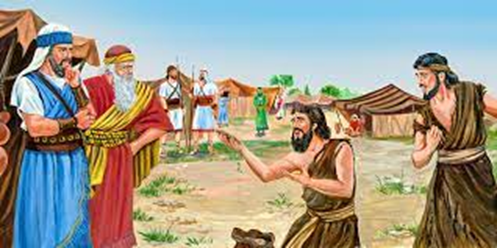
But the people of Gibeon, having heard what Joshua had done to Jericho and Ai, acted deceptively and set out as envoys, carrying on their donkeys worn-out sacks and old wineskins, cracked and mended. They put worn, patched sandals on their feet and threadbare clothing on their bodies, and their whole supply of bread was dry and moldy. They went to Joshua in the camp at Gilgal and said to him and the men of Israel, “We have come from a distant land; please make a treaty with us.”

But the men of Israel said to the Hivites, “Perhaps you dwell near us. How can we make a treaty with you?”

“We are your servants,” they said to Joshua.

Then Joshua asked them, “Who are you and where have you come from?”

“Your servants have come from a very distant land,” they replied, “because of the fame of the LORD your God. For we have heard the reports of Him and all that He did in Egypt, as well as all that He did to the two kings of the Amorites beyond the Jordan—Sihon king of Heshbon and Og king of Bashan, who reigned in Ashtaroth. So the elders and inhabitants of our land told us, ‘Take provisions for your journey; go to meet them and say to them: We are your servants. Please make a treaty with us.’

This bread of ours was warm when we packed it at home on the day we left to come to you. But take a look, it is now dry and moldy. These wineskins were new when we filled them, but look, they are cracked. And these clothes and sandals are worn out from our very long journey.”

Then the men of Israel sampled their provisions, but did not seek the counsel of the LORD. And Joshua made a treaty of peace with them to let them live, and the leaders of the congregation swore an oath to them.

God had ordered the Israelites to wipe out all the inhabitants of Canaan, including all of the Amorite tribes. But after hearing what had happened to Jericho and to Ai, the men of Gibeon decided that war was useless and resorted to deception instead. The Gibeonites realized that if Joshua and his men knew how close the Gibeonites really lived, they would be killed, so they pretended to have come on a long journey. The Gibeonites spoke admiringly of the God of Israel, knowing that would flatter the Israelites. And the Gibeonites dressed in ragged clothes and worn – out sandals and took moldy provisions with them.

The Israelites were completely fooled! Listening to the flattering words about God, Joshua and his men failed to ask that same God whether or not these people were lying. The Israelites sampled some of the provision to verify that they were moldy and forgot to think about how easy it would be to fake something. Not even thinking twice, the Israelites made a treaty of peace with the Gibeonites, letting them live and swearing oaths to them.

APPLICATION: We read this story and wonder how anybody could have been so gullible. Had WE been in that situation, we certainly would not have been so foolish…. Or would we?

There’s a saying that if something seems too good to be true, generally, it is. When these men with their worn – out clothes and moldy provisions showed up, Joshua and his elders should have backed off and prayed about the situation. At the very least, the Israelites could have delayed a decision for a day or two; that would have given them enough time to thoroughly consider why these people were making this gesture when nobody else had done so.

Perhaps part of the reason the Israelites jumped to a wrong conclusion was the successes they had already had at Jericho and at Ai. By now the fighting men were strutting around showing off for the ladies and feeling very pleased with themselves. When the Gibeonites showed up, the Israelites acted out of pride and self – confidence, two very dangerous emotions when facing challenges in a new land.

The tendency to rely on our own judgement when we should be asking God is an all too human mistake. We feel that once God has taken us a certain distance, we should be able to continue on our own, failing to realize that we have only achieved a certain level of success by the grace of God. We are like small children learning to walk, who let go of our father’s hand just long enough to totter across a room and grab onto a chair for support.

One might think that Joshua would have learned his lesson by his initial defeat at Ai when he listened to his spies instead of to the Lord. Never forget that Joshua was a leader with hundreds of thousands of people demanding things and trying to tell him what he should do. Under such circumstances, making wise decisions can be quite difficult. When the Gibeonites showed up, Joshua might have thought that at least the decision concerning these people was a “no – brainer.” Well, it was a demonstration of no brains; however, the situation was far more complex than Joshua initially realized. And Joshua’s oaths were binding, not only on him, but for hundreds of years to come. Much later, King Saul had problems with the Gibeonites, all because Joshua took a quick decision rather than praying about it.

What do you do if you realize you have made a foolish decision? One veteran missionary who served in hospitals in India tells several stories about herself. Working in a cross – cultural environment with medical workers from many other countries gives one unlimited opportunities to make mistakes and offend people. This lady explains that when she realizes that she is in the wrong, she tries to apologize as quickly as possible but then also asks God to “do a Malchus’ ear repair” on the situation.

Who was Malchus? In John 18:10 – 11, Malchus was the servant of the High Priest. When Jesus was arrested at the Garden of Gethsemane, Simon Peter grabbed a sword and cut off Malchus’ ear. Jesus touched Malchus and healed his ear. “Malchus’ ear situations” generally represent times when we have done something wrong and have no idea how to heal the breach.

When Joshua made this ill – considered agreement with the Gibeonites, God didn’t save him from his mistake. And subsequently, the Israelites wound up having to protect the Gibeonites. God will not protect you from your wrong choices when you ignore Him; however, God can and will heal situations when you let Him. God can still heal “Malchus’ ear situations.”

PRAYER: Father God, thank You for loving us even when we ignore You and make foolish mistakes. Help us to ask for guidance instead of blundering on by ourselves. In the mighty and precious Name of King Jesus. Amen.
FEBRUARY 19, 2022 BE STRONG! BE COURAGEOUS! JOSHUA 8:30 – 34 NEVER FORGET!

February 19, 2022

Joshua 8:30 – 34 “At that time Joshua built an altar on Mount Ebal to the LORD, the God of Israel, just as Moses the servant of the LORD had commanded the Israelites. He built it according to what is written in the Book of the Law of Moses: “an altar of uncut stones on which no iron tool has been used. And on it they offered burnt offerings to the LORD, and they sacrificed peace offerings.

And there in the presence of the Israelites, Joshua inscribed on the stones a copy of the law of Moses, which he had written. All Israel, foreigners and citizens alike, with their elders, officers, and judges, stood on both sides of the ark of the covenant of the LORD facing the Levitical priests who carried it. Half of the people stood in front of Mount Gerizim and half of them in front of Mount Ebal, as Moses the servant of the LORD had commanded earlier to bless the people of Israel.

Afterward, Joshua read aloud all the words of the law—the blessings and the curses—according to all that is written in the Book of the Law. There was not a word of all that Moses had commanded that Joshua failed to read before the whole assembly of Israel, including the women, the little ones, and the foreigners who lived among them.”

Joshua has just celebrated the victories over Ai and Bethel. Now it’s time to carry out the rest of the instructions God gave through Moses. God has commanded Joshua and the Israelites to divide into two groups. Joshua is to build an altar of uncut stones on top of Mount Ebal and offer sacrifices and peace offerings. The stones are to remain rough because God doesn’t want the Israelites succumbing to the temptation to create elaborate altars such as those they saw in Egypt. God is not worried about buildings; God is more concerned about obedience and heart attitudes.

The Israelites are standing with the Levitical priests and the Ark of the Covenant. Half the Israelites are standing at the foot of Mount Ebal and half at the foot of Mount Gerizim. Joshua has inscribed the words of the Law on stones and now reads them out to all the Israelites and to everyone accompanying them. God wants His people to remember Whose they are, where they have come from, and His intentions for them. Later on, the Israelites will prove that they are extremely proficient at forgetting, but for now, they are being obedient.

APPLICATION: “Never Forget!” Around the world, this phrase means so many different things to so many people. There are Holocaust monuments and museums, memorials to unknown soldiers from various wars – the list is endless. Why is it important to remember and to commemorate important events?

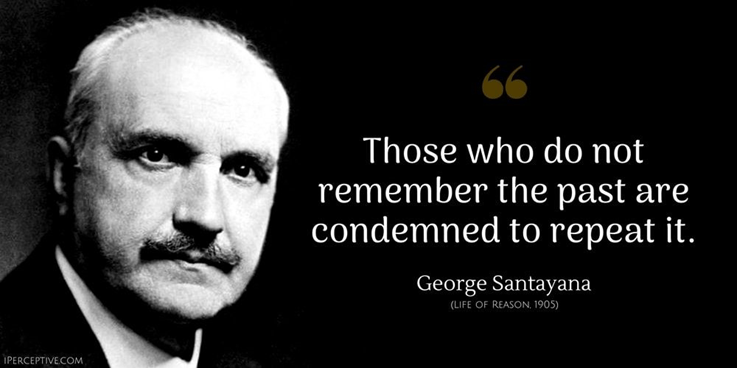
George Santayana is quoted as having said, “Those who do not remember the past are condemned to repeat it.” Certainly, there are parts of the past that the Israelites don’t wish to repeat! Slavery in Egypt for 400 years? Wandering around in the Wilderness for 40 years? Suffering through worries about food and water and grazing? No thanks!

God doesn’t want the Israelites to have to repeat their past either. That is why God has instructed Joshua to read all of the Law to the Israelites. But what about us? Do we try to learn from our past mistakes or do we try to blank out those memories in hopes that they won’t come back to bite us?

Both my husband and I have been previously married and divorced. Divorce is horrible; it’s like a death with nobody to bury. The aftermath of divorce can echo through generations. We firmly believe that marriages should be lasting covenants; however, there are some times when things happen that are beyond one’s control. But when we met, as previously divorced people, we prayed long and hard that God would knit us together and that we would learn from our past mistakes. God has been faithful to do that and we can testify that through the years, God has redeemed our painful pasts and has created something bright and lasting.

What can we do with painful memories? God can be the Keeper of our yesterdays, our todays, and our tomorrows. If something is too painful, ask God to help you handle it. Ask God to redeem that memory so that you can gain everything possible out of it. And then let it go. Trust God to handle it.

PRAYER: Father God, many of us are carrying memories we wish we could forget! Help us to trust You with those memories and redeem them, so that Your perfect love and grace can heal the hurts in our lives. In the matchless Name of King Jesus. Amen.