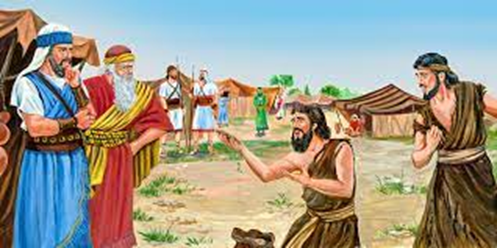
Joshua 9:1 – 15 “Now when news of this reached all the kings west of the Jordan—those in the hill country, the foothills, and all along the coast of the Great Sea toward Lebanon (the Hittites, Amorites, Canaanites, Perizzites, Hivites, and Jebusites)— they came together to wage war against Joshua and Israel.
But the people of Gibeon, having heard what Joshua had done to Jericho and Ai, acted deceptively and set out as envoys, carrying on their donkeys worn-out sacks and old wineskins, cracked and mended. They put worn, patched sandals on their feet and threadbare clothing on their bodies, and their whole supply of bread was dry and moldy. They went to Joshua in the camp at Gilgal and said to him and the men of Israel, “We have come from a distant land; please make a treaty with us.”
But the men of Israel said to the Hivites, “Perhaps you dwell near us. How can we make a treaty with you?”
“We are your servants,” they said to Joshua.
Then Joshua asked them, “Who are you and where have you come from?”
“Your servants have come from a very distant land,” they replied, “because of the fame of the LORD your God. For we have heard the reports of Him and all that He did in Egypt, as well as all that He did to the two kings of the Amorites beyond the Jordan—Sihon king of Heshbon and Og king of Bashan, who reigned in Ashtaroth. So the elders and inhabitants of our land told us, ‘Take provisions for your journey; go to meet them and say to them: We are your servants. Please make a treaty with us.’
This bread of ours was warm when we packed it at home on the day we left to come to you. But take a look, it is now dry and moldy. These wineskins were new when we filled them, but look, they are cracked. And these clothes and sandals are worn out from our very long journey.”
Then the men of Israel sampled their provisions, but did not seek the counsel of the LORD. And Joshua made a treaty of peace with them to let them live, and the leaders of the congregation swore an oath to them.”
God had ordered the Israelites to wipe out all the inhabitants of Canaan, including all of the Amorite tribes. But after hearing what had happened to Jericho and to Ai, the men of Gibeon decided that war was useless and resorted to deception instead. The Gibeonites realized that if Joshua and his men knew how close the Gibeonites really lived, they would be killed, so they pretended to have come on a long journey. The Gibeonites spoke admiringly of the God of Israel, knowing that would flatter the Israelites. And the Gibeonites dressed in ragged clothes and worn – out sandals and took moldy provisions with them.
The Israelites were completely fooled! Listening to the flattering words about God, Joshua and his men failed to ask that same God whether or not these people were lying. The Israelites sampled some of the provision to verify that they were moldy and forgot to think about how easy it would be to fake something. Not even thinking twice, the Israelites made a treaty of peace with the Gibeonites, letting them live and swearing oaths to them.

APPLICATION: We read this story and wonder how anybody could have been so gullible. Had WE been in that situation, we certainly would not have been so foolish…. Or would we?
There’s a saying that if something seems too good to be true, generally, it is. When these men with their worn – out clothes and moldy provisions showed up, Joshua and his elders should have backed off and prayed about the situation. At the very least, the Israelites could have delayed a decision for a day or two; that would have given them enough time to thoroughly consider why these people were making this gesture when nobody else had done so.
Perhaps part of the reason the Israelites jumped to a wrong conclusion was the successes they had already had at Jericho and at Ai. By now the fighting men were strutting around showing off for the ladies and feeling very pleased with themselves. When the Gibeonites showed up, the Israelites acted out of pride and self – confidence, two very dangerous emotions when facing challenges in a new land.
The tendency to rely on our own judgement when we should be asking God is an all too human mistake. We feel that once God has taken us a certain distance, we should be able to continue on our own, failing to realize that we have only achieved a certain level of success by the grace of God. We are like small children learning to walk, who let go of our father’s hand just long enough to totter across a room and grab onto a chair for support.
One might think that Joshua would have learned his lesson by his initial defeat at Ai when he listened to his spies instead of to the Lord. Never forget that Joshua was a leader with hundreds of thousands of people demanding things and trying to tell him what he should do. Under such circumstances, making wise decisions can be quite difficult. When the Gibeonites showed up, Joshua might have thought that at least the decision concerning these people was a “no – brainer.” Well, it was a demonstration of no brains; however, the situation was far more complex than Joshua initially realized. And Joshua’s oaths were binding, not only on him, but for hundreds of years to come. Much later, King Saul had problems with the Gibeonites, all because Joshua took a quick decision rather than praying about it.
What do you do if you realize you have made a foolish decision? One veteran missionary who served in hospitals in India tells several stories about herself. Working in a cross – cultural environment with medical workers from many other countries gives one unlimited opportunities to make mistakes and offend people. This lady explains that when she realizes that she is in the wrong, she tries to apologize as quickly as possible but then also asks God to “do a Malchus’ ear repair” on the situation.
Who was Malchus? In John 18:10 – 11, Malchus was the servant of the High Priest. When Jesus was arrested at the Garden of Gethsemane, Simon Peter grabbed a sword and cut off Malchus’ ear. Jesus touched Malchus and healed his ear. “Malchus’ ear situations” generally represent times when we have done something wrong and have no idea how to heal the breach.
When Joshua made this ill – considered agreement with the Gibeonites, God didn’t save him from his mistake. And subsequently, the Israelites wound up having to protect the Gibeonites. God will not protect you from your wrong choices when you ignore Him; however, God can and will heal situations when you let Him. God can still heal “Malchus’ ear situations.”
PRAYER: Father God, thank You for loving us even when we ignore You and make foolish mistakes. Help us to ask for guidance instead of blundering on by ourselves. In the mighty and precious Name of King Jesus. Amen.
 Burunche's Blog
Leave a comment