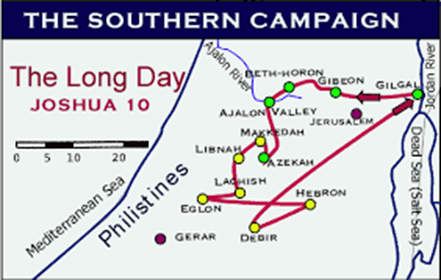
Joshua 10:28 – 43 “On that day Joshua captured Makkedah and struck it down with the sword, along with its king. He devoted to destruction everyone in the city, leaving no survivors. So he did to the king of Makkedah as he had done to the king of Jericho.
Then Joshua and all Israel with him moved on from Makkedah to Libnah and fought against Libnah. And the LORD also delivered that city and its king into the hands of Israel, and Joshua struck down all the people with the sword, leaving no survivors. And he did to the king of Libnah as he had done to the king of Jericho.
And Joshua and all Israel with him moved on from Libnah to Lachish. They laid siege to it and fought against it. And the LORD delivered Lachish into the hands of Israel, and Joshua captured it on the second day. He struck down all the people with the sword, just as he had done to Libnah.
At that time Horam king of Gezer went to help Lachish, but Joshua struck him down along with his people, leaving no survivors.
So Joshua moved on from Lachish to Eglon, and all Israel with him. They laid siege to it and fought against it. That day they captured Eglon and struck it down with the sword, and Joshua devoted to destruction everyone in the city, just as he had done to Lachish.
Then Joshua and all Israel with him went up from Eglon to Hebron and fought against it. They captured it and struck down with the sword its king, all its villages, and all the people. Joshua left no survivors, just as he had done at Eglon; he devoted to destruction Hebron and everyone in it.
Finally Joshua and all Israel with him turned toward Debir and fought against it. And they captured Debir, its king, and all its villages. They struck them down with the sword and devoted to destruction everyone in the city, leaving no survivors. Joshua did to Debir and its king as he had done to Hebron and as he had done to Libnah and its king.
So Joshua conquered the whole region—the hill country, the Negev, the foothills, and the slopes, together with all their kings—leaving no survivors. He devoted to destruction everything that breathed, just as the LORD, the God of Israel, had commanded. Joshua conquered the area from Kadesh-barnea to Gaza, and the whole region of Goshen as far as Gibeon.
And because the LORD, the God of Israel, fought for Israel, Joshua captured all these kings and their land in one campaign. Then Joshua returned with all Israel to the camp at Gilgal.”
While a few fighting men from the five royal cities might have escaped the original battle, allegedly, nobody escaped Joshua’s subsequent campaigns. But did these campaigns really happen as described in these two chapters? Probably not.
In a series of fascinating analytical articles, the web site https://biblicalhistoricalcontext.com/ raises a number of questions and points out the fact that the descriptions of the Southern Campaign and the Northern Campaign in Joshua 10 and 11 are not actually historical descriptions of what happened, but instead are a perfect example of “Ancient Conquest Accounts.” Such accounts were common throughout the ancient world and included language of annihilation, repetitive and redundant language, hyperbole, common narrative structure, and focus on the leader. The ancient Egyptians, for example, recorded numerous such claims on various stone pillars called steles. These accounts were not intended to be factual but rather to indicate that a leader had restored order out of chaos. In one fascinating example, Ramses III claimed to have annihilated the “Peleset,” the Sea People, when he actually used them as mercenaries and then settled them in the cities of Gaza, Ashkelon, and Ashdod. (The Peleset became the Philistines.) (The series is too long to quote everything here; however, I highly recommend that you read the whole series of articles on https://biblicalhistoricalcontext.com/).
Archaeologists attempting to prove the veracity of the “blitzkrieg” campaigns of Joshua have been unable to do so. While many ancient cities were destroyed, they were not all destroyed in the same time period, but rather over the space of roughly 200 years. Later on, the Book of Judges points out that at Joshua’s death, there was still a great deal of land to be conquered; if the Canaanites had actually been wiped out completely, there shouldn’t have been anything left to conquer. There are also the physical challenges represented by the narrative. Again, biblicalhistoricalcontext.com makes the following points:
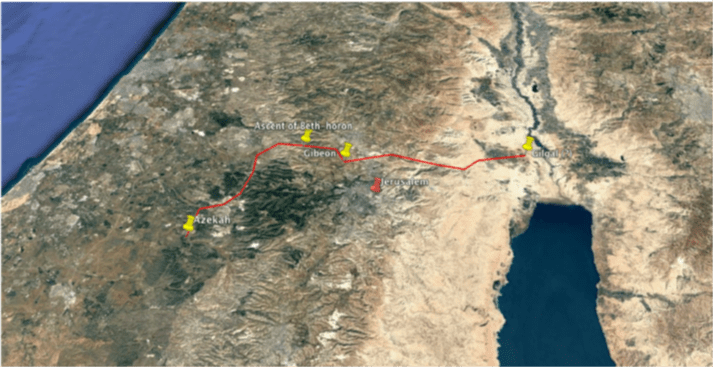
“This would be a journey of 44.5 miles/71.5 km. And the record tells us that it happened in one day. Bear in mind a few things: 1. They began the journey at Gilgal, which is around 400 m. below sea level, they went up to Gibeon, which is around 770 m. above sea level., and then down the Ascent of Beth – horon to Azekah, which is around 250 m. above sea level. So the Israelite army had altitude changes of almost 1.7 km, just over a mile. 2. They would have had to carry supplies of food and water. 3. Over the course of that one day the Israelites started with a forced early morning march from one of the lowest places on earth to one of the highest in Canaan. When they arrived, they fought a battle against a coalition of 5 armies. They chased those who’d retreated down a long and steep canyon and continued picking them off over a distance of many miles of Canaanite country to Azekah.” Anyone who has ever been to Israel knows that there are practically no flat spots and that the terrain is rugged, making it nearly impossible for these events to have occurred in this fashion.
When you look at the accounts in both Joshua 10 and 11, you realize that they appear to be following a formula and that they are emphasizing the importance of the leader. Why write this way? Ancient conquest accounts were propaganda intended to encourage people that their divinely appointed ruler had everything under control. Remember that the Israelites, including Joshua, came out of Egypt, where they had undoubtedly encountered such writing. The purposes of such writing was to “demonstrate the leader’s prowess in battle, to list off their achievements, and to claim divine favour.” Even the account of Joshua’s prayer to God to stop the sun follows the leader – focused formula.

If these two chapters are actually some kind of propaganda, why did God allow them to be included in the Book of Joshua? God always meets people where they are and as they are. The ancient Israelites were people of their time, and these two chapters represent one of the ways by which they encouraged themselves. These two chapters represent the hopes the Israelites had for a quick conquest and their attempts to remind themselves that they had a divinely – appointed leader. These two chapters are a snapshot into the minds and hearts of the Israelites. After these two chapters, the Book of Joshua returns to historical narrative.
APPLICATION: It’s tempting to sneer at the ancient Israelites and their conquest literature, but history is always written by the victors, not by the defeated. Watch any kind of sport and listen to the announcers and you can hear “conquest accounts” being developed right on the air! It is a human tendency to emphasize our successes and to put ignore our failures as much as possible. But what happens if you begin believing your own propaganda? At that point, you are in danger of becoming a legend in your own mind and your own little god.
When the ancient Romans held triumphal marches in Rome, there was one individual whose job it was to walk alongside the conqueror and continually whisper in his ear, “Remember, Caesar, you too are mortal!” Each of us needs to realize that we continue to exist only by the grace and mercy of Almighty God, who loves us even when we are fooling ourselves about our own importance.
PRAYER: Father God, thank You for loving us and for caring for us. Thank You for preserving accounts so that we can better understand the hopes and dreams of those who came before us. In the mighty and precious Name of King Jesus. Amen.
 Burunche's Blog
February 24, 2022 at 5:01 pm
I think in prayer we conquer, and that is in one day. Perhaps the conquer was done one prayer at a time and with God over Joshua, faithful prayer was done, and the people were moved out of their way without the animals and nature taking over. i have had my prayer heard without action done, and yet I know it will be done. Still fascinating about the possible propaganda…