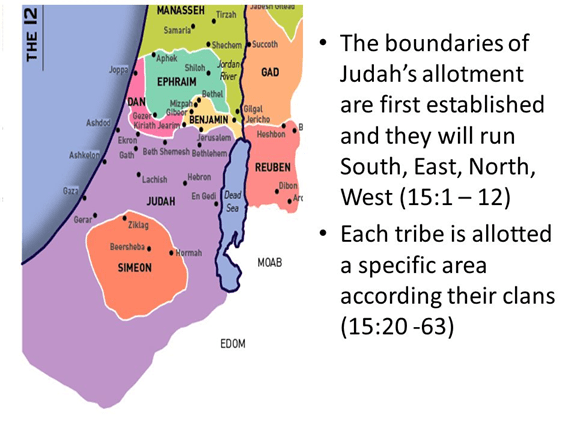
Joshua 15:20 – 63 “This is the inheritance of the clans of the tribe of Judah. These were the southernmost cities of the tribe of Judah in the Negev toward the border of Edom: Kabzeel, Eder, Jagur, Kinah, Dimonah, Adadah, Kedesh, Hazor, Ithnan, Ziph, Telem, Bealoth, Hazor-hadattah, Kerioth-hezron (that is, Hazor), Amam, Shema, Moladah, Hazar-gaddah, Heshmon, Beth-pelet, Hazar-shual, Beersheba, Biziothiah, Baalah, Iim, Ezem, Eltolad, Chesil, Hormah, Ziklag, Madmannah, Sansannah, Lebaoth, Shilhim, Ain, and Rimmon—twenty-nine cities in all, along with their villages.
These were in the foothills: Eshtaol, Zorah, Ashnah, Zanoah, En-gannim, Tappuah, Enam, Jarmuth, Adullam, Socoh, Azekah, Shaaraim, Adithaim, and Gederah (or Gederothaim)—fourteen cities, along with their villages. Zenan, Hadashah, Migdal-gad, Dilan, Mizpeh, Joktheel, Lachish, Bozkath, Eglon, Cabbon, Lahmas, Chitlish, Gederoth, Beth-dagon, Naamah, and Makkedah—sixteen cities, along with their villages. Libnah, Ether, Ashan, Iphtah, Ashnah, Nezib, Keilah, Achzib, and Mareshah—nine cities, along with their villages.
Ekron, with its towns and villages; from Ekron to the sea, all the cities near Ashdod, along with their villages; Ashdod, with its towns and villages; Gaza, with its towns and villages, as far as the Brook of Egypt and the coastline of the Great Sea.
These were in the hill country: Shamir, Jattir, Socoh, Dannah, Kiriath-sannah (that is, Debir), Anab, Eshtemoh, Anim, Goshen, Holon, and Giloh—eleven cities, along with their villages. Arab, Dumah, Eshan, Janim, Beth-tappuah, Aphekah, Humtah, Kiriath-arba (that is, Hebron), and Zior—nine cities, along with their villages. Maon, Carmel, Ziph, Juttah, Jezreel, Jokdeam, Zanoah, Kain, Gibeah, and Timnah—ten cities, along with their villages. Halhul, Beth-zur, Gedor, Maarath, Beth-anoth, and Eltekon—six cities, along with their villages. Kiriath-baal (that is, Kiriath-jearim), and Rabbah—two cities, along with their villages.
These were in the wilderness: Beth-arabah, Middin, Secacah, Nibshan, the City of Salt, and En-gedi—six cities, along with their villages.
But the descendants of Judah could not drive out the Jebusites who lived in Jerusalem. So to this day the Jebusites live there among the descendants of Judah.”
108 cities with their villages! This was the potential inheritance for the Tribe of Judah. Without going into all the details, you can readily see that the Tribe of Judah received more land than any other tribe. But much of this land was wilderness, desert, or semi – desert. And much of it was already occupied by tribes that had no intention of being conquered. For example, the Philistines occupied the towns of Gaza, Ashkelon, Ekron, Ashdod, and Gath. Nobody ever really conquered the Philistines until the armies One of the telling remarks was verse 63: “But the descendants of Judah could not drive out the Jebusites who lived in Jerusalem. So to this day the Jebusites live there among the descendants of Judah.”As a city built on a hill, Jerusalem was easily defended. It was not until King David came that a Judean conquered Jerusalem. The story is told in 2 Samuel 5:6 – 9 “6 The king and his men marched to Jerusalem to attack the Jebusites, who lived there. The Jebusites said to David, “You will not get in here; even the blind and the lame can ward you off.” They thought, “David cannot get in here.” Nevertheless, David captured the fortress of Zion—which is the City of David.On that day David had said, “Anyone who conquers the Jebusites will have to use the water shaft to reach those ‘lame and blind’ who are David’s enemies.” That is why they say, “The ‘blind and lame’ will not enter the palace.” David then took up residence in the fortress and called it the City of David. He built up the area around it, from the terraces inward.” Once David had conquered Jerusalem, he went on to defeat the Philistines; however, the Philistines remained a distinct cultural group until they were conquered by the Babylonians in 604 B.C. (https://www.nationalgeographic.com/culture/article/ancient-dna-reveal-philistine-origins) T
Despite the fact that the Tribe of Judah had been allotted so much land, they failed to conquer much of it. The worst part was the spiritually disastrous influence these unconquered people had on the Israelites. God knew what He was doing when He ordered destruction. Once the Israelites began to compromise, it was much easier to continue than to stand firm. And once the Israelite children began to intermarry with these other people groups, new problems arose.
APPLICATION: Compromise! It seems so safe and so easy, and it’s actually so deadly! Around the world, there are numerous examples of government figures who have made compromises, only to find later that these decisions have led to disaster.
The Tribe of Judah had a mandate to go out and completely conquer that relatively enormous chunk of territory. But parts of the land allotted to Judah had very rugged terrain and difficult conditions. Part of the land was occupied by people with sophisticated weapons. In the end, the Tribe of Judah conquered some of the land, but not all of it.
When things are difficult, it is tempting to back off, to relax a little, and to hope that somehow things will turn out all right. But the Book of Proverbs warns us that such thinking is very dangerous! “A little sleep, a little slumber, a little folding of the hands to rest, and poverty will come upon you like a robber, and need like a bandit.” Proverbs 24:33 – 34
Many times, we realize that God is calling us to do something difficult, something great. Our biggest problem is that we look at ourselves and our own resources and strength, forgetting that if God is calling us to do something, it is His responsibility to give us the strength and resources. Gladys Aylward was a poorly educated housemaid in London who felt God calling her to become a missionary in China. The China Inland Mission rejected Gladys, feeling that she could never learn the Chinese language. But Gladys believed that Jehovah God had called her to work in China and she set off across Europe and Russia by train. Eventually, Gladys did make it to China, where she learned the Chinese language quite well and where she fitted in. The story of Gladys Aylward is told in the book The Little Woman. To the end of Gladys’ life, she always trusted Jehovah God to do great and mighty things, and He did.
IS GOD CALLING YOU TO DO SOMETHING WONDERFUL? DON’T LOOK AT YOURSELF! LOOK TO THE SAME GOD WHO GUIDED AND HELPED GLADYS AYLWARD!
PRAYER: Father God, thank You that You do not play favorites! You helped Gladys Aylward and You will help anyone who truly wants to do Your will. Help us to follow hard after You all the days of our lives. In the mighty Name of King Jesus. Amen.

 Burunche's Blog
March 4, 2022 at 3:44 am
Very Nice! God Bless, Martin
March 5, 2022 at 2:04 am
Well timed, I am having issues of this sort accepting/changing. As always a good sermon, and the the little woman was a great story.