Joshua 20:1 – 9 “Then the Lord said to Joshua: “Tell the Israelites to designate the cities of refuge, as I instructed you through Moses, so that anyone who kills a person accidentally and unintentionally may flee there and find protection from the avenger of blood. When they flee to one of these cities, they are to stand in the entrance of the city gate and state their case before the elders of that city. Then the elders are to admit the fugitive into their city and provide a place to live among them. If the avenger of blood comes in pursuit, the elders must not surrender the fugitive, because the fugitive killed their neighbor unintentionally and without malice aforethought. They are to stay in that city until they have stood trial before the assembly and until the death of the high priest who is serving at that time. Then they may go back to their own home in the town from which they fled.”
So they set apart Kedesh in Galilee in the hill country of Naphtali, Shechem in the hill country of Ephraim, and Kiriath Arba (that is, Hebron) in the hill country of Judah. East of the Jordan (on the other side from Jericho) they designated Bezer in the wilderness on the plateau in the tribe of Reuben, Ramoth in Gilead in the tribe of Gad, and Golan in Bashan in the tribe of Manasseh. Any of the Israelites or any foreigner residing among them who killed someone accidentally could flee to these designated cities and not be killed by the avenger of blood prior to standing trial before the assembly.”
Cities of refuge! Why were these cities so important? In those days, the law of lex talionis, “an eye for an eye and a tooth for a tooth,” generally prevailed throughout the Middle East. If someone was killed, it was imperative that a member of the family, “the avenger of blood,” should hunt down the person and kill him. But what if there was an accident? For example, two men might be cutting down trees, and the axe head from one man’s axe might fly off, striking the second man in the head and killing him. What happens to the innocent man who had no intent to harm his friend? At that point, the innocent man who was grieving the tragic loss of his friend would have to hide himself someplace if he were to avoid being killed by the avenger of blood. Then, as now, accidents could easily happen. The cities of refuge were intended for those innocently involved in such an accident.
Notice that those fleeing to cities of refuge were still made to stand trial before the city elders. Even if such people were found to be blameless, they would still have to remain within the city of refuge until the current high priest died. Why base a return to a home town on the life of the high priest? By indicating that the length of stay in the city of refuge was dependent on the remaining number of years the high priest would live, this law removed the burden of the decision about the length of stay from the city elders. Since the city elders obviously had no control over the high priest’s life, this law clearly placed the amount of time the fugitive would spend in a city of refuge squarely on God. Even the most argumentative Israelite would hesitate to argue with God.
APPLICATION: Accidents can happen! As a child growing up on a midwestern farm, I had farm safety drilled into my head by my parents from an early age. Working with livestock and machinery affords unlimited opportunities for terrible things to occur. In my home area, one farmer and his son died tragically because they were pushing a portable grain elevator across the farm yard when it came into contact with a high – tension wire. Both men were electrocuted. A few months ago, several young men in our northern Ghanaian village drowned in the River Oti when they mis – judged the depth of the water and attempted to land at the wrong spot, stepping out of their canoe into a deep hole.
The fundamental ideas behind the cities of refuge were two – fold: the ideas that accidents happen and that those surviving might be completely innocent of any malicious intent. If you return to the description of the cities of refuge given in Deuteronomy 19:1 – 13, you will see that anyone who was actually found guilty of murder would be handed over by the city elders and not given extended shelter.
One interesting question is this: suppose someone was innocently involved in a death and served their time at the city of refuge. Now the high priest has died, and that person is free to return to their home city. How will such a person be received when they return to their home town? One can only hope for that individual that having fulfilled his debt to society, his former friends and relations would receive him kindly.
How proficient are we at forgiving those who have injured or killed our loved ones? The summer I was 7, my father nearly died in a head – on collision caused by a drunk driver. While the drunk driver escaped unscathed, my father came so close to dying that he literally was at the gates of heaven, seeing his dead grandparents when my mother’s prayers called him back to life. At the time, I failed to take notice; however, now I realize that my mother never uttered a word of complaint or criticism about this man who had so nearly deprived her of her husband and the father of her children. Rather than become bitter, my mother focused all her efforts on supporting my father and helping him get well. Eventually, he made a complete recovery.
Years later, as a general surgery resident, I found myself at the bedside of an eleven year – old boy who had suffered brain damage as a result of a drunk driver. The boy’s father was full of bitterness and could speak of little else apart from planning his revenge on this man. I found myself telling this father that he needed to forgive the man who had done this before he could expect his son to be healed. I felt at the time that this insight was from the Lord. Unforgiveness blocks far more blessings than we can possibly realize.
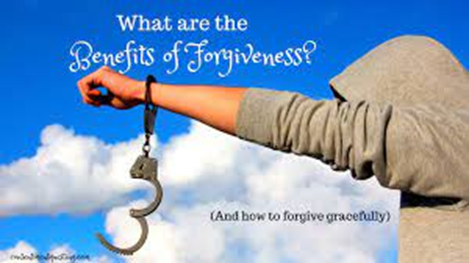
Have you locked up someone emotionally and refused to forgive them? Sad to say, the person you are hurting most is yourself. As long as you focus on the degree of hurt and refuse to forgive, you are like someone in spiritual and emotional handcuffs. Forgiveness is the key to freedom. It’s your choice. What will you do now?
PRAYER: Father God, many of us are treasuring hurts, not realizing that by doing so, we are only damaging ourselves. Help us to freely forgive those who have hurt us in any way, realizing that through Jesus Christ you have already forgiven us. In the mighty and precious Name of King Jesus. Amen.
 Burunche's Blog
Leave a comment