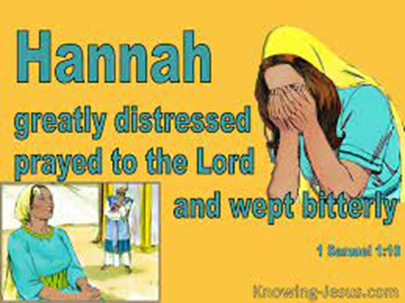
I Samuel 1:1 – 18: “Now there was a man named Elkanah who was from Ramathaim-zophim in the hill country of Ephraim. He was the son of Jeroham, the son of Elihu, the son of Tohu, the son of Zuph, an Ephraimite. He had two wives, one named Hannah and the other Peninnah. And Peninnah had children, but Hannah had none.
Year after year Elkanah would go up from his city to worship and sacrifice to the LORD of Hosts at Shiloh, where Eli’s two sons, Hophni and Phinehas, were priests to the LORD. And whenever the day came for Elkanah to present his sacrifice, he would give portions to his wife Peninnah and to all her sons and daughters. But to Hannah he would give a double portion, for he loved her even though the LORD had closed her womb.
Because the LORD had closed Hannah’s womb, her rival would provoke her and taunt her viciously. And this went on year after year. Whenever Hannah went up to the house of the LORD, her rival taunted her until she wept and would not eat. “Hannah, why are you crying?” her husband Elkanah asked. “Why won’t you eat? Why is your heart so grieved? Am I not better to you than ten sons?”
So, after they had finished eating and drinking in Shiloh, Hannah stood up. Now Eli the priest was sitting on a chair by the doorpost of the temple of the LORD. In her bitter distress, Hannah prayed to the LORD and wept with many tears. And she made a vow, pleading, “O LORD of Hosts, if only You will look upon the affliction of Your maidservant and remember me, not forgetting Your maidservant but giving her a son, then I will dedicate him to the LORD all the days of his life, and no razor shall ever come over his head.”
As Hannah kept on praying before the LORD, Eli watched her mouth. Hannah was praying in her heart, and though her lips were moving, her voice could not be heard.
So, Eli thought she was drunk and said to her, “How long will you be drunk? Put away your wine!”
“No, my lord,” Hannah replied. “I am a woman oppressed in spirit. I have not had any wine or strong drink, but I have poured out my soul before the LORD. Do not take your servant for a wicked woman; for all this time I have been praying out of the depth of my anguish and grief.”
“Go in peace,” Eli replied, “and may the God of Israel grant the petition you have asked of Him.”
“May your maidservant find favor with you,” said Hannah. Then she went on her way, and she began eating again, and her face was no longer downcast.”
CHILDLESSNESS!!! For women throughout the world, there are few sorrows worse than being unable to conceive or to carry a pregnancy to term. Even in industrialized countries, barren women may find themselves facing divorces because their husband want offspring so badly. In less developed countries, children are even more important because they are needed to help families and because many children die before the age of five. But for women in polygamous marriages, the situation is much worse. Now there is competition among the wives to see who can bear the most children the quickest. That was the situation in which Hannah found herself.
“Hannah had a rival.” This is the way a Ghanaian lady would have described the situation. And the rival had already borne several children. In the world of polygamous marriages, this gave the rival an incredible advantage; if she wanted something, she could argue that she should be given extra attention because of her fruitfulness. In a society in which women needed men for protection, Hannah might have been lucky if her husband didn’t simply divorce her or give her the poorest part of the house in which to live or allow her rival to nearly starve her. But Hannah was fortunate; Elkanah loved her so much that he would give her a double share of the meat from the routine sacrifices.
Why did Eli think Hannah was drunk? Well, Eli himself was not a good role model. Later on, we learn that Eli’s sons had been routinely profaning sacrifices by fishing out the choicest parts of the meat before the sacrifice was offered to the Lord, rather than being satisfied with the portion allotted to the priest. Eli knew about this and did nothing to correct his sons. It’s possible that Eli’s sons had been entering the Tabernacle when they were drunk. Despite all these failings, however, Eli was still able to pronounce a blessing over Hannah, a blessing that would be fulfilled.
APPLICATION: Why does the Bible spend so much time describing Elkanah and Hannah? These people were to become the parents of Samuel, one of the most important prophets in the Old Testament. God wants us to know how virtuous these people were so that we might understand that part of the power of Samuel’s ministry came from his parents and the way they raised him.
“And she made a vow, pleading, “O LORD of Hosts, if only You will look upon the affliction of Your maidservant and remember me, not forgetting Your maidservant but giving her a son, then I will dedicate him to the LORD all the days of his life, and no razor shall ever come over his head.” This statement seems baffling, unless you realize that Hannah is promising to dedicate her son to the Lord and to raise him as a Nazarite, specially dedicated to the Lord. Hannah isn’t sure that she can even bear one child, let alone others; but yet she is willing to give that one child, the first fruits of her womb, back to the Lord. As a potential mother of an only child, Hannah is vowing to make the supreme sacrifice. Hannah is giving her son away even before he has been conceived.
Would we have as much faith and courage as Hannah? Many times, parents want to protect their children to keep them safe; however, the Gospel must reach the unsafe parts of the world also. We have friends who have a son ministering to Indians in a remote part of South America. This young man routinely travels by canoe and sleeps in rough jungle huts unprotected from mosquitoes. As I am writing this, a fellow missionary working in Ukraine has moved to a slightly safer area but is still caring for the disabled. The town in which our colleague has sheltered could be attacked at any point. It has been said that the only things we can give our children are roots and wings. The parents of these missionaries have succeeded in doing both. May God help all of us to do the same for our children.
PRAYER: Father God, thank You for loving us and for caring for us. Lord, let everyone who reads this devotional realize that children are only on loan to us and that they are safest when we give them back to You. Help us to trust You for the safety and well being of our children, but let us not hold them back from following hard after You. In the mighty Name of King Jesus. Amen.
 Burunche's Blog
March 16, 2022 at 4:27 pm
A good reminder for all about how it is around the world and to be glad for our blessing when we have them