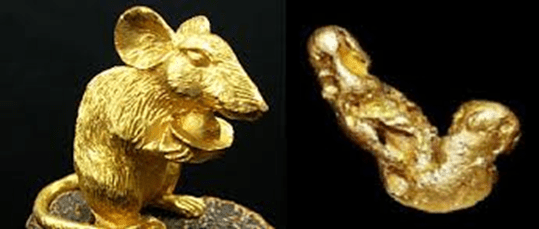
1 Samuel 6:1 – 21 “When the ark of the LORD had been in the land of the Philistines for seven months, the Philistines summoned the priests and diviners, saying, “What shall we do with the ark of the LORD? Tell us how to send it back to its place.” They replied, “If you return the ark of the God of Israel, do not send it away empty, but by all means return it to Him with a guilt offering. Then you will be healed, and you will understand why His hand has not been lifted from you.”
“What guilt offering should we send back to Him?” asked the Philistines. “Five gold tumors and five gold rats,” they said, “according to the number of rulers of the Philistines, since the same plague has struck both you and your rulers. Make images of your tumors and of the rats that are ravaging the land. Give glory to the God of Israel, and perhaps He will lift His hand from you and your gods and your land. Why harden your hearts as the Egyptians and Pharaoh hardened theirs? When He afflicted them, did they not send the people on their way as they departed?
Now, therefore, prepare one new cart with two milk cows that have never been yoked. Hitch the cows to the cart, but take their calves away and pen them up. Take the ark of the LORD, set it on the cart, and in a chest beside it put the gold objects you are sending Him as a guilt offering. Then send the ark on its way, 9but keep watching it. If it goes up the road to its homeland, toward Beth-shemesh, it is the LORD who has brought on us this great disaster. But if it does not, then we will know that it was not His hand that punished us and that it happened by chance.”
So the men did as instructed. They took two milk cows, hitched them to the cart, and penned up their calves. Then they put the ark of the LORD on the cart, along with the chest containing the gold rats and the images of the tumors.

And the cows headed straight up the road toward Beth-shemesh, staying on that one highway and lowing as they went, never straying to the right or to the left. The rulers of the Philistines followed behind them to the border of Beth-shemesh.
Now the people of Beth-shemesh were harvesting wheat in the valley, and when they looked up and saw the ark, they were overjoyed at the sight. The cart came to the field of Joshua of Beth-shemesh and stopped there near a large rock. The people chopped up the cart and offered the cows as a burnt offering to the LORD. And the Levites took down the ark of the LORD and the chest containing the gold objects, and they placed them on the large rock. That day the men of Beth-shemesh offered burnt offerings and made sacrifices to the LORD.
And when the five rulers of the Philistines had seen this, they returned to Ekron that same day.
As a guilt offering to the LORD, the Philistines had sent back one gold tumor for each city: Ashdod, Gaza, Ashkelon, Gath, and Ekron. The number of gold rats also corresponded to the number of Philistine cities belonging to the five rulers—the fortified cities and their outlying villages. And the large rock on which they placed the ark of the LORD stands to this day in the field of Joshua of Beth-shemesh.
But God struck down some of the people of Beth-shemesh because they looked inside the ark of the LORD. He struck down seventy men, and the people mourned because the LORD had struck them with a great slaughter. The men of Beth-shemesh asked, “Who can stand in the presence of the LORD, this holy God? To whom should the ark go up from here?” So they sent messengers to the people of Kiriath-jearim, saying, “The Philistines have returned the ark of the LORD. Come down and take it up with you.”
One more time, the pagan Philistines prove that they have more regard for the God of Israel than do the Israelites! Faced with certain disaster, the Philistines remind themselves of the God represented by the Ark of the Covenant. Although they still refuse to accept this God as their own, they realize they may need to return the Ark to the Israelites. As farmers, the Philistines known that no milk cow will willing leave her calf, so they propose a test in which two milk cows with new calves are hitched to a cart bearing the Ark. Certainly, if these cows go straight to Israel rather than turning around and heading for their calves, the God of Israel must have been behind the plagues. As fetish worshipers, the Philistines also send along 10 gold statues, 5 images of rats and 5 images of the tumors that afflicted them. This specific mention of rats further reinforces the idea that the plague was bubonic plague, since dysentery is necessarily not spread by rats.
The cows head straight for Beth – shemesh, where the Israelites are harvesting wheat. The watching Philistines are satisfied that their plagues were from the Lord of Israel and that they have averted further disaster, so they return home. The Israelites are overjoyed, but do they celebrate the cows and hang garlands around their necks? Do the cows get fed special feed for their efforts? Nope! The Israelites promptly break the cart into pieces and slaughter the cows, using them as a burnt offering to God.
While there is no record of any Philistine ever looking inside the Ark, the men of Beth – shemesh are not nearly as reverent. Seventy men are struck dead when they arrogantly open the Ark. Are the people of Beth – shemesh sorry for their sins? Are you kidding? The only thing those people can think of is to get rid of the Ark as fast as possible, so they message the people of Kiriath – jearim to come and collect the Ark.
APPLICATION: This story is fascinating because it contains the miracle of the milk cows, the relative reverence of the Philistines, and the lack of reverence of the Israelites. True, the Israelites do offer animal sacrifices, courtesy of the Philistines; however, they totally fail to recognize the holiness of the Ark. Clearly, nobody has bothered to teach the Israelites about their own God and they have no idea how special the Ark is. At least the Philistines placed the Ark in the temple of Dagon, the holiest place they possessed. The Israelites are so dense that they simply view the Ark as a potential source of entertainment, and open it.
The request from the people of Beth – shemesh for the people of Kiriath – jearim to come collect the Ark would be funny if it weren’t so tragic. God has given the people of Beth –shemesh the opportunity to shelter the symbol of His holiness. The people of Beth – shemesh totally mishandle the Ark, reaping the results, but failing to repent and honor God as they should. By now, the Israelites have come to view the Almighty, all – powerful God as little more than another local deity, similar to the Baals and the Ashtoreths they have already come to worship.
Let’s look at those cows for a moment. The cows are perhaps the most innocent actors in this entire story. All these cows want is to return to their calves; however, God impels them to pull the cart with the Ark all the way to Beth – shemesh. The cows are lowing all the way, grieving the loss of their calves, but they are being obedient to God. Once the cows arrive at Beth – shemesh, they are immediately slaughtered and sacrificed. Nobody celebrates the cows or thanks the cows. The cows have fulfilled their mission, and they are killed and their bodies burned. As believers, many times we try to fulfill God’s will, hoping that someone will see how special we are and applaud us. The last thing we want is to go unnoticed, let alone having to be sacrificed!
The question is this: Do we really desire God to fulfill His plans if it means that we are not going to gain recognition? Are we willing to walk away from a project, recognizing that we have completely fulfilled our role in it, or do we insist on hanging on, hoping for additional honors? The cows became burnt offerings; at the end, there was nothing left to show they had ever existed. Are we so committed to God’s perfect Plan that we are willing to have every trace of our involvement be obliterated, as long as God’s work goes forward?
The mission hospital in which we work began the same year I was born. Through the years, many Christian workers have served sacrificially so that lives can be saved and men and women can come to know Christ. We who work there today stand on the shoulders of spiritual giants. Even though we may not know the names of all these workers, God knows. At the end of the day, it is God who keeps the records. Are we willing to trust Him with our reputations?
PRAYER: Father God, thank You for loving us and for caring for us. Lord God, help us to follow You so closely that we are not concerned about receiving praise or recognition but that we want only for you to tell us, “Well done, good and faithful servant. Enter into the joy of your Master.” In the mighty and precious Name of King Jesus. Amen.

 Burunche's Blog
Leave a comment