1 Samuel 10:17 – 27 “After this, Samuel summoned the people to the LORD at Mizpah and said to the Israelites, “This is what the LORD, the God of Israel, says: ‘I brought Israel up out of Egypt, and I rescued you from the hands of the Egyptians and of all the kingdoms that oppressed you.’ But today you have rejected your God, who saves you from all your troubles and afflictions, and you have said to Him, ‘No, set a king over us.’ Now therefore present yourselves before the LORD by your tribes and clans.”
Thus, Samuel had all the tribes of Israel come forward, and the tribe of Benjamin was selected. Then he had the tribe of Benjamin come forward by its clans, and the clan of Matri was selected. (Some sources say, “And he brought the family of the Matrites near man by man.”) Finally, Saul son of Kish was selected. But when they looked for him, they could not find him. So again, they inquired of the LORD, “Has the man come here yet?”
And the LORD replied, “Behold, he has hidden himself among the baggage.”
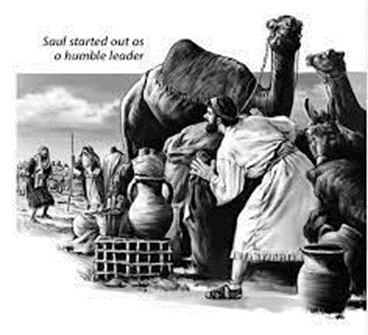
So, they ran and brought Saul, and when he stood among the people, he was a head taller than any of the others. Samuel said to all the people, “Do you see the one the LORD has chosen? There is no one like him among all the people.”
And all the people shouted, “Long live the king!”
Then Samuel explained to the people the rights of kingship. He wrote them on a scroll and laid it up before the LORD. And Samuel sent all the people away, each to his own home.
Saul also went to his home in Gibeah, and the men of valor whose hearts God had touched went with him.
But some worthless men said, “How can this man save us?” So, they despised him and brought him no gifts; but Saul remained silent about it.”
The time for selecting the king has come, and Samuel has called the Israelites together at Mizpah, “watchtower,” about 8 miles north of Jerusalem. Once more, Samuel reminds the Israelites that they are the ones who have rejected God as King over Israel and have made it necessary to select a human king. Now Samuel is casting lots as a means of indicating God’s choice for a king. Why is it necessary to cast lots and to bring the tribes out one by one? The Israelites firmly believe that God is the one who will control the results of this process. If Samuel simply stands up and informs the Israelites that God has already chosen Saul, the Israelites will probably refuse to listen and will reject Saul.
As the tribes come forth and the lot – casting continues, there are probably men already grumbling in the background, “BENJAMIN??? God has selected the tribe of BENJAMIN? Why not my tribe? Benjamin is the smallest and least important tribe in Israel! There must be some mistake!”) By the time the family of Kish is selected and then Saul is nowhere to be found, the grumbling is probably becoming deafening. But Saul can’t hide forever, and the Lord tells Samuel that Saul is hiding among the baggage. Samuel brings Saul out and proclaims him as king.
“Then Samuel explained to the people the rights of kingship. He wrote them on a scroll and laid it up before the LORD. And Samuel sent all the people away, each to his own home. Saul also went to his home in Gibeah, and the men of valor whose hearts God had touched went with him.
But some worthless men said, “How can this man save us?” So, they despised him and brought him no gifts; but Saul remained silent about it.”
Samuel obeys the Lord and explains the rights of kingship to the people; he then writes all that information on a scroll and lays it up before the Lord, probably placing it in a special jar so that it will be preserved. “Men of valor” accompany Saul back to Gibeah. While most of the people go along with God’s choice of Saul as king, there are still some naysayers muttering in the background. It’s likely that these men are from tribes that were passed over during the selection process. “Hmph! Casting lots? Tell me that decision was not manipulated! Samuel is old; he’s probably been bought off by those fellows from Benjamin! Well, we’ll see what happens when Saul has to actually face an enemy! Either he’ll perform like a king or he won’t.” While everyone else brings gifts to Saul, these guys just sulk.
APPLICATION: Have you ever thought that God selected you for a task, only to find out that there were lots of people poised to reject you? When my husband and I first went to the small village where we have spent most of our missionary careers, we KNEW that God had called us! The Holy Spirit wrapped around us like a warm blanket and we were certain that God wanted us to be there. But when we actually moved into that remote area, there were a number of opponents. One man who had previously worked at the clinic and who was now running a chemist shop and doing procedures spread wild stories about us around town. Young nurses were carrying lies about us to the Regional Director of Health Services in hopes that they would be rewarded by being transferred to a better location. Then came the Northern Ethnic Conflict of 1994, when a number of doctors left the government facilities. We were in Accra when fighting broke out; however, we made it back by the end of March and began operating the next day. As we continued to save lives, the critics became quiet. We learned that we could overcome nearly any lie if we kept consistently serving the people.
There are many things that Saul did not do well in the course of his career as a king, but one thing he did right was this: when faced with criticism, Saul kept still. Saul could have attempted to confront his critics, but that really wouldn’t have solved anything. It was far better for Saul to act and demonstrate that God had chosen the right man.
We are still in the Lenten season. One of the many amazing things about the story of Jesus as he went through the mockery of kangaroo court trials at both a religious and civil level is this: Jesus kept still. Jesus was the Son of God as well as the son of man; had he wanted to, he could have identified each of his accusers and could have told the crowds the innermost thoughts of their hearts. Jesus could have completely embarrassed all those who were in league against him, but he refused. Jesus underwent cruel punishment and the most degrading form of death imaginable for the sake of all who would believe in him.
1 Peter 2:21 – 25 tells us, “This is the kind of life you’ve been invited into, the kind of life Christ lived. He suffered everything that came his way so you would know that it could be done, and also know how to do it, step-by-step. He never did one thing wrong, not once said anything amiss. They called him every name in the book and he said nothing back. He suffered in silence, content to let God set things right. He used his servant body to carry our sins to the Cross so we could be rid of sin, free to live the right way. His wounds became your healing. You were lost sheep with no idea who you were or where you were going. Now you’re named and kept for good by the Shepherd of your souls.” (The Message)
If God has called you to do something, listen to God and not to men and women who only want to tear you down! Be certain that it is really God who has called you, but once you are sure, go ahead! There has never been a righteous man or woman or a righteous cause that has not attracted criticism. The more closely you are following God, the stronger the satanic opposition is likely to be.
PRAYER: Father God, thank You for loving us and for caring for us. Thank You for the glorious example that Jesus set for us, that when we face unjust criticism, we don’t always have to defend ourselves because You can set things right. Help us to follow hard after You all the days of our lives. In the mighty and precious Name of King Jesus. Amen.
 Burunche's Blog
Leave a comment