
1 Samuel 16:1 – 13 “Now the LORD said to Samuel, “How long are you going to mourn for Saul, since I have rejected him as king over Israel? Fill your horn with oil and go. I am sending you to Jesse of Bethlehem, for I have selected from his sons a king for Myself.”
“How can I go?” Samuel asked. “Saul will hear of it and kill me!”
The LORD answered, “Take a heifer with you and say, ‘I have come to sacrifice to the LORD.’ Then invite Jesse to the sacrifice, and I will show you what you are to do. You are to anoint for Me the one I indicate.”
So, Samuel did what the LORD had said and went to Bethlehem. When the elders of the town met him, they trembled and asked, “Do you come in peace?”
“In peace,” he replied. “I have come to sacrifice to the LORD. Consecrate yourselves and come with me to the sacrifice.” Then he consecrated Jesse and his sons and invited them to the sacrifice. When they arrived, Samuel saw Eliab and said, “Surely here before the LORD is His anointed.”
But the LORD said to Samuel, “Do not look at his appearance or height, for I have rejected him; the LORD does not see as man does. For man sees the outward appearance, but the LORD sees the heart.”
Then Jesse called Abinadab and presented him to Samuel, who said, “The LORD has not chosen this one either.”
Next Jesse presented Shammah, but Samuel said, “The LORD has not chosen this one either.” Thus, Jesse made seven of his sons pass before Samuel, but Samuel told him, “The LORD has not chosen any of these.”
And Samuel asked him, “Are these all the sons you have?”
“There is still the youngest,” Jesse replied, “but he is tending the sheep.”
“Send for him,” Samuel replied. “For we will not sit down to eat until he arrives.”
So, Jesse sent for his youngest son and brought him in. He was ruddy, with beautiful eyes and a handsome appearance. And the LORD said, “Rise and anoint him, for he is the one.”
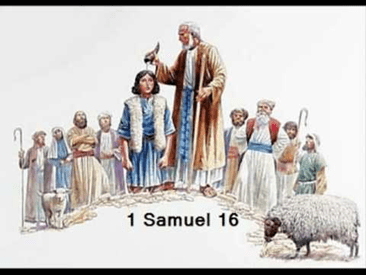
So, Samuel took the horn of oil and anointed him in the presence of his brothers, and the Spirit of the LORD rushed upon David from that day forward. Then Samuel set out and went to Ramah.”
Saul has turned away from the Lord and now the Lord is turning away from Saul. It is Saul himself who has formed an obstruction between himself and God. God instructs Samuel to fill his anointing horn with oil and to go to Bethlehem; however, Samuel realizes that Saul has become dangerous and fears that Saul will kill him. Samuel’s statement is a sad commentary on Saul’s spiritual deterioration. The Lord advises Samuel to take along a heifer for a sacrifice, something that Samuel would commonly do anyway.
It’s ironic that even though Samuel fears Saul, the elders of Bethlehem tremble when they see Samuel and ask if he is coming in peace. Obviously, the elders of Bethlehem are worried that Samuel may be coming to confront them on some issue. What are these elders hiding? Who knows? But Samuel reassures the elders, consecrating them and inviting them to the sacrifice. It’s likely that Jesse is one of the elders, so such an invitation would taken for granted.
When Samuel asks Jesse to have his sons present themselves, Jesse is probably both excited and worried. Samuel, the prophet, is asking to see his sons; what’s going on? Has one of the boys committed some sin? Is God about to wipe out everyone in Jesse’s family? Samuel doesn’t explain but simply begins going from one son to the next, carrying his anointing oil with him. Finally, Samuel himself is baffled and turns to Jesse. “Are these all of your sons?” Samuel asks. “Well, there’s the teenager out watching the sheep,” Jesse replies in confusion. While Jesse keeps a straight face, he’s thinking, “DAVID??? Samuel wants to see DAVID? Why? David is the youngest and smallest; he’s just a small boy. What’s going on?”
Jesse calls David, and as soon as David comes, God orders Samuel to anoint David. “So, Samuel took the horn of oil and anointed him in the presence of his brothers, and the Spirit of the LORD rushed upon David from that day forward.” Throughout Samuel’s life, he has felt the presence of the Lord, but when the Holy Spirit rushes upon David, Samuel stands entranced and amazed. The weight of holiness enfolding David is so strong that it is overwhelming. Samuel is almost driven to his knees. The Hebrew term for the Holy Spirit is “Ruach ha – kodesh.” “Ruach” can mean either “spirit” or “breath.” Samuel realizes that God has breathed over David, empowering him. For Samuel, there is no doubt that David is most certainly the Lord’s anointed who will become king instead of Saul.

APPLICATION: For years, God’s choice of David has given hope to untold numbers of believers. David’s story is the ultimate “feel good” tale. The least likely member of the family turns out to be a future king. David has been risking his life, guarding the family flocks. By David’s own admission later on, he has had to kill lions and bears with only his sling and his staff as weapons. There is nothing to indicate that Jesse has worried about David; after all, Jesse thinks so little of David that when Samuel comes inviting Jesse and his sons to a sacrifice and the feast afterwards, Jesse doesn’t even invite David, but leaves him out in the field with the sheep.
Why has God chosen David, a fifteen – year old nobody? For years, while tending those sheep and goats, David has been spending time with God. While other shepherd boys might be playing games or sleeping, David has taught himself to play the harp and has been talking with God. To protect the sheep and goats, David has also become a deadly marksman with a sling. Today we think very little of slings; however, in the ancient world, slings served the same purpose as long – range rifles in the hands of sharpshooters. Judges 20:16 gives this description: “Among Benjamin’s elite troops, 700 were left-handed, and each of them could sling a rock and hit a target within a hairsbreadth without missing.“ A sling is highly portable and requires only rocks and a skilled user to render it a lethal weapon.
One thing David has NOT been doing as he sits all alone with his sheep; David has not been wasting time feeling sorry for himself. There is nothing to indicate that David has worried about his age or his position in the family; instead, David has been steadily growing spiritually and physically.
Are you a David? Have you been given a lowly position in your organization? Do you feel marginalized? Take heart! Remember that all the time that David was out there in that pasture by himself, God was still with him. Each time David picked up that harp and played to the Lord or picked up that slingshot and practiced his sharp – shooting, God was there watching and smiling.
Colossians 3:17 tells us, “And whatever you do, in word or deed, do it all in the name of the Lord Jesus, giving thanks to God the Father through Him.” Are you a cleaner or a janitor? Then clean to the glory of God! Make the place you clean shine so that anyone who comes there will be comfortable. In New York City, one man was operating an elevator in a huge office building. Rather than leave the elevator unadorned, this man began asking people who rode his elevator for their prayer requests and posting anonymous prayer requests on the walls of the elevator. In addition, this man also decorated the elevator beautifully. Workers in that office building would stand in line to ride that elevator to the exclusion of others, just to see what was new that day and to get the operator to pray for them. Many people testified that simply riding that elevator became one of the brightest spots of their day. Most of the people in that office building remained anonymous, but everybody knew their friend, the elevator operator.
PRAYER: Father God, thank you for loving us and for caring for us. Lord, help us to realize that You have called us to be right where we are right now and that You can make us a blessing to all those around us, if we will only let You. Help us to listen for Your voice and to follow hard after You all the days of our lives. In the mighty and precious Name of King Jesus. Amen.
 Burunche's Blog
Leave a comment