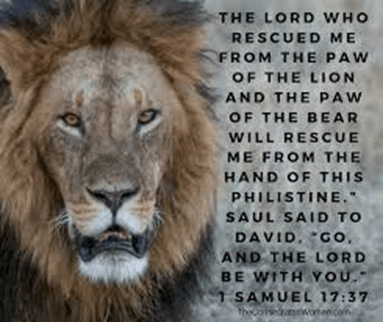
1 Samuel 17:12 – 37 “Now David was the son of a man named Jesse, an Ephrathite from Bethlehem of Judah who had eight sons in the days of Saul. And Jesse was old and well along in years. The three older sons of Jesse had followed Saul to the war: The firstborn was Eliab, the second was Abinadab, and the third was Shammah. And David was the youngest. The three oldest had followed Saul, but David went back and forth from Saul to tend his father’s sheep in Bethlehem. For forty days the Philistine came forward every morning and evening to take his stand.
One day Jesse said to his son David, “Take this ephah of roasted grain (20 dry quarts or 22 liters) and these ten loaves of bread for your brothers and hurry to their camp. Take also these ten portions of cheese to the commander of their unit. Check on the welfare of your brothers and bring back an assurance from them. (Bring back some token that they are all right.) They are with Saul and all the men of Israel in the Valley of Elah, fighting against the Philistines.”
So, David got up early in the morning, left the flock with a keeper, loaded up, and set out as Jesse had instructed him. He reached the camp as the army was marching out to its position and shouting the battle cry. And Israel and the Philistines arrayed in formation against each other.
Then David left his supplies in the care of the quartermaster and ran to the battle line. When he arrived, he asked his brothers how they were doing. And as he was speaking with them, suddenly the champion named Goliath, the Philistine from Gath, came forward from the Philistines and shouted his usual words, which David also heard.
When all the men of Israel saw Goliath, they fled from him in great fear. Now the men of Israel had been saying, “Do you see this man who keeps coming out to defy Israel? To the man who kills him the king will give great riches. And he will give him his daughter in marriage and exempt his father’s house from taxation in Israel.”
David asked the men who were standing with him, “What will be done for the man who kills this Philistine and removes this disgrace from Israel? Just who is this uncircumcised Philistine, that he should defy the armies of the living God?”
The people told him about the offer, saying, “That is what will be done for the man who kills him.”
Now when David’s oldest brother Eliab heard him speaking to the men, his anger burned against David. “Why have you come down here?” he asked. “And with whom did you leave those few sheep in the wilderness? I know your pride and wickedness of heart—you have come down to see the battle!”
“What have I done now?” said David. “Was it not just a question?” Then he turned from him toward another and asked about the offer, and those people answered him just as the first ones had answered.
Now David’s words were overheard and reported to Saul, who called for him.
And David said to Saul, “Let no man’s heart fail on account of this Philistine. Your servant will go and fight him!”
But Saul replied, “You cannot go out against this Philistine to fight him. You are just a boy, and he has been a warrior from his youth.”
David replied, “Your servant has been tending his father’s sheep, and whenever a lion or a bear came and carried off a lamb from the flock, I went after it, struck it down, and delivered the lamb from its mouth. If it reared up against me, I would grab it by its fur, strike it down, and kill it. Your servant has killed lions and bears; this uncircumcised Philistine will be like one of them, for he has defied the armies of the living God.”
David added, “The LORD, who delivered me from the claws of the lion and the bear, will deliver me from the hand of this Philistine.”
“Go,” said Saul, “and may the LORD be with you.”
When the story begins, David is still out herding sheep. David’s three oldest brothers have gone to join King Saul’s army and are now in the Elah valley, watching Saul defy them on a daily basis. Although Saul has selected David as his armor bearer, David has been going back and forth between Bethlehem, where his father is, and Saul’s army. Although Goliath has been challenging the Israelites for forty days, David has evidently been back in Bethlehem all that time and so has not learned of Goliath’s challenge. Jesse sends David back to the camp with grain and bread for his brothers and with cheese for their commanding officer.
Every morning, the Israelites have been marching out from their camp, shouting war cries and advancing to the battle line ….. until Goliath appears. And every time Goliath appears, the Israelites have run back to their camp. David arrives to meet his brothers in the battle line and witnesses Goliath’s challenge and the Israelites’ terrified responses first – hand. Some well – intentioned soul informs David of Saul’s promises of wealth and the hand of his daughter in marriage for any champion defeating Goliath. But when David’s eldest brother Eliab overhears this conversation, he immediately begins insulting David, implying that David has only come to witness the battle and has abandoned his sheep in the wilderness.
At this point, several things are clear. It’s quite likely that David’s seven older brothers are still jealous and furious that Samuel has anointed David and not one of them. David’s older brothers have come to feel entitled, viewing David as little better than a servant. It’s also apparent that David’s brothers have no idea of how many sheep David has been herding or the dangers that David has faced. Evidently, Jesse has never sent one of the older sons out to herd sheep. Sadly enough, David’s family has come to view David as dispensable.
When Saul learns of David’s interest, he too underestimates David, telling David that Goliath has been a warrior from his youth. But David counters that argument by informing Saul that he also has been accustomed to battle, only he has been facing lions and bears by himself. David has been grabbing these vicious animals by their fur and killing them! It’s quite possible that David’s older brothers have never faced the kind of dangers that David has been facing for years.
Not only does David have battle experience, but David has two other advantages: David has faith in the Lord and the Lord’s anointing rests upon him. While Saul tells David, “May the Lord be with you,” it is David who is the true believer.
APPLICATION: I was raised on an Illinois farm in the 1950’s and 1960’s. In those days, most farm work was done by hand, and we had a wide range of animals and poultry. As the oldest child in the family, I followed my father out to the farm as soon as I could walk. As a child, I pitched manure with a four – tined pitchfork, shoveled ground feed from a pickup truck into a storage bin, and learned to milk cows by hand. I have had my feet stepped on by beef cattle and have been slammed into the side of the barn by them. I have scooped half – frozen mud out of hog watering tanks in the dead of winter with a prairie wind howling out of the northwest at forty miles an hour. I have chopped silage out of a pit silo under similar conditions. Blessedly, I never had to fight any lions or bears, but the work was hard, and there were times when I was in danger. My experiences were far from unique; my friends could all tell similar stories, and I was only doing what previous generations of farm kids had done.
Learning to face adversity as a child gives you an enormous advantage later in life. Once you have faced major challenges as a child, things that adult life throws at you become more doable. Even though Saul’s soldiers were carrying weapons, it’s likely that none of them had ever been tested in battle. They had no idea of how to size up Goliath, how to spot his weak points, and how to formulate a strategy for victory. No wonder that these men would take to their heels as soon as Goliath would show up! David, on the other hand, was actually a seasoned warrior who was accustomed to analyzing dangerous situations and finding the best means of defending himself. As a small man facing a large man, David knew that he had to stay beyond the reach of Saul and Saul’s weapons; hence, David’s choice of his slingshot as his weapon of choice.
What can we learn from this part of David’s story? Don’t waste your work experiences! You may think that you have been assigned the dirtiest jobs in your place of work. You have no idea how God is going to use that training and information later on. If you will bless God in the midst of your struggle and thank Him for the lessons He is teaching, one day you will see the reason behind the suffering.
Two of my favorite Christian poets and hymn writers are Annie Johnson Flint and Fances Ridley Havergal. Both these women struggled with major health problems. Annie was a skilled teacher; however, she developed crippling rheumatoid arthritis that brought that dream to a swift end. Frances Ridley Havergal also faced health challenges and died at age 43, from peritonitis. Neither of these women was famous; however, both of them wrote hymns and poems that have continued to inspire millions to this day.
James 1:2 – 4 tells us, “Consider it pure joy, my brothers and sisters, whenever you face trials of many kinds, because you know that the testing of your faith produces perseverance. Let perseverance finish its work so that you may be mature and complete, not lacking anything.” The day David needed battle experience and courage, he already had both those advantages because of the dangers he had already faced. None of David’s brothers had ever killed a single lion or bear, but David had killed both. The suffering you have complained about may be the very thing God is using for your promotion.
PRAYER: Father God, thank You for loving us and for caring for us. Lord, thank You that You can redeem every bit of suffering in our lives, using it for Your purposes and for Your glory. May we follow hard after You all the days of our lives! In the mighty and precious Name of King Jesus. Amen.
 Burunche's Blog
Leave a comment