Archive for April, 2022

APRIL 20, 2022 SO YOU WANT TO BE A PROPHET #36 1 SAMUEL 22:1 – 23 WHERE CAN YOU FIND SAFETY?

April 20, 2022

1 Samuel 22:1 – 23 “So David left Gath and took refuge in the cave of Adullam. When his brothers and the rest of his father’s household heard about it, they went down to him there. And all who were distressed or indebted or discontented rallied around him, and he became their leader. About four hundred men were with him.

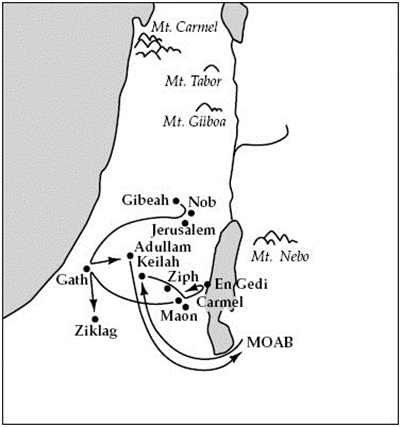
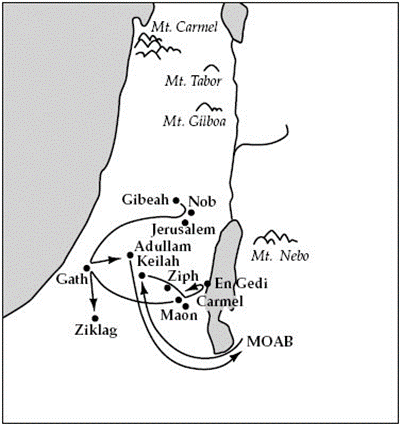
From there David went to Mizpeh of Moab, where he said to the king of Moab, “Please let my father and mother stay with you until I learn what God will do for me.” So, he left them in the care of the king of Moab, and they stayed with him the whole time David was in the stronghold. Then the prophet Gad said to David, “Do not stay in the stronghold. Depart and go into the land of Judah.” So David left and went to the forest of Hereth.

Soon Saul learned that David and his men had been discovered. At that time Saul was in Gibeah, sitting under the tamarisk tree on the hill at Gibeah, with his spear in his hand and all his servants standing around him.

Then Saul said to his servants, “Listen, men of Benjamin! Is the son of Jesse giving all of you fields and vineyards and making you commanders of thousands or hundreds? Is that why all of you have conspired against me? Not one of you told me that my own son had made a covenant with Jesse’s son. Not one of you has shown concern for me or revealed to me that my son has stirred up my own servant to lie in wait against me, as is the case today.”

But Doeg the Edomite, who had stationed himself with Saul’s servants, answered: “I saw the son of Jesse come to Ahimelech son of Ahitub at Nob. Ahimelech inquired of the LORD for him and gave him provisions. He also gave him the sword of Goliath the Philistine.”

Then the king sent messengers to summon Ahimelech the priest, the son of Ahitub, and his father’s whole family, who were priests at Nob. And all of them came to the king. “Listen now, son of Ahitub,” said Saul.

“Here I am, my lord,” he replied.

And Saul asked him, “Why have you and the son of Jesse conspired against me? You gave him bread and a sword and inquired of God for him so that he could rise up against me to lie in wait, as he is doing today.”

Ahimelech answered the king, “Who among all your servants is as faithful as David, the king’s son-in-law, the captain of your bodyguard who is honored in your house? Was that day the first time I inquired of God for him? Far be it from me! Let not the king accuse your servant or any of my father’s household, for your servant knew nothing of this whole affair—not in part or in whole.”

But the king replied, “You will surely die, Ahimelech, you and all your father’s house!”
Then the king ordered the guards at his side, “Turn and kill the priests of the LORD, because they too sided with David. For they knew he was fleeing, but they did not tell me.”

But the king’s servants would not lift a hand to strike the priests of the LORD.

So, the king ordered Doeg, “You turn and strike down the priests!”

And Doeg the Edomite turned and struck down the priests himself. On that day he killed eighty-five men who wore the linen ephod. He also put to the sword Nob, the city of the priests, with its men and women, children and infants, oxen, donkeys, and sheep.

But one of the sons of Ahimelech son of Ahitub escaped. His name was Abiathar, and he fled to David. And Abiathar told David that Saul had killed the priests of the LORD.

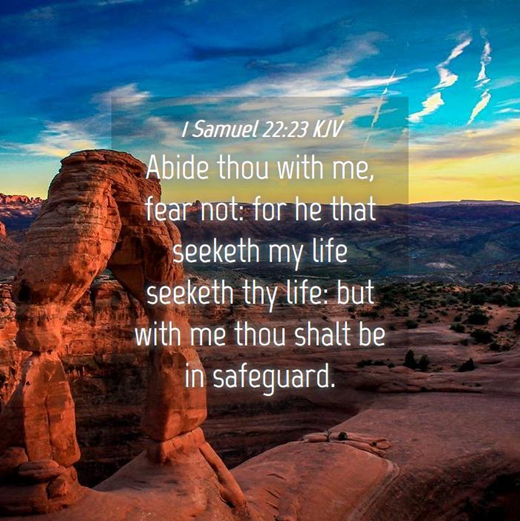
Then David said to Abiathar, “I knew that Doeg the Edomite was there that day, and that he was sure to tell Saul. I myself am responsible for the lives of everyone in your father’s house. Stay with me; do not be afraid, for he who seeks your life is seeking mine as well. You will be safe with me.”

Saul is steadily becoming worse and worse. When someone in Gath recognizes David, David flees to the cave of Adullam and hides there. Now the same brothers who have previously mocked David join him at the cave, along with the rest of his father’s household. David recognizes that not even his aged parents are safe and sends them to the king of Moab. Evidently, David has had some dealings with this king previously and the king knows David to be an honest, trustworthy, and upright man. Obviously, the king of Moab knows what’s happening with Saul and has little use for him.  

And all who were distressed or indebted or discontented rallied around him, and he became their leader. About four hundred men were with him.” During Saul’s reign, he has evidently cut a wide swath through the affections of the Israelites and has left misery in his wake. Four hundred men who are “distressed or indebted or discontented” are rallying around David. Samuel has had nothing to do with Saul for some time, and God has withdrawn the anointing of the Holy Spirit. Left to his own devices, Saul has likely reverted to idol worship, and the demons are causing his mental and emotional state to spiral downwards. The thing Saul needs most is to repent; however, this is the last thing Saul is likely to do!

Not trusting the Israelites, Saul now listens to Doeg, his Edomite head shepherd, who tells him about the help the priests at Nob have given David. In a rage, Saul orders that his servants kill all the inhabitants of Nob; however, his servants refuse out of respect for God and for His priests. Saul then sends Doeg, an unbeliever, to annihilate Nob, slaughtering everyone and everything, including all the animals. This is ironic. When God ordered Saul to wipe out all the Ammonites, including their animals, Saul refused to do so. But now Saul is willing to do to the innocent priests and their families what he refused to do to the Ammonites upon the express orders of the Lord of Israel.  

What hold does Doeg have on Saul? Are they worshiping the same pagan deities? Or is Doeg simply an opportunist bent on getting rich from Saul?

One of Ahimelech’s sons, Abiathar, has escaped and now tells David everything. David is in agony! Gentle Ahimelech and all the priests and their families are dead because of helping David. When David went to Nob, he had no idea that Doeg was there and by the time he realized it, Doeg had already witnessed Ahimelech’s actions. All that David can do now is to offer Abiathar his protection, assuring Abiathar that God is helping them.

APPLICATION: LIFE IS NOT FAIR!!! Ahimelech testified that he had inquired of the Lord many times for David before the day that Doeg was in Nob. Ahimelech acted in good faith, not realizing that Saul’s paranoia had reached new lows. Truly, the priests of Nob and their families were martyred by Saul.

Today in many parts of Africa, India, and Asia, Christians are being martyred for their faith. What is so wonderful about Jesus Christ that anyone would be willing to die rather than renounce Him? The priests of Nob worshiped the One True Living God, the God of Israel, the same God who spoke to Moses out of the burning bush and who led the Israelites for forty years in the wilderness, preserving them and multiplying them. Today Christians are willing to die for their faith because they have an eternal hope. There ‘s a reason that those following Christ describe their conversion experience as “being saved.” Those who truly follow Christ know that without Him, there is no hope in their lives, but with Him they have hope and the promise of eternal life.

If you have never experienced the hope that Jesus Christ can bring into your life, then you may be a church member, but you are not a Christian. In John 14:6 Jesus told his disciples, “I am the way, the truth, and the life. No man comes to the Father, except by me.” When Jesus died on the cross at Calvary, he made the ultimate blood sacrifice for the sins of all who would believe in Him. No amount of good works will earn any of us a place in heaven because all of us are sinners, caught in the web of our sins. Why not step out of the comfort zone of church membership or pseudo – faith garnered from watching on – line media into the reality of faith in Jesus Christ?

PRAYER: Lord Jesus Christ, I confess that I am a sinner and that nothing I can do is good enough to pay for my sins. Thank You for dying for me and spilling Your Blood, even though You never sinned. Lord, forgive me and cleanse me. I thank You that You have promised eternal life to all who will believe in You. I turn my life over to You and ask You to help me so that I will follow hard after You all the rest of my life. Amen.
APRIL 19, 2022 SO YOU WANT TO BE A PROPHET #35 1 SAMUEL 21:1 – 15 WOULD YOU HELP A FRIEND EVEN IF IT MIGHT COST YOU YOUR LIFE?

April 19, 2022

1 Samuel 21:1 – 15 “Then David came to Nob, to Ahimelech the priest. And when Ahimelech met David, he trembled and asked him, “Why are you alone? Why is no one with you?”

“The king has given me a mission,” David replied. “He told me no one is to know about the mission or charge. And I have directed my young men to meet me at a certain place. Now then, what do you have on hand? Give me five loaves of bread, or whatever can be found.”

“There is no common bread on hand,” the priest replied, “but there is some consecrated bread—provided that the young men have kept themselves from women.”

David answered, “Women have indeed been kept from us, as usual when I set out. And the equipment of the young men is holy, as it is even on common missions, and all the more at this time.” So, the priest gave him the consecrated bread, since there was no bread there but the Bread of the Presence, which had been removed from before the LORD and replaced with hot bread on the day it was taken away. Now one of Saul’s servants was there that day, detained before the LORD. And his name was Doeg the Edomite, the chief shepherd for Saul.

Then David asked Ahimelech, “Is there not a spear or sword on hand here? For I have brought neither my sword nor my weapons with me, because the king’s business was urgent.”

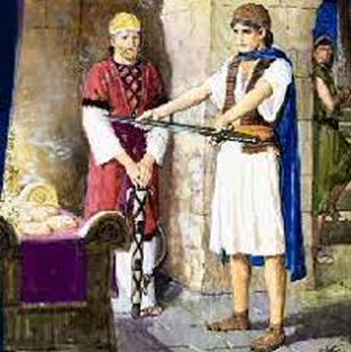
The priest replied, “The sword of Goliath the Philistine, whom you killed in the Valley of Elah, is here; it is wrapped in a cloth behind the ephod. If you want, you may take it. For there is no other but this one.”

And David said, “There is none like it; give it to me.”

That day David fled from Saul and went to Achish king of Gath. But the servants of Achish said to him, “Is this not David, the king of the land? Did they not sing about him in their dances, saying:

‘Saul has slain his thousands, and David his tens of thousands’?”

Now David took these words to heart and was very much afraid of Achish the king of Gath. So, he changed his behavior before them and feigned madness in their hands; he scratched on the doors of the gate and let his saliva run down his beard.

Then Achish said to his servants, “Look, you can see the man is insane! Why have you brought him to me? Am I in need of madmen, that you have brought this man to rave in my presence? Must this man come into my house?”  


David is really on the run! Jonathan has warned David that Saul is truly out to kill him, no matter what. When David and his men come to the city of Nob, where many of the priests live, they are tired and hungry and have no weapons apart from any slings that they might have carried with them. Ahimelech, the high priest, is terrified when David shows up. Nob isn’t that far away from Jerusalem or Gibeah and Ahimelech may already have heard of Saul’s attempts to kill David. David tells Ahimelech a half – truth, telling him that Saul has sent David on an urgent mission. Well, Saul certainly has given David an urgent reason to travel. If David had remained in Saul’s vicinity, Saul would have killed him! When David asks for bread, Ahimelech gives David and his men the show bread that has already been removed from the tabernacle. Technically, only the priests were supposed to consume that bread; however, Ahimelech sensibly feels that as long as David and his men have abstained from sex for several days, they are ritually clean. Ahimelech also gives David Goliath’s sword. Unfortunately, Saul’s chief shepherd, an Edomite named Doeg, witnesses the entire transaction. Doeg’s only interest is whatever he can get from King Saul.

From Nob, David flees to the Philistine city of Gath where Achish is king; however, the king’s servants immediately recognize David and rat him out to the king. David realizes that he has made a mistake and saves himself by pretending to be mad. Evidently, David’s men have remained outside Gath, hiding somewhere else since David is the main target of Saul’s fury.

APPLICATION: Mark 2:23 – 28 tells the story of how Jesus and his disciples were walking past grain fields on the Sabbath. The disciples began pulling off some of the heads of grain and eating them; however, the Pharisees immediately began criticizing Jesus, accusing his disciples and him of working on the Sabbath. Jesus referred to this story of David and the showbread and concluded that “The Sabbath was made for man and not man for the Sabbath. So, the Son of Man is even Lord of the Sabbath.” Jesus used the story of the showbread to emphasize the fact that compassion was more important than rules. By the time of Jesus, the Pharisees had developed so many rules regarding the Sabbath that only very wealthy people could afford to follow all of them.

It appears that David is lying to Ahimelech when he tells Ahimelech that Saul has sent David on an urgent mission; however, it is quite possible that Ahimelech realizes exactly what is happening. Certainly, Saul has been behaving strangely and the news has to have traveled throughout Israel. Saul has never really been a friend to priests; he is no believer. But David doesn’t realize that there is someone who can report to Saul until he sees Doeg. David is undoubtedly worried that he has put Ahimelech in a dangerous position; however, by this point, there is nothing he can do except to leave as quickly as possible. David goes to Gath because he figures that is the last place where Saul is likely to search for him.

Ahimelech helps David even though he undoubtedly knows that there is more to the story than David is admitting. As a high priest, Ahimelech would have access to many sources of information. Perhaps Ahimelech even realizes that Saul is after David and that David is a fugitive. But Ahimelech is a believer and follows the laws of Moses. Hospitality is a fundamental virtue in this culture, and Ahimelech gives David what he can, hoping that he will be able to give Saul a suitable answer if Saul shows up; this might well be why Ahimelech appears to believe David’s lies.

Doeg the Edomite is an interesting character. Why is Saul employing a foreigner as his chief shepherd? Has Saul abused his Israelite workers to the point that nobody in Israel wants to work for him? What is Doeg doing in Nob anyway? There’s no indication that Saul has any sheep in that area. Perhaps Saul is using Doeg as a spy and has sent him to Nob, thinking that David might turn up there.

Doing the right thing can sometimes be very perilous. As I am writing this, I am following the posts of a missionary family in Ukraine who are assisting refugees to flee the country. This family has put themselves in a very dangerous position, and it is quite possible that if their town is overrun by the Russians, they may be slaughtered. A Roman centurion was about to set off into a very dangerous area. Someone asked him what he expected to happen. The centurion replied, “It is necessary for me to go. It is not necessary that I return.”

This is Easter time and we are celebrating the death and resurrection of Jesus Christ. Jesus knew full well what awaited him when he went up to Jerusalem to celebrate the Passover; yet, he went. Had Jesus turned around and hidden himself, he might have dodged the crucifixion but mankind would have been eternally damned. Because Jesus chose to willingly lay down his life, all who will believe in him will have eternal life.

How far are you willing to go to fulfill God’s perfect will for your life? If God asks you to do something dangerous to help friends, will you help or will you hide? Will you choose as Jesus did, risking everything? Choose well. You are choosing for eternity.

PRAYER: Father God, thank You for loving us and for caring for us. Lord, protect all those believers who are caring for refugees in dangerous situations. Help those of us who currently live in safety to be willing to help and to even lay down our lives if it becomes necessary. In the mighty Name of King Jesus. Amen.

APRIL 18, 2022 SO YOU WANT TO BE A PROPHET #34 1 SAMUEL 20:18 – 42 JONATHAN GETS A RUDE AWAKENING!

April 18, 2022

1 Samuel 20:18 “Then Jonathan said to David, “Tomorrow is the New Moon, and you will be missed if your seat is empty. When you have stayed three days, hurry down to the place you hid on the day this trouble began, and remain beside the stone Ezel. I will shoot three arrows to the side of it, as if I were aiming at a target. Then I will send a boy and say, ‘Go, find the arrows!’ Now, if I expressly say to him, ‘Look, the arrows are on this side of you; bring them,’ then come, because as surely as the LORD lives, it is safe for you and there is no danger. But if I say to the young man, ‘Look, the arrows are beyond you,’ then you must go, for the LORD has sent you away. And as for the matter you and I have discussed, the LORD is a witness between you and me forever.”

So, David hid in the field, and when the New Moon had come, the king sat down to eat. He sat in his usual place by the wall, opposite Jonathan and beside Abner, but David’s place was empty. Saul said nothing that day because he thought, “Something has happened to David to make him ceremonially unclean—surely he is unclean.”

But on the day after the New Moon, the second day, David’s place was still empty, and Saul asked his son Jonathan, “Why hasn’t the son of Jesse come to the meal either yesterday or today?”

Jonathan answered, “David urgently requested my permission to go to Bethlehem, saying, ‘Please let me go because our clan is holding a sacrifice in the city, and my brother has told me to be there. So now, if I have found favor in your eyes, please let me go and see my brothers.’ That is why he did not come to the king’s table.”

Then Saul’s anger burned against Jonathan, and he said to him, “You son of a perverse and rebellious woman! Do I not know that you have chosen the son of Jesse to your own shame and to the disgrace of the mother who bore you? For as long as the son of Jesse lives on this earth, neither you nor your kingship shall be established. Now send for him and bring him to me, for he must surely die!”

“Why must he be put to death?” Jonathan replied. “What has he done?” Then Saul hurled his spear at Jonathan to kill him; so, Jonathan knew that his father was determined to kill David. Jonathan got up from the table in fierce anger and did not eat any food that second day of the month, for he was grieved by his father’s shameful treatment of David. In the morning Jonathan went out to the field for the appointment with David, and a small boy was with him. He said to the boy, “Run and find the arrows I shoot.” And as the boy ran, Jonathan shot an arrow beyond him.

When the boy reached the place where Jonathan’s arrow had fallen, Jonathan called to him, “Isn’t the arrow beyond you?” Then Jonathan cried out, “Hurry! Make haste! Do not delay!” So, the boy picked up the arrow and returned to his master.

But the boy did not know anything; only Jonathan and David knew the arrangement. Then Jonathan gave his equipment to the boy and said, “Go, take it back to the city.”

When the young man had gone, David got up from the south side of the stone, fell facedown, and bowed three times. Then he and Jonathan kissed each other and wept together—though David wept more.

And Jonathan said to David, “Go in peace, for the two of us have sworn in the name of the LORD when we said, ‘May the LORD be a witness between you and me, and between your descendants and mine forever.’” Then David got up and departed, and Jonathan went back into the city.”

It finally has happened! All this time, Jonathan has been trying to convince himself that his father really likes David, but now Jonathan’s eyes are opened. Saul is expecting David to show up for the feast of the New Moon and is already plotting to kill David. You can almost see Saul sitting there fidgeting and cracking his knuckles, obsessing on how he will kill David. But David doesn’t turn up, and when Jonathan makes a perfectly reasonable excuse for David, Saul goes ballistic! Not only does Saul insult Jonathan, but he even attempts to spear Jonathan just as he has attempted to spear David.

Now Jonathan finally realizes that Saul indeed plans to murder David at the first opportunity. The next day, Jonathan fulfills his agreement with David, going out for some informal target practice. Jonathan deliberately tells the small boy who is retrieving his arrows that the arrows are beyond him – the signal Jonathan and David have agreed upon to indicate that Saul is out to kill David. The boy retrieves the arrows and returns to the city, while David and Jonathan hug each other and weep together. David probably weeps more because he realizes that this may be the last time he sees Jonathan and he already knows that eventually he and not Jonathan will become king. David realizes that for him to become king, Saul must die; but now for the first time, David is realizing that Jonathan might die as well. David has moved in the prophetic for years, and not all prophetic insights are pleasant ones.

APPLICATION: What do you do when your cherished beliefs about someone turn out to be false?  Jonathan was a loyal son and he longed for Saul to be a virtuous father. But the longer Saul was king, the further his mental state deteriorated. The day Saul insulted Jonathan’s mother and then threw that spear at him, Jonathan was forced to face a grim reality. It became obvious that Saul didn’t care for Jonathan nearly as much as he cared about remaining in power at all costs.

As children, we accept bizarre situations as normal because we have no frame of reference. It is only as we mature that we reflect and realize that we were in dysfunctional situations without realizing it. David and Jonathan both came from dysfunctional families. After all, David’s father thought so little of him that he sent David out to risk his life defending the family sheep from lions and bears. When Samuel came to anoint one of Jesse’s sons as the next king, Jesse didn’t even consider David worthy of mention. We don’t know how many other children Saul had apart from Jonathan; however, at one point, Saul was willing to kill Jonathan because Jonathan had eaten some honey at a time when Saul had foolishly insisted that his men fast completely until the end of a battle. Only public outcry saved Jonathan that time. Now when Jonathan was making reasonable excuses for David and asking polite questions, Saul was prepared to kill Jonathan with a spear in front of the entire court. Those stories don’t speak well for either Jesse or for Saul.

King Saul never worshiped the God of Israel; he only went through the motions. In many respects, Saul was a total failure as a father. We know nothing about Jesse; however, from the behavior of David’s brothers, it’s doubtful that David’s family were sincerely faithful to God either. David turned out as well as he did because he spent all that time out in the wilderness, alone with the sheep and God. God was much more important to David as a father than was Jesse.  

What do you do if your father is incompetent, vicious, unconcerned, or absent? No matter which category your father falls into, you are a fatherless child. Psalm 68:5 – 6 tells us “A father of the fatherless, a defender of widows, Is God in His holy habitation. God sets the solitary in families…”

Let’s face it, there are NO perfect fathers! Even if your father seems to be a lot better than those of your friends, sooner or later, he will fail because he is human. But we have a Heavenly Father who always loves us and always cares for us, who knows us better than we know ourselves. We do not have to depend on earthly fathers for all our training; we can pray to God, and He will guide us and protect us. “Protect us?” you ask. But what about the Christians all over the world who are being killed for their faith? What kind of protection is that?” That is a worthy question. God has never promised to keep us from all suffering, but He has promised to give us the strength to endure suffering. God will protect us spiritually from evil if we only will ask. And God will help us to become good parents so that we can follow His plans for raising children.

Don’t waste time regretting that your father has failed you. Turn to God, and He will comfort, strengthen, encourage, guide and keep you.

PRAYER: Father God, thank You for loving us and for caring for us. Lord, let all those who read these words come to know You, the ultimate Father for whom their hearts long. In the mighty and precious Name of King Jesus. Amen.

APRIL 17, 2022 SO YOU WANT TO BE A PROPHET #33 1 SAMUEL 20:1 – 17  DAVID AND JONATHAN MAKE A BINDING COVENANT

April 17, 2022

1 Samuel 20:1 – 17 “Then David fled from Naioth in Ramah. He came to Jonathan and asked, “What have I done? What is my iniquity? How have I sinned against your father, that he wants to take my life?”

“Far from it!” Jonathan replied. “You will not die. Indeed, my father does nothing, great or small, without telling me. So why would he hide this matter from me? This cannot be true!”

But David again vowed, “Your father knows very well that I have found favor in your eyes, and he has said, ‘Jonathan must not know of this, or he will be grieved.’ As surely as the LORD lives and as you yourself live, there is but a step between me and death.”

Then Jonathan said to David, “Whatever you desire, I will do for you.”

So, David told him, “Look, tomorrow is the New Moon, and I am supposed to dine with the king. Instead, let me go and hide in the field until the third evening from now. If your father misses me at all, tell him, ‘David urgently requested my permission to hurry to Bethlehem, his hometown, because there is an annual sacrifice for his whole clan.’ If he says, ‘Good,’ then your servant is safe, but if he is enraged, you will know he has evil intentions. Therefore, deal faithfully with your servant, for you have brought me into a covenant with you before the LORD. If there is iniquity in me, then kill me yourself; why should you bring me to your father?”

“Never!” Jonathan replied. “If I ever found out that my father had evil intentions against you, would I not tell you?”

Then David asked Jonathan, “Who will tell me if your father answers you harshly?”

“Come,” he replied, “let us go out to the field.” So, the two of them went out into the field, and Jonathan said, “By the LORD, the God of Israel, I will sound out my father by this time tomorrow or the next day. If he is favorable toward you, will I not send for you and tell you? But if my father intends to bring evil on you, then may the LORD punish me, and ever so severely, if I do not tell you and send you on your way in safety. May the LORD be with you, just as He has been with my father. And as long as I live, treat me with the LORD’s loving devotion that I may not die, and do not ever cut off your loving devotion from my household—not even when the LORD cuts off every one of David’s enemies from the face of the earth.”

So, Jonathan made a covenant with the house of David, saying, “May the LORD hold David’s enemies accountable.” And Jonathan had David reaffirm his vow out of love for him, for Jonathan loved David as he loved himself.”

 Jonathan and David are comrades in arms, warriors who recognize each other’s value and who love and respect each other deeply. Although there is no record of Jonathan’s spiritual state, it is likely that Jonathan does worship the Lord of Israel while his father has long since gotten caught up in idol worship.

It is amazing that up to this point, Jonathan still refuses to acknowledge his father’s fear and hatred of David. Saul has already tried to pin David to the wall with his spear at least twice; certainly, the news of that should have gone throughout the palace. Jonathan loves his father and wants to believe that his father is fundamentally a good man; however, Jonathan is enough of a realist to recognize that he might be wrong and that Saul really is out to kill David. Jonathan may also know about Samuel’s having anointed David to be the next king. At any rate, Jonathan makes a covenant with David.

May the LORD be with you, just as He has been with my father. And as long as I live, treat me with the LORD’s loving devotion that I may not die, and do not ever cut off your loving devotion from my household—not even when the LORD cuts off every one of David’s enemies from the face of the earth.”

So, Jonathan made a covenant with the house of David, saying, “May the LORD hold David’s enemies accountable.” And Jonathan had David reaffirm his vow out of love for him, for Jonathan loved David as he loved himself.” David honored this covenant for the rest of his life, and when he became king, he sought out Jonathan’s family members and cared for them.

APPLICATION: For centuries, the relationship between Jonathan and David has served as a model of devoted friendship. Not only are these two young men about the same age, but each of them recognizes the other’s sterling character. Jonathan’s description of the covenant indicates the possibility that someone in his household may become one of David’s enemies in the future.

How many of us have friends on whom we can really count? David and Jonathan are swearing loyalty to the death; do any of us have friends who are that devoted? Sadly, in this day and age, many of us have lots of acquaintances but very few real friends on whom we can count. Jonathan’s father was not a friend to either Jonathan or David, and sometimes our family members may also disappoint us.

Where can we turn for encouragement and support? Proverbs 18:24 tells us, A man of many companions may come to ruin, but there is a friend who stays closer than a brother.” But what if you don’t know anybody like that?

There is one man with whom any one of us can be friends, the man Jesus. Jesus was the Son of God and came to earth to live as a sinless man and to die for the sins of all those in the world who would believe in Him. John 3:16 says, “For God so loved the world that He gave His one and only Son, that everyone who believes in Him shall not perish but have eternal life.

Jonathan and David made a covenant to help and protect each other. Jesus has already carried out His part of the covenant; He has suffered, died, and has been resurrected. But covenants require two parties. What will your response be? Will you accept what Jesus has done for you and allow Him to become your friend?

PRAYER: Dear Lord Jesus, thank you for dying for our sins. Lord, we know that by ourselves, nothing we do is good enough to make it into heaven. But we also know that You have made a way for us. Lord, forgive us our sins. Help us to follow hard after You all the days of our lives. Amen.

APRIL 16, 2022 SO YOU WANT TO BE A PROPHET #32 1 SAMUEL 19:1 – 24 MESS WITH A REAL PROPHET AND YOU WILL BE UTTERLY HUMILIATED!

April 16, 2022

1 Samuel 19:1 – 24 “Then Saul ordered his son Jonathan and all his servants to kill David. But Jonathan delighted greatly in David, so he warned David, saying, “My father Saul intends to kill you. Be on your guard in the morning; find a secret place and hide there. I will go out and stand beside my father in the field where you are, so I can ask about you. And if I find out anything, I will tell you.” Then Jonathan spoke well of David to his father Saul and said to him, “The king should not sin against his servant David; he has not sinned against you. In fact, his actions have been highly beneficial to you. He took his life in his hands when he struck down the Philistine, and the LORD worked a great salvation for all Israel. You saw it and rejoiced, so why would you sin against innocent blood by killing David for no reason?” Saul listened to the voice of Jonathan and swore an oath: “As surely as the LORD lives, David will not be put to death.”

So, Jonathan summoned David and told him all these things. Then Jonathan brought David to Saul to serve him as he had before. When war broke out again, David went out and fought the Philistines and struck them with such a mighty blow that they fled before him. But as Saul was sitting in his house with his spear in his hand, a spirit of distress from the LORD came upon him. While David was playing the harp, Saul tried to pin him to the wall with his spear. But the spear struck the wall and David eluded him, ran away, and escaped that night.

Then Saul sent messengers to David’s house to watch him and kill him in the morning. But David’s wife Michal warned him, “If you do not run for your life tonight, tomorrow you will be dead!” So, Michal lowered David from the window, and he ran away and escaped. Then Michal took a household idol and laid it in the bed, placed some goat hair on its head, and covered it with a garment. When Saul sent the messengers to seize David, Michal said, “He is ill.” But Saul sent the messengers back to see David and told them, “Bring him up to me in his bed so I can kill him.” And when the messengers entered, there was the idol in the bed with the quilt of goats’ hair on its head.

And Saul said to Michal, “Why did you deceive me like this? You sent my enemy away and he has escaped!” Michal replied, “He said to me, ‘Help me get away, or I will kill you!’”

So, David ran away and escaped. And he went to Samuel at Ramah and told him all that Saul had done to him. Then he and Samuel went to Naioth and stayed there. When it was reported to Saul that David was at Naioth in Ramah, he sent messengers to capture him. But when they saw the group of prophets prophesying, with Samuel leading them, the Spirit of God came upon them, and Saul’s messengers also began to prophesy. When this was reported to Saul, he sent more messengers, but they began to prophesy as well. So, Saul tried again and sent messengers a third time, and even they began to prophesy. Finally, Saul himself left for Ramah and came to the large cistern at Secu, where he asked, “Where are Samuel and David?” “At Naioth in Ramah,” he was told.

So, Saul went to Naioth in Ramah. But the Spirit of God came upon even Saul, and he walked along prophesying until he came to Naioth in Ramah. Then Saul stripped off his robes and also prophesied before Samuel. And he collapsed and lay naked all that day and night. That is why it is said, “Is Saul also among the prophets?”

King Saul is really losing his mind! First, Saul orders Jonathan and all his servants to kill David. Jonathan quickly informs David and advises David to hide himself out in the fields. Jonathan thinks he has convinced Saul to spare David’s life when Saul swears an oath to that effect; however, Saul’s oaths are really useless. The next time David is playing his harp to soothe Saul, Saul tries to pin David to the wall with his spear. David runs to his home; however, his wife Michal, who loves him, advises him to flee. Michal lets David down from an upstairs window, and David escapes. But what happens next is fascinating.

While David believes in the One True Living God, Michal obviously is still an idol worshiper. Michal takes a teraphim, a household god, wraps it in cloaks and places goat hair on its head. If Michal were worshiping the Lord of Israel, she wouldn’t tolerate a teraphim in her home. The existence of this household god in Michal’s possession strongly supports the idea that King Saul and his family never worshiped the God of Israel but rather worshiped the idols of the tribes surrounding them. Sadly, this idol worship will later lead to a tragedy for Michal.

At this point, David decides it’s time to report back to Samuel, who is still living in Ramah. When Samuel learns of Saul’s bizarre behavior, he and David relocate to Naioth, where there is a school of prophets over which Samuel is presiding. Saul sends three groups of messengers to seize David; however, as soon as these men come under the influence of the Holy Spirit, they begin prophesying and leave David alone. Finally, Saul figures that if he wants something done right, he should do it himself, so he too comes to Naioth. But as Saul is traveling to Naioth, he comes under the influence of the Holy Spirit and begins prophesying as he walks along. When Saul reaches Samuel at Naioth, Saul strips off his robes and lies naked, prophesying for a day and a night. This incident gives rise to a popular saying, “Is Saul also among the prophets?”

Don’t mess with a real prophet if you don’t want to be totally humiliated! The world is full of self – styled prophets who will tell people what they want to hear. But a prophet who is speaking by the influence of the Holy Spirit will always tell the truth and may speak things that can completely embarrass you. Now at Naioth, there are Saul’s three groups of messengers as well as Saul. Under the influence of the Holy Spirit, Saul has stripped off his royal robes and is lying naked. The Holy Spirit has moved on Saul’s messengers as a sign that the Lord God of Israel is in control and not King Saul. Now that same Holy Spirit has led Saul to remove his robes as a further sign that his kingship is coming to an end.  

Why doesn’t David begin prophesying? David has been submitted to the Holy Spirit for years and has no need of any demonstrations of his obedience. But Saul and his men have never really submitted to the One True Living God until now.

APPLICATION: The One True Living God is not to be scorned! King Saul has become a legend in his own mind; however, he has never truly worshiped the Lord of Israel. Obedience is better than sacrifice, and Saul has never been fully obedient, despite slaughtering all kinds of animals for ritual sacrifices.

Psalm 95:6 – 11 tells us, “O come, let us worship and bow down; let us kneel before the LORD our Maker. For He is our God, and we are the people of His pasture, the sheep under His care. Today, if you hear His voice, do not harden your hearts as you did at Meribah, in the day at Massah in the wilderness, where your fathers tested and tried Me, though they had seen My work. For forty years I was angry with that generation, and I said, “They are a people whose hearts go astray, and they have not known My ways.” So, I swore on oath in My anger, “They shall never enter My rest.”

Saul has always settled for form over function, for preserving appearances while he does his own will. Even if we do our own wills in God’s Name, we will never succeed because we are already starting from a wrong basis. When David went to Samuel, he did not begin prophesying because he had been writing prophetic songs for much of his life. David’s heart was clean and he did not need to strip off any worldly trappings.

What is the state of your heart? Are you a David, following God whole – heartedly? Or are you a Saul, keeping up appearances and trying to do your own will, even if you claim to be doing things for God? When God had Samuel anoint David, God told Samuel that He sees the heart and is not impressed with outward appearances. Today, let us truly worship the One True Living God!

PRAYER: Father God, thank You for loving us and for caring for us. Lord Jesus, thank You for living as a man, dying for our sins, and for Your glorious resurrection. Holy Spirit, move in the hearts of all who read this devotional, that they will truly know You in Your fullness. In the mighty and precious Name of King Jesus. Amen.

APRIL 15, 2022 SO YOU WANT TO BE A PROPHET #31 1 SAMUEL 18:17 – 30 WHAT KIND OF A DOWRY IS THIS?

April 15, 2022

1 Samuel 18:17 – 30 “Then Saul said to David, “Here is my oldest daughter, Merab. I will give her to you in marriage. Only be valiant for me and fight the LORD’s battles.” But Saul was thinking, “I need not raise my hand against him; let the hand of the Philistines be against him.” And David said to Saul, “Who am I, and what is my family or my father’s clan in Israel, that I should become the son-in-law of the king?” So, when it was time to give Saul’s daughter Merab to David, she was given in marriage to Adriel of Meholah.

Now Saul’s daughter Michal loved David, and when this was reported to Saul, it pleased him. “I will give her to David,” Saul thought, “so that she may be a snare to him, and the hand of the Philistines may be against him.” So, Saul said to David, “For a second time now you can be my son-in-law.”

Then Saul ordered his servants, “Speak to David privately and tell him, ‘Behold, the king is pleased with you, and all his servants love you. Now therefore, become his son-in-law.’”

But when Saul’s servants relayed these words to David, he replied, “Does it seem trivial in your sight to be the son-in-law of the king? I am a poor man and lightly esteemed.”

And the servants told Saul what David had said.

Saul replied, “Say to David, ‘The king desires no other dowry but a hundred Philistine foreskins as revenge on his enemies.’” But Saul intended to cause David’s death at the hands of the Philistines.

When the servants reported these terms to David, he was pleased to become the king’s son-in-law. Before the wedding day arrived, David and his men went out and killed two hundred Philistines. He brought their foreskins and presented them as payment in full to become the king’s son-in-law. Then Saul gave his daughter Michal to David in marriage.

When Saul realized that the LORD was with David and that his daughter Michal loved David, he grew even more afraid of David. So, from then on Saul was David’s enemy.

Every time the Philistine commanders came out for battle, David was more successful than all of Saul’s officers, so that his name was highly esteemed.”

Saul has decided that David is really his enemy, failing to realize that he, Saul, is the problem. It is God who has chosen David to be the next king because of David’s pure heart; David fully realizes that he has no resources on his own apart from God. Rather than have David assassinated, Saul tries to encourage David to engage the Philistines in hopes that they will do his dirty work for him. (Tragically, later on when David has impregnated Bathsheba, David uses the same sneaky device to kill Uriah the Hittite, Bathsheba’s husband. David arranges for Uriah to be sent into the thickest part of a battle where he is slaughtered.)

Saul’s first ploy is to give his oldest daughter to David; however, David gives a wise and humble answer. “Who am I, and what is my family or my father’s clan in Israel, that I should become the son-in-law of the king?” Saul’s daughter Michal falls in love with David. Saul immediately seizes this opportunity by requiring one hundred Philistine foreskins as a dowry, essentially demanding that David kill one hundred Philistine warriors before he can marry Michal. But David and his men kill two hundred Philistines and David presents their foreskins to Saul. Now Saul realizes that the Lord is with David and that Michal loves David and will be loyal to him. David, meanwhile, is scoring additional successes in battle.

APPLICATION: Centuries after David lived, St. Paul posed the question, “What then shall we say in response to these things? If God is for us, who can be against us?” (Romans 8:31) David succeeded because God was with him and was empowering him. When Saul threw down the challenge of killing 100 Philistines, David and his men killed 200, leaving no doubt that David had fulfilled Saul’s demands. Although this demand sounds grisly, such things were not unheard of at that time, and Saul was exercising his royal prerogative.

While none of us would choose to be put in David’s position, we may still find ourselves facing demands on our job that seem incredible. David’s example should encourage us. David was able to win through by the power of God. God does not play favorites; that same power is available to us today.

PRAYER: Father God, thank You for loving us and for caring for us. Lord, help us to remember that when we face challenges, Your mighty power is available to us just as it was to David. In the mighty Name of King Jesus. Amen.

APRIL 14, 2022 SO YOU WANT TO BE A PROPHET #30 1 SAMUEL 18:1 – 16 ARE YOU GROWING BETTER OR MORE BITTER?

April 14, 2022

1 Samuel 18:1 – 16 “After David had finished speaking with Saul, the souls of Jonathan and David were knit together, and Jonathan loved him as himself. And from that day Saul kept David with him and did not let him return to his father’s house.

Then Jonathan made a covenant with David because he loved him as himself. And Jonathan removed the robe he was wearing and gave it to David, along with his tunic, his sword, his bow, and his belt.

 So, David marched out and prospered in everything Saul sent him to do, and Saul set him over the men of war. And this was pleasing in the sight of all the people, and of Saul’s officers as well.

As the troops were returning home after David had killed the Philistine, the women came out of all the cities of Israel to meet King Saul with singing and dancing, with joyful songs, and with tambourines and other instruments. And as the women danced, they sang out:

“Saul has slain his thousands,

and David his tens of thousands.”

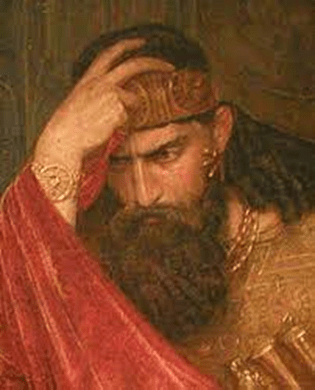
And Saul was furious and resented this song. “They have ascribed tens of thousands to David,” he said, “but only thousands to me. What more can he have but the kingdom?” And from that day forward Saul kept a jealous eye on David.

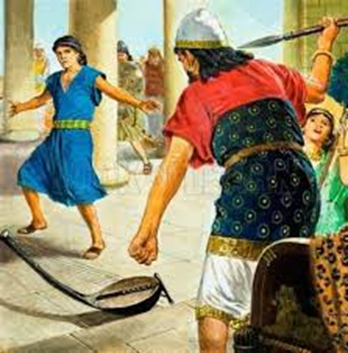
The next day a spirit of distress sent from God came upon Saul, and he prophesied inside the house while David played the harp as usual. Now Saul was holding a spear, and he hurled it, thinking, “I will pin David to the wall.” But David eluded him twice.

So, Saul was afraid of David, because the LORD was with David but had departed from Saul. Therefore, Saul sent David away and gave him command of a thousand men. David led the troops out to battle and back, and he continued to prosper in all his ways, because the LORD was with him. When Saul saw that David was very successful, he was afraid of him. But all Israel and Judah loved David, because he was leading them out to battle and back.”

Jonathan, Saul’s son, was a brave warrior. When Jonathan met David, they realized they were kindred souls. David had already killed Goliath and was now leading the army of Israel out to war. The two men understood each other and had no need for lengthy explanations. Once a military person, always a military person. Most former military people have little use for people who have never served but who still feel they are experts on military matters. Trying to describe the experience of being under fire is almost impossible, and fielding ignorant observations leaves many military men and women fed up with the general public. Remember that Jonathan and his armor bearer had tackled a Philistine camp by themselves and had come out victorious. By this point, Jonathan may also have begun to realize that there was something wrong with his father and that his father was becoming emotionally and mentally unhinged. Both Jonathan and David needed a close friend and God allowed them to find each other. As tokens of close friendship, Jonathan gave David the robe he was wearing, along with his tunic, his sword, his bow and his belt.

God gave David success in all his efforts. Saul’s officers and fighting men were undoubtedly relieved to have someone sane leading them, and they responded admirably. But a new problem surfaced; the people in the street were singing songs about Saul slaying thousands while David slayed tens of thousands. Saul became insanely jealous! Saul was the king and David was an interloper! Surely, David must have his eye on the kingdom!

Was Saul aware that Samuel had already anointed David as the next king? Possible but doubtful. Samuel had been careful to disguise that assignment as a routine sacrifice. Perhaps the elders of Bethlehem gossiped about the situation; however, it’s possible that only Jesse and his sons were parties to David’s anointing. Certainly, David’s older brothers wouldn’t be in a hurry to spread the news; they were still furious about being passed over by Samuel.  

“The next day a spirit of distress sent from God came upon Saul, and he prophesied inside the house while David played the harp as usual. Now Saul was holding a spear, and he hurled it, thinking, “I will pin David to the wall.” But David eluded him twice.” Saul was becoming increasingly paranoid and may have become delusional as well. The mention of “prophesying” is confusing. Was Saul actually prophesying by the power of the Holy Spirit, or was he speaking by the inspiration of a demonic spirit? Saul’s attempt to spear David twice suggests that Saul was increasingly coming under the influence of the demonic.  

“So, Saul was afraid of David, because the LORD was with David but had departed from Saul. Therefore, Saul sent David away and gave him command of a thousand men. David led the troops out to battle and back, and he continued to prosper in all his ways, because the LORD was with him. When Saul saw that David was very successful, he was afraid of him. But all Israel and Judah loved David, because he was leading them out to battle and back.” What’s happening? If Saul was worried about David’s influence over the people, why didn’t Saul take over military leadership instead of giving David an even – larger stage on which to perform? By this point, Saul was close to the end of his reign and was probably in his late 60’s. Perhaps Saul was tired of fighting or perhaps he was hoping that the Philistines would kill David, saving him the trouble. At any rate, God was blessings David’s efforts magnificently.

APPLICATION: The progressive deterioration of King Saul is one of the saddest stories in the Old Testament. Rebellious and arrogant, first, Saul lost the opportunity to found a dynasty, and then he lost the kingdom. By all accounts, Jonathan, Saul’s son, was an excellent man who deserved a better father. There is nothing to indicate that David was doing anything to undermine Saul. As a young military commander acting under the guidance of the Lord, David was simply glad to be fulfilling God’s will. Throughout David’s life, he consistently honored Saul as a second father and refused to do anything to damage Saul.

What can we learn from this situation? There is a slogan painted on small public buses that reads “No condition is permanent.” Proverbs 27:24 asks, “For riches are not forever; does a crown endure to all generations?”  As long as King Saul was alive, he still had the chance to turn his heart back to the Lord of Israel and to truly worship and serve Him. Even though Saul had lost the kingdom, he still had the opportunity to do good. But at some point, Saul had already turned away from the Lord. Not once did Saul refer to the Lord of Israel as his Lord, but he continued to refer to the Lord as the God of Samuel, the Lord of Samuel, or merely the Lord. Saul never really knew God at all. It’s entirely possible that as a young man, Saul may have gotten caught up in some kind of idol worship that blinded his eyes to the Lord.

David was doing nothing to harm Saul but was only proceeding to follow the calling God had placed on his life. But years of involvement with the demonic was causing Saul to become increasingly confused and violent. David and Saul were on a collision course. Perhaps Saul had told himself that there would be plenty of time to worship the Lord later. But “later” never came.

What are we doing with our lives? Whom are we worshiping? We are in Easter Week and you are reading this devotional on Maundy Thursday, the day that commemorates Jesus’ last supper with His disciples. That night, Jesus knew He was going to die, even if the disciples did not. Jesus knew that He had been sent to be the sinless blood sacrifice for the sins of all those who would believe in Him.

Saul or David, eternal damnation or eternal salvation. Saul continually turned away from the Lord and eventually died a confused and bitter man. David followed the Lord and received the accolade that he was a man after God’s own heart. The choice is ours. Choose wisely.

PRAYER:  Father God, please help all who read this to know You in Your love, Your mercy, Your fullness, and Your grace. Help us to follow hard after You all the days of our lives. In the mighty and precious Name of King Jesus. Amen.

APRIL 13, 2022 SO YOU WANT TO BE A PROPHET #29 1 SAMUEL 17:38 – 58 FACE GIANTS AND WIN WITH GOD’S HELP!

April 12, 2022

1 Samuel 17:38 -58 “Then Saul clothed David in his own tunic, put a bronze helmet on his head, and dressed him in armor. David strapped his sword over the tunic and tried to walk, but he was not accustomed to them.

“I cannot walk in these,” David said to Saul. “I am not accustomed to them.” So, David took them off. And David took his staff in his hand, selected five smooth stones from the brook, and put them in the pouch of his shepherd’s bag. And with his sling in hand, he approached the Philistine.

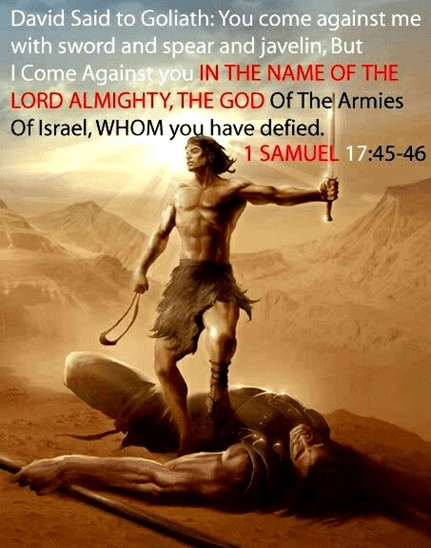
Now the Philistine came closer and closer to David, with his shield-bearer before him. When the Philistine looked and saw David, he despised him because he was just a boy, ruddy and handsome. “Am I a dog,” he said to David, “that you come at me with sticks?” And the Philistine cursed David by his gods. “Come here,” he called to David, “and I will give your flesh to the birds of the air and the beasts of the field!” But David said to the Philistine, “You come against me with sword and spear and javelin, but I come against you in the name of the LORD of Hosts, the God of the armies of Israel, whom you have defied. This day the LORD will deliver you into my hand. This day I will strike you down, cut off your head, and give the carcasses of the Philistines to the birds of the air and the creatures of the earth. Then the whole world will know that there is a God in Israel. And all those assembled here will know that it is not by sword or spear that the LORD saves; for the battle is the LORD’s, and He will give all of you into our hands.”

As the Philistine started forward to attack him, David ran quickly toward the battle line to meet him. Then David reached into his bag, took out a stone, and slung it, striking the Philistine on the forehead. The stone sank into his forehead, and he fell face down on the ground.

Thus, David prevailed over the Philistine with a sling and a stone; without a sword in his hand, he struck down the Philistine and killed him. David ran and stood over him. He grabbed the Philistine’s sword and pulled it from its sheath and killed him; and he cut off his head with the sword.

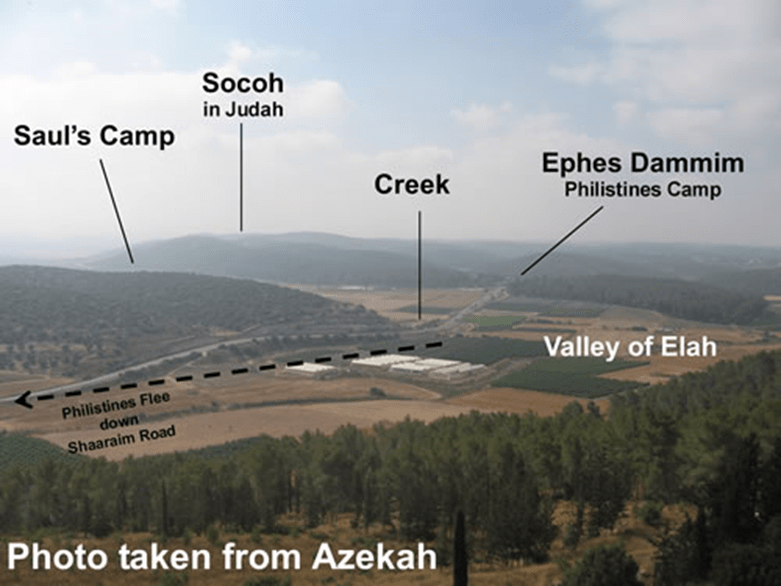
When the Philistines saw that their hero was dead, they turned and ran. Then the men of Israel and Judah charged forward with a shout and pursued the Philistines to the entrance of Gath and to the gates of Ekron. And the bodies of the Philistines were strewn along the Shaaraim road to Gath and Ekron.

When the Israelites returned from their pursuit of the Philistines, they plundered their camps. David took the head of the Philistine and brought it to Jerusalem, but he put Goliath’s weapons in his own tent. As Saul had watched David going out to confront the Philistine, he said to Abner the commander of the army, “Abner, whose son is this young man?”

“As surely as you live, O king,” Abner replied, “I do not know.”

“Find out whose son this young man is!” said the king.

So, when David returned from killing the Philistine, still holding his head in his hand, Abner took him and brought him before Saul.

“Whose son are you, young man?” asked Saul.

“I am the son of your servant Jesse of Bethlehem,” David replied.”

Saul had good intentions but little understanding. When David stood before Saul, the only thing Saul could think of was to dress David in his (Saul’s) armor and to give him a sword. But David was about to face a giant whose reach was far greater than David’s. Swords and armor would be worthless under such conditions. Saul was used to fighting men his own size while David had already been killing animals far bigger than he was. David had more experience in such situations than Saul did. Selecting five smooth stones that would work well in a sling, David advanced to the battle.

As David approached, Goliath began cursing him by the Philistine gods. David’s reply is one that echoes down the ages. “But David said to the Philistine, “You come against me with sword and spear and javelin, but I come against you in the name of the LORD of Hosts, the God of the armies of Israel, whom you have defied. This day the LORD will deliver you into my hand. This day I will strike you down, cut off your head, and give the carcasses of the Philistines to the birds of the air and the creatures of the earth. Then the whole world will know that there is a God in Israel. And all those assembled here will know that it is not by sword or spear that the LORD saves; for the battle is the LORD’s, and He will give all of you into our hands.”

Make no mistake! This battle was not merely a physical one. The Philistines had been invoking the names of their gods, but now David came in the Name of the One True Living God. David RAN toward the battle line, setting a stone in his sling as he did so. David needed speed so that he could get in, shoot that stone from his sling, and then retreat beyond the reach of Goliath’s spear. One smooth stone plus the power of the One True Living God and Goliath lay dead on the ground. Not taking any chances, David seized Goliath’s sword and cut off his head!

The Valley of Elah is about 15 miles (23 km.) west of Bethlehem and about 20 miles (32 km.) east of the Mediterranean Sea. It’s located on the western edge of the Judean lower hills and was an important travel route from the coastal cities up to the center of the land of Judah and its main cities of Bethlehem, Jerusalem, and Hebron. The distance between the point at which David killed Goliath and the city of Gath is roughly six miles. Ekron was eleven miles north of Gath.

Make no mistake! The defeat of Goliath was not merely a physical one, but also a spiritual one as well. It is possible that as long as Goliath was roaring out his challenges and invoking the Philistine gods, those same demons may have deceived the Israelites, causing them to believe that the entire Philistine battle line was full of giants. Once Goliath was no longer a threat, the Israelites realized they were facing normal – sized men and charged on the Philistines, killing many of them and chasing the remnant as far as the cities of Gath and Ekron.

APPLICATION: It’s amazing how easy it is to create giants in our own imagination! Challenges that are not dealt with promptly may come to assume gigantic proportions in our minds. But if we will face these challenges and begin to take action against them, we may find that they shrink rapidly. Paul Assaiante and James Zug have written a book entitled “Run to the Roar: Coaching to Overcome Fear.” The book description is as follows: ““Run to the Roar” is the story of a coach who succeeds in recruiting young men from around the world, getting them to work as a team, managing personalities, calming egos, and encouraging daily effort and focus under pressure.” The book is based on the experiences of the coach of the Trinity men’s squash team. “For 244 consecutive dual matches over the past twelve years, the Trinity men’s squash team has gone unbeaten. No other team in any collegiate sport has achieved the same sustained level of greatness.” (Strand Publisher’s description)

As long as the Israelites sat in their camps, they were safe but defeated. It was only when David moved in the power of the Holy Spirit to kill Goliath that the Israelites were able to go forward. What giants are you facing today? Perhaps it is something as simple as needing to declutter your home. You may feel that you are facing towering piles of books or papers. Pray and ask God for guidance and strength and then make a small start. Remember, it only took David one smooth stone to kill Goliath. Your giants may fall more easily than you think if you face them.

PRAYER: Father God, thank You for loving us and for caring for us. Lord, many of us are facing giants of various kinds. Help us to look to You for Your Holy Spirit power and then to begin dealing with the giants. In the mighty and precious Name of King Jesus. Amen.

APRIL 12, 2022 SO YOU WANT TO BE A PROPHET #28 1 SAMUEL 17:12 – 37 WHEN THE GOING GETS TOUGH, WHICH WAY DO YOU RUN?

April 12, 2022

1 Samuel 17:12 – 37 “Now David was the son of a man named Jesse, an Ephrathite from Bethlehem of Judah who had eight sons in the days of Saul. And Jesse was old and well along in years. The three older sons of Jesse had followed Saul to the war: The firstborn was Eliab, the second was Abinadab, and the third was Shammah. And David was the youngest. The three oldest had followed Saul, but David went back and forth from Saul to tend his father’s sheep in Bethlehem. For forty days the Philistine came forward every morning and evening to take his stand.

One day Jesse said to his son David, “Take this ephah of roasted grain (20 dry quarts or 22 liters) and these ten loaves of bread for your brothers and hurry to their camp. Take also these ten portions of cheese to the commander of their unit. Check on the welfare of your brothers and bring back an assurance from them. (Bring back some token that they are all right.) They are with Saul and all the men of Israel in the Valley of Elah, fighting against the Philistines.”

So, David got up early in the morning, left the flock with a keeper, loaded up, and set out as Jesse had instructed him. He reached the camp as the army was marching out to its position and shouting the battle cry. And Israel and the Philistines arrayed in formation against each other.

Then David left his supplies in the care of the quartermaster and ran to the battle line. When he arrived, he asked his brothers how they were doing. And as he was speaking with them, suddenly the champion named Goliath, the Philistine from Gath, came forward from the Philistines and shouted his usual words, which David also heard.

When all the men of Israel saw Goliath, they fled from him in great fear. Now the men of Israel had been saying, “Do you see this man who keeps coming out to defy Israel? To the man who kills him the king will give great riches. And he will give him his daughter in marriage and exempt his father’s house from taxation in Israel.”

David asked the men who were standing with him, “What will be done for the man who kills this Philistine and removes this disgrace from Israel? Just who is this uncircumcised Philistine, that he should defy the armies of the living God?”

The people told him about the offer, saying, “That is what will be done for the man who kills him.”

Now when David’s oldest brother Eliab heard him speaking to the men, his anger burned against David. “Why have you come down here?” he asked. “And with whom did you leave those few sheep in the wilderness? I know your pride and wickedness of heart—you have come down to see the battle!”

“What have I done now?” said David. “Was it not just a question?” Then he turned from him toward another and asked about the offer, and those people answered him just as the first ones had answered.

Now David’s words were overheard and reported to Saul, who called for him.

And David said to Saul, “Let no man’s heart fail on account of this Philistine. Your servant will go and fight him!”

But Saul replied, “You cannot go out against this Philistine to fight him. You are just a boy, and he has been a warrior from his youth.”

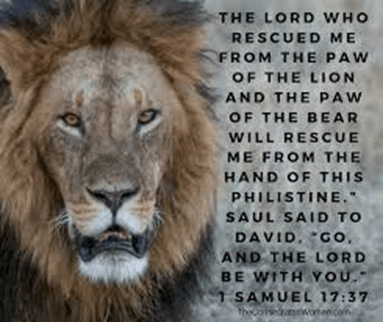
David replied, “Your servant has been tending his father’s sheep, and whenever a lion or a bear came and carried off a lamb from the flock, I went after it, struck it down, and delivered the lamb from its mouth. If it reared up against me, I would grab it by its fur, strike it down, and kill it. Your servant has killed lions and bears; this uncircumcised Philistine will be like one of them, for he has defied the armies of the living God.”

David added, “The LORD, who delivered me from the claws of the lion and the bear, will deliver me from the hand of this Philistine.”

“Go,” said Saul, “and may the LORD be with you.”

When the story begins, David is still out herding sheep. David’s three oldest brothers have gone to join King Saul’s army and are now in the Elah valley, watching Saul defy them on a daily basis. Although Saul has selected David as his armor bearer, David has been going back and forth between Bethlehem, where his father is, and Saul’s army. Although Goliath has been challenging the Israelites for forty days, David has evidently been back in Bethlehem all that time and so has not learned of Goliath’s challenge. Jesse sends David back to the camp with grain and bread for his brothers and with cheese for their commanding officer.

Every morning, the Israelites have been marching out from their camp, shouting war cries and advancing to the battle line ….. until Goliath appears. And every time Goliath appears, the Israelites have run back to their camp. David arrives to meet his brothers in the battle line and witnesses Goliath’s challenge and the Israelites’ terrified responses first – hand. Some well – intentioned soul informs David of Saul’s promises of wealth and the hand of his daughter in marriage for any champion defeating Goliath. But when David’s eldest brother Eliab overhears this conversation, he immediately begins insulting David, implying that David has only come to witness the battle and has abandoned his sheep in the wilderness.

At this point, several things are clear. It’s quite likely that David’s seven older brothers are still jealous and furious that Samuel has anointed David and not one of them. David’s older brothers have come to feel entitled, viewing David as little better than a servant. It’s also apparent that David’s brothers have no idea of how many sheep David has been herding or the dangers that David has faced. Evidently, Jesse has never sent one of the older sons out to herd sheep. Sadly enough, David’s family has come to view David as dispensable.

When Saul learns of David’s interest, he too underestimates David, telling David that Goliath has been a warrior from his youth. But David counters that argument by informing Saul that he also has been accustomed to battle, only he has been facing lions and bears by himself. David has been grabbing these vicious animals by their fur and killing them! It’s quite possible that David’s older brothers have never faced the kind of dangers that David has been facing for years.

Not only does David have battle experience, but David has two other advantages: David has faith in the Lord and the Lord’s anointing rests upon him. While Saul tells David, “May the Lord be with you,” it is David who is the true believer.

APPLICATION: I was raised on an Illinois farm in the 1950’s and 1960’s. In those days, most farm work was done by hand, and we had a wide range of animals and poultry. As the oldest child in the family, I followed my father out to the farm as soon as I could walk. As a child, I pitched manure with a four – tined pitchfork, shoveled ground feed from a pickup truck into a storage bin, and learned to milk cows by hand. I have had my feet stepped on by beef cattle and have been slammed into the side of the barn by them. I have scooped half – frozen mud out of hog watering tanks in the dead of winter with a prairie wind howling out of the northwest at forty miles an hour. I have chopped silage out of a pit silo under similar conditions. Blessedly, I never had to fight any lions or bears, but the work was hard, and there were times when I was in danger. My experiences were far from unique; my friends could all tell similar stories, and I was only doing what previous generations of farm kids had done.

Learning to face adversity as a child gives you an enormous advantage later in life. Once you have faced major challenges as a child, things that adult life throws at you become more doable. Even though Saul’s soldiers were carrying weapons, it’s likely that none of them had ever been tested in battle. They had no idea of how to size up Goliath, how to spot his weak points, and how to formulate a strategy for victory. No wonder that these men would take to their heels as soon as Goliath would show up! David, on the other hand, was actually a seasoned warrior who was accustomed to analyzing dangerous situations and finding the best means of defending himself. As a small man facing a large man, David knew that he had to stay beyond the reach of Saul and Saul’s weapons; hence, David’s choice of his slingshot as his weapon of choice.

What can we learn from this part of David’s story? Don’t waste your work experiences! You may think that you have been assigned the dirtiest jobs in your place of work. You have no idea how God is going to use that training and information later on. If you will bless God in the midst of your struggle and thank Him for the lessons He is teaching, one day you will see the reason behind the suffering.

Two of my favorite Christian poets and hymn writers are Annie Johnson Flint and Fances Ridley Havergal. Both these women struggled with major health problems. Annie was a skilled teacher; however, she developed crippling rheumatoid arthritis that brought that dream to a swift end. Frances Ridley Havergal also faced health challenges and died at age 43, from peritonitis. Neither of these women was famous; however, both of them wrote hymns and poems that have continued to inspire millions to this day.

James 1:2 – 4 tells us, “Consider it pure joy, my brothers and sisters, whenever you face trials of many kinds, because you know that the testing of your faith produces perseverance. Let perseverance finish its work so that you may be mature and complete, not lacking anything.” The day David needed battle experience and courage, he already had both those advantages because of the dangers he had already faced. None of David’s brothers had ever killed a single lion or bear, but David had killed both. The suffering you have complained about may be the very thing God is using for your promotion.

PRAYER: Father God, thank You for loving us and for caring for us. Lord, thank You that You can redeem every bit of suffering in our lives, using it for Your purposes and for Your glory. May we follow hard after You all the days of our lives! In the mighty and precious Name of King Jesus. Amen.

APRIL 11, 2022 SO YOU WANT TO BE A PROPHET #27 1 SAMUEL 17:1 – 11 GOT ANY GIANTS IN YOUR LIFE?

April 11, 2022

1 Samuel 17:1 – 11 “Now the Philistines gathered their forces for war at Socoh in Judah, and they camped between Socoh and Azekah in Ephes-dammim. Saul and the men of Israel assembled and camped in the Valley of Elah, arraying themselves for battle against the Philistines.

The Philistines stood on one hill and the Israelites stood on another, with the valley between them.

Then a champion named Goliath, who was from Gath, came out from the Philistine camp. He was six cubits and a span in height, (Goliath was approximately 9 feet 9 inches or 297 centimeters tall), and he had a bronze helmet on his head. He wore a bronze coat of mail weighing five thousand shekels, (5,000 shekels is approximately 125.6 pounds or 57.0 kilograms.) and he had armor of bronze on his legs and a javelin of bronze slung between his shoulders. The shaft of his spear was like a weaver’s beam, and its iron point weighed six hundred shekels. (600 shekels is approximately 15.1 pounds or 6.8 kilograms.) In addition, his shield bearer went before him.

And Goliath stood and shouted to the ranks of Israel, “Why do you come out and array yourselves for battle? Am I not a Philistine, and are you not servants of Saul? Choose one of your men and have him come down against me. If he is able to fight me and kill me, then we will be your servants. But if I prevail against him and kill him, then you shall be our servants and labor for us.”

Then the Philistine said, “I defy the ranks of Israel this day! Give me a man to fight!”

On hearing the words of the Philistine, Saul and all the Israelites were dismayed and greatly afraid.”

Saul was no coward, but he had never faced a giant before. When the Israelites first came into Canaan, there were giants in several different places, and they routed those giants with the help of the Lord. Caleb at age 85 took on the task of clearing out giants from the town that he re-named Hebron. But these giants and the manner in which God dealt with them had become the stuff of legends, old wives’ tales to frighten children. Now Saul was having to face up to reality; giants still existed and one was challenging his army.

Why did Goliath appear at this particular time? Certainly, Saul wanted nothing to do with him, and yet, Saul may have been partially responsible for Goliath’s arrival. Saul did not worship the One True Living God. Had Saul been playing with Dagon worship? Dagon was the major Philistine deity. Or had Saul involved himself in other pagan rites? All we know is that the Holy Spirit had departed from Saul and all the Israelites, leaving them “dismayed and greatly afraid.” As a leader, Saul had left his people spiritually unprotected by failing to truly worship the Lord. There were probably other Israelites who were also worshiping pagan deities, which didn’t help either. The spiritual wall was down, and the Philistines came through the breaches. The Israelites were at a loss as to what to do next.

APPLICATION: What do you do when a giant shows up? There are all kinds of giants out there, from local ones to international ones. As I am writing this, Russia is attacking Ukraine and the Ukrainians are hanging on. Russia is far bigger and more powerful than Ukraine; the Russian forces definitely possess the relative proportions of Goliath. But most Ukrainians are Christians and Christians around the world are praying for Ukraine. God continues to do miracles in Ukraine. One hospital was running out of supplies just as a van pulled up, bringing the very items that they needed. Relief workers are telling stories of God’s protection and provision.

Many of us are facing or have faced giants, giants of poverty, struggle for education, discrimination on the job, family antipathies, and other problems. If we look inside ourselves, we feel we are woefully inadequate and we see no solutions, apart from continued submission to terrible circumstances. But if we will trust God, He will bring deliverance and relief. Notice, we will still have to face our giants; giants don’t go away because you have turned your back on them. But God can give us perfect solutions and perfect peace if we will only trust Him.

Why not tell God all your problems and then wait quietly to see what He will advise you to do? But be prepared! God may order you to do the very thing you have been dreading. If God orders you, then you can rest in the knowledge that He is the One who will give you the strength and the power to go ahead.

PRAYER: Father God, thank You for loving us and for caring for us. Lord, there are many people facing gigantic problems. Be with them, strengthen them, help them and keep them. Be with the Ukrainians and bring an end to that war! In the mighty and precious Name of King Jesus. Amen.