2 Samuel 1:1 – 26 After the death of Saul, David returned from the slaughter of the Amalekites and stayed in Ziklag two days. On the third day a man with torn clothes and dust on his head arrived from Saul’s camp. When he came to David, he fell to the ground to pay him homage.
“Where have you come from?” David asked.
“I have escaped from the Israelite camp,” he replied.
“What was the outcome?” David asked. “Please tell me.”
“The troops fled from the battle,” he replied. “Many of them fell and died. And Saul and his son Jonathan are also dead.”
David asked the young man who had brought him the report, “How do you know Saul and his son Jonathan are dead?”
“I happened to be on Mount Gilboa,” he replied, “and there was Saul, leaning on his spear, with the chariots and the cavalry closing in on him. When he turned around and saw me, he called out and I answered, ‘Here I am!’
‘Who are you?’ he asked. So, I told him, ‘I am an Amalekite.’
Then he begged me, ‘Stand over me and kill me, for agony has seized me but my life still lingers.’ So, I stood over him and killed him, because I knew that after he had fallen, he could not survive. And I took the crown that was on his head and the band that was on his arm, and I have brought them here to my lord.”
Then David took hold of his own clothes and tore them, and all the men who were with him did the same. They mourned and wept and fasted until evening for Saul and his son Jonathan, and for the people of the LORD and the house of Israel, because they had fallen by the sword.
And David inquired of the young man who had brought him the report, “Where are you from?”
“I am the son of a foreigner,” he answered. “I am an Amalekite.”
So, David asked him, “Why were you not afraid to lift your hand to destroy the LORD’s anointed?” Then David summoned one of the young men and said, “Go, execute him!” So, he struck him down, and he died. For David had said to the Amalekite, “Your blood be on your own head because your own mouth testified against you, saying, ‘I killed the LORD’s anointed.’”

Then David took up this lament for Saul and his son Jonathan, and he ordered that the sons of Judah be taught the Song of the Bow. It is written in the Book of Jashar:
“Your glory, O Israel, lies slain on your heights.
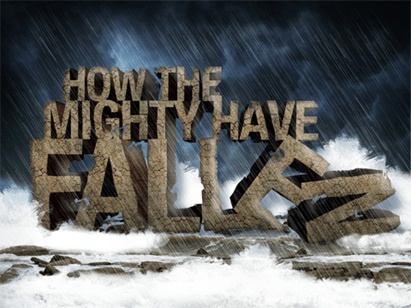
How the mighty have fallen!
Tell it not in Gath; proclaim it not in the streets of Ashkelon,
lest the daughters of the Philistines rejoice,
and the daughters of the uncircumcised exult.
O mountains of Gilboa, may you have no dew or rain,
no fields yielding offerings of grain.
For there the shield of the mighty was defiled, the shield of Saul, no longer anointed with oil.
From the blood of the slain, from the fat of the mighty, the bow of Jonathan did not retreat, and the sword of Saul did not return empty.
Saul and Jonathan, beloved and delightful in life, were not divided in death.
They were swifter than eagles, they were stronger than lions.
O daughters of Israel, weep for Saul, who clothed you in scarlet and luxury, who decked your garments with ornaments of gold.
How the mighty have fallen in the thick of battle! Jonathan lies slain on your heights.
I grieve for you, Jonathan, my brother. You were delightful to me;
your love to me was extraordinary, surpassing the love of women.
How the mighty have fallen and the weapons of war have perished!”
When David and his men were sent back to Ziklag, they found the Amalekites had raided the city, destroying much of it and carrying off everything. Now David and his men have defeated the Amalekites, delivering their own families, and have returned to what’s left of Ziklag to recover. Since much of Ziklag has been built of stone, there is still shelter. At this point, David doesn’t know that Saul and Jonathan have died; for all he knows, Saul might be preparing to attack him again.
A young man comes to inform David of Saul’s death, bearing Saul’s crown and armband as proof. Is this young Amalekite simply an opportunist? This young man states that he “happened” to be on Mount Gilboa. HUH??? How does one “happen” to be in the midst of a hot battle? Has this young man actually struck a killing blow on Saul? Given the fact that Saul was supposed to wipe out the Amalekites and he refused to do so, it would be an ironic twist of fate if Saul received his final wound at the hand of an Amalekite. It’s more likely that this man is lying, and that he was scavenging the battle ground after the fight and removed the crown and the arm band from Saul’s dead body. If this young Amalekite thinks he will gain favor with David by presenting proof of Saul’s death, he is sadly mistaken! David has this young man killed for claiming that he has struck the death blow to Saul.
To cope with this tragedy, David and his men tear their clothes and then mourn and fast until evening. In deep grief, David composes a song he calls “The Song of the Bow.” Such songs of mourning for those dying in battle have been created since antiquity. The words of David’s song have glistened down through the ages as he describes the battle and gives homage to Saul and Jonathan. David and Jonathan have forged a warrior bond in which each of them trusts the other with his life. Such bonds are not dissolved by death.
APPLICATION: There are so many lessons to be gleaned from this chapter. The young Amalekite carrying the news to David probably assumed that David would be thrilled and would reward him richly. Had this young man been truthful, he might not have died. He could have come in sympathy, giving David Saul’s crown and armband as tokens of grief. But all accounts state that Saul fell on his own sword and was not killed by someone else. Those lies cost this man his life.
Certainly, David’s grief for Jonathan was very real, but what about his grief over Saul? Wouldn’t David have felt a sense of relief that Saul couldn’t chase him anymore? Saul tried to kill David on several occasions and pursued him until David fled to Gath; yet, David grieved for Saul as well as Jonathan. Perhaps part of David’s grief for Saul came from realizing how Saul had fallen short of God’s best for his life. Saul was a tragic figure. And then there is David’s grief over Jonathan.
Anyone who has ever served in the military, fire service, EMS, or in any other dangerous situation knows that they must be able to trust those around them to keep them safe. There are bonds of loyalty and friendship forged in dangerous situations that never are dissolved. When we got married, our best man was J. J., my husband’s partner on the rescue truck in the fire department in which they both worked. Those two men had put their lives on the line for each other repeatedly; it was only fitting that we should honor J.J. in this fashion. Veterans in the U.S. greet each other by saying “Welcome home!” because many of them never heard that during their years of service. There are many veterans for whom David’s Song of the Bow is the expression of their grief over fallen comrades.
One of the tragedies of Saul’s life was that he failed to realize how much David loved and admired him. Saul’s relationship with Jonathan and his other sons appears to have been a distant one. Because Saul was so caught up in going his own way, he was blind to those around him. Only after Saul’s death could David safely express his admiration for Saul. Don’t be like Saul! Look around you and see those whom you can encourage and those whom you love.
David hoped for more time to be with Jonathan; however, that opportunity never happened. If you are blessed to have a loyal friend, make sure that friend knows the depth of your admiration for them. My mother used to say, “Don’t wait to give me flowers at my funeral. Give me the flowers while I can smell them.” Treasure your comrades in arms. Find ways to let them know how much you care. When David tore his clothes in grief, he was symbolizing the manner in which Jonathan had been torn out of his life. Death tears us apart. Give someone those flowers while they can still smell them!
PRAYER: Lord Jesus, thank You for loving us so much that You came as a man and sacrificed Yourself for our sins. Lord, help us to follow hard after You all the days of our lives. Help us to love and encourage those around us, realizing that they might die at any moment. Amen.
 Burunche's Blog
Leave a comment