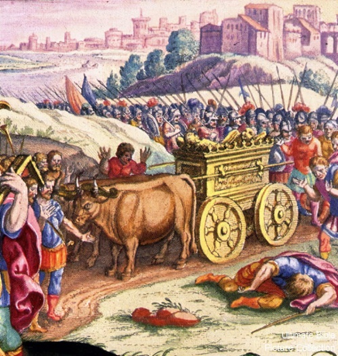
2 Samuel 6:1 – 11 “David again assembled the choice men of Israel, thirty thousand in all. And he and all his troops set out for Baale of Judah to bring up from there the ark of God, which is called by the Name— the name of the LORD of Hosts, who is enthroned between the cherubim that are on it.
They set the ark of God on a new cart and brought it from the house of Abinadab, which was on the hill. Uzzah and Ahio, the sons of Abinadab, were guiding the new cart, bringing with it the ark of God. And Ahio was walking in front of the ark.
David and all the house of Israel were celebrating before the LORD with all kinds of wood instruments, harps, stringed instruments, tambourines, sistrums, and cymbals. When they came to the threshing floor of Nacon, Uzzah reached out and took hold of the ark of God, because the oxen had stumbled. And the anger of the LORD burned against Uzzah, and God struck him down on the spot for his irreverence, and he died there beside the ark of God.
Then David became angry because the LORD had burst forth against Uzzah; so he named that place Perez-uzzah, as it is called to this day.
That day David feared the LORD and asked, “How can the ark of the LORD ever come to me?” So he was unwilling to move the ark of the LORD to the City of David; instead, he took it aside to the house of Obed-edom the Gittite. Thus, the ark of the LORD remained in the house of Obed-edom the Gittite for three months, and the LORD blessed him and all his household.”
Now that David was king in Jerusalem, he wanted to bring the Ark of the Covenant back to Jerusalem where it belonged. The Ark was the chief symbol of the Israelite religion, and as such, it was vitally important for it to be located in the center of religious worship and political power. David realized that anybody who possessed the Ark might pose a political threat.
God gave Moses complete instructions as to the handling of the ark and how it should be carried. God further instructed that any king of Israel should personally write out his own copy of the Law, so that the king would know the Law well and would follow it wisely. But that was a few hundred years ago, and meanwhile, Israel had descended into a kind of Dark Ages, a time when many judges appeared long enough to deliver Israel from their enemies but when men did whatever they wanted to do. The last verse of the Book of Judges tells us that “In those days, there was no king in Israel; every man did what was right in his own eyes.” (Judges 21:25) Other versions say “there was no constant vision.” At any rate, God’s instructions had been forgotten.
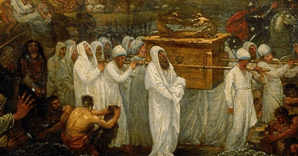
By the time King David ascended to the throne, probably only a handful of priests remembered God’s instructions regarding the handling of the Ark of the Covenant. The Ark was designed to be carried with poles borne on the shoulders of the priests. Even the priests had to be very careful about how they handled the Ark. All those details were captured in the Laws of Moses, but nobody was paying attention. David and the priests loaded the Ark onto a new cart and began the procession to Jerusalem. But at one point, one of the oxen pulling the cart stumbled, and a man named Uzzah reached out to steady the Ark on the cart. God struck Uzzah dead on the spot! David named that spot “Perez Uzzah,” which means “outbreak against Uzzah.” But is that what really happened? If the cart was a stable one, it shouldn’t have mattered whether an ox stumbled or not. It’s far more likely that Uzzah was using this incident as an excuse to peek into the Ark, and that’s why God struck him dead. If merely touching the Ark meant death, how could anybody have loaded the Ark onto that cart in the first place? No, Uzzah was guilty of transgressing against God; he was not as innocent as we might suppose.
At this point, David really didn’t know what to do, so he ordered that the Ark be left in the closest household, that of Obed – edom, the Gittite. Who were the Gittites? According to the International Standard Bible Encyclopedia, the Gittites originally came from Gath; however, numbers of them emigrated to Judah, probably under the influence of David. 600 Gittites served as a body guard for David, with Ittai as their head. The Gittites were remarkable for their great stature. Did Obed – edom simply leave the Ark on the cart? We don’t know; however, Obed – edom and his family must have handled the Ark reverently, because God blessed him and all his household.
APPLICATION: David had good intentions and his heart was right before the Lord; even so, he needed to learn that he couldn’t just do God’s work in his own way. One American evangelist noted for his humor described how he began his ministry by trying to copy every other evangelist then ministering. Nothing was working. Finally, this man asked the Lord, “What’s wrong? I’m doing what You called me to do!” The Lord said, “No, you’re doing your will in My Name. I didn’t call you to imitate anybody else. I called you to be just what you are.” “What’s the difference?” asked the frustrated evangelist. “Results!” answered the Lord.
David thought he knew how to handle the Ark; after all, he was doing just what the Philistines had done when they returned the Ark to Israel. But the difference was that the Philistines were unaware of God’s orders concerning the treatment of the Ark while the Israelites should have known better. It was bad enough that Phineas and Hophni had hauled the Ark off to the battlefield as if it were a fetish. But this cavalier treatment of the Ark by the Israelites had to stop. When Uzzah seized the opportunity to touch the Ark inappropriately, God demonstrated His power.
What did David do wrong? There is no mention of David praying and asking God for counsel before loading the Ark onto that cart. Even though David worshiped God, David didn’t realize just how holy the Ark really was. David had not studied the Law of Moses enough to understand the fashion in which the Ark was to be handled. Sometimes we do good things on our own, assuming that we can copy what someone else has done in a similar situation. But action without prayer can bring disaster. Just look at Uzzah!
Most of us have little or no idea just how holy God is. We throw God’s name around, even abbreviating it in text messages. We use God’s name as a swear word or as an exclamation. If not for God’s mercies, we would all be cinders. But God IS merciful, and He does forgive us when we repent because of the Blood of Jesus. We should go through our days prayerfully, mindful that God’s ways are higher and better than ours.
PRAYER: Father God, thank You for loving us and for caring for us. Lord, help us not to take You for granted, but to look to You for guidance. In the mighty and precious Name of King Jesus. Amen.
 Burunche's Blog
Leave a comment