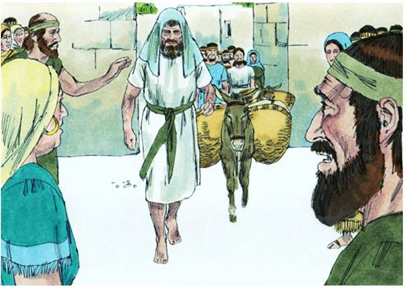
2 Samuel 15:13 – 37 “Then a messenger came to David and reported, “The hearts of the men of Israel are with Absalom.”
And David said to all the servants with him in Jerusalem, “Arise and let us flee, or we will not escape from Absalom! We must leave quickly, or he will soon overtake us, heap disaster on us, and put the city to the sword.”
The king’s servants replied, “Whatever our lord the king decides, we are your servants.”
Then the king set out, and his entire household followed him. But he left behind ten concubines to take care of the palace.
So, the king set out with all the people following him. He stopped at the last house, and all his servants marched past him—all the Cherethites and Pelethites, and six hundred Gittites who had followed him from Gath.
Then the king said to Ittai the Gittite, “Why should you also go with us? Go back and stay with the new king, since you are both a foreigner and an exile from your homeland. In fact, you arrived only yesterday; should I make you wander around with us today while I do not know where I am going? Go back and take your brothers with you. May the LORD show you loving devotion and faithfulness.”
But Ittai answered the king, “As surely as the LORD lives, and as my lord the king lives, wherever my lord the king may be, whether it means life or death, there will your servant be!”
“March on then,” said David to Ittai. So Ittai the Gittite marched past with all his men and all the little ones who were with him.
Everyone in the countryside was weeping loudly as all the people passed by. And as the king crossed the Kidron Valley, all the people also passed toward the way of the wilderness.
Zadok was also there, and all the Levites with him were carrying the ark of the covenant of God. And they set down the ark of God, and Abiathar offered sacrifices until the people had passed out of the city.
Then the king said to Zadok, “Return the ark of God to the city. If I find favor in the eyes of the LORD, He will bring me back and let me see both it and His dwelling place again. But if He should say, ‘I do not delight in you,’ then here I am; let Him do to me whatever seems good to Him.”
The king also said to Zadok the priest, “Are you not a seer? Return to the city in peace—you with your son Ahimaaz and Abiathar with his son Jonathan. See, I will wait at the fords of the wilderness until word comes from you to inform me.”
So Zadok and Abiathar returned the ark of God to Jerusalem and stayed there.
But David continued up the Mount of Olives, weeping as he went up. His head was covered, and he was walking barefoot. And all the people with him covered their heads and went up, weeping as they went.
Now someone told David: “Ahithophel is among the conspirators with Absalom.”
So, David pleaded, “O LORD, please turn the counsel of Ahithophel into foolishness!”
When David came to the summit, where he used to worship God, Hushai the Archite was there to meet him with his robe torn and dust on his head.
David said to him, “If you go on with me, you will be a burden to me. But you can thwart the counsel of Ahithophel for me if you return to the city and say to Absalom: ‘I will be your servant, my king; in the past I was your father’s servant, but now I will be your servant.’
Will not Zadok and Abiathar the priests be there with you? Report to them everything you hear from the king’s palace. Indeed, their two sons, Ahimaaz son of Zadok and Jonathan son of Abiathar, are there with them. Send them to me with everything you hear.”
So, David’s friend Hushai arrived in Jerusalem just as Absalom was entering the city.”
This is the day when God’s prophecies given through Nathan are coming true, and it is even worse than David has anticipated. David gets word that Absalom is about to enter Jerusalem, evidently from the west, so David and his household, including his body guard that has followed him from Gath and their families, flee eastward across the Kidron Valley and up the Mount of Olives. The Gittites are citizens of Gath who have allied themselves with David and the Israelites, worshiping the God of Israel rather than Dagon. Evidently, David used to offer sacrifices on the Mount of Olives before setting up the tabernacle in Jerusalem and bringing the ark back to occupy it.
Despite the fact that Absalom has done everything he can to cement his position with the Israelites, David is still immensely popular. David’s entire household follows him, as do the Gittites and the Cherethites and Pelethites. (The Cherethites and Pelethites may be additional Philistines who are also following David. Some sources suggest that they are mercenaries; however, they are extremely loyal.) Everyone in the countryside is weeping as David passes, proving that Absalom may have deceived some influential people, but that the hearts of the common citizens are still with David. Even Ittai, a Gittite from Gath who has only been with David a single day, insists on accompanying David, a tribute to David’s ability to engender loyalty.
The priests and Levites led by Zadok bring the Ark of the Covenant and Abiathar, Zadok’s son, makes offerings as David’s followers are passing. David encourages Zadok and the others to return to Jerusalem but to send word to him “at the fords of the wilderness,” presumably, the fords of the Jordan River. David’s affirmation of faith as he sends Zadok back to Jerusalem is remarkable. “If I find favor in the eyes of the LORD, He will bring me back and let me see both it and His dwelling place again. But if He should say, ‘I do not delight in you,’ then here I am; let Him do to me whatever seems good to Him.” David recognizes that his punishment is from the Lord and that only God can restore him. David is laying himself and his kingship on a spiritual altar for the Lord to deal with as He wills.
Who is Hushai the Archite? Evidently, Hushai is a wise older man who has been counseling David, possibly after Ahithophel’s defection to Absalom. David’s statement that if Hushai accompanies David’s band of exiles, he will simply be a burden might refer to Hushai’s age and his physical status. David realizes that the brilliant Ahithophel has already switched loyalties to Absalom; if Hushai also joins Absalom, Absalom will merely take it as additional proof of his popularity. David needs someone who can “thwart the counsel of Ahithophel,” and Hushai is the ideal person. David might be heart – broken and grieving, but he is still a savvy military commander.
APPLICATION: David flees Jerusalem because he does not want a blood bath to engulf Jerusalem. Despite the incident with Uriah and Bathsheba, David still inspires enormous confidence and loyalty in people. If you run the numbers, there may have been as many as 1,000 people following David out of Jerusalem, and David waits at the last house on the edge of town to be sure that everyone makes it out safely. Now David and his people must escape to the wilderness beyond the Jordan and wait for word from Jerusalem. Fortunately, David is intimately familiar with local hiding places from the years when Saul was pursuing him.
It is while David and his people are on the run that David composes the 63rd Psalm.
1You, God, are my God, earnestly I seek you; I thirst for you, my whole being longs for you, in a dry and parched land where there is no water.
2 I have seen you in the sanctuary and beheld your power and your glory.
3 Because your love is better than life, my lips will glorify you.
4 I will praise you as long as I live, and in your name, I will lift up my hands.
5 I will be fully satisfied as with the richest of foods; with singing lips my mouth will praise you.
6 On my bed I remember you; I think of you through the watches of the night.
7 Because you are my help, I sing in the shadow of your wings.
8 I cling to you; your right hand upholds me.
9 Those who want to kill me will be destroyed; they will go down to the depths of the earth.
10 They will be given over to the sword and become food for jackals.
11 But the king will rejoice in God; all who swear by God will glory in him, while the mouths of liars will be silenced.
David abjectly repented following the seizure of Bathsheba and the murder of her husband, and now David is re – affirming his reliance on God. David knows that if the armies of Israel are truly with Absalom, his followers will be defeated in any kind of battle. This moment might be the darkest that David has ever faced; however, he is reminding himself of the goodness and the protection God has given him in the past. Even though David has committed horrible sin, it is this glistening faith that continues to endear him to God.
What can we learn from this part of David’s story? Despite David’s own anxieties, he continues to care for his people. Rather than fleeing at the head of the column, David remains at the edge of Jerusalem until the last member of his cavalcade has passed. David cares about the Ark, the symbol of the Lord God of Israel. Refusing to haul the Ark around, David insists that it be returned to Jerusalem where it will be safe. David recognizes the justice of Absalom’s rebellion and refuses to complain about it, concentrating on dealing with the logistics problems instead. Finally, David commits himself to God, realizing that only God can deliver him. You may face crises in leadership through no fault of your own. If and when those stresses come, remember David’s example.
PRAYER: Father God, thank You for loving us and for caring for us. Lord, there are many who face challenges in their organizations. Be with them and guide them. Help them to realize that You are the Source of all hope and that only You can sort things out. In the mighty and precious Name of King Jesus. Amen.
 Burunche's Blog
Leave a comment