2 Samuel 14:1 – 33 “Now Joab son of Zeruiah perceived that the king’s heart longed for Absalom. So, Joab sent to Tekoa to bring a wise woman from there. He told her, “Please pretend to be a mourner; put on clothes for mourning and do not anoint yourself with oil. Act like a woman who has mourned for the dead a long time. Then go to the king and speak these words to him.” And Joab put the words in her mouth.
When the woman from Tekoa went to the king, she fell face down in homage and said, “Help me, O king!”
“What troubles you?” the king asked her. “Indeed,” she said, “I am a widow, for my husband is dead. And your maidservant had two sons who were fighting in the field with no one to separate them, and one struck the other and killed him. Now the whole clan has risen up against your maidservant and said, ‘Hand over the one who struck down his brother, that we may put him to death for the life of the brother whom he killed. Then we will cut off the air as well!’ So, they would extinguish my one remaining ember by not preserving my husband’s name or posterity on the earth.”
“Go home,” the king said to the woman, “and I will give orders on your behalf.”
But the woman of Tekoa said to the king, “My lord the king, may any blame be on me and on my father’s house, and may the king and his throne be guiltless.”
“If anyone speaks to you,” said the king, “bring him to me, and he will not trouble you again!”
“Please,” she replied, “may the king invoke the LORD your God to prevent the avenger of blood from increasing the devastation, so that my son may not be destroyed!”
“As surely as the LORD lives,” he vowed, “not a hair of your son’s head will fall to the ground. “Then the woman said, “Please, may your servant speak a word to my lord the king?”
“Speak,” he replied.
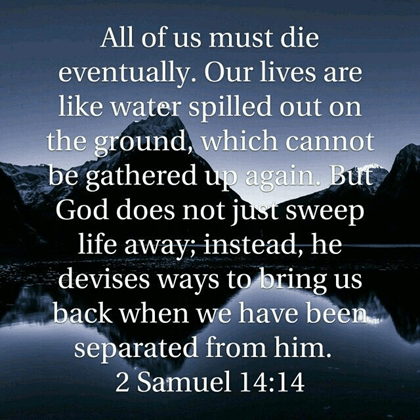
The woman asked, “Why have you devised a thing like this against the people of God? When the king says this, does he not convict himself, since he has not brought back his own banished son? For surely, we will die and be like water poured out on the ground, which cannot be recovered. Yet God does not take away a life; but He devises ways that the banished one may not be cast out from Him.
Now therefore, I have come to present this matter to my lord the king because the people have made me afraid. Your servant thought, ‘I will speak to the king. Perhaps he will grant the request of his maidservant. For the king will hear and deliver his maidservant from the hand of the man who would cut off both me and my son from God’s inheritance.’
And now your servant says, ‘May the word of my lord the king bring me rest, for my lord the king is able to discern good and evil, just like the angel of God. May the LORD your God be with you.’”
Then the king said to the woman, “I am going to ask you something; do not conceal it from me!”
“Let my lord the king speak,” she replied.
So, the king asked, “Is the hand of Joab behind all this?”
The woman answered, “As surely as you live, my lord the king, no one can turn to the right or to the left from anything that my lord the king says. Yes, your servant Joab is the one who gave me orders; he told your maidservant exactly what to say. Joab your servant has done this to bring about this change of affairs, but my lord has wisdom like the wisdom of the angel of God, to know everything that happens in the land.”
Then the king said to Joab, “I hereby grant this request. Go, bring back the young man Absalom.” Joab fell face down in homage and blessed the king. “Today,” said Joab, “your servant knows that he has found favor with you, my lord the king, because the king has granted his request.”
So, Joab got up, went to Geshur, and brought Absalom to Jerusalem. But the king added, “He may return to his house, but he must not see my face.” So, Absalom returned to his own house, but he did not see the king.”
Now there was not a man in all Israel as handsome and highly praised as Absalom. From the sole of his foot to the top of his head, he did not have a single flaw. And when he cut the hair of his head—he shaved it every year because his hair got so heavy—he would weigh it out to be two hundred shekels, (5 pounds, or 2.3 kg) according to the royal standard. Three sons were born to Absalom, and a daughter named Tamar, who was a beautiful woman.
Now Absalom lived in Jerusalem two years without seeing the face of the king. Then he sent for Joab to send him to the king, but Joab refused to come. So, Absalom sent the second time, but Joab still would not come.
Then Absalom said to his servants, “Look, Joab’s field is next to mine, and he has barley there. Go and set it on fire!”
And Absalom’s servants set the field on fire.
Then Joab came to Absalom’s house and demanded, “Why did your servants set my field on fire?”
“Look,” said Absalom, “I sent for you and said, ‘Come here. I want to send you to the king to ask: Why have I come back from Geshur? It would be better for me if I were still there.’ So now, let me see the king’s face, and if there is iniquity in me, let him kill me.”
So, Joab went and told the king, and David summoned Absalom, who came to him and bowed face down before him. Then the king kissed Absalom.”
This passage is long but difficult to break up without losing the story. When David ordered Joab to place Uriah in the hottest part of the battle so that Uriah would be killed, he put Joab in a terrible position, fracturing Joab’s loyalty to him in the process. For the sake of the battles David and Joab have fought together, Joab remains somewhat loyal; however, he is beginning to transfer that loyalty over to David’s exiled son Absalom.
Joab arranges for a woman to present herself as if she were a widow with two sons, one of whom killed the other. If the clan were to kill the remaining son, this woman would have no heir and no representation left in Israel, so she is begging the king to spare her son’s life. When David agrees, the woman asks David why he has not brought Absalom back, since the circumstances are similar. David rapidly realizes that Joab has engineered this situation, but he agrees for Absalom to return to Jerusalem. But David feels that there must be some kind of punishment for Absalom having murdered his half – brother Amnon, so David refuses to see Absalom. When Joab refuses to get David to lift this partial ban, Absalom sets Joab’s barley field on fire, getting Joab’s immediate attention! Joab persuades David to reinstate Absalom, and David does so.
Did Absalom deserve reinstatement? No. Absalom murdered Amnon. But the whole situation is a mess. Had David protected Tamar in the first place, nothing would have happened. Perhaps David was feeling guilty for not having paid more attention to Amnon, so when Amnon requested that Tamar come, David granted the request. Obviously, nobody asked Tamar whether or not she agreed, but then, Tamar was only a woman. Once Amnon raped Tamar, David should have punished Amnon in some fashion; however, David did nothing but sit and fume. Had David punished Amnon, perhaps by banishing him from Jerusalem, that might have helped the situation greatly. There is never any indication that David troubled himself to meet Tamar or to comfort Tamar, even though she was his own daughter. Had David behaved like a truly loving father to Tamar, none of this would ever have happened.
And then there was Absalom’s murder of Amnon. Was Absalom REALLY that upset about Amnon raping Tamar, or did he have other motives? Amnon was the eldest son and therefore, the natural heir to the throne. Amnon’s death would clear the way for Absalom to succeed David.
APPLICATION: David allowed Absalom to return to the palace and reinstated him as a sign of forgiveness. But Absalom had other ideas. God had already promised to spare David’s life; however, He also foretold that someone would drag David’s wives out and rape them publicly. It was Shakespeare who wrote, “Oh, what a tangled web we weave, when first we practice to deceive.” David’s failures as a leader and a father were beginning to bear bitter fruit.
We might look at the mess into which David’s family descended and question how such a man could possibly be considered “a man after God’s own heart.” But the plain fact is that all of us are human and none of us is perfect. Oswald Chambers describes us well when he says that we generally have “spiritual measles.” The meditation for June 12th from My Utmost for His Highest says this: “God writes our new name only on those places in our lives where He has erased our pride, self-sufficiency, and self-interest. Some of us have our new name written only in certain spots, like spiritual measles. And in those areas of our lives, we look all right. When we are in our best spiritual mood, you would think we were the highest quality saints. But don’t dare look at us when we are not in that mood. A true disciple is one who has his new name written all over him— self-interest, pride, and self-sufficiency have been completely erased.”
David did a lot of things wrong; however, he repented and he truly worshiped God. Only God knows how much of David had his new name written on him by the time David died. One lesson to learn from David’s story is to guard your heart! David was anointed by God to be king and was given all kinds of success in battle. David became a very wealthy man, fathering a number of children. But David did not guard his heart, and that became his downfall. What happened to David can happen to any of us. Guard your heart!
PRAYER: Father God, thank You for loving us and for caring for us. Lord, help us to guard our hearts! If someone as close to you as David was can fall, so can we. Help us to follow hard after you all the days of our lives. In the matchless Name of King Jesus. Amen.







 Burunche's Blog