2 Samuel 21:1 – 14 “During the reign of David there was a famine for three successive years, and David sought the face of the LORD. And the LORD said, “It is because of the blood shed by Saul and his family, because he killed the Gibeonites.”
At this, David summoned the Gibeonites and spoke to them. (Now the Gibeonites were not Israelites, but a remnant of the Amorites. The Israelites had taken an oath concerning them, but in his zeal for Israel and Judah, Saul had sought to kill them.)
So, David asked the Gibeonites, “What shall I do for you? How can I make amends so that you may bless the inheritance of the LORD?”
The Gibeonites said to him, “We need no silver or gold from Saul or his house, nor should you put to death anyone in Israel for us.”
“Whatever you ask, I will do for you,” he replied.
And they answered the king, “As for the man who consumed us and plotted against us to exterminate us from existing within any border of Israel, let seven of his male descendants be delivered to us so that we may hang them before the LORD at Gibeah of Saul, the chosen of the LORD.”
“I will give them to you,” said the king.
Now the king spared Mephibosheth son of Jonathan, the son of Saul, because of the oath before the LORD between David and Jonathan son of Saul. But the king took Armoni and Mephibosheth, the two sons whom Rizpah daughter of Aiah had borne to Saul, as well as the five sons whom Merab daughter of Saul had borne to Adriel son of Barzillai the Meholathite. And he delivered them into the hands of the Gibeonites, and they hanged them on the hill before the LORD. So, all seven of them fell together; they were put to death in the first days of the harvest, at the beginning of the barley harvest.
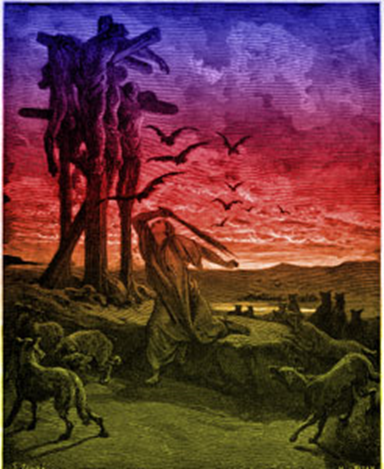
And Rizpah the daughter of Aiah took sackcloth and spread it out for herself on a rock. From the beginning of the harvest until the rain from heaven poured down on the bodies, she did not allow the birds of the air to rest on them by day, nor the beasts of the field by night.
When David was told what Saul’s concubine Rizpah, daughter of Aiah, had done, he went and took the bones of Saul and his son Jonathan from the men of Jabesh-gilead, who had stolen them from the public square of Beth-shan where the Philistines had hung the bodies after they had struck down Saul at Gilboa.
So, David had the bones of Saul and his son Jonathan brought from there, along with the bones of those who had been hanged. And they buried the bones of Saul and his son Jonathan in Zela in the land of Benjamin, in the tomb of Saul’s father Kish.
After they had done everything the king had commanded, God answered their prayers for the land.”
This is a gruesome story. The Gibeonites were part of the Amorite tribe destined for destruction by Joshua and his men. But the Gibeonites cleverly pretended to be from a distant land, and Joshua and his men foolishly entered into a covenant with them. (The story is told in Joshua 9.) Joshua and his men put the Gibeonites to hard labor, but they protected them. Saul violated that covenant when he tried to wipe out the Gibeonites. Allegedly, Saul’s actions stemmed from his zeal for Israel; however, Saul’s ancestral home town is listed as Gibeon. The wording of these passages suggests that not only Saul, but several of his family members also continued to wage war on the Gibeonites, further violating Joshua’s covenant with them.
Drought and famine have hit the land of Israel. Israel is a mountainous land that depends a great deal on seasonal rainfall. If the rains fail, conditions soon become dire. When this story opens, the rains have failed for three years and crops are shriveled and animals are dying. Famine is stalking the land, and David asks the Lord what he should do. God’s answer is a grim one: this famine has come because Saul and his family have violated the covenant with the Gibeonites and have been killing them. David needs to make things right with the Gibeonites.
When David summons the Gibeonites, their information is arresting. “We need no silver or gold from Saul or his house, nor should you put to death anyone in Israel for us.” Although the Gibeonites deny that they want anyone to die, in fact, they are simply preparing the way for their next request. “As for the man who consumed us and plotted against us to exterminate us from existing within any border of Israel, let seven of his male descendants be delivered to us so that we may hang them before the LORD at Gibeah of Saul, the chosen of the LORD.” The Gibeonites are planning to execute seven of Saul’s descendants just outside the town that was his capital for 22 years while he was king. David complies with this request.
Why does God not only allow these executions to take place but even to set His seal of approval by lifting the famine? Saul and his family have evidently been blood – thirsty covenant breakers. It’s possible that these descendants of Saul have continued his vendetta against the Gibeonites. God knows the human heart, and God knows those members of Saul’s family who have continued to violate Joshua’s oath, putting all of Israel in jeopardy as a result.
One of the most striking parts of this story is the dedication of Saul’s concubine Rizpah. Rizpah cannot save her two sons; however, she refuses to let vultures and wild beasts get at the bodies. Rizpah camps out by the place of execution and stays there throughout the barley harvest until the rains start. King David is so moved by Rizpah’s devotion that he collects the bones of Saul and Jonathan from the city of Jabesh – gilead, along with the bones of the men who have been hanged, and buries all of them in the tomb of Saul’s father Kish in Zela in the land of Benjamin. Once these remains have been suitably buried, God answers the prayers of those praying for the famine to lift.
APPLICATION: There are many reasons why God does not answer our prayers immediately. Sometimes, we are asking for things that God wants to give, but the time is not yet ripe. Sometimes we are asking wrongly for things for ourselves or for loved ones, things that might actually be to our detriment. Many people pray for prosperity, not realizing that they can choke on riches and their children may never know God as a result. Sometimes we ask for things, but God sets conditions. This story is an example of God setting extreme conditions.
Saul and his descendants have continued to murder Gibeonites, even though Joshua’s covenant with them remains valid. The shedding of innocent blood brings curses on a land, and Saul’s family has brought curses on Israel. It is quite possible that Saul has more descendants than those listed; however, God will even protect the innocent in Saul’s family.
Rizpah’s faithfulness in protecting the bodies is magnificent. Rizpah knows that if someone does not remain there, horrible things will happen to those bodies. How does Rizpah do it? Does someone from the household bring her food and water all those weeks? We don’t know; we only know that Rizpah’s devotion wins David’s approval, and he buries the remains of those seven men along with the bones of Saul and Jonathan in the family tomb.
Notice that the famine only lifts after the burial of the bodies of Jonathan, Saul, and Saul’s seven male descendants. These men have had to die; however, even their bodies are to be handled honorably.
Many times, we choose to believe that our actions do not have spiritual consequences. There is no action without a spiritual consequence. Saul’s family has suffered because multiple generations have broken the covenant between the Israelites and the Gibeonites. We must guard our hearts and minds so that we do not break covenants with those around us and so that we don’t bring curses into our own families. May God help us!
PRAYER: Father God, thank you for loving us and for caring for us. Help us to be careful to respect covenants and to refuse to shed innocent blood at any time. In the mighty and precious Name of King Jesus. Amen.
 Burunche's Blog
Leave a comment