
1 Kings 6:1 – 38 “In the four hundred and eightieth year after the Israelites had come out of the land of Egypt, in the month of Ziv, the second month of the fourth year of Solomon’s reign over Israel, he began to build the house of the LORD. (Ziv was the second month of the ancient Hebrew lunar calendar, usually occurring within the months of April and May.)
The house that King Solomon built for the LORD was sixty cubits long, twenty cubits wide, and thirty cubits high. (The house was approximately 90 feet long, 30 feet wide, and 45 feet high (27.4 meters long, 9.1 meters wide, and 13.7 meters high). The portico at the front of the main hall of the temple was twenty cubits long, (20 cubits is approximately 30 feet or 9.1 meters) extending across the width of the temple and projecting out ten cubits in front of the temple. (10 cubits is approximately 15 feet or 4.6 meters.) He also had narrow windows framed high in the temple.
The Chambers
Against the walls of the temple and the inner sanctuary, Solomon built a chambered structure around the temple, in which he constructed the side rooms. The bottom floor was five cubits wide, the middle floor six cubits, and the third floor seven cubits. He also placed offset ledges around the outside of the temple, so that nothing would be inserted into its walls. The temple was constructed using finished stones cut at the quarry, so that no hammer or chisel or any other iron tool was heard in the temple while it was being built.
The entrance to the bottom floor was on the south side of the temple. A stairway led up to the middle level, and from there to the third floor.
So, Solomon built the temple and finished it, roofing it with beams and planks of cedar. He built chambers all along the temple, each five cubits high and attached to the temple with beams of cedar.
God’s Promise to Solomon
Then the word of the LORD came to Solomon, saying: “As for this temple you are building, if you walk in My statutes, carry out My ordinances, and keep all My commandments by walking in them, I will fulfill through you the promise I made to your father David. And I will dwell among the Israelites and will not abandon My people Israel.”
The Temple’s Interior
So, Solomon built the temple and finished it. He lined the interior walls with cedar paneling from the floor of the temple to the ceiling, and he covered the floor with cypress boards.
He partitioned off the twenty cubits at the rear of the temple with cedar boards from floor to ceiling to form within the temple an inner sanctuary, the Most Holy Place. And the main hall in front of this room was forty cubits long. (40 cubits is approximately 60 feet or 18.3 meters.)
The cedar paneling inside the temple was carved with gourds and open flowers. Everything was cedar; not a stone could be seen.
Solomon also prepared the inner sanctuary within the temple to set the ark of the covenant of the LORD there. 20 The inner sanctuary was twenty cubits long, twenty cubits wide, and twenty cubits high. He overlaid the inside with pure gold, and he also overlaid the altar of cedar.
So, Solomon overlaid the inside of the temple with pure gold, and he extended gold chains across the front of the inner sanctuary, which was overlaid with gold. So, he overlaid with gold the whole interior of the temple, until everything was completely finished. He also overlaid with gold the entire altar that belonged to the inner sanctuary.
The Cherubim
In the inner sanctuary he made two cherubim, each ten cubits high, out of olive wood. One wing of the first cherub was five cubits long, and the other wing was five cubits long as well. So, the full wingspan was ten cubits. The second cherub also measured ten cubits; both cherubim had the same size and shape, and the height of each cherub was ten cubits. (10 cubits is 15 feet or 4.6 meters.)
And he placed the cherubim inside the innermost room of the temple. Since their wings were spread out, the wing of the first cherub touched one wall, while the wing of the second cherub touched the other wall, and in the middle of the room their wingtips touched. He also overlaid the cherubim with gold. Then he carved the walls all around the temple, in both the inner and outer sanctuaries, with carved engravings of cherubim, palm trees, and open flowers. And he overlaid the temple floor with gold in both the inner and outer sanctuaries.
The Doors
For the entrance to the inner sanctuary, Solomon constructed doors of olive wood with five-sided doorposts. The double doors were made of olive wood, and he carved into them cherubim, palm trees, and open flowers and overlaid the cherubim and palm trees with hammered gold. In the same way he made four-sided doorposts of olive wood for the sanctuary entrance. The two doors were made of cypress wood, and each had two folding panels. He carved into them cherubim, palm trees, and open flowers; and he overlaid them with gold, hammered evenly over the carvings.
The Courtyard
Solomon built the inner courtyard with three rows of dressed stone and one row of trimmed cedar beams.
The foundation of the house of the LORD was laid in the fourth year of Solomon’s reign, in the month of Ziv. In his eleventh year and eighth month, the month of Bul, the temple was finished in every detail and according to every specification. So, he built the temple in seven years. (Bul was the eighth month of the ancient Hebrew lunar calendar, usually occurring within the months of October and November.)
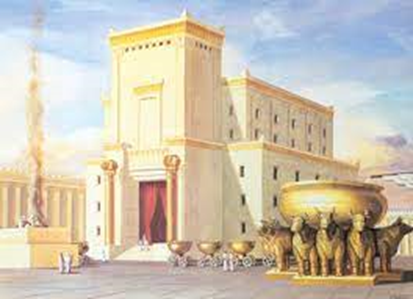
It’s difficult to split up this chapter because the descriptions flow from one area to the next. Overall, the temple is made with stones cut and dressed at the quarry and then moved from the mountains to Jerusalem so that there would be no sound of chisels and hammers at the work site. The sheer size of these stones is mind – boggling. According to one source, the smallest stones weight between 2 to 5 tons and the largest stone of them all – possibly the largest building stone in antiquity – is 13.6 meters long, 4.6 meters thick and 3.3 meters high, and is estimated to weigh 570 tons. The builders used dry construction – there is no cement between the stones. (https://www.jerusalem-insiders-guide.com/temple-of-jerusalem.html) These stones may have been dragged by oxen from the quarries.
One thing that has always puzzled me is why the width of the chambers increased from story to story rather than decreasing. It is possible that the thickness of the walls decreased slightly with each new story. That would allow for more space with less weight on the structures below.
Cedar and gold are used extensively throughout the temple. Both these items are luxury items that were generally used sparingly even in the homes of the very wealthy; however, Solomon lines rooms with cedar and then overlays them with gold, sparing no expense. Solomon actually inherited much of this gold from his father David.
In the midst of this building frenzy, God steps in and speaks to Solomon. “Then the word of the LORD came to Solomon, saying: “As for this temple you are building, if you walk in My statutes, carry out My ordinances, and keep all My commandments by walking in them, I will fulfill through you the promise I made to your father David. And I will dwell among the Israelites and will not abandon My people Israel.” It would seem that God is less impressed with the glories of the new temple and far more concerned about heart attitudes. Sadly, Solomon appears to accept this warning but refuses to heed it.
APPLICATION: How much use are fancy buildings? Some people have coined a term for those insisting on building elaborate houses of worship; these people are said to possess an “edifice complex.” Through the centuries, building programs have caused problems. In modern times, building programs have sometimes resulted in church splits, leaving fewer people to bear the costs of ongoing construction. At the same time, the money spent on buildings could have done a great deal to relieve suffering in the areas immediately around the church.
When Jesus was speaking with the Samaritan woman at the well, he told her, “God is spirit, and his worshipers must worship in the Spirit and in truth.” (John 4:24) Most effective ministry takes place outside church buildings, not inside. One wonders how enthusiastically the ancient Israelites glorified God when they came to Solomon’s temple and realized the enormous wealth that had been spent on it. It is fascinating to note that at no point does the Bible indicate that God had any hand in the plans for the temple, apart from the general layout that was originally given to Moses for the tabernacle in the wilderness. Sadly, it is quite possible for people to get caught up in appearances and to fail to worship “in spirit and in truth.” This problem of heart attitude is exactly what God warned Solomon about.
Truly, our lives are to be places of worship. Our workplaces, our homes, and our places of recreation should be just as sacred to God as any church building. Worship is not something that you can turn off and on like a water faucet. We must check our hearts! Are we impressed with beautiful structures and programs, forgetting that they are worthless unless God shows up? May God help us!
PRAYER: Father God, thank You for loving us and for caring for us. Lord, help us to worship You in spirit and in truth. Help us to remember that You are not impressed by programs or structures but only by our hearts. In the mighty and precious Name of King Jesus. Amen.
 Burunche's Blog
Leave a comment