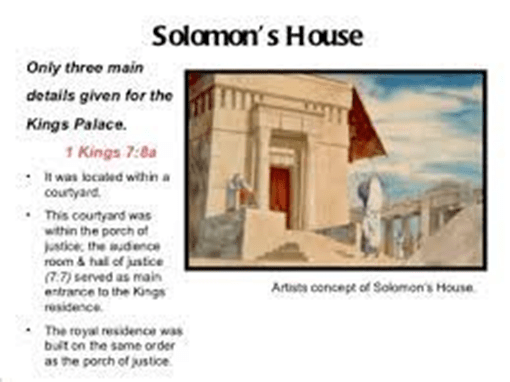
1 Kings 7:1 – 12 “Solomon, however, took thirteen years to complete the construction of his entire palace.
He built the House of the Forest of Lebanon a hundred cubits long, fifty cubits wide, and thirty cubits high, with four rows of cedar pillars supporting the cedar beams. (The house was approximately 150 feet long, 75 feet wide, and 45 feet high (45.7 meters long, 22.9 meters wide, and 13.7 meters high).
The house was roofed with cedar above the beams that rested on the pillars—forty-five beams, fifteen per row. There were three rows of high windows facing one another in three tiers. All the doorways had rectangular frames, with the openings facing one another in three tiers.
Solomon made his colonnade fifty cubits long and thirty cubits wide, with a portico in front of it and a canopy with pillars in front of the portico. (The colonnade was approximately 75 feet long and 45 feet wide (22.9 meters long and 13.7 meters wide).
In addition, he built a hall for the throne, the Hall of Justice, where he was to judge. It was paneled with cedar from floor to ceiling.
And the palace where Solomon would live, set further back, was of similar construction. He also made a palace like this hall for Pharaoh’s daughter, whom he had married. All these buildings were constructed with costly stones, cut to size and trimmed with saws inside and out from the foundation to the eaves, and from the outside to the great courtyard. The foundations were laid with large, costly stones, some ten cubits long (15 feet) and some eight cubits long. (12 feet) Above these were high-grade stones, cut to size, and cedar beams.
The great courtyard was surrounded by three rows of dressed stone and a row of trimmed cedar beams, as were the inner courtyard and portico of the house of the LORD.”

We read these accounts and think, “Ho hum! Just another set of lists.” But these descriptions have been preserved for a reason. The cedar described here is the giant cedars of Lebanon, the image of which still appears on the Lebanese flag. These trees were enormous and their wood was highly prized. Many rich people might have a single room paneled in cedar, but Solomon was making colonnades and paneling rooms with cedar in the palace as well as the temple. King Hiram of Tyre had his men cutting huge numbers of cedars and floating them down the Mediterranean Sea to ports in Israel where they were off – loaded and brought to Jerusalem. Part of the timber work force was also from Israel, with thirty thousand men working in three – month shifts – ten thousand men at a time would work for one month in Lebanon, be home two months, and then return to Lebanon.
Notice that Solomon only used dressed stones, which meant that the stones were already carved to specification at the quarry and were then brought to Jerusalem to be set in place. This way Solomon didn’t have to put up with the nasty noise of stone masons chiseling stone.
APPLICATION: We work in a remote part of northeastern Ghana. Most of the patients who come to the mission hospital where we work are subsistence farmers who struggle from one rainy season to the next to grow enough food for their families. There are many times when we pay medical bills so that families will not use up their meager resources, only to starve later. We regularly see heart – breaking situations. Several years ago, the movie of Les Miserables came out while we were in the U.S. Some friends took us to the movie as a treat; however, I only made It through the first twenty minutes and then broke down sobbing and had to leave the theater. The movie is an excellent portrayal of Victor Hugo’s masterpiece and deserves all the awards that it has garnered. My problem was that I identified so closely with the very poor portrayed in the movie that I couldn’t stand to be entertained by their poverty.
Before I began working among very poor people, I could read the accounts of Solomon’s temple and his other buildings and simply marvel. But after years of experience, I now wonder what the average Israelite thought about the palaces Solomon built for Pharaoh’s daughter and for himself. Were the Israelites delighted, or did they wish that this magnificence had not come at such high a price? There’s no doubt that visiting dignitaries would be astounded when they saw the temple and the palaces employing such expensive materials. Perhaps the Israelites thought it was all worth it for the sake of national pride. But on the other hand, perhaps they didn’t. At any rate, who would dare to question King Solomon?
Wealth is one of the most difficult things for most people to handle. R. G. LeTourneau was a prolific inventor who developed innovative earth moving equipment. Le Tourneau was a dedicated Christian and made so much money that he donated 90% of his salary to various Christian endeavors and lived off the remaining 10%. Le Tourneau lived well but simply, never allowing his wealth to distract him from serving God. For many of us, we are far safer with modest means. Solomon is no exception, and we will later learn what happened to him as a result of all this wealth.
PRAYER: Father God, thank You for loving us and for caring for us. Lord, help us to follow hard after You and no after money. In the mighty and precious Name of King Jesus. Amen.
 Burunche's Blog
Leave a comment