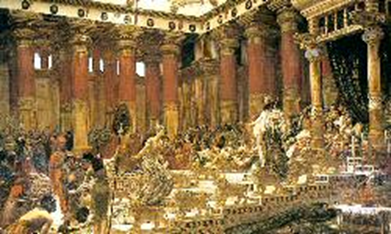
1 Kings 7:13 – 47 “Now King Solomon sent to bring Huram from Tyre. He was the son of a widow from the tribe of Naphtali, and his father was a man of Tyre, a craftsman in bronze. Huram had great skill, understanding, and knowledge for every kind of bronze work. So, he came to King Solomon and carried out all his work.
He cast two pillars of bronze, each eighteen cubits high and twelve cubits in circumference. Each pillar was approximately 27 feet high and 18 feet in circumference (8.2 meters high and 5.5 meters in circumference). He also made two capitals of cast bronze to set on top of the pillars, each capital five cubits high.
(5 cubits is approximately 7.5 feet or 2.3 meters.) For the capitals on top of the pillars he made a network of lattice, with wreaths of chainwork, seven for each capital. Likewise, he made the pillars with two rows of pomegranates around each grating to cover each capital atop the pillars. And the capitals atop the pillars in the portico were shaped like lilies, four cubits high. (4 cubits is approximately 6 feet or 1.8 meters) On the capitals of both pillars, just above the rounded projection next to the network, were the two hundred pomegranates in rows encircling each capital.
Thus, he set up the pillars at the portico of the temple. The pillar to the south he named Jachin, (He establishes) and the pillar to the north he named Boaz. (In Him is strength) And the tops of the pillars were shaped like lilies. So, the work of the pillars was completed.
The Molten Sea
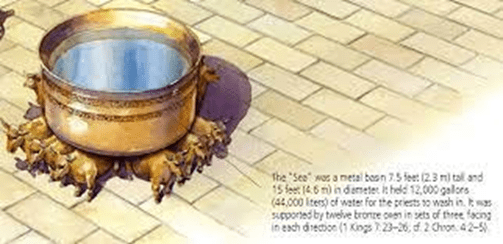
He also made the Sea of cast metal. It was circular in shape, measuring ten cubits from rim to rim, five cubits in height, and thirty cubits in circumference. The Sea was approximately 15 feet from rim to rim, 7.5 feet in height, and 45 feet in circumference (4.6 meters from rim to rim, 2.3 meters in height, and 13.7 meters in circumference). Below the rim, ornamental buds encircled it, ten per cubit all the way around the Sea, cast in two rows as a part of the Sea.
The Sea stood on twelve oxen, three facing north, three facing west, three facing south, and three facing east. The Sea rested on them, with all their hindquarters toward the center. It was a handbreadth thick, (A handbreadth is approximately 2.9 inches or 7.4 centimeters) and its rim was fashioned like the brim of a cup, like a lily blossom. It could hold two thousand baths. (2,000 baths is approximately 11,600 gallons or 44,000 liters.)
The Ten Bronze Stands
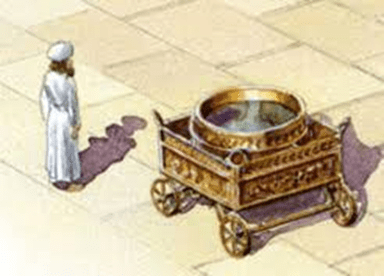
In addition, he made ten movable stands of bronze, each four cubits long, four cubits wide, and three cubits high.
This was the design of the stands: They had side panels attached to uprights, and on the panels between the uprights were lions, oxen, and cherubim. On the uprights was a pedestal above, and below the lions and oxen were wreaths of beveled work. Each stand had four bronze wheels with bronze axles and a basin resting on four supports, with wreaths at each side. The opening to each stand inside the crown at the top was one cubit deep, with a round opening like the design of a pedestal, a cubit and a half wide. And around its opening were engravings, but the panels of the stands were square, not round. There were four wheels under the panels, and the axles of the wheels were attached to the stand; each wheel was a cubit and a half in diameter. The wheels were made like chariot wheels; their axles, rims, spokes, and hubs were all of cast metal.
Each stand had four handles, one for each corner, projecting from the stand. At the top of each stand was a circular band half a cubit high. The supports and panels were cast as a unit with the top of the stand.
He engraved cherubim, lions, and palm trees on the surfaces of the supports and panels, wherever each had space, with wreaths all around. In this way he made the ten stands, each with the same casting, dimensions, and shape.
The Ten Bronze Basins He also made ten bronze basins, each holding forty baths (40 baths is approximately 232 gallons or 880 liters) and measuring four cubits across, one basin for each of the ten stands. He set five stands on the south side of the temple and five on the north, and he put the Sea on the south side, at the southeast corner of the temple.
Completion of the Bronze Works Additionally, Huram made the pots, shovels, and sprinkling bowls. So Huram finished all the work that he had undertaken for King Solomon in the house of the LORD: the two pillars; the two bowl-shaped capitals atop the pillars; the two sets of network covering both bowls of the capitals atop the pillars; the four hundred pomegranates for the two sets of network (two rows of pomegranates for each network covering both the bowl-shaped capitals atop the pillars); the ten stands; the ten basins on the stands; the Sea; the twelve oxen underneath the Sea; and the pots, shovels, and sprinkling bowls.
All the articles that Huram made for King Solomon in the house of the LORD were made of burnished bronze. The king had them cast in clay molds in the plain of the Jordan between Succoth and Zarethan. Solomon left all these articles unweighed, because there were so many. The weight of the bronze could not be determined.”
Whew! By now, the temple is really beginning to glisten inside! Bronze is a slightly darker color than gold; however, all that bronze would mean that the temple would look amazing whenever light hit the columns, the sea, or the basins with their portable stands. No wonder that Huram had to cast all these things in clay molds in the plain of the Jordan.
There’s no doubt that Solomon’s temple was an incredible building with phenomenal features. The saddest part of this situation is that eventually, Israel and Judah both stopped worshiping the Lord and turned to demons instead. The Assyrians and the Babylonians raided Jerusalem, cutting the bronze into pieces and carrying it off.
APPLICATION: There is a Latin phrase sic transit gloria mundi, which means, “So passes the glory of the world.” 1 John 2:15 – 17 tells us, “Do not love the world or anything in the world. If anyone loves the world, the love of the Father is not in him. For all that is in the world—the desires of the flesh, the desires of the eyes, and the pride of life—is not from the Father, but from the world. The world is passing away, along with its desires; but whoever does the will of God remains forever.” God is the only safe Person to trust. Politicians, religious leaders, heads of corporations, movie stars, sports heroes – all these people are fallible and will eventually disappoint you. Wealth can evaporate, and your health may fail suddenly without warning. As I am writing this, our hospital is in mourning for a young nurse, a beloved wife and mother of two small children, who suddenly dropped dead a few days ago.
When Solomon built this temple, there were probably people who assumed that it would stand forever. But only a few hundred years later, invading armies would tear the temple to pieces, looting the gold and silver and bronze, and carrying the spoils away. Eventually, Solomon realized that his wealth did not satisfy him and expressed his disillusionment in the Book of Ecclesiastes.
Where do you look for help? Psalm 46:1 says that “God is our refuge and strength, an ever – present help in times of trouble.” Put your trust in God! Your Heavenly Father will never disappoint you.
PRAYER: Father God, thank You for loving us and for caring for us. Help all who read these words to trust in You and rejoice in Your Love. In the mighty and precious Name of King Jesus. Amen.
 Burunche's Blog
Leave a comment