Archive for July, 2022

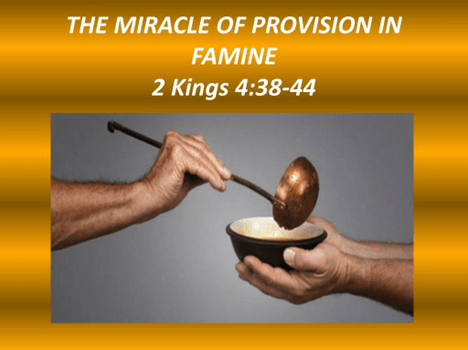
JULY 31, 2022 SPIRITUAL BLACK HOLES PART 2 #7 2 KINGS 4:38 – 44 GOD SAVES A COOKING DISASTER  AND FEEDS ONE HUNDRED MEN

July 31, 2022

2 Kings 4:38 – 44 “When Elisha returned to Gilgal, there was a famine in the land. As the sons of the prophets were sitting at his feet, he said to his attendant, “Put on the large pot and boil some stew for the sons of the prophets.”

One of them went out to the field to gather herbs, and he found a wild vine from which he gathered as many wild gourds as his garment could hold. Then he came back and cut them up into the pot of stew, though no one knew what they were.

And they poured it out for the men to eat, but when they tasted the stew they cried out, “There is death in the pot, O man of God!” And they could not eat it.

Then Elisha said, “Get some flour.” He threw it into the pot and said, “Pour it out for the people to eat.” And there was nothing harmful in the pot.

Now a man from Baal-shalishah came to the man of God with a sack of twenty loaves of barley bread from the first ripe grain. “Give it to the people to eat,” said Elisha.

But his servant asked, “How am I to set twenty loaves before a hundred men?”

“Give it to the people to eat,” said Elisha, “for this is what the LORD says: ‘They will eat and have some left over.’ ”

So he set it before them, and they ate and had some left over, according to the word of the LORD.”

Elisha has returned to Gilgal in the eastern part of Israel from Shunem to the west. Rather than stay in comfort in Shunem, Elisha is joining the sons of the prophets to teach them. Because of the idolatry that is rife in Israel, God has removed His blessings and there is a famine in the land. One of the young men goes out to collect wild cucumbers or wild squash, but he makes a mistake. The website https://bible.org/seriespage/11-death-pot-2-kings-438-41 tells us, “Untrained in these matters, he mistook the wild vine for an edible cucumber or squash. What he found is believed to be the citrallus colocynthus, which had a leaf like a squash but was bitter and poisonous due to its very severe purgative qualities. If eaten in large amounts, it would tear up the digestive tract and could even cause death. In small amounts you might not die, but you might think you were going to – and might even want to.”

What happens to the stew when Elisha pours that flour into it? God intervenes and heals the stew, removing the poison from it. But what must the prophets be thinking as Elisha orders them to try the stew again? After suffering from severe stomach cramps, it might take a great deal of faith just to try that stew again!

A man brings a sack of twenty loaves of barley bread from the first ripe grain. This donation represents an offering of first fruits; the man is not keeping his new grain for himself but is sharing it with men of God. But there are only twenty loaves and there are one hundred men to feed. Again, the servant just keeps handing out pieces of bread and the bread feeds all these men. In addition, there are still lots of left overs after everyone has eaten his fill.  

Notice something. The only thing that makes these men special is that in a time when many in Israel are pursuing idols of all kinds, these men have dedicated themselves to learning about the One True Living God. Are these men perfect? Far from it! But God is honoring the dedication of these men by providing for them.

APPLICATION: There have been all kinds of lessons drawn from these two stories. The sons of the prophets are those men who have dedicated themselves to serving God and to learning more about him. Because of that dedication, even though a famine is hitting the land, God is still providing for these men.

We live in uncertain times. Economies are shaking and collapsing. Industries are failing. There is political unrest in a number of places. But God still has people who love Him and who are serving Him. God will take care of His people. Does that mean that we will not suffer along with everyone else? Of course not! The famine is hitting these men at Gilgal just as it is hitting everywhere else in Israel. But God faithfully provides their basic needs.

What eventually happens to these men is not known. It is possible that later some of them may die for their faith. But on this day, at this point in time, God shows up and supplies abundantly.

Throughout the world, Christians are dying for their faith. It is entirely possible that we too may eventually be called on to lay down our lives. Let us trust that if and when that time comes, God will give us the strength, the grace, and the courage to endure to the end. The same God who has healed the stew and provided bread for these one hundred men is still able. Let us praise Him and worship Him!

PRAYER: Father God, thank You for loving us and for caring for us. Lord, help us to follow hard after You all the days of our lives and help us to trust You to provide for us. In the mighty and precious Name of King Jesus. Amen.

JULY 30, 2022 SPIRITUAL BLACK HOLES PART 2 #6 2 KINGS 4:8 – 37 ELISHA RAISES A CHILD FROM THE DEAD

July 30, 2022

2 Kings 4:8 – 37 “One day Elisha went to Shunem, and a prominent woman who lived there persuaded him to have a meal. So whenever he would pass by, he would stop there to eat.

Then the woman said to her husband, “Behold, now I know that the one who often comes our way is a holy man of God. Please let us make a small room upstairs and put in it a bed, a table, a chair, and a lamp for him. Then when he comes to us, he can stay there.”

One day Elisha came to visit and went to his upper room to lie down. And he said to Gehazi his servant, “Call the Shunammite woman.” And when he had called her, she stood before him, and Elisha said to Gehazi, “Now tell her, ‘Look, you have gone to all this trouble for us. What can we do for you? Can we speak on your behalf to the king or the commander of the army?’ ”

“I have a home among my own people,” she replied.

So he asked, “Then what should be done for her?” “Well, she has no son,” Gehazi replied, “and her husband is old.”

“Call her,” said Elisha.

So Gehazi called her, and she stood in the doorway. And Elisha declared, “At this time next year, you will hold a son in your arms.” “No, my lord,” she said. “Do not lie to your maidservant, O man of God.”

But the woman did conceive, and at that time the next year she gave birth to a son, just as Elisha had told her.

And the child grew, and one day he went out to his father, who was with the harvesters. “My head! My head!” he complained to his father. So his father told a servant, “Carry him to his mother.”

After the servant had picked him up and carried him to his mother, the boy sat on her lap until noon, and then he died. And she went up and laid him on the bed of the man of God. Then she shut the door and went out.

And the woman called her husband and said, “Please send me one of the servants and one of the donkeys, that I may go quickly to the man of God and return.”

“Why would you go to him today?” he replied. “It is not a New Moon or a Sabbath.” “Everything is all right,” she said.

Then she saddled the donkey and told her servant, “Drive onward; do not slow the pace for me unless I tell you.”  So she set out and went to the man of God at Mount Carmel.

When the man of God saw her at a distance, he said to his servant Gehazi, “Look, there is the Shunammite woman. Please run out now to meet her and ask, ‘Are you all right? Is your husband all right? Is your child all right?’ ” And she answered, “Everything is all right.”

When she reached the man of God at the mountain, she clung to his feet. Gehazi came over to push her away, but the man of God said, “Leave her alone, for her soul is in deep distress, and the LORD has hidden it from me and has not told me.”

Then she said, “Did I ask you for a son, my lord? Didn’t I say, ‘Do not deceive me?’ ”

So Elisha said to Gehazi, “Tie up your garment, take my staff in your hand, and go! If you meet anyone, do not greet him, and if anyone greets you, do not answer him. Then lay my staff on the boy’s face.”

And the mother of the boy said, “As surely as the LORD lives and as you yourself live, I will not leave you.” So he got up and followed her.

Gehazi went on ahead of them and laid the staff on the boy’s face, but there was no sound or response. So he went back to meet Elisha and told him, “The boy has not awakened.”

When Elisha reached the house, there was the boy lying dead on his bed. So he went in, closed the door behind the two of them, and prayed to the LORD.

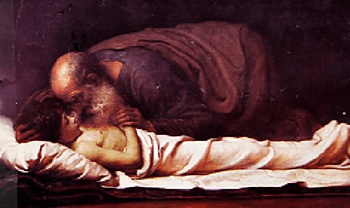
Then Elisha got on the bed and lay on the boy, mouth to mouth, eye to eye, and hand to hand. As he stretched himself out over him, the boy’s body became warm. Elisha turned away and paced back and forth across the room. Then he got on the bed and stretched himself out over the boy again, and the boy sneezed seven times and opened his eyes.

Elisha summoned Gehazi and said, “Call the Shunammite woman.” So he called her and she came. Then Elisha said, “Pick up your son.” She came in, fell at his feet, and bowed to the ground. Then she picked up her son and went out.

The assurance of a good meal, a bed, a table, a chair, a lamp, and a room in the upper part of the house where the evening breezes would make everything delightful – these were the homely things that this practical – minded lady of Shunem provided for the prophet Elisha and his servant Gehazi. As far as we know, Elisha had no wife or child and he had left his parents to follow Elijah. There were probably many times when Elisha and Gehazi had to settle for sleeping in stables or even in caves. Under such circumstances, the promise of good food, safe drinking water, and a clean attractive place to sleep and meditate must have seemed like a dream come true to Elisha and Gehazi. Little wonder then, that Elisha would try to do something to repay this lady’s kindness.

The Shunammite woman had no son and her husband was old. Perhaps she was a young woman who had been married off to an older man by her parents so that she would have a comfortable situation and would be able to assist them. At any rate, Elisha interceded for this lady and God gave her a son. All was well until the day when the boy was in the field with his father and the harvesters and began complaining of a severe headache. Within a few hours, this sweet child was dead and his mother was distraught. But this lady was a woman of faith; she believed that if Elisha had prayed for the birth of this child, Elisha might still be able to pray and raise this child from the dead.

This lady’s husband was not a believer. It was the faithful wife who insisted that all was well, even after she had carried her dead son’s body up to Elisha’s room. Despite protests from her husband, this lady courageously had a donkey saddled and then rushed to Elisha, still proclaiming that all was well. But all was not well and when Elisha sent Gehazi with his staff as a sign of authority, the boy remained dead. Elisha and the woman returned to her home. Elisha went upstairs, shut the door, and prayed to the Lord. Then Elisha stretched himself out on the boy, allowing God’s power to flow through his body and into that lifeless body. Suddenly the boy began breathing and sneezed seven times. Why seven times? Seven was considered the number of completion. God allowed the boy to sneeze seven times because He was healing the boy thoroughly. How Elisha and the Shunammite lady must have grinned at each other as Elisha called her and told her to pick up her son. That lady did not need to be told twice! That little boy probably got the hugging of his life as his mother embraced him, sobbing tears of joy.

APPLICATION: This is rainy season, a time of year when parents rush their malaria – stricken children in pale and seizing. We try to save every child; however, sometimes we fail. We might ask why God has chosen to raise this lady and yet allows so many of these children to die with complications of malaria. We will never know until we reach heaven. But what is remarkable about this story is not merely the raising of a child from the dead, but the faith of his mother. This lady has carried her dead son’s body up to the prophet’s room. She knows that her son is dead, and yet, she keeps maintaining that nothing is wrong and that everything will be all right. Yes, God moves through Elisha to heal the boy; however, it is the faith of the boy’s mother that impels her to saddle that donkey and rush post – haste to call Elisha to come. A woman of lesser faith would have simply shrugged her shoulders and buried the child and no miracle would ever have taken place.

We read these stories and wonder if God really does this stuff. A few years ago, a lady came to our mission hospital from across the river in Togo. We treated her for several days and then she went to stay at a local pastor’s house in town. That night, about 7:30, the lady died! There was no doubt that the lady was truly dead; she stopped breathing, had no heartbeat, and her body was starting to become stiff. The pastor led prayers for the lady and her family. Lacking anyplace else to put the body, her female relatives carefully laid her in one corner of the room and then prepared to go to sleep themselves in the same room. But two hours later, at 9:30 PM, the lady woke up. Let me say that again: THE LADY WOKE UP! God raised that lady from the dead, and she was healed. The problems that had sent her to the hospital were gone.

We can always ask God for healing; there is nothing wrong in asking. And we can ask repeatedly; Jesus encouraged his disciples to pray persistently. But at the end of the day, we must remember that we are only in advertising and that God is in management. Sometimes we don’t know what might happen if someone continues to live. God loves our family members far better than we can and He knows the end from the beginning. Let us come to God in faith, trusting Him and asking for big things, knowing that a loving heavenly Father will give us His very best.

PRAYER: Father God, thank You for loving us and for caring for us. Lord, help us to trust You, even when circumstances seem grim. Thank You for loving those who are dear to us far more than we ever can. Help us to pray and not to give up but to recognize Your timing in our lives and the lives of our loved ones. In the mighty and precious Name of King Jesus. Amen.

JULY 29, 2022 SPIRITUAL BLACK HOLES PART 2 #5 – 2 KINGS 4:1 – 7 GOD’S GOT YOUR BACK!

July 29, 2022

2 Kings 4:1 – 7 “Now the wife of one of the sons of the prophets cried out to Elisha, “Your servant, my husband, is dead, and you know that your servant feared the LORD. And now his creditor is coming to take my two children as his slaves!”

“How can I help you?” asked Elisha. “Tell me, what do you have in the house?”

She answered, “Your servant has nothing in the house but a jar of oil.” “Go,” said Elisha, “borrow jars, even empty ones, from all your neighbors. Do not gather just a few. Then go inside, shut the door behind you and your sons, and pour oil into all these jars, setting the full ones aside.”

So she left him, and after she had shut the door behind her and her sons, they kept bringing jars to her, and she kept pouring. When all the jars were full, she said to her son, “Bring me another.”

But he replied, “There are no more jars.” Then the oil stopped flowing.

She went and told the man of God, and he said, “Go, sell the oil, and pay your debt. Then you and your sons can live on the remainder.”

GOD TAKES CARE OF WIDOWS AND ORPHANS! The widow Mariam was in despair. Mariam’s late husband Ebenezer was no money manager! While Ebenezer was alive, he had foolishly borrowed from Simon, the most vicious money lender in town, assuming he would easily be able to repay later. Then came the day when Ebenezer collapsed out in the field. By the time neighbors could reach Ebenezer, there was nothing they could do for him, except to carry his dead body back to his home. Now Simon the money lender was at Mariam’s door, demanding that she hand over Joshua, age 10, and Samuel, age 8, so that he could sell them as slaves and get his money. To Mariam, her sons were her hope and her future. Little wonder then, that Mariam was appealing to Elisha for assistance.

Notice how Elisha proceeded in this matter. First, Elisha asked Mariam what she had in her house. When Mariam replied that she had one jar of oil, Elisha advised her to borrow every container she possibly could from her neighbors. To get those containers must have been a challenge; how did Mariam explain things to her neighbors without appearing foolish? But Mariam was desperate; perhaps she simply told others that the prophet had ordered her to do this. Nobody messed with prophets! Next Mariam and her sons were to shut themselves up in their home and then begin pouring oil from the original container into all the borrowed ones. In a village where anyone’s business quickly became everyone’s business, Elisha didn’t want a crowd of onlookers to rush into Mariam’s home and possibly steal anything from Mariam. This miracle was to be a private one, not a public one.

Finally, Mariam and her sons had to keep pouring as long as they had containers, and Mariam did just that. What must Mariam have thought when she filled the first few containers and the oil was still flowing? All that we know is that Mariam kept calling for more containers and her sons kept bringing them to her until the whole room was full and there were no more containers left. That’s when the oil stopped flowing.

APPLICATION: What if Mariam had only borrowed a few containers? Would there have been enough oil to pay the debt and leave money for her sons and her to live on? Although the major emphasis in this passage is on Elisha and the power of God that flowed through him, we must never overlook the faith of this widow. Many times, God might want to do something through us or for us; however, He cannot because we don’t want to appear foolish. Had this widow not risked looking ridiculous, she would never have borrowed enough containers to accommodate the oil necessary for her and her sons to survive.  

Does God really do this stuff? A few days ago, I told the story of the KFC miracle that happened to friends. But many years ago, something similar happened to me. While I was still in general surgery residency, I was interviewing for positions in pediatric surgery, using much of my income to travel to various training sites around America. At the same time, I was supporting an orphan through a charity and giving through my church as well. In August of that year, I re – stocked my dry supplies such as beans, flour, soy powder, etc. Normally, I would have to purchase these things once a month. But that fall, the levels of the supplies hit the half – way point and then stayed there. One night as I was cooking supper, I suddenly realized what was happening and that I had not bought new supplies in several months. Even though I had not specifically asked God to multiply these things, God had done so. Since then, there have been times during our missionary careers when God has multiplied finances and supplies.

God is faithful! Notice that God did not supply Mariam’s wants, but her needs. Mariam’s biggest need was for money to settle her late husband’s debts so that her sons would not be sold as slaves. God through Elisha made a way so that debt could be settled and Mariam and the boys would also have money to live on. Sometimes we ask God for things to satisfy our wants, rather than our needs.

Also notice that God worked with what Mariam had. Elisha did not order Mariam to go out and buy anything. If Mariam had had flour, God would have multiplied the flour.

What do you truly need today? Go somewhere quiet and then talk with God. Rest assured that the same God who saved this widow from having to sell her sons into slavery can still supply your needs. But be prepared! You might have to look as foolish as a poor lady running around a village borrowing jars from her neighbors.

PRAYER: Father God, thank You for loving us and for caring for us. Lord, help us to come to You with our needs and to trust that You will hear and answer. In the mighty and precious Name of King Jesus. Amen.

JULY 28, 2022 SPIRITUAL BLACK HOLES PART 2 2 KINGS 3:1 – 27 INSANITY IS MAKING THE SAME MISTAKE TWICE AND EXPECTING DIFFERENT RESULTS!

July 28, 2022

 2 Kings 3:1 – 27 “In the eighteenth year of Jehoshaphat’s reign over Judah, Jehoram son of Ahab became king of Israel, and he reigned in Samaria twelve years. And he did evil in the sight of the LORD, but not as his father and mother had done. He removed the sacred pillar of Baal that his father had made.

Nevertheless, he clung to the sins that Jeroboam son of Nebat had caused Israel to commit; he did not turn away from them.

Now Mesha king of Moab was a sheep breeder, and he would render to the king of Israel a hundred thousand lambs and the wool of a hundred thousand rams. But after the death of Ahab, the king of Moab rebelled against the king of Israel. So at that time King Jehoram set out from Samaria and mobilized all Israel. And he sent a message to Jehoshaphat king of Judah: “The king of Moab has rebelled against me. Will you go with me to fight against Moab?”

“I will go,” replied Jehoshaphat. “I am like you, my people are your people, and my horses are your horses.” Then he asked, “Which way shall we go up?”

“By way of the Desert of Edom,” replied Joram.

So the king of Israel, the king of Judah, and the king of Edom set out, and after they had traveled a roundabout route for seven days, they had no water for their army or for their animals.

“Alas,” said the king of Israel, “for the LORD has summoned these three kings to deliver them into the hand of Moab!”

But Jehoshaphat asked, “Is there no prophet of the LORD here? Let us inquire of the LORD through him.”

And one of the servants of the king of Israel answered, “Elisha son of Shaphat is here. He used to pour water on the hands of Elijah.”

Jehoshaphat affirmed, “The word of the LORD is with him.” So the king of Israel and Jehoshaphat and the king of Edom went down to him.

Elisha, however, said to the king of Israel, “What have we to do with each other? Go to the prophets of your father and of your mother!”

“No,” replied the king of Israel, “for it is the LORD who has summoned these three kings to deliver them into the hand of Moab.”

Then Elisha said, “As surely as the LORD of Hosts lives, before whom I stand, were it not for my regard for the presence of Jehoshaphat king of Judah, I would not look at you or acknowledge you. But now, bring me a harpist.”

And while the harpist played, the hand of the LORD came upon Elisha and he said, “This is what the LORD says: ‘Dig this valley full of ditches.’ For the LORD says, ‘You will not see wind or rain, but the valley will be filled with water, and you will drink—you and your cattle and your animals.’ This is a simple matter in the sight of the LORD, and He will also deliver the Moabites into your hand. And you shall attack every fortified city and every city of importance. You shall cut down every good tree, stop up every spring, and ruin every good field with stones.”

The next morning, at the time of the morning sacrifice, water suddenly flowed from the direction of Edom and filled the land.

Now all the Moabites had heard that the kings had come up to fight against them. So all who could bear arms, young and old, were summoned and stationed at the border. When they got up early in the morning, the sun was shining on the water, and it looked as red as blood to the Moabites across the way.

“This is blood!” they exclaimed. “The kings have clashed swords and slaughtered one another. Now to the plunder, Moab!”

But when the Moabites came to the camp of Israel, the Israelites rose up and attacked them, and they fled before them. So the Israelites invaded their land and struck down the Moabites. They destroyed the cities, and each man threw stones on every good field until it was covered. They stopped up every spring and cut down every good tree. Only Kir-haraseth was left with stones in place, but men with slings surrounded it and attacked it as well.

When the king of Moab saw that the battle was too fierce for him, he took with him seven hundred swordsmen to break through to the king of Edom, but they could not prevail. So he took his firstborn son, who was to succeed him, and offered him as a burnt offering on the city wall. And there was great fury against the Israelites, (Israel’s fury was great) so they withdrew and returned to their own land.”

Jehoram, a.k.a., Joram, has succeeded his father Ahab and his brother Ahaziah and is now ruling the Northern Kingdom of Israel. Joram has made a tiny concession to the God of Israel by cutting down the Baal pillar; however, he is busy pursuing every other cult available. Mesha, king of Moab, recognizes the opportunity to get free and stop paying expensive tributes, so he rebels. Joram then calls on Jehoshaphat and the king of Edom for assistance. The last time Jehoshaphat helped a king of Israel, it was during the battle against the Syrians in which Ahab was severely wounded so that he died. Jehoshaphat foolishly wore his royal robes into battle and was nearly killed; however, the Syrians realized who he was and left him alone. Now Joram is calling for assistance and Jehoshaphat is busy making ringing statements. “I am like you, my people are your people, and my horses are your horses.”  

Joram stupidly advises that they should bring their armies through the Desert of Edom, and the three armies run out of water. When Jehoshaphat asks for a prophet of the Lord, Elisha appears and orders the armies to dig ditches in the dry valley so that God will fill them. Elisha further orders that after they have gotten water, they should completely destroy the land of Moab by cutting down every good tree, stopping up the springs, and dropping stones on every piece of good land.

Somewhere in the mountains it rains, and the ditches fill with water. When the morning sun strikes the water, turning it red, the Moabites think that the three armies are fighting amongst themselves and rush to attack. The three armies then destroy the Moabite army and carry out Elisha’s orders. Every walled city in Moab is destroyed, leaving only Kir – haraseth. Just as the armies are about to destroy this city, the king of Moab offers his eldest son who would succeed him as a burnt offering on the city wall. Horrified, the armies retreat.

What is the point of Mesha sacrificing his first – born son who would otherwise succeed him? Among the myriads of theories, Drew Holland from Martin Methodist College offers what might be the most logical explanation in his article “An Alternative Approach to the Dilemma of 2 Kings 3:27.” (https://place.asburyseminary.edu/cgi/viewcontent.cgi?article=1126&context=jibs) Holland suggests that King Mesha’s sacrifice is actually a sign of surrender and an atonement for the sin of rebellion. Holland tells us, “The burnt offering was commonly sacrificed in a wartime situation by battle losers to express apology, and it was also done by vassal kings to solidify a relationship with a suzerain king. Both types fit Mesha in 2 Kgs 3, the rebellious vassal wishing to re-establish his relationship with his suzerain after defeat.”

Holland then contends that the Israelites have conquered Kir – haraseth and are now involved as partners in Mesha’s horrific sacrifice. “Second, this sacrifice has practical functions. It both expresses contrition in cultic terms and serves the political purpose of ensuring that Mesha’s successor would not seek vengeance against the Israelites. If Mesha’s first-born son is the offering to be destroyed in a sacrifice, he will not live to seek the rebellious path of his father. In the words of Julie Faith Parker, “By sacrificing his son, King Mesha saves his kingdom from defeat while robbing it of its next ruler.”

Third, the idea of the “first-born” ( הַבְּכוֹר ), is intrinsically connected with the burnt offering and is instructive to revealing the nature of the burnt offering in this case. The gift for a burnt offering is typically a first-born male. With regard to the offering of human children, Gen 22 provides an instructive example. God commands Abraham to offer Isaac, the first-born male of Abraham and Sarah, as a burnt offering. However, the angel soon prevents Abraham from following through, allowing Abraham to offer a ram instead. A similar idea is at play in 2 Kgs 3:27, where Mesha’s beloved first-born is offered as a burnt offering. Yet, in contrast to Abraham, Mesha follows through with the offering.

One function of the sacrifice of the first-born male is as a substitute for the sacrificer…celebrating success for the victor and as an instrument of contrition for the loser…

Rather, the burnt offering is only intended to be undertaken after a battle is complete. If one loses the battle, the burnt offering has repentant force. If one wins the battle, the burnt offering has celebratory intentions. The significance attached to burnt offerings affirms not only the rationale for Mesha’s sacrifice but also the point of the prior section that the battle at Kir-hareseth was complete and that Israel had won, fulfilling Elisha’s prophecy.

It functions to indicate that the Israelites were behaving in a cultically ambiguous, thus inappropriate manner. We have little idea to whom Mesha, supported by the Israelites, sacrificed. But we do know it was cultically inappropriate for Yhwh’s people to participate in it.”

The “great wrath” mentioned would then be the wrath of God poured out on the Israelites for participating in Mesha’s horrible sacrifice as on – lookers essentially participating in the sacrificial ritual, rather than removing themselves from the scene. The fear of the Lord literally descends on the Israelites, causing them to suddenly withdraw and return home.

APPLICATION: Jehoshaphat is at it again! Having failed to learn from the near – fatal experience with Ahab, Jehoshaphat is back allying himself with Joram. Does Jehoshaphat derive some kind of pleasure from comparing himself with Joram, something similar to the smug feelings enjoyed by the families of addicts? (“Well, no matter what I do, I will NEVER be as bad as him!”) Does Jehoshaphat still cherish notions of being able to re – unite Israel and Judah? Or is Jehoshaphat bored and hoping for glory or loot? Whatever the case, Jehoshaphat has made the same mistake he made with Ahab; he has allied himself with someone who is totally unrighteous.

This time, Jehoshaphat winds up as a participant in a child sacrifice, something abhorrent to the God whom Jehoshaphat claims to serve. Nowhere in the Scripture does it say that Jehoshaphat has absented himself from this sacrifice. What excuse can Jehoshaphat possibly offer to the Lord? Jehoshaphat is pushing the envelope, teetering on the brink of full – bore cultic worship.

We may criticize Jehoshaphat, but the temptation to indulge our curiosity is ever – present. One pastor friend found himself addicted to on – line pornography when he failed to eliminate an invitation that popped up while he was surfing the internet. On – line videos, Netflix, television programs – the possibilities are endless.

Proverbs 4:23 tells us, “Above all else, guard your heart, for everything you do flows from it.” As we move through our days, may we guard our hearts carefully!

PRAYER: Father God, thank You for loving us and for caring for us. Lord, help us to closely guard our hearts, that we may follow hard after You all the days of our lives. In the mighty and precious Name of King Jesus. Amen.
JULY 27,2022 SPIRITUAL BLACK HOLES PART 2 2 KINGS 2:15 – 25 HOW DO YOU FOLLOW THE DOG AND PONY ACT?

July 27, 2022

2 Kings 2:15 – 25 “When the sons of the prophets who were facing him from Jericho saw what had happened, they said, “The spirit of Elijah rests on Elisha.” And they went to meet him and bowed down to the ground before him.

 “Look now,” they said to Elisha, “we your servants have fifty valiant men. Please let them go and search for your master. Perhaps the Spirit of the LORD has taken him up and put him on one of the mountains or in one of the valleys.”

“Do not send them,” Elisha replied.

But when they pressed him to the point of embarrassment, he said, “Send them.”

And they sent fifty men, who searched for three days but did not find Elijah.

When they returned to Elisha, who was staying in Jericho, he said to them, “Didn’t I tell you not to go?”

Then the men of the city said to Elisha, “Please note, our lord, that the city’s location is good, as you can see. But the water is bad and the land is unfruitful.”

“Bring me a new bowl,” he replied, “and put some salt in it.”

So they brought it to him, and Elisha went out to the spring, cast the salt into it, and said, “This is what the LORD says: ‘I have healed this water. No longer will it cause death or unfruitfulness.’ ” And the waters there have been healthy to this day, according to the word spoken by Elisha.

From there, Elisha went up to Bethel, and as he was walking up the road, a group of boys (insignificant young men) came out of the city and jeered at him, chanting, “Go up, you baldhead! Go up, you baldhead!”

Then he turned around, looked at them, and called down a curse on them in the name of the LORD. Suddenly two female bears came out of the woods and mauled forty-two of the boys. And Elisha went on to Mount Carmel, and from there he returned to Samaria.

Elisha has just watched Elijah being swept up into heaven, riding in a chariot of fire. Even before Elijah and Elisha crossed the Jordan, Elisha knew that Elijah was leaving the earth that day; he simply didn’t know how it would happen. The sons of the prophets were watching from the west side of the Jordan near Jericho and may even have seen the chariot of fire; certainly, they watched as Elisha struck the waters of Jordan with Elijah’s cloak and crossed on dry land. But the sons of the prophets had very little faith, so they imagined that God had simply picked Elijah up and transported him someplace else. When the sons of the prophets demanded to search for Elijah, Elisha probably just shrugged his shoulders and let them go at it, knowing that Elijah was no longer on the earth.

When Joshua destroyed the city of Jericho, he cursed anyone who would rebuild it. During the reign of wicked King Ahab, Hiel of Bethel rebuilt Jericho at the cost of his eldest son and his youngest son. These boys may have been slaughtered and their bodies buried before the walls and gates were established. Little wonder then, if there was a curse on the land and the water was foul. But Elisha had received a double portion of Elijah’s spirit, and he was prepared. The use of a new bowl with salt served as a symbolic gesture of God’s healing of the land and the water. That spring still exists today, and the land around Jericho remains highly productive.

“Elisha’s Spring (also called the Prophet’s Fountain and Elisha’s Fountain) is a freshwater spring near the archaeological mound of Tel Jericho where remains of settlements were found dating back to about 8,000 BC.

” (https://www.beinharimtours.com)

Evidently, from time immemorial, there were always bunches of young men hanging around to see what kind of trouble they could cause.  But one gang got a horrible shock. After leaving Jericho, Elisha was walking toward Bethel when these fellows began mocking him for his baldness. Although the name Elijah is generally translated as “Yahweh is my God,” another translation is “lord of the hair,” perhaps indicating that Elijah had flowing locks. At that time, baldness was considered as a type of physical deformity, so these hoodlums felt that they had found someone they could pick on. Bad move! Elisha called down a curse from the Lord, and two female bears rushed out of the woods and mauled forty – two gang members. From Bethel, Elijah went on to Mount Carmel and then back to Samaria.

Why did God allow forty – two young men to be mauled by bears? Perhaps the Bible only gives us a sanitized version of what actually took place. Perhaps this gang actually planned to attack and kill Elisha. At any rate, the message would have gone out throughout the land: don’t mess with God’s prophet!

APPLICATION: In the days of vaudeville shows, there were certain slots on the program that were undesirable. Performers never wanted to follow a very popular act because the audience was likely to take a break and go for refreshments when that act ended, leaving the next performers with a shrunken audience. People loved to watch acts involving trained dogs or trained ponies or a combination of the two, hence the name “dog and pony act.” The worst place on the program was the slot following the dog and pony act, because to be able to keep the audience’s attention after that meant that you had to have something very special.

Elisha succeeded Elijah and received a double portion of his spirit; however, Elisha was also in the position of following an incredibly successful mentor. After all, Elijah not only called down fire from heaven to consume his sacrifice on Mount Carmel, but he also called that same fire down on two different companies of soldiers when they came to arrest him. Perhaps God allowed the miracle at Jericho and the deliverance from this gang both to emphasize His approval of Elisha and also to encourage Elisha.

God’s calling and anointing on Elisha was no weaker than His calling and anointing on Elijah. But God called Elisha to a different ministry. One of the biggest mistakes one can make is to compare oneself to a highly successful predecessor. Each of us is unique with our own abilities and talents. God knows us far better than we know ourselves and calls us to work that is particularly suited to the gifts He has given or will give. But one thing we must remember: we can only accomplish things by God’s power, not by our own. 2 Corinthians 4:7 tells us, But we have this treasure in jars of clay to show that this all-surpassing power is from God and not from us.”

Today, if you are feeling overwhelmed at the tasks before you, why not ask God for the strength and courage to complete those tasks? If God is calling you to a work, He will certainly provide the energy and the vision for you to complete it.

PRAYER: Father God, thank You for loving us and for caring for us. Lord, help us to trust that where You guide, You will provide and that You will give us the strength to complete the work to which You are calling us. In the matchless Name of King Jesus. Amen.

JULY 26, 2022 SPIRITUAL BLACK HOLES PART 2 2 KINGS 2:1 – 14 GOD SWEEPS ELIJAH UP INTO HEAVEN!

July 26, 2022

2 Kings 2:1 – 14 “Shortly before the LORD took Elijah up to heaven in a whirlwind, Elijah and Elisha were on their way from Gilgal, and Elijah said to Elisha, “Please stay here, for the LORD has sent me on to Bethel.”

But Elisha replied, “As surely as the LORD lives and as you yourself live, I will not leave you.”

So they went down to Bethel. Then the sons of the prophets at Bethel came out to Elisha and said, “Do you know that the LORD will take your master away from you today?”

“Yes, I know,” he replied. “Do not speak of it.”

And Elijah said to Elisha, “Please stay here, for the LORD has sent me on to Jericho.”

But Elisha replied, “As surely as the LORD lives and as you yourself live, I will not leave you.”

So they went to Jericho.

Then the sons of the prophets at Jericho came up to Elisha and said, “Do you know that the LORD will take your master away from you today?”

“Yes, I know,” he replied. “Do not speak of it.”

And Elijah said to Elisha, “Please stay here, for the LORD has sent me on to the Jordan.”

But Elisha replied, “As surely as the LORD lives and as you yourself live, I will not leave you.”

So the two of them went on.

Then a company of fifty of the sons of the prophets went and stood at a distance, facing Elijah and Elisha as the two of them stood by the Jordan. And Elijah took his cloak, rolled it up, and struck the waters, which parted to the right and to the left, so that the two of them crossed over on dry ground.

After they had crossed over, Elijah said to Elisha, “Tell me, what can I do for you before I am taken away from you?”

“Please, let me inherit a double portion of your spirit,” Elisha replied.

“You have requested a difficult thing,” said Elijah. “Nevertheless, if you see me as I am taken from you, it will be yours. But if not, then it will not be so.”

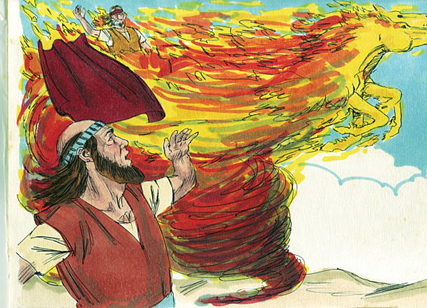
As they were walking along and talking together, suddenly a chariot of fire with horses of fire appeared and separated the two of them, and Elijah went up into heaven in a whirlwind.

As Elisha watched, he cried out, “My father, my father, the chariots and horsemen of Israel!” And he saw Elijah no more. So taking hold of his own clothes, he tore them in two.

Elisha also picked up the cloak that had fallen from Elijah, and he went back and stood on the bank of the Jordan.  Then he took the cloak of Elijah that had fallen from him and struck the waters. “Where now is the LORD, the God of Elijah?” he asked. And when he had struck the waters, they parted to the right and to the left, and Elisha crossed over.

Both Elijah and Elisha KNEW that God was taking Elijah away that day. Neither of them anticipated what might happen. All that Elisha knew was that the man he had followed, his mentor and the man who had taken his father’s place, was about to leave him alone. Little wonder then, that when Elijah began heading toward the Jordan, Elisha refused to remain behind. From Gilgal to Bethel to Jericho to the ford of the Jordan east of Jericho – Elisha stuck to Elijah like a cockle burr. Three times Elijah attempts to get Elisha to remain behind and three times Elisha refuses. The two men cross the Jordan on dry ground after Elijah strikes the water with his mantle.

When Elijah sees that Elisha is truly determined to stay with him until God moves, Elijah asks Elisha what final thing he can do for Elisha. “Give me a double portion of your spirit!” says Elisha. Elisha is wise enough to recognize that in himself, he is not adequate. While this is a difficult thing, Elijah assures Elisha that if Elisha sees Elijah as he is being taken away, Elisha will definitely receive a double portion of Elijah’s spirit. (We know that Elijah has been moving in the power of the Holy Spirit.) Suddenly, a chariot of fire with horses of fire sweeps Elijah up into heaven. As Elijah is ascending, he drops his cloak, and Elisha retrieves it. Elisha has received the blessing that he craved. Tearing his own clothes apart, Elisha drapes himself in Elijah’s mantle until he reaches the Jordan. Striking the waters, Elisha cries out, “Where is the God of Elijah?” The river waters part, and Elisha crosses on dry ground, assured that God has answered his prayer.

APPLICATION: This is a magnificent story! Anyone who has been criticizing Elijah for a lack of faith must consider his ascension into heaven. Why does Elijah test Eisha three times? Elijah knows that his time is short and that Elisha must succeed him. Even though God has assured Elijah that Elisha will take his place, Elijah is probably anxious to see if Elisha will really stay the course. Elisha’s refusal to stay back and his willingness to accompany Elijah to the end are the signs Elijah is searching for.

Why does Elisha tear his clothes? Torn clothes are a sign of grief, and Elisha is grieving for the loss of his friend, even as he stands amazed at the miracle God has just performed. At the same time, Elisha is also putting off the clothes of his old life and taking up the mantle of Elijah. Elisha has stood the test; he has watched Elijah being taken up into heaven and now has inherited a double portion of Elijah’s spirit. Will Elisha have an easy life? Absolutely not! Elisha is going to face all kinds of difficulties. But Elisha has received the anointing that he wanted and he is trusting God to go before him. That’s why Elisha strikes the water of the Jordan and crosses on dry ground.

Psalm 116:15 tells us “Precious in the sight of the Lord is the death of His saints.” No matter how God’s saints die or when, God is right there, sweeping them up into heaven. Even when there are no chariots of fire, God is still there and His Holy Spirit still ministers. When my mother was dying, I was at her bedside. Suddenly in my spirit, I could see my mother and a figure in a robe walking away from me toward a stream in a beautiful meadow. Coming toward across the stream was Jesus. And as Jesus took my mother into his arms, she died. One year later, I told that story at a church in Charleston, WV, only to have a lady in the group come up afterwards and tell me that she had seen something nearly identical when her beloved husband died.

The love of God for His saints is passionate and beautiful beyond all imagining. Whether we are taken up in fiery chariots or gathered up in God’s arms, He is always there for us, just as He has been our entire lives. Such love demands our devotion in return. Let us worship this loving Father by dedicating our lives to Him!

PRAYER: Father God, thank You for loving us and for caring for us. Lord, help us to realize just how deep Your love is for us and to love You in return. In the mighty and precious Name of King Jesus. Amen.  

JULY 25, 2022 SPIRITUAL BLACK HOLES PART 2 – 2 KINGS 1:1 – 18 GOD KEEPS HIS CURSES AS WELL AS HIS PROMISES!

July 25, 2022

2 Kings 1:1 – 18 “After the death of Ahab, Moab rebelled against Israel. Now Ahaziah had fallen through the lattice of his upper room in Samaria and injured himself. So he sent messengers and instructed them: “Go inquire of Baal-zebub, the god of Ekron, whether I will recover from this injury.”

But the angel of the LORD said to Elijah the Tishbite, “Go up to meet the messengers of the king of Samaria and ask them, ‘Is it because there is no God in Israel that you are on your way to inquire of Baal-zebub, the god of Ekron?’ Therefore, this is what the LORD says: ‘You will not get up from the bed on which you are lying. You will surely die.’ ” So Elijah departed.

When the messengers returned to the king, he asked them, “Why have you returned?”

They replied, “A man came up to meet us and said, ‘Go back to the king who sent you and tell him that this is what the LORD says: Is it because there is no God in Israel that you are sending these men to inquire of Baal-zebub, the god of Ekron? Therefore, you will not get up from the bed on which you are lying. You will surely die.’ ”

The king asked them, “What sort of man came up to meet you and spoke these words to you?”

“He was a hairy man,” they answered, “with a leather belt around his waist.”

“It was Elijah the Tishbite,” said the king.

Then King Ahaziah sent to Elijah a captain with his company of fifty men. So the captain went up to Elijah, who was sitting on top of a hill, and said to him, “Man of God, the king declares, ‘Come down!’ ”

Elijah answered the captain, “If I am a man of God, may fire come down from heaven and consume you and your fifty men.”

And fire came down from heaven and consumed the captain and his fifty men. So the king sent to Elijah another captain with his fifty men. And the captain said to Elijah, “Man of God, the king declares, ‘Come down at once!’ ”

Again Elijah replied, “If I am a man of God, may fire come down from heaven and consume you and your fifty men.”

And the fire of God came down from heaven and consumed the captain and his fifty men.

So the king sent a third captain with his fifty men. And the third captain went up, fell on his knees before Elijah, and begged him, “Man of God, may my life and the lives of these fifty servants please be precious in your sight.  Behold, fire has come down from heaven and consumed the first two captains of fifty, with all their men. But now may my life be precious in your sight.”

Then the angel of the LORD said to Elijah, “Go down with him. Do not be afraid of him.”

So Elijah got up and went down with him to the king.

And Elijah said to King Ahaziah, “This is what the LORD says: Is there really no God in Israel for you to inquire of His word? Is that why you have sent messengers to inquire of Baal-zebub, the god of Ekron? Therefore you will not get up from the bed on which you are lying. You will surely die.”

So Ahaziah died according to the word of the LORD that Elijah had spoken. And since he had no son, Jehoram (Ahaziah’s brother) succeeded him in the second year of the reign of Jehoram son of Jehoshaphat over Judah.

As for the rest of the acts of Ahaziah, along with his accomplishments, are they not written in the Book of the Chronicles of the Kings of Israel?”

Remember God’s curses on King Ahab in 1 Kings 21:21 – 22? “‘I will bring calamity on you and consume your descendants; I will cut off from Ahab every male in Israel, both slave and free. I will make your house like that of Jeroboam son of Nebat and like that of Baasha son of Ahijah, because you have provoked My anger and caused Israel to sin.’”

King Ahaziah, the son of King Ahab, has fallen through the lattice at his palace, suffering severe injury. A true son of Ahab and Jezebel, Ahaziah tries to consult Jezebel’s god Baal – zebub to see if he will recover. But God sends the prophet Elijah to confront Ahaziah’s messengers, sending them back with a stern question: ‘”Is it because there is no God in Israel that you are on your way to inquire of Baal-zebub, the god of Ekron?’ Therefore this is what the LORD says: ‘You will not get up from the bed on which you are lying. You will surely die.”

Ahaziah is foolish enough to send a company of fifty soldiers plus a captain to arrest Elijah. Bad move! Elijah calls down fire from heaven that consumes the captain and his fifty men, leaving only scorch marks. Ahaziah is a slow learner, so he dispatches another company of fifty soldiers with a captain, only for those men to also be consumed by heavenly fire. But when Ahaziah insists on sending a third company of fifty soldiers, their captain is smart enough to beg for his life and the lives of his men.

God gives Elijah the go – ahead to accompany this captain and his soldiers. Elijah proceeds to Ahaziah’s bedside, where he personally delivers his message from the Lord. Ahaziah dies, and because he has no son, Jehoram, Ahaziah’s brother, succeeds Ahaziah.

APPLICATION: God is not Santa Claus! King Ahab narrowly escaped having his body eaten by dogs after his death, although the dogs did lick up his blood from the place where his servants washed his chariot. But God through Elijah has pronounced curses on every member of Ahab’s family, swearing that every male belonging to that family, whether slave or free, will be cut off. As we continue to study 2 Kings, we will see what happens to Ahab’s other sons.

We are fond of claiming that God keeps his positive promises; however, we may choose to ignore the fact that God also keeps his Word when He has pronounced curses over someone. In God’s Word, He has pronounced blessings on those who keep His Word but He also has pronounced curses on those who flout His commandments.

“But I don’t believe in God,” you might say. Fine, your choice. But God’s Word is still there and His commandments still stand whether or not you choose to believe in Him or to accept His commandments.

How can we know what God wants us to do with our lives? Read God’s Word, the Bible, carefully. Pray and ask God to help you understand His Word and apply it to your life. Let us pray.

PRAYER: Father God, thank You for loving us and for caring for us. Lord, please teach us Your commandments and Your Will for our lives so that we may please You. In the mighty and precious Name of King Jesus. Amen.

JULY 24, 2022 SPIRITUAL BLACK HOLES #24 1 KINGS 22:41 – 53 ARE THERE STILL “HIGH PLACES” IN YOUR LIFE?

July 24, 2022

1 Kings 22:41 – 53 “In the fourth year of Ahab’s reign over Israel, Jehoshaphat son of Asa became king of Judah. Jehoshaphat was thirty-five years old when he became king, and he reigned in Jerusalem twenty-five years. His mother’s name was Azubah daughter of Shilhi.

And Jehoshaphat walked in all the ways of his father Asa; he did not turn away from them, but did what was right in the eyes of the LORD. The high places, however, were not removed; the people still sacrificed and burned incense on the high places. Jehoshaphat also made peace with the king of Israel.

As for the rest of the acts of Jehoshaphat, along with the might he exercised and how he waged war, are they not written in the Book of the Chronicles of the Kings of Judah? He banished from the land the male shrine prostitutes who remained from the days of his father Asa. And there was no king in Edom; a deputy served as king.

Jehoshaphat built ships of Tarshish to go to Ophir for gold, but they never set sail, because they were wrecked at Ezion-geber. At that time Ahaziah son of Ahab said to Jehoshaphat, “Let my servants sail with your servants,” but Jehoshaphat refused. And Jehoshaphat rested with his fathers and was buried with them in the city of his father David. And his son Jehoram reigned in his place.

In the seventeenth year of Jehoshaphat’s reign over Judah, Ahaziah son of Ahab became king of Israel, and he reigned in Samaria two years. And he did evil in the sight of the LORD and walked in the ways of his father and mother and of Jeroboam son of Nebat, who had caused Israel to sin. Ahaziah served and worshiped Baal, provoking the LORD, the God of Israel, to anger, just as his father had done.”

Consider Jehoshaphat. Jehoshaphat did a great deal of good, following in the ways of his father King Asa, and banishing the male shrine prostitutes, something Asa had failed to do. But….the high places still remained, and people still sacrificed and burned incense on the high places. Jehoshaphat also made peace with King Ahab, even going to war with him and attempting a joint sea venture to secure gold from Ophir.

What were these “high places?” The citizens of Judah and Israel had adapted all the pagan religions forbidden to them by the Lord and had established shrines on the tops of mountains and hills and in places where there were unusually large trees. Even though Jehoshaphat succeeded in getting rid of the male shrine prostitutes, he did not tackle these high places. Why didn’t Jehoshaphat eliminate the high places while he was at it? Perhaps Jehoshaphat feared that if he attempted to close down all these shrines, the people of Judah would rebel and join the people of Israel, the Northern Kingdom.

Did Jehoshaphat ever really make those shrines a matter of earnest prayer? Doubtful! Those shrines were not God’s will for Israel, and God would certainly have helped Jehoshaphat to get rid of them, had Jehoshaphat asked. Jehoshaphat himself worshiped the Lord; however, he failed to encourage others to do so as he might have. JEHOSHAPHAT NEVER TOOK A STAND AGAINST THE HIGH PLACES, AND HIS KINGDOM SUFFERED AS A RESULT.

What was the point of Jehoshaphat making peace with Ahab and even going to war with him and attempting a cooperative venture with him? While it was true that the Northern Kingdom was larger than Judah, it is equally true that Judah did quite well for itself. Perhaps Jehoshaphat wanted to consider himself as a diplomat and therefore made a peace treaty with Ahab. But when Jehoshaphat failed to heed the warnings of the prophet Micaiah, he nearly paid for that mistake with his life. The picture we get of King Jehoshaphat is of someone with good intentions who accomplished quite a lot but who ultimately failed to dedicate his life to the Lord completely.

Oswald Chambers in his book My Utmost for His Highest describes many of us as having spiritual measles – we look great if you look at the right spots, but our commitment is spotty at best.

Why did God wreck those ships before they could ever set sail? Well, consider what might have happened had that venture succeeded, bringing back gold. Gold didn’t help Solomon and Jehoshaphat might have been drawn completely away from God, had he gotten lots of gold.

APPLICATION: How many high places do we have in our lives? Do we exercise self – control in some areas, only to fail completely in others? Do we fail to exercise, over – eat, watch programs online or on TV that will drag us down spiritually? One problem with bad habits is that they are very easy to form and very tough to break. And we all have pet sins that we overlook by making excuses for ourselves. But all of these things are “high places” and do not lead us closer to God.

May God help us to search our hearts and confess these pet sins. When we do so, God will help us get rid of those high places.

PRAYER: Father God, thank You for loving us and for caring for us. Lord, open our eyes to see our pet sins that are dragging us away from you. Help us to recognize these things and to confess them so that You can help us get rid of them forever. In the mighty and precious Name of King Jesus. Amen.

JULY 23, 2022 SPIRITUAL BLACK HOLES #23 1 KINGS 22:29 – 42 AHAB’S CHICKENS COME HOME TO ROOST!

July 23, 2022

1 Kings 22:29 – 42 “So the king of Israel and Jehoshaphat king of Judah went up to Ramoth-gilead. And the king of Israel said to Jehoshaphat, “I will disguise myself and go into battle, but you wear your royal robes.” So the king of Israel disguised himself and went into battle.

Now the king of Aram had ordered his thirty-two chariot commanders, “Do not fight with anyone, small or great, except the king of Israel.”

When the chariot commanders saw Jehoshaphat, they said, “Surely this is the king of Israel!” So they turned to fight against him, but Jehoshaphat cried out. And when the chariot commanders saw that he was not the king of Israel, they turned back from pursuing him.

However, a certain man drew his bow without taking special aim, and he struck the king of Israel between the joints of his armor. So the king said to his charioteer, “Turn around and take me out of the battle, for I am badly wounded!”

The battle raged throughout that day, and the king was propped up in his chariot facing the Arameans. And the blood from his wound ran out onto the floor of the chariot, and that evening he died. As the sun was setting, the cry rang out in the army:

“Every man to his own city, and every man to his own land!”

So the king died and was brought to Samaria, where they buried him. And the chariot was washed at the pool of Samaria where the prostitutes bathed, and the dogs licked up Ahab’s blood, according to the word that the LORD had spoken. 

As for the rest of the acts of Ahab, along with all his accomplishments and the ivory palace and all the cities he built, are they not written in the Book of the Chronicles of the Kings of Israel? And Ahab rested with his fathers, and his son Ahaziah reigned in his place.”

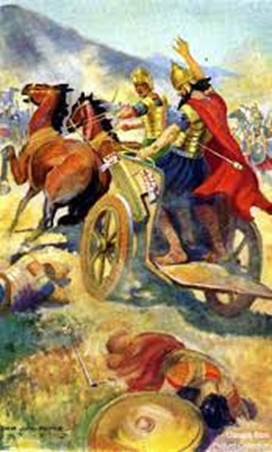
Jehoshaphat must be a special kind of stupid! Not only has Jehoshaphat entered into an alliance with Ahab, not only has Jehoshaphat totally ignored God’s warning that this battle will end in disaster, but Jehoshaphat agrees to wear his royal robes into battle while Ahab disguises himself. At this point, Jehoshaphat’s pride is putting him in jeopardy of getting killed. The king of Aram, that is, Syria, has ordered his men to only attack Ahab. Naturally, the Syrian soldiers assume that Jehoshaphat must be Ahab; however, when he cries out, they realize their mistake and back off. But one Syrian soldier looses off an arrow at a whim, and that arrow pierces Ahab through the joints in his armor, severely wounding him.

Ahab has his charioteer take him out of the battle but prop him up so he can watch. All this time, Ahab’s blood is pouring onto the chariot floor. Finally, Ahab dies at evening. When the word goes out to the Israelite soldiers, they desert the battle, returning to their homes, just as Micaiah has predicted. Meanwhile, Ahab’s men have brought his body in his chariot back to Samaria. Ahab’s body is buried; however, when Ahab’s servants send the chariot to be washed at the pool of Samaria, the dogs lick up Ahab’s blood. God’s judgment on Ahab has come to pass.

APPLICATION: When I was growing up on a Midwestern farm, we raised chickens that were truly free range. One of my jobs in the summertime was to take a long pole and encourage the chickens roosting on the low – lying branches of the trees to leave the trees and return to the chicken house for the night. We used to have a saying that if someone had acted foolishly and was now suffering the consequences of their actions, their chickens were coming home to roost. My mother expanded that saying, “Beware when your chickens come home to roost, because they might turn out to be turkey buzzards!” Mom meant that sometimes you think the consequences of your actions will be quite mild; meanwhile, they are far worse than you could possibly anticipate.

Ahab has wasted his life in demon worship, in sexual perversion, in indulging his whims and his passions. Archaeologists have found traces of shattered ivory in digs at Samaria, the remnants of Ahab’s ivory palace. https://armstronginstitute.org/394-samaria-ivories-proof-of-the-bible tells us “In a series of excavations from 1908 to 1935, archaeologists unearthed over 12,000 ivory pieces in the ancient Israelite capital city of Samaria. While there is some debate over the precise age of the artifacts, most scholars agree that they date to the eighth or ninth century b.c.e., most likely around the time of Israelite King Ahab (circa 870–850 b.c.e.)

Even after Ahab has repented, his heart has not really changed. If Ahab has a change of heart, he will heed Micaiah’s warnings, abandon the attack on Ramoth – gilead, and stay home. Ahab dies because some nameless Syrian soldier shoots a random arrow and God guides that arrow through the joints of Ahab’s armor. Although Ahab’s body is preserved for burial, the dogs still lick up his blood when his chariot is sent for washing. Truly, Ahab’s chickens have come home to roost and they really are turkey buzzards!

Ahab is remembered as one of the most wicked kings ever to rule Israel. Raised without any spiritual background whatsoever, Ahab then allied himself with a Sidonian priestess of Baal who imported all kinds of perversions. Ahab would stop at nothing when he craved something; hence, Ahab’s seizure of Naboth’s vineyard. At the end of everything, all that is left of Ahab is a horrible reputation, a deplorable example, and 12,000 ivory shards that might be from his palace room.

Actions have consequences. The Bible tells us, But if you fail to keep your word, then you will have sinned against the LORD, and you may be sure that your sin will find you out. (Numbers 32:23) Ahab mis – spent his entire life and only dodged having his body being eaten by dogs because of a late repentance. What about us? Do we realize how much our own actions affect us or do we blunder on, assuming that our actions are fine and that at the end God will give us a pass for being nice people?

No matter how good we have bee, we will only have salvation from our sins through the blood of Jesus Christ. Let us not make Ahab’s mistake but trust Jesus today.

PRAYER: Father God, thank you for loving us and for caring for us. Lord, help us to trust in Your gift of salvation through Jesus Christ. In the mighty and precious Name of King Jesus. Amen.  

JULY 22, 2022 SPIRITUAL BLACK HOLES #22 1 KINGS 22:1 – 28 BEFORE YOU AGREE TO HELP SOMEON, ASK GOD!!!

July 22, 2022

1 Kings 22:1 – 28 “Then three years passed without war between Aram and Israel. However, in the third year, Jehoshaphat king of Judah went down to visit the king of Israel, who said to his servants, “Do you not know that Ramoth-gilead is ours, but we have failed to take it from the hand of the king of Aram?”

So he asked Jehoshaphat, “Will you go with me to fight against Ramoth-gilead?”

Jehoshaphat answered the king of Israel, “I am like you, my people are your people, and my horses are your horses.” But Jehoshaphat also said to the king of Israel, “Please inquire first for the word of the LORD.”

So the king of Israel assembled the prophets, about four hundred men, and asked them, “Should I go to war against Ramoth-gilead, or should I refrain?” “Go up,” they replied, “and the Lord will deliver it into the hand of the king.” But Jehoshaphat asked, “Is there not still a prophet of the LORD here of whom we can inquire?”

The king of Israel answered, “There is still one man who can ask the LORD, but I hate him because he never prophesies anything good for me, but only bad. He is Micaiah son of Imlah.”

“The king should not say that!” Jehoshaphat replied.

So the king of Israel called one of his officials and said, “Bring Micaiah son of Imlah at once.”

Dressed in royal attire, the king of Israel and Jehoshaphat king of Judah were sitting on their thrones at the threshing floor by the entrance of the gate of Samaria, with all the prophets prophesying before them.

Now Zedekiah son of Chenaanah had made for himself iron horns and declared, “This is what the LORD says: ‘With these you shall gore the Arameans until they are finished off.’ ”

And all the prophets were prophesying the same, saying, “Go up to Ramoth-gilead and prosper, for the LORD will deliver it into the hand of the king.”

Then the messenger who had gone to call Micaiah instructed him, “Behold now, with one accord the words of the prophets are favorable to the king. So please let your words be like theirs, and speak favorably.”

But Micaiah said, “As surely as the LORD lives, I will speak whatever the LORD tells me.”

When Micaiah arrived, the king asked him, “Micaiah, should we go to war against Ramoth-gilead, or should we refrain?”

“Go up and triumph,” Micaiah replied, “for the LORD will give it into the hand of the king.”

But the king said to him, “How many times must I make you swear not to tell me anything but the truth in the name of the LORD?”

So Micaiah declared: “I saw all Israel scattered on the hills like sheep without a shepherd. And the LORD said, ‘These people have no master; let each one return home in peace.’ ”

Then the king of Israel said to Jehoshaphat, “Did I not tell you that he never prophesies good for me, but only bad?”

Micaiah continued, “Therefore hear the word of the LORD: I saw the LORD sitting on His throne, and all the host of heaven standing by Him on His right and on His left. And the LORD said, ‘Who will entice Ahab to march up and fall at Ramoth-gilead?’ And one suggested this, and another that. Then a spirit came forward, stood before the LORD, and said, ‘I will entice him.’ ‘By what means?’ asked the LORD.

And he replied, ‘I will go out and be a lying spirit in the mouths of all his prophets.’

‘You will surely entice him and prevail,’ said the LORD. ‘Go and do it.’

So you see, the LORD has put a lying spirit in the mouths of all these prophets of yours, and the LORD has pronounced disaster against you.”

Then Zedekiah son of Chenaanah went up, struck Micaiah in the face, and demanded, “Which way did the Spirit of the LORD go when He departed from me to speak with you?”

Micaiah replied, “You will soon see, on that day when you go and hide in an inner room.”

And the king of Israel declared, “Take Micaiah and return him to Amon the governor of the city and to Joash the king’s son, and tell them that this is what the king says: ‘Put this man in prison and feed him only bread and water until I return safely.’ ”

But Micaiah replied, “If you ever return safely, the LORD has not spoken through me.” Then he added, “Take heed, all you people!”

Jehoshaphat, the King of Judah, is a righteous man. Why should Jehoshaphat would have anything to do with Ahab in the first place? Ahab has a very unsavory reputation and Jehoshaphat worships the God of Israel. But here is Jehoshaphat allying himself with Ahab.

The one intelligent thing Jehoshaphat does is to request that Ahab and he inquire from the Lord. Ahab has four hundred prophets hanging around the palace; however, we have no idea the origin of these prophets or their spiritual loyalties. From the ensuing dialogue it seems that these prophets are more interested in telling Ahab what he wants to hear than they are in really representing the Lord. It’s entirely possible that none of those prophets has ever actually encountered God in any fashion but that they have been dealing with demonic spirits instead. Despite the glib answers from these prophets, Jehoshaphat is ill at ease; he knows fake prophets when he hears them. Jehoshaphat asks if there is a true prophet of the Lord from which they can inquire.

Amazingly, Ahab admits that indeed, there is one true prophet of the Lord, Micaiah; however, Ahab hates Micaiah because he tells Ahab harsh truths. When Micaiah arrives, he initially tries to dodge the question by shrugging his shoulders and telling Ahab to go on up to Ramoth – gilead. But amazingly, Ahab realizes this is not a word from the Lord and charges Micaiah to tell the truth. Micaiah then tells Ahab that God is allowing Ahab to be deceived by the lying spirit in the mouths of Ahab’s prophets so that Ahab will go to Ramoth – gilead and be killed. Predictably, Ahab gets offended and order Micaiah to be thrown into prison, to be fed only bread and water until Ahab returns safely. Micaiah advises everyone present that if Ahab returns safely, then he, Micaiah, has not spoken the word of the Lord.

APPLICATION: Ahab is one confused dude! On the one hand, Ahab realizes that he has been feeding and accommodating four hundred yes – men disguising themselves as prophets. Ahab actually recognizes that Micaiah is a true prophet of the Lord and demands that Micaiah tell him the truth; yet, when Micaiah does exactly that, Ahab begins to puff and blow and becomes offended. Even now, if Ahab were to heed Micaiah, he would abandon the attempt to regain Ramoth – gilead and would simply stay home. But Ahab is already fancying himself as the conquering hero, a true son of his father Omri, who was the army commander. And Ahab has already made an alliance with Jehoshaphat. For Ahab to back off now would mean an enormous loss of face. The fact that Ahab might die doesn’t even enter into his mind. Truly, the lying spirit in the mouths of those four hundred prophets is succeeding.

One wonders why when Jehoshaphat hears this prediction, he doesn’t urge Ahab to abandon the idea of attacking Ramoth – gilead. But Jehoshaphat has also made sweeping statements, “I am like you, my people are your people, and my horses are your horses.”  Now it’s Jehoshaphat’s turn to refuse to back off, even after he hears the word of the Lord from Micaiah.

We read this story and wonder how or why Jehoshaphat has ever gotten himself mixed up with Ahab in the first place and why Jehoshaphat fails to heed the warning of the Lord when Micaiah gives it. Jehoshaphat has made several mistakes:

  1. Jehoshaphat should never have visited Ahab. What has light to do with darkness?
  2. Jehoshaphat has made foolishly conceived but grand – sounding promises and now feels obligated to fulfill them.
  3. Even when Jehoshaphat pushes Ahab until a true prophet of God speaks, Jehoshaphat fails to listen to the warning from God as well. Perhaps Jehoshaphat is treasuring some notion that if Ahab dies in battle, he, Jehoshaphat, will be able to save the day, conquer Ramoth – gilead, and perhaps even re-unite the northern and southern kingdoms.
  4. Jehoshaphat refuses to listen when Micaiah says, “I saw all Israel scattered on the hills like sheep without a shepherd. And the LORD said, ‘These people have no master; let each one return home in peace.’ ”

Bad companions, hasty promises, delusions of grandeur, and a failure to listen to the Lord – these are Jehoshaphat’s mistakes, and they can easily become ours as well. May we remain humble and close to the Lord, so that when He speaks, we will hear and obey!

PRAYER: Father God, thank You for loving us and for caring for us. Lord, help us to work with those who truly love You and who will listen to Your voice. Help us not to wander off, enticed by our own imaginations. In the mighty and precious Name of King Jesus. Amen.