Archive for August, 2022

AUGUST 31, 2022 SPIRITUAL BLACK HOLES PART 2 #38 2 KINGS 19: 20 – 37 GOD TAKES ON THE ASSYRIANS AND WINS!

August 31, 2022

2 Kings 19:20 – 37 Sennacherib’s Fall Prophesied (Isaiah 37:21–35) “Then Isaiah son of Amoz sent a message to Hezekiah: “This is what the LORD, the God of Israel, says: I have heard your prayer concerning Sennacherib king of Assyria. This is the word that the LORD has spoken against him: ‘The Virgin Daughter of Zion despises you and mocks you; the Daughter of Jerusalem shakes her head behind you. Whom have you taunted and blasphemed? Against whom have you raised your voice and lifted your eyes in pride? Against the Holy One of Israel! Through your servants you have taunted the Lord, and you have said: “With my many chariots I have ascended to the heights of the mountains, to the remote peaks of Lebanon. I have cut down its tallest cedars, the finest of its cypresses. I have reached its farthest outposts, the densest of its forests. I have dug wells and drunk foreign waters. With the soles of my feet, I have dried up all the streams of Egypt.”

Have you not heard? Long ago I ordained it; in days of old I planned it. Now I have brought it to pass,

that you should crush fortified cities into piles of rubble. Therefore, their inhabitants, devoid of power, are dismayed and ashamed. They are like plants in the field, tender green shoots, grass on the rooftops, scorched before it is grown.

But I know your sitting down, your going out and coming in, and your raging against Me. Because your rage and arrogance against Me have reached My ears, I will put My hook in your nose and My bit in your mouth; I will send you back the way you came.’

And this will be a sign to you, O Hezekiah: This year you will eat what grows on its own, and in the second year what springs from the same. But in the third year you will sow and reap; you will plant vineyards and eat their fruit. And the surviving remnant of the house of Judah will again take root below and bear fruit above. For a remnant will go forth from Jerusalem, and survivors from Mount Zion. The zeal of the LORD of Hosts will accomplish this.

So this is what the LORD says about the king of Assyria: ‘He will not enter this city or shoot an arrow into it. He will not come before it with a shield or build up a siege ramp against it. He will go back the way he came, and he will not enter this city,’ declares the LORD. ‘I will defend this city and save it for My own sake and for the sake of My servant David.’”

And that very night the angel of the LORD went out and struck down 185,000 men in the camp of the Assyrians. When the people got up the next morning, there were all the dead bodies! So Sennacherib king of Assyria broke camp and withdrew. He returned to Nineveh and stayed there. One day, while he was worshiping in the temple of his god Nisroch, his sons Adrammelech and Sharezer put him to the sword and escaped to the land of Ararat. And his son Esar-haddon reigned in his place.”

When the prophet Isaiah encountered God in the temple, God asked, “Whom shall I send? Who will go for us?” Isaiah answered, “Here I am. Send me.” (Isaiah 6:8) Now Isaiah is moving in the full power of the Holy Spirit.

Whew! First, the Lord tells Sennacherib clearly that he has been taunting the God of Israel and not merely the people of Jerusalem and Judah. Second, God informs Sennacherib that the only reason that Sennacherib has been so successful in battle is that God has used him as a tool to crush these nations. God has weakened the nations before the Assyrians, assuring that the Assyrians success in battle. But the Assyrians have assumed that they have done all these things in their own strength, rather than realizing that God has been helping them.

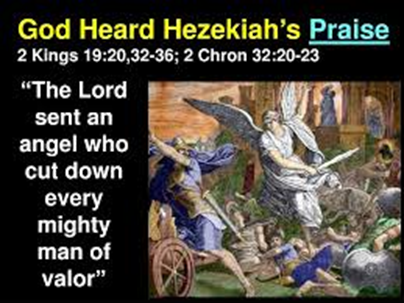
God tells Sennacherib that He knows everything about Sennacherib, including the most intimate details of Sennacherib’s life. God controls Sennacherib and not the other way around. “Because your rage and arrogance against Me have reached My ears, I will put My hook in your nose and My bit in your mouth; I will send you back the way you came.’” God is as good as His Word; that night 185,000 Assyrian soldiers die in their tents. This frightens Sennacherib into returning to Nineveh and remaining there. Once back in Nineveh, Sennacherib is assassinated by two of his sons as he is worshiping in the temple of Nisroch, and a third son succeeds him.

But God is not through. There is a second part to the prophecy directed at Hezekiah. God promises Hezekiah that Sennacherib will not attack Jerusalem and that Sennacherib will return to Nineveh. God gives Hezekiah a sign: “And this will be a sign to you, O Hezekiah: This year you will eat what grows on its own, and in the second year what springs from the same. But in the third year you will sow and reap; you will plant vineyards and eat their fruit. And the surviving remnant of the house of Judah will again take root below and bear fruit above. For a remnant will go forth from Jerusalem, and survivors from Mount Zion. The zeal of the LORD of Hosts will accomplish this.

The besieging Assyrian army has undoubtedly pillaged the countryside, making it impossible for anyone to plant crops; hence, the need to eat whatever springs up on its own for the next two years. But God is promising that these crops will bear enough to sustain the Judeans. By the third year after the Assyrian invasion, the people of Judah will be able to resume sowing and reaping. Those remaining in Judah will be established and the population will flourish.

APPLICATION: A SURE PROMISE FROM AN OMNIPOTENT GOD! The phrase “The zeal of the Lord of Hosts will accomplish this” is used in at least one other passage in Isaiah. In Isaiah 9 Isaiah promises that the Messiah will come, ending by assuring that “The zeal of the Lord of Hosts will accomplish this.” (Isiah 9:7) God is promising that He will do everything He can to make this promise a living reality. In the case of the promises of Isaiah 9, Jesus eventually came as Messiah and fulfilled all the prophecies about him.

We might read this passage and think, “Oh, how nice. What a lovely thing for God to say.” But these words are being given to people who have been trembling in fear that they will have to eat their own dung, drink their own urine, and possibly resort to cannibalism in the midst of a siege. God doesn’t waste time in pious platitudes; He is too busy making things happen.  

Can we trust God’s promises? Absolutely! The question is not, can we trust God; rather, the question is, can God trust us? In the case of the kingdom of Judah, as long as the rulers were just, the citizens worshiped God. But as soon as an unjust ruler ascended the throne, the Judeans plunged back into idolatry. At this point, Hezekiah is on the throne and so people are worshiping God. But God knows that later on, other rulers who are idol worshipers will come. Amazingly, despite this foreknowledge, God still delivers Jerusalem and Judah because of His promises to David.

We have choices every day. We can choose to believe God and His promises and to worship Him, or we can go our own way, as did the Assyrians. But God’s way is the only right way. Let us bow down before Him and worship Him!

PRAYER: Father God, thank You for loving us and for caring for us. Lord, help us to follow hard after You all the days of our lives and to trust You, even when things look dark. In the mighty and precious Name of King Jesus. Amen.
AUGUST 30, 2022 SPIRITUAL BLACK HOLES PART 2 #37 2 KINGS 19:1 – 19 WHEN THE ENEMY IS AT THE GATES, THE BEST THING YOU CAN DO IS TO PRAY!

August 30, 2022

2 Kings 19:1 – 37 “On hearing this report, King Hezekiah tore his clothes, put on sackcloth, and entered the house of the LORD. And he sent Eliakim the palace administrator, Shebna the scribe, and the leading priests, all wearing sackcloth, to the prophet Isaiah son of Amoz to tell him, “This is what Hezekiah says: Today is a day of distress, rebuke, and disgrace; for children have come to the point of birth, but there is no strength to deliver them. Perhaps the LORD your God will hear all the words of the Rabshakeh, whom his master the king of Assyria has sent to defy the living God, and He will rebuke him for the words that the LORD your God has heard. Therefore, lift up a prayer for the remnant that still survives.”

So the servants of King Hezekiah went to Isaiah, who replied, “Tell your master that this is what the LORD says: ‘Do not be afraid of the words you have heard, with which the servants of the king of Assyria have blasphemed Me. Behold, I will put a spirit in him so that he will hear a rumor and return to his own land, where I will cause him to fall by the sword.’”

When the Rabshakeh heard that the king of Assyria had left Lachish, he withdrew and found the king fighting against Libnah. Now Sennacherib had been warned about Tirhakah king of Cush: “Look, he has set out to fight against you.”

So Sennacherib again sent messengers to Hezekiah, saying, “Give this message to Hezekiah king of Judah:

‘Do not let your God, in whom you trust, deceive you by saying that Jerusalem will not be delivered into the hand of the king of Assyria. Surely you have heard what the kings of Assyria have done to all the other countries, devoting them to destruction. Will you then be spared? Did the gods of the nations destroyed by my fathers rescue those nations—the gods of Gozan, Haran, and Rezeph, and of the people of Eden in Telassar? Where are the kings of Hamath, Arpad, Sepharvaim, Hena, and Ivvah?’ ”

Hezekiah’s Prayer (Isaiah 37:14–20)

So Hezekiah received the letter from the messengers, read it, and went up to the house of the LORD and spread it out before the LORD. And Hezekiah prayed before the LORD:

“O LORD, God of Israel, enthroned between the cherubim, You alone are God over all the kingdoms of the earth. You made the heavens and the earth. Incline Your ear, O LORD, and hear; open Your eyes, O LORD, and see. Listen to the words that Sennacherib has sent to defy the living God.

Truly, O LORD, the kings of Assyria have laid waste these nations and their lands. They have cast their gods into the fire and destroyed them, for they were not gods, but only wood and stone—the work of human hands.

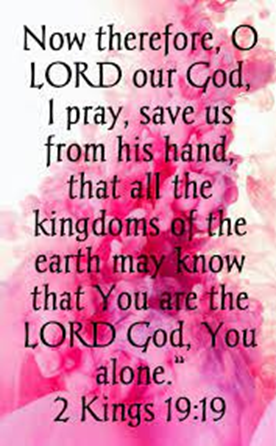
And now, O LORD our God, please save us from his hand, so that all the kingdoms of the earth may know that You alone, O LORD, are God.”

Hezekiah is in despair! There’s no doubt that unless God does a miracle, Judah is doomed to horrific destruction.

 But Hezekiah does the most sensible thing that he can possibly do. Hezekiah sends the chief scribe, the palace administrator, and the chief priests to the prophet Isaiah, hoping for a word from the Lord. And Isaiah delivers one of the most encouraging messages possible. “Do not be afraid of the words you have heard, with which the servants of the king of Assyria have blasphemed Me. Behold, I will put a spirit in him so that he will hear a rumor and return to his own land, where I will cause him to fall by the sword.’”   

God arranges for kings of Cush and Libna to begin fighting the Assyrians. Even as Sennacherib is withdrawing, he is still sending threatening messages to King Hezekiah. Sennacherib is still mocking the God of Israel, asserting that the gods of all the other nations he has defeated have proved useless. It is at this point that Hezekiah prays a magnificent prayer.

“O LORD, God of Israel, enthroned between the cherubim, You alone are God over all the kingdoms of the earth. You made the heavens and the earth. Incline Your ear, O LORD, and hear; open Your eyes, O LORD, and see. Listen to the words that Sennacherib has sent to defy the living God.

Truly, O LORD, the kings of Assyria have laid waste these nations and their lands. They have cast their gods into the fire and destroyed them, for they were not gods, but only wood and stone—the work of human hands.

And now, O LORD our God, please save us from his hand, so that all the kingdoms of the earth may know that You alone, O LORD, are God.”

APPLICATION: Hezekiah’s response to the looming threat of destruction from the Assyrians stands as an example for all of us. At any moment, the Assyrian army might attack Jerusalem, and Hezekiah knows that his people will be destroyed if that happens. But Hezekiah still trusts in the God of Israel and affirms this trust in his prayer.

What does it mean to truly trust God? To trust God, we must first know Him. It is impossible to trust a stranger. Even though Hezekiah does not realize it, he has been preparing for this critical moment through years of absorbing God’s Word and through prayer. When Hezekiah acknowledges God’s greatness, this is not idle talk, but the witness of a man who truly knows God. Hezekiah does not argue that the people of Judah deserve to be delivered; instead, Hezekiah begs God to deliver them so that all the kingdoms of the earth may know that He alone is God. Hezekiah wants to be delivered, but he wants God to demonstrate His power, His might, and His glory.

How frequently do we seek God’s glory in our daily lives? If we claim to be Christians, are we good advertising for the God whom we say we worship? At work, do we give of our best, or do we slack off, dumping responsibilities on others? Are we rude or critical with our families? Do we manipulate and use people for our own ends?

Our lives should be lives of service and of demonstration of the transforming power of God.

Hezekiah has prepared himself for this crisis and he passes the test of faith. We never know when we too will be called upon to act in faith and to step out trusting that God will deliver us. But we must learn to know God if we are to be able to trust Him. We must read His Word and pray.

One misconception about prayer is that it is a monologue conducted at high speed and loud volume as if God were deaf. Such an approach is quite ridiculous when you consider that you are spending time with someone who knows you better than you know yourself. And how are you to hear from God if you keep talking? If you really want to hear from God, find someplace where you can be quiet and then ask God to speak to you. Rest assured; you will find gentle messages coming into your mind. The longer you are quiet, the more you will hear from God.

PRAYER: Father God, thank You for loving us and for caring for us. Lord, help all who read these words to find a place where they can be quiet and listen to You. In the mighty and precious Name of King Jesus. Amen.

AUGUST 29, 2022 SPIRITUAL BLACK HOLES PART 2 #36 2 KINGS 18:17 – 37 THE ASSYRIANS ARE AT THE GATES OF JERUSALEM!

August 29, 2022

2 Kings 18:17 – 37 Sennacherib Threatens Jerusalem (2 Chronicles 32:9–19; Isaiah 36:1–22)

“Nevertheless, the king of Assyria sent the Tartan, the Rabsaris, and the Rabshakeh, along with a great army, from Lachish to King Hezekiah at Jerusalem. (Hebrew Tartan is the title of a field marshal, general, or commander in the Assyrian military. Hebrew Rabsaris is the title of the chief eunuch in the Assyrian military. Hebrew Rabshakeh is the title of a high-ranking Assyrian military officer; here and throughout chapters 18 and 19, as well as Isaiah 36 and 37.) They advanced up to Jerusalem and stationed themselves by the aqueduct of the upper pool, on the road to the Launderer’s Field. Then they called for the king; and Eliakim son of Hilkiah the palace administrator, Shebnah the scribe, and Joah son of Asaph the recorder, went out to them.

The Rabshakeh said to them, “Tell Hezekiah that this is what the great king, the king of Assyria, says: What is the basis of this confidence of yours?  You claim to have a strategy and strength for war, but these are empty words. In whom are you now trusting, that you have rebelled against me?

Look now, you are trusting in Egypt, that splintered reed of a staff that will pierce the hand of anyone who leans on it. Such is Pharaoh king of Egypt to all who trust in him. But if you say to me, ‘We trust in the LORD our God,’ is He not the One whose high places and altars Hezekiah has removed, saying to Judah and Jerusalem: ‘You must worship before this altar in Jerusalem’?

Now, therefore, make a bargain with my master, the king of Assyria. I will give you two thousand horses—if you can put riders on them! For how can you repel a single officer among the least of my master’s servants when you depend on Egypt for chariots and horsemen? So now, was it apart from the LORD that I have come up against this place to destroy it? The LORD Himself said to me, ‘Go up against this land and destroy it.’”

Then Eliakim son of Hilkiah, along with Shebnah and Joah, said to the Rabshakeh, “Please speak to your servants in Aramaic, since we understand it. Do not speak with us in Hebrew in the hearing of the people on the wall.” But the Rabshakeh replied, “Has my master sent me to speak these words only to you and your master, and not to the men sitting on the wall, who are destined with you to eat their own dung and drink their own urine?”

Then the Rabshakeh stood and called out loudly in Hebrew: “Hear the word of the great king, the king of Assyria!  This is what the king says: Do not let Hezekiah deceive you; he cannot deliver you from my hand. Do not let Hezekiah persuade you to trust in the LORD when he says, ‘The LORD will surely deliver us; this city will not be given into the hand of the king of Assyria.’

Do not listen to Hezekiah, for this is what the king of Assyria says: Make peace with me and come out to me. Then every one of you will eat from his own vine and his own fig tree, and drink water from his own cistern, until I come and take you away to a land like your own—a land of grain and new wine, a land of bread and vineyards, a land of olive trees and honey—so that you may live and not die. But do not listen to Hezekiah, for he misleads you when he says, ‘The LORD will deliver us.’

Has the god of any nation ever delivered his land from the hand of the king of Assyria?  Where are the gods of Hamath and Arpad? Where are the gods of Sepharvaim, Hena, and Ivvah? Have they delivered Samaria from my hand? Who among all the gods of these lands has delivered his land from my hand? How then can the LORD deliver Jerusalem from my hand?”

But the people remained silent and did not answer a word, for Hezekiah had commanded, “Do not answer him.”

Then Hilkiah’s son Eliakim the palace administrator, Shebna the scribe, and Asaph’s son Joah the recorder came to Hezekiah with their clothes torn, and they relayed to him the words of the Rabshakeh.”

Things are looking dire for the citizens of Jerusalem and King Hezekiah. The Assyrians are at the gates of the city and are screaming out threats of total destruction. Everyone knows that the Assyrian army is vicious – skinning people alive and then hanging them from the walls of their own city, walling city leaders up in closed rooms so they starve and die, ripping open the wombs of pregnant women.

Look at the arguments that the Assyrians put forth:

  1. King Hezekiah should never have rebelled in the first place. This argument has merit. Why Hezekiah thought he could challenge the largest empire in the Middle East is something nobody can understand.
  2. The Rabshakeh mocks Hezekiah for trusting in Egypt for help. This argument is also quite realistic. The description of Egypt as a splintered reed of a staff that will pierce the hand of anyone who leans on it is pure genius.
  3. The Rabshakeh mocks Hezekiah for trusting in God, assuming that the Asherah poles, the Nehushtan, and the other pagan shrines Hezekiah has destroyed all are part of the worship of the One True Living God. The Rabshakeh is totally wrong, and will soon learn what a mistake it is to mock the God of Israel.
  4. The Rabshakeh claims that God has sent him to destroy Judah and Jerusalem. WRONG!!! The Rabshakeh knows nothing of God and is engaging in hyperbole.
  5. Finally, the Rabshakeh asks, “Has the god of any nation ever delivered his land from the hand of the king of Assyria? Where are the gods of Hamath and Arpad? Where are the gods of Sepharvaim, Hena, and Ivvah? Have they delivered Samaria from my hand? Who among all the gods of these lands has delivered his land from my hand? How then can the LORD deliver Jerusalem from my hand?” Obviously, the Rabshakeh knows nothing of the power of God. Perhaps the Rabshakeh has never heard of the way in which God totally destroyed the Egyptian army, or perhaps he refuses to believe that event really happened.

APPLICATION: As this chapter ends, things look bleak for Judah and for King Hezekiah. But very soon the Rabshakeh is going to have an in – depth encounter with the power of the Living God. Before it’s over, God will miraculously deliver King Hezekiah and the kingdom of Judah. Eventually the Rabshakeh will return to his own land where he will be assassinated. God will route the most ferocious army in the Middle East just as He destroyed the Egyptian army during the Exodus.

Perhaps you feel stuck in an untenable situation with no possibility of deliverance. Perhaps you can identify with King Hezekiah and his officers as you listen to Satan’s threats. But remember that God does not play favorites. The God who delivered King Hezekiah and Judah can certainly deliver you.

PRAYER: Father God, thank You for loving us and for caring for us. Lord, help us to turn to You for deliverance, knowing that You can do far above anything we can possibly ask or think. In the mighty and precious Name of King Jesus. Amen.

AUGUST 28, 2022 SPIRITUAL BLACK HOLES PART 2 #35 2 KINGS 18:1 – 16 HEZEKIAH TAKES OVER AND DESTROYS A BRONZE SNAKE?!?!?!

August 28, 2022

2 Kings 18:1 – “In the third year of the reign of Hoshea son of Elah over Israel, Hezekiah son of Ahaz became king of Judah. He was twenty-five years old when he became king, and he reigned in Jerusalem twenty-nine years. His mother’s name was Abi, the daughter of Zechariah. And he did what was right in the eyes of the LORD, just as his father David had done. He removed the high places, shattered the sacred pillars, and cut down the Asherah poles. He also demolished the bronze snake called Nehushtan (“bronze snake”) that Moses had made, for up to that time the Israelites had burned incense to it.

 Hezekiah trusted in the LORD, the God of Israel. No king of Judah was like him, either before him or after him. He remained faithful to the LORD and did not turn from following Him; he kept the commandments that the LORD had given Moses.

And the LORD was with Hezekiah, and he prospered wherever he went. He rebelled against the king of Assyria and refused to serve him. He defeated the Philistines as far as Gaza and its borders, from watchtower to fortified city.

In the fourth year of Hezekiah’s reign, which was the seventh year of the reign of Hoshea son of Elah over Israel, Shalmaneser king of Assyria marched against Samaria and besieged it. And at the end of three years, the Assyrians captured it. So Samaria was captured in the sixth year of Hezekiah, which was the ninth year of Hoshea king of Israel. The king of Assyria exiled the Israelites to Assyria and settled them in Halah, in Gozan by the Habor River, and in the cities of the Medes. This happened because they did not listen to the voice of the LORD their God, but violated His covenant—all that Moses the servant of the LORD had commanded—and would neither listen nor obey.

In the fourteenth year of Hezekiah’s reign, Sennacherib king of Assyria attacked and captured all the fortified cities of Judah. So Hezekiah king of Judah sent word to the king of Assyria at Lachish, saying, “I have done wrong; withdraw from me, and I will pay whatever you demand from me.”

And the king of Assyria exacted from Hezekiah king of Judah three hundred talents of silver (300 talents is approximately 11.3 tons or 10.3 metric tons of silver.)  and thirty talents of gold. (30 talents is approximately 1.13 tons or 1.03 metric tons of gold.) Hezekiah gave him all the silver that was found in the house of the LORD and in the treasuries of the royal palace.

At that time Hezekiah stripped the gold with which he had plated the doors and doorposts of the temple of the LORD, and he gave it to the king of Assyria.”

 The kingdom of Judah is hitting the skids morally and spiritually! Citizens of Judah have created shrines on the top of every hill and under every green tree. Some people are even still burning incense to Nehushtan, the bronze serpent that Moses created in the wilderness. Why was this bronze serpent created?

Numbers 21:4 – 9 tells us, “Then they set out from Mount Hor along the route to the Red Sea, in order to bypass the land of Edom. But the people grew impatient on the journey and spoke against God and against Moses: “Why have you led us up out of Egypt to die in the wilderness? There is no bread or water, and we detest this wretched food!” So the LORD sent venomous snakes among the people, and many of the Israelites were bitten and died. Then the people came to Moses and said, “We have sinned by speaking against the LORD and against you. Intercede with the LORD so He will take the snakes away from us.” So Moses interceded for the people. Then the LORD said to Moses, “Make a fiery serpent and mount it on a pole. When anyone who is bitten looks at it, he will live.” So Moses made a bronze snake and mounted it on a pole. If anyone who was bitten looked at the bronze snake, he would live.” This incident solved the problem of complainers in the Israelite camp for a little while, but left an object that could be worshiped in hopes of getting good fortune.

The same people who have steadfastly refused to study the Law of Moses and to keep it have managed to turn that bronze serpent into a fetish and burn incense to it! Nehushtan worship serves as a perfect example of people who have the form of worship but who totally neglect the substance. It’s quite likely that once the bronze serpent had served its useful purpose, Moses stuck it back in his tent and forgot about it. But unfortunately, someone who wanted to venerate Moses retrieved the serpent and began worshiping it. Little wonder then, that when Hezekiah ascends the throne and begins smashing pagan images, he destroys the Nehushtan serpent as well.

Hezekiah’s very nature is a miracle. Where has Hezekiah learned about the God of Israel? Somehow, Hezekiah has studied the Law of Moses for himself and keeps it. Amazing!

Why does Hezekiah rebel against Assyria and stop paying tribute? Perhaps this decision has been taken while the Assyrians were still in their own land, before they wiped out the kingdom of Israel and carried off its citizens. Certainly, Hezekiah must know how cruel the Assyrians are! At any rate, the kingdom of Judah pays heavily for that ill – considered decision – Hezekiah winds up stripping the temple and the royal palace of silver and gold. But the Assyrians don’t stay bought; instead, they collect Hezekiah’s tribute and then besiege Jerusalem anyway.

APPLICATION: Stephen R. Covey in his 1989 book The 7 Habits of Highly Effective People makes the point that we can either choose to go for form or substance, but not for both. Ironically, this book was published at a time when people in America were lurching toward choosing leaders who appeared good, rather than those of upright moral and spiritual standing. The ensuing years have only brought an ever – increasing flood of wrong choices.

Object worship is very appealing; objects stay put and don’t confront you with your mistakes. Worshiping objects frees you to behave as you choose, creating your own rules. Self – worship is particularly appealing, because it is a closed loop; we make our own rules for admiring ourselves. The One True Living God, on the other hand, is always trying to bring people to a deeper knowledge of Himself. The more we know about God, the more we realize how far short we fall of His Righteousness, His Purity, and His Holiness. We fall on our faces in worship, not because we feel so good about ourselves and therefore good about God, but because we have realized that only God is worthy of our worship and praise. Ironically, as we worship God, God cleans us up and draws our attention away from ourselves and to Him as the ultimate Source of all goodness and light.

When the prophet Isaiah saw the Lord in the temple in Jerusalem, his first thought was, “Woe is me, for I am ruined, because I am a man of unclean lips dwelling among a people of unclean lips; for my eyes have seen the King, the LORD of Hosts.” (Isaiah 6:5) When one of the seraphim took a coal from the altar and touched Isaiah’s lips, he told Isaiah, “Now that this has touched your lips, your iniquity is removed and your sin is atoned for.” (Isaiah 6:7) It was after that when the Lord asked, “Whom shall I send, and who shall go for us?” and Isaiah responded, “Here am I. Send me.”

One of my favorite hymns is “I, the Lord of Sea and Sky.” I can never sing this hymn or even listen to it without being moved to tears. This is the prayer for today. Here are the words:

I, The Lord Of Sea And Sky,
I Have Heard My People Cry.
All Who Dwell In Dark And Sin,
My Hand Will Save.
I Who Made The Stars Of Night,
I Will Make Their Darkness Bright.
Who Will Bear My Light To Them?
Whom Shall I Send?

Here I Am Lord, Is It I, Lord?
I Have Heard You Calling In The Night.
I Will Go Lord, If You Lead Me.
I Will Hold Your People In My Heart.

I, The Lord Of Snow And Rain,
I Have Borne My People’s Pain.
I Have Wept For Love Of Them, They Turn Away.
I Will Break Their Hearts Of Stone,
Give Them Hearts For Love Alone.
I Will Speak My Word To Them
Whom Shall I Send?

Here I Am Lord, Is It I, Lord?
I Have Heard You Calling In The Night.
I Will Go Lord, If You Lead Me.
I Will Hold Your People In My Heart.

I, The Lord Of Wind And Flame
I Will Tend The Poor And Lame.
I Will Set A Feast For Them,
My Hand Will Save
Finest Bread I Will Provide,
Till Their Hearts Be Satisfied.
I Will Give My Life To Them,
Whom Shall I Send?

Here I Am Lord, Is It I, Lord?
I Have Heard You Calling In The Night.
I Will Go Lord, If You Lead Me.
I Will Hold Your People In My Heart.

AUGUST 27, 2022 SPIRITUAL BLACK HOLES #34 2 KINGS 17:25 – 41 THE ORIGIN OF THE SAMARITANS

August 27, 2022

2 Kings 17:24 – 41 “Then the king of Assyria brought people from Babylon, Cuthah, Avva, Hamath, and Sepharvaim and settled them in the towns of Samaria to replace the Israelites. They took possession of Samaria and lived in its towns.

Now when the settlers first lived there, they did not worship the LORD, so He sent lions among them, which killed some of them. So they spoke to the king of Assyria, saying, “The peoples that you have removed and placed in the cities of Samaria do not know the requirements of the God of the land. Because of this, He has sent lions among them, which are indeed killing them off.”

Then the king of Assyria commanded: “Send back one of the priests you carried off from Samaria, and have him go back to live there and teach the requirements of the God of the land.”

Thus one of the priests they had carried away came and lived in Bethel, and he began to teach them how they should worship the LORD.

Nevertheless, the people of each nation continued to make their own gods in the cities where they had settled, and they set them up in the shrines that the people of Samaria had made on the high places. The men of Babylon made Succoth-benoth, the men of Cuth made Nergal, the men of Hamath made Ashima, the Avvites made Nibhaz and Tartak, and the Sepharvites burned their children in the fire to Adrammelech and Anammelech the gods of Sepharvaim.

So the new residents worshiped the LORD, but they also appointed for themselves priests of all sorts to serve in the shrines of the high places. They worshiped the LORD, but they also served their own gods according to the customs of the nations from which they had been carried away. To this day they are still practicing their former customs. None of them worship the LORD or observe the statutes, ordinances, laws, and commandments that the LORD gave the descendants of Jacob, whom He named Israel.

For the LORD had made a covenant with the Israelites and commanded them, “Do not worship other gods or bow down to them; do not serve them or sacrifice to them. Instead, worship the LORD, who brought you out of the land of Egypt with great power and an outstretched arm. You are to bow down to Him and offer sacrifices to Him. And you must always be careful to observe the statutes, ordinances, laws, and commandments He wrote for you. Do not worship other gods. Do not forget the covenant I have made with you. Do not worship other gods, but worship the LORD your God, and He will deliver you from the hands of all your enemies.”

But they would not listen, and they persisted in their former customs. So these nations worshiped the LORD but also served their idols, and to this day their children and grandchildren continue to do as their fathers did.”

When the citizens of the Northern Kingdom were carried off to Assyria, the Assyrians brought in people from Babylon, Cuthah, Avva, Hamath, and Sepharvaim – all places to the east of Israel to settle the land and to pay tribute to the Assyrians. Understandably, these people brought their own religions with them. When these new settlers entered Israel and saw the shrines the Israelites had left, they were thrilled and took over these shrines for their own worship. (How convenient!) But lions began attacking the new settlers and they complained to Assyrian headquarters. Assuming that the God of Israel was merely one more territorial spirit, the Assyrians sent back one priest, who tried to teach these settlers how to worship God. This effort was moderately successful; the lion attacks ceased. But the settlers simply took on the trappings of Jewish worship and added them to the things they were already doing. Bethel continued to serve as the center of Jewish – style worship; however, it was a bastardized form of worship at best and the people who were practicing it were a mongrel people by Jewish standards.

When the Jews began returning from Babylon under Ezra and later under Nehemiah, they refused to have anything to do with the Samaritans, viewing the Samaritan worship as corrupt and invalid. The Samaritans responded by trying to disrupt the rebuilding of Jerusalem and the temple. Even though the Jews had gone into exile because of their apostasy, they still viewed themselves as a much purer race than the Samaritans. Under Nehemiah, there was a sorting out of families that had intermarried with Babylonians rather than restricting themselves to Jews. This racial and religious pride persisted up to Jesus’ day.

In Jesus’ day, Samaria was under Roman control and was a center of Hellenistic culture. (Encyclopedia Britannica) By the time of Jesus, the Jews had re – settled much of Israel and were again practicing worship according to the Law of Moses. But during the Babylonian exile, a number of other traditions were added to the Law of Moses, and now the Pharisees were demanding that these traditions also be practiced if one was to REALLY be Godly. Since the Samaritans were practicing a syncretistic religion that merged practices from a number of different sources, the Jews felt that they were also religiously superior and generally wanted nothing to do with Samaritans.

When Jesus passed through Samaria and stopped to speak to a woman at a well in the middle of the day, this contact was revolutionary. The woman herself was shocked that Jesus would even give her the time of day, let alone speak to her of the things of God. (John 4)

APPLICATION: When God gave Moses the Law, He warned the Israelites that if they insisted on worshiping the pagan gods they would find in Canaan, they would be seized and sent into exile. Deuteronomy 32 embodies the Song of Moses that God commanded the Israelites to teach to each succeeding generation. The Israelites failed to do this, for had they done so, they would have been fully warned. The Song begins by describing the grace of God to the Israelites and how He delivered them from Egypt. But then the Song turned prophetical.

Deuteronomy 32:15 – 27 “But Jeshurun grew fat and kicked— becoming fat, bloated, and gorged. He abandoned the God who made him and scorned the Rock of his salvation. They provoked His jealousy with foreign gods; they enraged Him with abominations. They sacrificed to demons, not to God, to gods they had not known, to newly arrived gods, which your fathers did not fear. You ignored the Rock who brought you forth; you forgot the God who gave you birth.

When the LORD saw this, He rejected them, provoked to anger by His sons and daughters. He said: “I will hide My face from them; I will see what will be their end. For they are a perverse generation— children of unfaithfulness.

They have provoked My jealousy by that which is not God; they have enraged Me with their worthless idols. So I will make them jealous by those who are not a people; I will make them angry by a nation without understanding. For a fire has been kindled by My anger, and it burns to the depths of Sheol; it consumes the earth and its produce, and scorches the foundations of the mountains.

I will heap disasters upon them; I will spend My arrows against them. They will be wasted from hunger and ravaged by pestilence and bitter plague; I will send the fangs of wild beasts against them, with the venom of vipers that slither in the dust. Outside, the sword will take their children, and inside, terror will strike the young man and the young woman, the infant and the gray-haired man. I would have said that I would cut them to pieces and blot out their memory from mankind, if I had not dreaded the taunt of the enemy, lest their adversaries misunderstand and say: ‘Our own hand has prevailed; it was not the LORD who did all this.’”

There is much more to the Song of Moses. This Song graphically predicted everything that eventually happened to the Israelites. The citizens of the Northern Kingdom were carried off into Assyria. The citizens of Judah were taken to Babylon. As long as the Jews were free to worship in Judah and Israel, they chased after every pagan deity they could find. Only after the Jews realized the extent of their losses did they turn to worship God in their lands of exile.

For the Israelites, riches and luxury proved to be their undoing. Rather than continue to be grateful to God for a miraculous deliverance and to worship God as He had asked, the Jews began taking their freedom for granted and abusing it. Proverbs 14:34 tells us, “Uprightness and right standing with God elevate a nation, but sin is a reproach to any people.” We need to repent individually and as nations for failing to truly follow God. Social programs, electric vehicles, and other initiatives will never touch climate change or any of the other problems currently facing our nations. Repentance – true repentance – and re – dedication to God is what is needed.

PRAYER: Father God, thank You for loving us and for caring for us. Lord, we confess that our countries have turned their backs on You and have gone into worthless endeavors in attempts to solve problems that require Your solutions. Lord, forgive us, help us to turn to You and trust only You, both individually and corporately. Heal us, Oh Lord, and heal our lands. In the mighty and precious Name of King Jesus. Amen.
AUGUST 26, 2022 SPIRITUAL BLACK HOLES #33 2 KINGS 17:1 – 23 ISRAEL IS CARRIED CAPTIVE TO ASSYRIA

August 26, 2022

2 Kings 17:1- 23 “In the twelfth year of the reign of Ahaz over Judah, Hoshea son of Elah became king of Israel, and he reigned in Samaria nine years. And he did evil in the sight of the LORD, but not like the kings of Israel who preceded him.

Shalmaneser king of Assyria attacked him, and Hoshea became his vassal and paid him tribute. But the king of Assyria discovered that Hoshea had conspired to send envoys to King So (Osorkon) of Egypt, and that he had not paid tribute to the king of Assyria as in previous years. Therefore, the king of Assyria arrested Hoshea and put him in prison.

Then the king of Assyria invaded the whole land, marched up to Samaria, and besieged it for three years.

In the ninth year of Hoshea, the king of Assyria captured Samaria and carried away the Israelites to Assyria, where he settled them in Halah, in Gozan by the Habor River, and in the cities of the Medes.

All this happened because the people of Israel had sinned against the LORD their God, who had brought them out of the land of Egypt from under the hand of Pharaoh king of Egypt. They had worshiped other gods and walked in the customs of the nations that the LORD had driven out before the Israelites, as well as in the practices introduced by the kings of Israel.

The Israelites secretly did things against the LORD their God that were not right. From watchtower to fortified city, they built high places in all their cities. They set up for themselves sacred pillars and Asherah poles on every high hill and under every green tree. They burned incense on all the high places like the nations that the LORD had driven out before them. They did wicked things, provoking the LORD to anger. They served idols, although the LORD had told them, “You shall not do this thing.” (Exodus 20:4–6; Deuteronomy 5:8–10)

Yet through all His prophets and seers, the LORD warned Israel and Judah, saying, “Turn from your wicked ways and keep My commandments and statutes, according to the entire Law that I commanded your fathers and delivered to you through My servants the prophets.” But they would not listen, and they stiffened their necks like their fathers, who did not believe the LORD their God. They rejected His statutes and the covenant He had made with their fathers, as well as the decrees He had given them. They pursued worthless idols and themselves became worthless, going after the surrounding nations that the LORD had commanded them not to imitate.

They abandoned all the commandments of the LORD their God and made for themselves two cast idols of calves and an Asherah pole. They bowed down to all the host of heaven and served Baal. They sacrificed their sons and daughters in the fire (offered their children as burnt offerings to Molech) and practiced divination and soothsaying. They devoted themselves to doing evil in the sight of the LORD, provoking Him to anger.

So the LORD was very angry with Israel, and He removed them from His presence. Only the tribe of Judah remained, and even Judah did not keep the commandments of the LORD their God, but lived according to the customs Israel had introduced. So the LORD rejected all the descendants of Israel. He afflicted them and delivered them into the hands of plunderers, until He had banished them from His presence.

When the LORD had torn Israel away from the house of David, they made Jeroboam son of Nebat king, and Jeroboam led Israel away from following the LORD and caused them to commit a great sin. The Israelites persisted in all the sins that Jeroboam had committed and did not turn away from them. Finally, the LORD removed Israel from His presence, as He had declared through all His servants the prophets. So Israel was exiled from their homeland into Assyria, where they are to this day.”

2 Peter 3:9 tells us, The Lord is not slow in keeping His promise as some understand slowness, but is patient with you, not wanting anyone to perish but everyone to come to repentance.” When God was bringing the Israelites into Canaan, He solemnly warned them repeatedly to follow His Law and His Commandments and to shun all pagan religious practices. When Jeroboam led Israel in rebellion against King Rehoboam, Solomon’s son, Jeroboam set up his own fake religion to entice the Israelites away from returning to Jerusalem to worship God. The Israelites really didn’t require much encouragement and began worshiping all the gods they could find. Time after time, God sent prophets to warn the Israelites that if they persisted in idol worship, they would be carried off into the countries where those practices started. The Israelites shoved their fingers into their ears and went off into more idolatry. Now the day of reckoning has arrived.

Hoshea, king of Israel, is really a nincompoop! At this time, Assyria is the dominant nation in the area. The Assyrians have a horrific reputation for cruelty to those who oppose them. (https://www.worldhistory.org/Assyrian_Warfare/) “The Assyrian kings were not to be trifled with and their inscriptions vividly depict the fate which was certain for those who defied them. The historian Simon Anglim writes: The Assyrians created the world’s first great army and the world’s first great empire. This was held together by two factors: their superior abilities in siege warfare and their reliance on sheer, unadulterated terror. It was Assyrian policy always to demand that examples be made of those who resisted them; this included deportations of entire peoples and horrific physical punishments. One inscription from a temple in the city of Nimrod records the fate of the leaders of the city of Suru on the Euphrates River, who rebelled from, and were reconquered by, King Ashurbanipal: I built a pillar at the city gate and I flayed all the chief men who had revolted and I covered the pillar with their skins; some I walled up inside the pillar, some I impaled upon the pillar on stakes.” 

Knowing all this, Hoshea still stops paying tribute to Assyria and begs the Egyptian Pharoah for assistance. As soon as the king of Assyria learns of this, he moves into Israel, throws Hoshea in jail, and besieges Samaria for three years. This siege results in the mass deportation of Israelite citizens into Assyria with a re – settlement of people from some other area. God’s promises of retribution have finally come true.

APPLICATION: God gave the nation of Israel centuries in which to repent, but they persisted in idolatry, becoming worse with each new generation. Even when God sent prophets such as Elijah, Elisha, Amos, Hosea directly to the northern kingdom, their citizens refused to heed these warnings. Some of the prophets ministering in Judah such as Isaiah and Micah also issued warnings; however, all these messages were ignored.

How do we know where our countries stand on God’s time clock? The clock in the illustration tells us that it is 7 minutes to midnight. When that clock reaches midnight, God will act suddenly and completely. Today corruption is rampant around the world. There is no nation that is not battling problems with human trafficking, drug addiction, and greedy officials. Human rights abuses are worse than ever before. In Africa, women and children are being used to mine the cobalt necessary for electric cars. (https://humantraffickingsearch.org/how-child-labor-could-be-fueling-your-electric-car/) There is no country in the world that does not stand in need of national repentance.

“But, “you say, “I am only one small person. What can I do?” You can PRAY!!! During the early days of World War II, the British forces were trapped in France and needed to evacuate. King George VI called for a National Day of Prayer, and citizens flocked into churches and cathedrals. “Their prayers were answered. Storm clouds filled the skies above Dunkirk, preventing the Luftwaffe from attacking the besieged British forces, and the calmness of the English Channel allowed a flotilla of small boats to join the Royal Navy in the evacuation of over 300,000 British, French and Belgian troops. Operation Dynamo was a resounding success. Light would continue to shine against the forces of darknessReflecting on these events, and several other ‘Days of Prayer’ held during the Second World War, the Bishop of Chelmsford remarked “If ever a great nation was on the point of supreme and final disaster, and yet was saved and reinstated, it was ourselves…it does not require an exceptionally religious mind to detect in all this the Hand of God.”  (https://www.goli.org.uk/post/80th-anniversary-of-the-nation-being-called-to-prayer#:~:text=Their%20prayers%20were%20answered.,British%2C%20French%20and%20Belgian%20troops.)

We can choose to wring our hands or shrug our shoulders and give up or we can pray! But if we fail to pray, we will never know what miracles of deliverance our nations will have missed. How long should we pray? In the 18th chapter of Luke, Jesus told the story of a widow who had a just cause. The only judge available was completely immoral, taking bribes and judging in favor of those who paid him. But every morning, this lady showed up at the judge’s chambers and refused to go away until he had listened to her. Finally, the judge relented, not because he agreed with the widow, but because he was tired of listening to her. Jesus concluded the story by saying, ““Listen to the words of the unjust judge. Will not God bring about justice for His elect who cry out to Him day and night? Will He continue to defer their help? I tell you; He will promptly carry out justice on their behalf. Nevertheless, when the Son of Man comes, will He find faith on earth?” (Luke 18:6 – 8)

PRAYER: Father God, thank You for loving us and for caring for us. Lord, help us to pray fervently for our nations and for the world, that Your Kingdom will fully come and that Your Will will be fully done throughout the world. And help us to pray frequently and persistently and not to lose heart! In the mighty and precious name of King Jesus. Amen.

AUGUST 25, 2022 SPIRITUAL BLACK HOLES PART 2 #32 2 KINGS 16:1 – 20 AHAZ TURNS JUDAH INTO LITTLE ASSYRIA!

August 25, 2022

2 Kings 16:1 – 20 “In the seventeenth year of Pekah son of Remaliah, Ahaz son of Jotham became king of Judah. Ahaz was twenty years old when he became king, and he reigned in Jerusalem sixteen years. And unlike David his father, he did not do what was right in the eyes of the LORD his God. Instead, he walked in the ways of the kings of Israel and even sacrificed his son in the fire, according to the abominations of the nations that the LORD had driven out before the Israelites. And he sacrificed and burned incense on the high places, on the hills, and under every green tree.

Then Rezin king of Aram and Pekah son of Remaliah king of Israel came up to wage war against Jerusalem. They besieged Ahaz but could not overcome him.

At that time Rezin king of Aram recovered Elath for Aram, drove out the men of Judah, and sent the Edomites into Elath, where they live to this day.

So Ahaz sent messengers to Tiglath-pileser king of Assyria, saying, “I am your servant and your son. Come up and save me from the hands of the kings of Aram and Israel, who are rising up against me.”

Ahaz also took the silver and gold found in the house of the LORD and in the treasuries of the king’s palace, and he sent it as a gift to the king of Assyria. So the king of Assyria responded to him, marched up to Damascus, and captured it. He took its people to Kir as captives and put Rezin to death.

Then King Ahaz went to Damascus to meet Tiglath-pileser king of Assyria. On seeing the altar in Damascus, King Ahaz sent Uriah the priest a model of the altar and complete plans for its construction. And Uriah the priest built the altar according to all the instructions King Ahaz had sent from Damascus, and he completed it by the time King Ahaz had returned.

When the king came back from Damascus and saw the altar, he approached it and presented offerings on it. He offered his burnt offering and his grain offering, poured out his drink offering, and sprinkled the blood of his peace offerings on the altar. He also took the bronze altar that stood before the LORD from the front of the temple (between the new altar and the house of the LORD) and he put it on the north side of the new altar.

Then King Ahaz commanded Uriah the priest, “Offer on the great altar the morning burnt offering, the evening grain offering, and the king’s burnt offering and grain offering, as well as the burnt offerings, grain offerings, and drink offerings of all the people of the land. Sprinkle on the altar all the blood of the burnt offerings and sacrifices. But I will use the bronze altar to seek guidance.”

So Uriah the priest did just as King Ahaz had commanded.

King Ahaz also cut off the frames of the movable stands and removed the bronze basin from each of them. He took down the Sea from the bronze oxen that were under it and put it on a stone base. And on account of the king of Assyria, he removed the Sabbath canopy they had built in the temple and closed the royal entryway outside the house of the LORD.

As for the rest of the acts of Ahaz, along with his accomplishments, are they not written in the Book of the Chronicles of the Kings of Judah?

And Ahaz rested with his fathers and was buried with them in the City of David, and his son Hezekiah reigned in his place.”

Ahaz is twenty years old when he becomes king and reigns until he is thirty – six, and his reign is nothing but a spiritual disaster! One teacher has described this chapter of 2 Kings as “How Ahaz spoiled Judah.” If there is a hill or a high place or a green tree anywhere near, Ahaz is there burning incense and making offerings. Ahaz gives up his son and heir as a burnt offering to Molech. No depravity is too low for Ahaz. Then Ahaz turns his attention to the temple of the Lord and proceeds to trash it, cutting off the bases from the rolling stands, removing the bronze oxen from underneath the bronze sea and replacing them with a stone base. If there is any way Ahaz can degrade the temple of the One True Living God, he’s all for it.

Ahaz curries favor with Tiglath – pileser, the Assyrian king, by emptying the temple and the palace of any treasures left and sending them to Assyria. To add to all these foul deeds, Ahaz travels to Damascus, where he sees a huge impressive altar. Nothing will do but for Ahaz to have someone make a copy of that altar and send the plans back to Uriah, the high priest, ordering Uriah to have a copy made and to place it in the central place of honor in the temple in Jerusalem. The altar of the Lord is shoved to one side but retained; after all, Ahaz might possibly want to consult the Lord for guidance. But meanwhile, Ahaz proceeds to act as his own priest, making all kinds of offerings on this new altar, despite the fact that he is totally unqualified to do so. Notice that Ahaz is maintaining the times of the offerings and the kinds of offerings; after all, we mustn’t offend Elohim too much. But the priests are relegated to sitting by while Ahaz does his thing.

Pity Uriah, the high priest! While there is no record of Uriah protesting about Ahaz’s horrible changes to the temple, what is Uriah supposed to do? Ahaz is obviously unstable mentally and emotionally and is fully capable of killing anyone who stands in his way.

It is highly significant that Ahaz modifies the temple to suit the king of Assyria, closing the royal entrance and removing the Sabbath canopy where the kings have sat ever since the time of Solomon. Ahaz is groveling before Tiglath – pileser as much as possible. Having rejected God, Ahaz has no choice but to resort to this kind of outrageous behavior.

APPLICATION: Ahaz stands – or crawls – as a perfect example of what happens once you begin to compromise with sin and attempt to be your own amateur providence. Ahaz can’t rely on God because he has never known God in any form. Ahaz views God as one more local deity to be consulted when things get really awful. It is obvious that Ahaz has never received any training about God from his father, or if he has, now Ahaz is busy rebelling. At age 20, Ahaz may well be ready to throw off any traces of godliness his father might have tried to inculcate. Some people remain immature for their entire lives; it’s possible that Ahaz lives out his sixteen years as king in a permanent state of adolescent rebellion. Truly, Ahaz helps ruin Judah.

The only time Ahaz follows the Law of Moses is when he observes the kinds of sacrifices to be made and the times of day for them. Ahaz appears to feel that going through the motions is enough, but he is absolutely wrong. Ahaz is the epitome of someone who has the form of religion but who has no idea of the substance. What makes the difference? Ahaz’s heart is not right before the Lord.

We might read this chapter and feel a bit smug; after all, we haven’t done any of the horrible things that Ahaz has done. But as Jesus told the Samaritan woman at the well in John 4, “God is a spirit and they who worship Him must worship in spirit and in truth.” How much of our worship resembles that of Ahaz – keeping times but not being truly obedient to God? Do we worship God in spirit and in truth?

Jesus once told his disciples a story about two men who went up to the temple to pray. One man was a Pharisee and the other was a tax collector. The Pharisee began by thanking God that he was not like other men – extortioners, unjust, or even like that tax collector. Then the Pharisee recited all his virtues to God and left. The tax collector stood off in a corner and beat his breast in despair, weeping as he said, “God, be merciful to me, a sinner!” Jesus advised his disciples that it was the tax collector who went home justified and not the Pharisee because those who exalted themselves would be humbled and those who humbled themselves would be exalted.

Ahaz spent his adult life prostrating himself before demons. It’s likely that the longer Ahaz worshiped those demons, the worse he became because he continually focused on the demonic. In the end, it was the demons who would receive his soul. Let us truly worship God while we can and pray that God will give us His nature!

PRAYER: Father God, thank You for loving us and for caring for us. Lord, help us to worship You in spirit and in truth. In the mighty and precious Name of King Jesus. Amen.

AUGUST 24, 2022 SPIRITUAL BLACK HOLES #31 2 KINGS 15:27 – 38 THE ASSYRIANS SHOW UP AND THE NORTHERN KINGDOM BEGINS TO CRUMBLE!

August 24, 2022

2 Kings 15:27 – 38 “In the fifty-second year of Azariah’s reign over Judah, Pekah son of Remaliah became king of Israel, and he reigned in Samaria twenty years. And he did evil in the sight of the LORD and did not turn away from the sins that Jeroboam son of Nebat had caused Israel to commit.

In the days of Pekah king of Israel, Tiglath-pileser king of Assyria came and captured Ijon, Abel-beth-maacah, Janoah, Kedesh, Hazor, Gilead, and Galilee, including all the land of Naphtali, and he took the people as captives to Assyria. Then Hoshea son of Elah led a conspiracy against Pekah son of Remaliah. In the twentieth year of Jotham son of Uzziah, Hoshea attacked Pekah, killed him, and reigned in his place.

As for the rest of the acts of Pekah, along with all his accomplishments, they are indeed written in the Book of the Chronicles of the Kings of Israel.

In the second year of the reign of Pekah son of Remaliah over Israel, Jotham son of Uzziah became king of Judah. He was twenty-five years old when he became king, and he reigned in Jerusalem sixteen years. His mother’s name was Jerusha daughter of Zadok. And he did what was right in the eyes of the LORD, just as his father Uzziah had done.

Nevertheless, the high places were not taken away; the people continued sacrificing and burning incense there.

Jotham rebuilt the Upper Gate of the house of the LORD.

As for the rest of the acts of Jotham, along with his accomplishments, are they not written in the Book of the Chronicles of the Kings of Judah?

(In those days the LORD began to send Rezin king of Aram (Syria) and Pekah son of Remaliah against Judah.)

And Jotham rested with his fathers and was buried with them in the City of David his father. And his son Ahaz reigned in his place.”

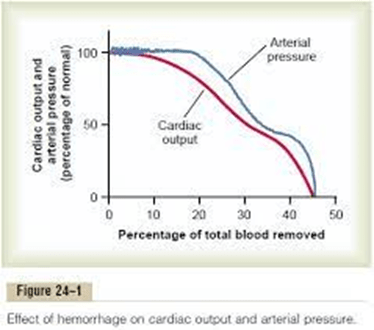
This image is a graph of what happens to the cardiac output of a patient who begins to bleed and who does not receive transfusion in time. Notice that at the beginning, a little blood loss does nothing to hurt the patient; the patient’s heart is able to compensate. But as the blood loss worsens, the patient slides into irreversible shock. At a point, no amount of transfusion will save the patient.

Both the northern nation of Israel and the southern nation of Judah have been hemorrhaging spiritually and morally for years. But in the beginning things didn’t really appear that bad. The telling phrase that keeps repeating is this: “Nevertheless, the high places were not taken away; the people continued sacrificing and burning incense there.” Offering by offering, the people were sliding further away from the Lord God of Israel and closer to complete destruction. Now the destruction has begun.

“In the days of Pekah king of Israel, Tiglath-pileser king of Assyria came and captured Ijon, Abel-beth-maacah, Janoah, Kedesh, Hazor, Gilead, and Galilee, including all the land of Naphtali, and he took the people as captives to Assyria.” Until now, God has held the Assyrians at bay; however, now the Assyrians swoop in and capture large portions of Israel on both sides of the Jordan River, carrying these idolaters back to Assyria. In retaliation for these humiliating defeats, Hoshea son of Elah assassinates Pekah and rules in his place. Events are beginning to reach the steep part of the curve in Israel and the precipitous downward slide will begin soon.

Meanwhile, in the southern kingdom of Judah, Jotham, the son of King Uzziah, takes up his rule and rules for sixteen years. But things are not peaceful in Judah. Idolatry continues apace and the king of Syria (Aram) and Pekah of Israel persistently attack Judah. The longer the citizens of Judah worship at the high places, the more God withdraws His protection from them. Judah is only lagging a few years behind Israel.

APPLICATION: We read these accounts and wonder how any nation could be so stupid and short – sighted as to abandon the One True Living God for idols. But look at recent events in America. At this point, America desperately needs a transfusion of righteousness that only God the Omnipotent can give us. America stands in critical need of revival, and no amount of espousing worthwhile causes will substitute for such a move.

There are many people in America and in other nations who appear to believe that if they just do enough good things, if they just save Colubus monkeys in Nigeria, or endangered species in other places, this will be enough. Now, there is nothing wrong with caring for the environment or for endangered species. God charged Adam and Eve to care for the animals and that charge remains today. But no amount of social action can compensate for sin, and sin appears to be multiplying throughout the world.

The problem for all nations today is the same problem faced by both Israel and Judah: sin. The citizens of both nations had turned away from their God to serve demons in the hopes that they could control events and people. But those powers were reserved for the One True Living God. To repent means to turn away from sin completely and to live as new people, but how are we to do that? Only God can help us! Only God has the power to save us from ourselves and to change us into His likeness.

No social programs, no scientific studies, no environmental protection efforts can possibly save us from our own sinful natures. When we look to these things for salvation, we are as confused as were the people who were burning incense and making sacrifices on the high places.

PRAYER: Father God, thank You for loving us and for caring for us. Lord, help all who read these words to understand their need for You and to turn to You for salvation. In the mighty and precious Name of King Jesus. Amen.

AUGUST 23, 2022 S2 PIRITUAL BLACK HOLES PART 2 #30 2 KINGS 15:1 – 26 WHEN A NATION REJECTS GOD, CHAOS ENSUES!

August 23, 2022

2 Kings 15:1 – 11 “In the twenty-seventh year of Jeroboam’s reign over Israel, Azariah (Uzziah) son of Amaziah became king of Judah. He was sixteen years old when he became king, and he reigned in Jerusalem fifty-two years. His mother’s name was Jecoliah; she was from Jerusalem. And he did what was right in the eyes of the LORD, just as his father Amaziah had done.

Nevertheless, the high places were not taken away; the people continued sacrificing and burning incense there.

And the LORD afflicted the king with leprosy until the day he died, so that he lived in a separate house while his son Jotham had charge of the palace and governed the people of the land.

As for the rest of the acts of Azariah (Uzziah), along with all his accomplishments, are they not written in the Book of the Chronicles of the Kings of Judah?

And Azariah rested with his fathers and was buried near them in the City of David. And his son Jotham reigned in his place. (Azariah/Uzziah could not be buried with his fathers due to the skin disease he had in his feet.)

In the thirty-eighth year of Azariah’s reign over Judah, Zechariah son of Jeroboam became king of Israel, and he reigned in Samaria six months. And he did evil in the sight of the LORD, as his fathers had done. He did not turn away from the sins that Jeroboam son of Nebat had caused Israel to commit.

Then Shallum son of Jabesh conspired against Zechariah, struck him down and killed him in front of the people, and reigned in his place.

 As for the rest of the acts of Zechariah, they are indeed written in the Book of the Chronicles of the Kings of Israel. So the word of the LORD spoken to Jehu was fulfilled: “Four generations of your sons will sit on the throne of Israel.”

 In the thirty-ninth year of Uzziah’s reign over Judah, Shallum son of Jabesh became king, and he reigned in Samaria one full month.

Then Menahem son of Gadi went up from Tirzah to Samaria, struck down and killed Shallum son of Jabesh, and reigned in his place.

As for the rest of the acts of Shallum, along with the conspiracy he led, they are indeed written in the Book of the Chronicles of the Kings of Israel.

At that time Menahem, starting from Tirzah, attacked Tiphsah (On the Euphrates River) and everyone in its vicinity, because they would not open their gates. So he attacked Tiphsah and ripped open all the pregnant women.

In the thirty-ninth year of Azariah’s reign over Judah, Menahem son of Gadi became king of Israel, and he reigned in Samaria ten years. And he did evil in the sight of the LORD, and throughout his reign he did not turn away from the sins that Jeroboam son of Nebat had caused Israel to commit.

Then Pul (Tiglath – Pileser) king of Assyria invaded the land, and Menahem gave Pul a thousand talents of silver  in order to gain his support and strengthen his own grip on the kingdom. (1,000 talents is approximately 37.7 tons or 34.2 metric tons of silver.) Menahem exacted this money from each of the wealthy men of Israel—fifty shekels of silver from each man—to give to the king of Assyria. So the king of Assyria withdrew and did not remain in the land. (50 shekels is approximately 1.26 pounds or 569.8 grams of silver.)

 As for the rest of the acts of Menahem, along with all his accomplishments, are they not written in the Book of the Chronicles of the Kings of Israel? And Menahem rested with his fathers, and his son Pekahiah reigned in his place.

In the fiftieth year of Azariah’s reign over Judah, Pekahiah son of Menahem became king of Israel and reigned in Samaria two years. And he did evil in the sight of the LORD and did not turn away from the sins that Jeroboam son of Nebat had caused Israel to commit.

Then his officer, Pekah son of Remaliah, conspired against him along with Argob, Arieh, and fifty men of Gilead. And at the citadel of the king’s palace in Samaria, Pekah struck down and killed Pekahiah and reigned in his place.

As for the rest of the acts of Pekahiah, along with all his accomplishments, they are indeed written in the Book of the Chronicles of the Kings of Israel.”

WHEW! Trying to keep all the kings mentioned in this chapter is tough. Although the name Azariah means little to most of us, we are very familiar with the name “Uzziah,” from Isaiah 6:1. “In the year that King Uzziah died, I saw the Lord, high and lifted up….” Uzziah reigned in Judah for 52 years and was generally good, except for the fact that people were still worshiping at the high places. But in Uzziah’s old age, he became proud and attempted to offer sacrifices himself, something he was not qualified to do. When the priests attempted to stop him, he refused. Suddenly, God caused Uzziah to become a leper and he was forced to quickly leave the temple and go into seclusion. Meanwhile, during Uzziah’s reign in Judah, there was a series of kings in Israel.

  1. Zechariah son of Jeroboam the Second – reigned for six months and was publicly assassinated by Shallum son of Jabesh. This ended God’s promise to Jehu that his family would reign for four generations.
  2. Shallum – set a new record for the shortest reign possible – 2 months. Shallum was murdered by Menahem son of Gadi.
  3. Menahem son of Gadi – reigned for ten years. Menahem was a very violent man, marching nearly 400 kilometers from Tirzah to Tiphsah on the Euphrates River. When the citizens of Tiphsah refused to open their gates, Menahem took the city, ripping open pregnant women. Menahem was purely evil, following the ways of Jeroboam the First. When Tiglath – Pileser, the Assyrian king, attacked Samaria, Menahem succeeded in buying him off by giving him 1,000 talents of silver – the staggering equivalent of 37.7 tons or 34.2 metric tons. Menahem got these riches from the wealthy citizens of Samaria.
  4.   Menahem died and was succeeded by his son Pekahiah.
  5. Pekahiah proved to be just as evil as his father, and only reigned for two years before being struck down by his chief officer Pekah, along with two other men and fifty men from Gilead on the east side of the Jordan.
REVOLVING DOOR

APPLICATION: At this point, the throne room of Israel practically needs a revolving door! Revolving doors allow one person to enter as another one leaves and are very efficient, moving quite rapidly. But revolving doors just keep moving in one direction, and if you don’t enter the hall when you get to the other side of the door, the door will force you onwards, slinging you back outside.

The root cause of the unrest in Israel was spiritual, dating all the way back to Jeroboam the son of Nebat, who led the rebellion against Rehoboam, who succeeded his father, Solomon. Despite God making direct promises to Jeroboam about blessing him, Jeroboam turned away from God, refusing to believe or accept those promises. Jeroboam insisted on establishing his own religion employing idols reminiscent of Egypt and the Canaanite religions. With a ruler actively promoting idolatry, it was little wonder that the ten tribes of Israel rapidly began worshiping every pagan god they had ever heard of.

Today there are nations around the world whose people once served the Living God. Now these nations have turned away and are preoccupied with technology, social programs, and all kinds of other causes. God is not bothered by technology; after all, He spoke the universe into existence with a single word. It is God who has given men the intelligence to learn things. King Solomon said in Proverbs 25:2 “It is the glory of God to conceal a matter, but it is the glory of kings to search out a matter.” God knows all about the issues of global warming, refugeeism, economic downturns, and all the other things with which people are preoccupied. God’s knowledge is perfect while our knowledge is spotty. (Incidentally, there is nothing new under the sun. Read the Old Testament and you will see evidence of climate changes and shifts of refugee populations thousands of years ago.)

But technology will never bring salvation, nor will attention to social or environmental causes. All of these things are worthwhile; yet, involving ourselves in these things to the exclusion of worshiping God will never bring us spiritual peace. No matter how many worthwhile causes we espouse, we can never earn our way into heaven.

Our problem today is the same problem that the human race has always had: sin. Even with the best of intentions, we still find ourselves judging others, feeling that we are better than others because of our very involvement in worthwhile causes. Sin is inescapable. Saint Paul said in Romans 7:21 “So I find it to be a law that when I want to do what is right and good, evil is ever present with me and I am subject to its insistent demands.” As human beings, we are caught in a quagmire with no way out. But God has made a way! God has sent His Son Jesus Christ to shed his blood as payment for our sins if we will only believe on Him.

Romans 8:2 tells us, “The law of the spirit of life in Christ Jesus has made me free from the law of sin and death.” If the people of the Northern Nation of Israel had returned to serve the God of Israel, God would have blessed them and given them political stability. But under the influence of the demonic, this nation as a whole and its people individually were pursuing an increasingly downhill path.

PRAYER: Father God, thank You for loving us and for caring for us. Lord, help us to realize that You are our only hope and not technology or worthy causes. Thank You for sending Jesus to be the blood sacrifice for our sins. In the mighty and precious Name of King Jesus. Amen.

AUGUST 22, 2022 SPIRITUAL BLACK HOLES PART 2 #29 2 KINGS 14:17 – 29 GOD CONTINUES TO HELP US FOR HIS NAME’S SAKE, NOT BECAUSE WE ARE VIRTUOUS! GYE NYAME!

August 22, 2022

2 Kings 14:17 – 29 “Amaziah son of Joash king of Judah lived for fifteen years after the death of Jehoash son of Jehoahaz king of Israel. As for the rest of the acts of Amaziah, are they not written in the Book of the Chronicles of the Kings of Judah?

And conspirators plotted against Amaziah in Jerusalem, and he fled to Lachish. But men were sent after him to Lachish, and they killed him there. They carried him back on horses and buried him in Jerusalem with his fathers in the City of David.

Then all the people of Judah took Azariah, who was sixteen years old, and made him king in place of his father Amaziah. Azariah was the one who rebuilt Elath and restored it to Judah after King Amaziah rested with his fathers.

In the fifteenth year of the reign of Amaziah son of Joash over Judah, Jeroboam son of Jehoash became king of Israel, and he reigned in Samaria forty-one years. And he did evil in the sight of the LORD and did not turn away from all the sins that Jeroboam son of Nebat had caused Israel to commit.

This Jeroboam restored the boundary of Israel from Lebo-hamath to the Sea of the Arabah, according to the word that the LORD, the God of Israel, had spoken through His servant Jonah son of Amittai, the prophet from Gath-hepher. For the LORD saw that the affliction of the Israelites, both slave and free, was very bitter. There was no one to help Israel, and since the LORD had said that He would not blot out the name of Israel from under heaven, He saved them by the hand of Jeroboam son of Jehoash.

As for the rest of the acts of Jeroboam, along with all his accomplishments and might, and how he waged war and recovered both Damascus and Hamath for Israel from Judah, are they not written in the Book of the Chronicles of the Kings of Israel?

And Jeroboam rested with his fathers, the kings of Israel. And his son Zechariah reigned in his place.”

After all was said and done, Amaziah wound up dying like his father at the hands of assassins. Amaziah’s inglorious defeat at the hands of Jehoash continued to rankle the leaders of Judah long after it was over. Even though Amaziah outlived Jehoash, he could never outlive the shame of the destruction of 200 meters of the wall of Jerusalem and the sacking of the temple and palace treasuries. Remember that Amaziah himself was also taken prisoner; the elders of Judah must have been forced to pay ransom for his release. Evidently, Amaziah learned nothing from his misadventures and continued to be so obnoxious that even when he fled to Lachish, assassins followed and killed him.

The elders of Judah were so anxious to get rid of Amaziah that after his death, they made his sixteen-year-old son Azariah king in his stead. Presumably, Azariah either behaved better or was more compliant; at any rate, eventually, he rebuilt Elath on the Red Sea and restored it to Judah.

What can be said about Jeroboam the Second, king of Israel? The most telling criticism is “And he did evil in the sight of the LORD and did not turn away from all the sins that Jeroboam son of Nebat had caused Israel to commit.” Jeroboam ruled for 41 years, and was a miserable man!  

But despite all the evil that Jeroboam the Second did, God still worked through him anyway. “This Jeroboam restored the boundary of Israel from Lebo-hamath to the Sea of the Arabah, according to the word that the LORD, the God of Israel, had spoken through His servant Jonah son of Amittai, the prophet from Gath-hepher. For the LORD saw that the affliction of the Israelites, both slave and free, was very bitter. There was no one to help Israel, and since the LORD had said that He would not blot out the name of Israel from under heaven, He saved them by the hand of Jeroboam son of Jehoash. As for the rest of the acts of Jeroboam, along with all his accomplishments and might, and how he waged war and recovered both Damascus and Hamath for Israel from Judah…”

Why did God use Jeroboam the Second, even though he was so evil? “There was no one to help Israel, and since the LORD had said that He would not blot out the name of Israel from under heaven, He saved them by the hand of Jeroboam son of Jehoash.” God always uses whoever is available. At that time, Jeroboam was the only one available, so God used him, even though God deplored his idolatry.

APPLICATION: Sometimes, we assume that God uses us because we are so special or so virtuous. We should be warned by this description of King Jeroboam the Second of Israel. This king pursued outright idolatry just as Jeroboam the First had done; however, God used him anyway. God was continuing to keep His promises to Israel; that was why He allowed Jeroboam the Second to be successful in battle.

During the American Civil War, Abraham Lincoln is quoted as having said that the question is not whether or not God is on our side, but whether or not we are on God’s side. This wicked king is an example of someone whom God was using, even though he refused to acknowledge God or worship Him. The question for us is this: Are we being careful to follow God? If we are successful, do we take all the credit, or do we realize that unless God has helped us, we would fail miserably?

Psalm 127 tells us, “Unless the Lord builds the house, they who build it labor in vain.” The most common Adinkra symbol in Ghana is the Gye Nyame symbol. “Gye Nyame” is a Twi expression literally meaning “Except God” or “Unless God” or “If not for God.” This symbol stands for several proverbs that asserts that only God can help and that we must rely on Him.

GYE NYAME

When you succeed, remember King Jeroboam the Second, and remember the Gye Nyame symbol. Jeroboam succeeded because God allowed him to and not because he deserved to do so. Be careful to remain humble, knowing that God is the only author of salvation and success.

PRAYER: Father God, thank You for loving us and for caring for us. Lord, help us to always remember that You are the only One who gives true victories and to rely only on You. In the mighty and precious Name of King Jesus. Amen.