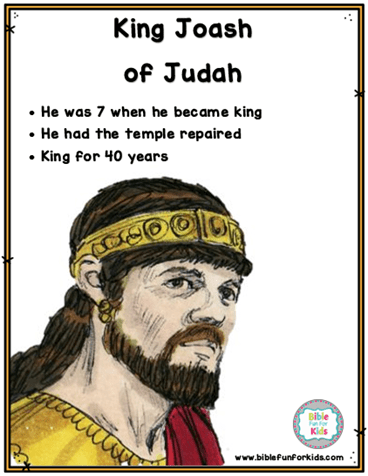
2 Kings 12:1 -16 “In the seventh year of Jehu, Joash a became king, and he reigned in Jerusalem forty years. His mother’s name was Zibiah; she was from Beersheba. And Joash did what was right in the eyes of the LORD all the days he was instructed by Jehoiada the priest.
Nevertheless, the high places were not removed; the people continued sacrificing and burning incense there.
Then Joash said to the priests, “Collect all the money brought as sacred gifts into the house of the LORD—the census money, the money from vows, and the money brought voluntarily into the house of the LORD. Let every priest receive it from his constituency, and let it be used to repair any damage found in the temple.” By the twenty-third year of the reign of Joash, however, the priests had not yet repaired the damage to the temple. So King Joash called Jehoiada and the other priests and said, “Why have you not repaired the damage to the temple? Now, therefore, take no more money from your constituency, but hand it over for the repair of the temple.”
So the priests agreed that they would not receive money from the people and that they would not repair the temple themselves.
Then Jehoiada the priest took a chest, bored a hole in its lid, and set it beside the altar on the right side as one enters the house of the LORD. There the priests who guarded the threshold put all the money brought into the house of the LORD.
Whenever they saw that there was a large amount of money in the chest, the royal scribe and the high priest would go up, count the money brought into the house of the LORD, and tie it up in bags. Then they would put the counted money into the hands of those who supervised the work on the house of the LORD, who in turn would pay those doing the work—the carpenters, builders, masons, and stonecutters. They also purchased timber and dressed stone to repair the damage to the house of the LORD, and they paid the other expenses of the temple repairs.
However, the money brought into the house of the LORD was not used for making silver basins, wick trimmers, sprinkling bowls, trumpets, or any articles of gold or silver for the house of the LORD. Instead, it was paid to those doing the work, and with it they repaired the house of the LORD.
No accounting was required from the men who received the money to pay the workmen, because they acted with integrity. The money from the guilt offerings and sin offerings was not brought into the house of the LORD; it belonged to the priests.”
Joash was only seven years old when he ascended the throne, but he performed well as long as Jehoiada, the righteous high priest, was there to guide him. At some point, Joash ordered that monies collected from all the temples in Judah be sent to repair the temple in Jerusalem. The exception to this command was the money from the guilt offerings and sin offerings that still belonged to the priests.
Anybody who has ever headed a building program can predict what happened next! The priests in the hinterlands were collecting money all right; however, they were conveniently keeping it for themselves. Even in Jerusalem, there were questions about having money to do the repairs. Finally, when Joash was 30 and had been ruling 23 years, he called all the priests to account. It’s likely that all this time, Jehoiada had been trying to get his fellow priests to do the right thing; however, those priests weren’t listening. Now that Joash has issued a royal edict, Jehoiada can relax a little. Jehoiada sets up a locked chest with a hole in it into which the monies will go. Problem solved.
The building program story rings true. We have friends who have built or who are building homes for themselves in their home villages in northern Ghana. Without exception, our friends have advised that anyone erecting a building will have to watch the workmen carefully; otherwise, cement bags will take legs and walk off somewhere else. Generally, one’s relatives are those most likely to cheat, using the excuse that there must be plenty of money in the situation anyway and they are poor villagers! It is a telling comment on the moral depravity of the priests of that time that the workmen were more honest than the priests. “No accounting was required from the men who received the money to pay the workmen, because they acted with integrity.” OK. Righteousness is where you find it.
APPLICATION: There are two phrases in this account that bear closer attention: And Joash did what was right in the eyes of the LORD all the days he was instructed by Jehoiada the priest. Nevertheless, the high places were not removed; the people continued sacrificing and burning incense there.” Poor Joash! He spent most of his early childhood being shifted from one room in the palace or temple to another. It’s likely that until the coronation, Joash had rarely seen the light of day. Then Joash became king at age seven. While Jehoiada was there to instruct him, there were probably also others flattering him in an attempt to gain power or riches. Joash really didn’t have a chance to mature very well, despite Jehoiada’s best efforts. How strong are we when those who have mentored us are no longer around? Will we continue to do the right thing, or will we compromise?
“The high places were not taken away.” Those high places were shrines on the top of every hill and mountain where the Israelites were making sacrifices to pagan gods. Even though the major temple of Baal was destroyed, people were still cherishing their pet sins and indulging in them rather than whole – heartedly following the One True Living God. Later on, the prophet Jeremiah would describe such people as those foolish enough to abandon clear flowing springs of living water, only to dig empty cisterns for themselves in an effort to be their own amateur providences by making such sacrifices. Whether or not these people chose to believe it, they were serving demons and would reap the results.
Where are the “high places” in our lives? Are we devoting large amounts of time to Netflix or TV programs rather than worshiping God? God wanted the Israelites to pursue lives of worship and to always have His commandments with them. Deuteronomy 6:4 – 9 tells us, “Hear, O Israel: The Lord our God, the Lord is one. Love the Lord your God with all your heart and with all your soul and with all your strength. These commandments that I give you today are to be on your hearts. Impress them on your children. Talk about them when you sit at home and when you walk along the road, when you lie down and when you get up. Tie them as symbols on your hands and bind them on your foreheads. Write them on the doorframes of your houses and on your gates.” God knew that people have short memories; those things to which we give our hearts are the objects of our worship.
WHAT IS WRITTEN ON THE DOOR FRAME OF YOUR HEART? In America these days, many people put banners outside their homes celebrating the season of the year or some holiday. But what do people see when they see us? The way we live and the way we conduct ourselves around others will speak more loudly than any banner. Even though the Israelites may have outwardly followed the commands in Deuteronomy 6, they were still making the rounds of the high places. After all, what if God wasn’t really God at all? Never mind the miracles God had done! Perhaps these other deities could give wealth or success if propitiated. Those worshiping at the shrines certainly seemed to be doing all right. May God help us to follow Him whole – heartedly!
PRAYER: Father God, thank You for loving us and for caring for us. Lord, help us to follow hard after You all the days of our lives and to utterly reject anything that will draw us further away from You. In the mighty and precious Name of King Jesus. Amen.

 Burunche's Blog
Leave a comment