Archive for September, 2022

SEPTEMBER 30,2022 ANOTHER LOOK AT THE ISRAELITES PART 1 #19 1 CHRONICLES 16:1 – 43 WORLD CLASS PRAISE!

September 30, 2022

A Tent for the Ark (2 Samuel 6:17-19)

1 Chronicles 16:1 – 43 “So they brought the ark of God and placed it inside the tent that David had pitched for it. And they presented burnt offerings and peace offerings before God. When David had finished sacrificing the burnt offerings and peace offerings, he blessed the people in the name of the LORD. Then he distributed to each and every Israelite, both men and women, a loaf of bread, a date cake, and a raisin cake.

David appointed some of the Levites to minister before the ark of the LORD, to celebrate, to give thanks, and to praise the LORD, the God of Israel. Asaph was the chief, Zechariah was second, then Jeiel, Shemiramoth, Jehiel, Mattithiah, Eliab, Benaiah, Obed-edom, and Jeiel. They were to play the harps and lyres, while Asaph sounded the cymbals 6and the priests Benaiah and Jahaziel blew the trumpets regularly before the ark of the covenant of God.

David’s Psalm of Thanksgiving (Psalm 96:1-13; Psalm 105:1-15; Psalm 106:1-48)

On that day David first committed to Asaph and his brothers this song of thanksgiving to the LORD:

“Give thanks to the LORD; call upon His name; make known His deeds among the nations.

Sing to Him, sing praises to Him; tell of all His wonders. Glory in His holy name; let the hearts of those who seek the LORD rejoice. Seek out the LORD and His strength; seek His face always.

Remember the wonders He has done, His marvels, and the judgments He has pronounced,

O offspring of His servant Israel, O sons of Jacob, His chosen ones. He is the LORD our God; His judgments carry throughout the earth.

Remember His covenant forever, the word He ordained for a thousand generations— 16the covenant He made with Abraham, and the oath He swore to Isaac.

He confirmed it to Jacob as a decree, to Israel as an everlasting covenant: ‘I will give you the land of Canaan as the portion of your inheritance.’

When they were few in number, few indeed, and strangers in the land, they wandered from nation to nation, from one kingdom to another. He let no man oppress them; He rebuked kings on their behalf:

‘Do not touch My anointed ones! Do no harm to My prophets!’

Sing to the LORD, all the earth. Proclaim His salvation day after day.

Declare His glory among the nations, His wonders among all peoples.

For great is the LORD, and greatly to be praised; He is to be feared above all gods.

For all the gods of the nations are idols, but it is the LORD who made the heavens.

Splendor and majesty are before Him; strength and joy fill His dwelling.

Ascribe to the LORD, O families of the nations, ascribe to the LORD glory and strength.

Ascribe to the LORD the glory due His name; bring an offering and come before Him.

Worship the LORD in the splendor of His holiness; tremble before Him, all the earth.

The world is firmly established; it cannot be moved.

Let the heavens be glad, and the earth rejoice. Let them say among the nations, ‘The LORD reigns!’

Let the sea resound, and all that fills it; let the fields exult, and all that is in them.

Then the trees of the forest will sing for joy before the LORD, for He is coming to judge the earth.

Give thanks to the LORD, for He is good; His loving devotion endures forever.

Then cry out: ‘Save us, O God of our salvation; gather and deliver us from the nations, that we may give thanks to Your holy name, that we may glory in Your praise.’

Blessed be the LORD, the God of Israel, from everlasting to everlasting.”

Then all the people said, “Amen!” and “Praise the LORD!”

Worship before the Ark

So David left Asaph and his brothers there before the ark of the covenant of the LORD, to minister there regularly according to the daily requirements, 38along with Obed-edom and his sixty-eight relatives. Obed-edom son of Jeduthun, and also Hosah, were to be gatekeepers.

And David left Zadok the priest and his fellow priests before the tabernacle of the LORD at the high place in Gibeon 40to regularly present burnt offerings to the LORD on the altar of burnt offerings, morning and evening, according to all that was written in the Law of the LORD, which He had commanded Israel to keep. With them were Heman, Jeduthun, and the rest of those chosen and designated by name to give thanks to the LORD, for “His loving devotion endures forever.” Heman and Jeduthun had with them trumpets and cymbals for the music and instruments for the songs of God. And the sons of Jeduthun were stationed at the gate.

Then all the people departed for their homes, and David returned home to bless his household.”

There is very little that needs to be said about this chapter. The description and psalm included have inspired millions of people ever since the events of this day. Undoubtedly, the dedication of the tent for the Ark was one of the highlights of David’s long reign as king. The preparations for the priests and for those who were to lead worship leaves little doubt that David was a genius when it came to organization, even though he probably got lots of advice from the priests.

APPLICATION: The best way to apply the lessons of this chapter is to read through it several times and then apply the lessons of praise.Ascribe to the LORD, O families of the nations, ascribe to the LORD glory and strength.

Ascribe to the LORD the glory due His name; bring an offering and come before Him. Worship the LORD in the splendor of His holiness; tremble before Him, all the earth. Give thanks to the LORD, for He is good; His loving devotion endures forever.

Then cry out: ‘Save us, O God of our salvation; gather and deliver us from the nations, that we may give thanks to Your holy name, that we may glory in Your praise.’

Blessed be the LORD, the God of Israel, from everlasting to everlasting.” All that is really left for us is to say, “Amen” and “Praise the Lord!”

PRAYER:  Father God, thank you for loving us and for caring for us. Lord, help us to praise you wherever we are and under all circumstances. Help us to remember that all nature continually praises you and that we are the ones who need to catch up with the ocean and the trees! May Your Name be praised forever! In the mighty and precious Name of King Jesus. Amen

SEPTEMBER 29, 2022 ANOTHER LOOK AT THE ISRAELITES PART 1 #18 1 CHRONICLES 15:1 – 29 DAVID MAKES A COURSE CORRECTION AND DOES THINGS RIGHT!

September 29, 2022

1 Chronicles 15:1 – 29 “David constructed buildings for himself in the City of David, and he prepared a place for the ark of God and pitched a tent for it. Then David said, “No one but the Levites may carry the ark of God, because the LORD has chosen them to carry the ark of the LORD and to minister before Him forever.”

And David assembled all Israel in Jerusalem to bring up the ark of the LORD to the place he had prepared for it. Then he gathered together the descendants of Aaron and the Levites: From the Kohathites, Uriel the chief and 120 of his relatives; from the Merarites, Asaiah the chief and 220 of his relatives; from the Gershomites, Joel the chief and 130 of his relatives; from the Elizaphanites, Shemaiah the chief and 200 of his relatives; from the Hebronites, Eliel the chief and 80 of his relatives; and from the Uzzielites, Amminadab the chief and 112 of his relatives.

David summoned the priests Zadok and Abiathar and the Levites Uriel, Asaiah, Joel, Shemaiah, Eliel, and Amminadab. And he said to them, “You are the heads of the Levitical families. You and your relatives must consecrate yourselves so that you may bring the ark of the LORD, the God of Israel, to the place I have prepared for it. It was because you Levites were not with us the first time that the LORD our God burst forth in anger against us. For we did not consult Him about the proper order.”

The Priests and Levites Carry the Ark So the priests and Levites consecrated themselves to bring up the ark of the LORD, the God of Israel. And the Levites carried the ark of God on their shoulders with the poles, as Moses had commanded in accordance with the word of the LORD. David also told the leaders of the Levites to appoint their relatives as singers to lift up their voices with joy, accompanied by musical instruments—harps, lyres, and cymbals. So the Levites appointed Heman son of Joel; from his brothers, Asaph son of Berechiah; from their brothers the Merarites, Ethan son of Kushaiah; and with them their brothers next in rank: Zechariah, Jaaziel, Shemiramoth, Jehiel, Unni, Eliab, Benaiah, Maaseiah, Mattithiah, Eliphelehu, Mikneiah, and the gatekeepers Obed-edom and Jeiel.

The musicians Heman, Asaph, and Ethan were to sound the bronze cymbals. Zechariah, Aziel, Shemiramoth, Jehiel, Unni, Eliab, Maaseiah, and Benaiah were to play the harps according to Alamoth.  And Mattithiah, Eliphelehu, Mikneiah, Obed-edom, Jeiel, and Azaziah were to lead the music with lyres according to Sheminith. Chenaniah the head Levite was the director of the music because he was highly skilled.

Berechiah and Elkanah were to be guardians of the ark. Shebaniah, Joshaphat, Nethanel, Amasai, Zechariah, Benaiah, and Eliezer—the priests—were to blow the trumpets before the ark of God. Obed-edom and Jehiah were also to be guardians of the ark.

Moving the Ark to Jerusalem

So David, the elders of Israel, and the commanders of thousands went with rejoicing to bring the ark of the covenant of the LORD from the house of Obed-edom. And because God helped the Levites who were carrying the ark of the covenant of the LORD, they sacrificed seven bulls and seven rams.

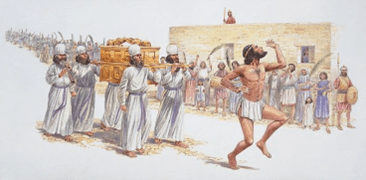
Now David was dressed in a robe of fine linen, as were all the Levites who were carrying the ark, as well as the singers and Chenaniah, the director of music for the singers. David also wore a linen ephod. So all Israel brought up the ark of the covenant of the LORD with shouting, with the sounding of rams’ horns and trumpets, and with cymbals and the music of harps and lyres.

Michal’s Contempt for David (2 Samuel 6:16)

As the ark of the covenant of the LORD was entering the City of David, Saul’s daughter Michal looked down from a window and saw King David dancing and celebrating, and she despised him in her heart.”

When David first wanted to move the ark from the home of Obed – edom at Kiriath – jearim, his heart was in the right place but he failed to do his homework. The priests didn’t speak up either. Despite the fact that the Ark was to be carried by the priests using special poles passing through rings on the sides of the Ark, David originally loaded the Ark on a cart pulled by oxen. When the cart lurched and a man named Uzzah reached out to steady the Ark, God struck Uzzah dead.

Now David has done a lot more investigation and has informed himself of the regulations regarding the transport of the Ark. “No one but the Levites may carry the ark of God, because the LORD has chosen them to carry the ark of the LORD and to minister before Him forever.” David gets the priests and Levites to properly consecrate themselves and prepare to carry the Ark. David has also prepared a place for the Ark, including a tent for the Ark. David makes sure that everything is organized, including assigning musicians with specific duties.

This time, everything goes well, and the Ark is successfully brought into Jerusalem. But there’s a sour note in the situation. When David first killed Goliath, he was given Michal, Saul’s daughter, as a wife. At one point, Michal saved David’s life by placing an image in his bed and telling Saul’s soldiers that David was sick. Later, Michal was given to another man, only for David to eventually claim her again. Michal’s second husband was very devoted and was broken – hearted when David reclaimed her. Evidently, Michal is still resentful. As David and the Ark procession comes into Jerusalem, David dances in ecstasy and joy. But Michal is embarrassed and despises David for making a spectacle of himself.  

APPLICATION: It takes a false start, but David has learned to make sure he is doing God’s work God’s way. As a leader, David has made sure that he has gotten his facts straight so that he is able to inspire the priests and Levites to carry out their duties properly. Having instructed those who are to carry the Ark and the musicians who are to accompany it, David then throws himself whole – heartedly into the celebration.

Poor Michal! Originally, Michal loved David; however, once given to another man, Michal may have found peace and a loving relationship in which she was valued for herself, rather than as a political pawn. Little wonder then, that when David demands Michal return to him, Michal herself might be miserable. Now rather than being David’s chief wife, Michal has to share David with a host of other women in the harem. So far, Michal has not given birth; some of these other women might be throwing Michal’s infertility up in her face. If Michal is already struggling, then when David disports himself in the streets of Jerusalem, Michal is ready to cut him down to size verbally. And there’s another problem: Michal’s father Saul never truly worshiped God, so Michal herself is not a God – worshiper. Michal cannot possibly understand David’s joy in the Lord because she has never known that joy.  

What is not recorded is the reactions of those in Jerusalem as the Ark returns. Those people might be just as giddy with joy as David. For all we know, there might be a whole procession of men and women dancing behind the Ark as it approaches the place David has prepared for it. With shofars and horns blowing, cymbals clashing, and all kinds of other instruments sounding, the very stones of Jerusalem might be shaking! Those living in villages close to Jerusalem might be listening and run to join the celebration when they hear the music and singing and shouting.

Over the years, Jerusalem has witnessed some amazing celebrations. There are the celebrations surrounding the opening of Solomon’s temple. There are the celebrations of Palm Sunday, when Jesus fulfills Scripture by riding into Jerusalem on a donkey. But some day, there will be a final celebration. Someday, Jesus, the Messiah, will return in all His glory. On that day, not only will people be singing and shouting, but the very rocks of Mount Moriah will cry out in ecstasy. For those of us who acknowledge Jesus as Savior and Lord, this return will be the best celebration of all.

1 Corinthians 15:51 – 58 tells us, “Listen, I tell you a mystery: We will not all sleep, but we will all be changed—in a flash, in the twinkling of an eye, at the last trumpet. For the trumpet will sound, the dead will be raised imperishable, and we will be changed. For the perishable must clothe itself with the imperishable, and the mortal with immortality. When the perishable has been clothed with the imperishable, and the mortal with immortality, then the saying that is written will come true: “Death has been swallowed up in victory.”

“Where, O death, is your victory? Where, O death, is your sting?” The sting of death is sin, and the power of sin is the law. But thanks be to God! He gives us the victory through our Lord Jesus Christ.Therefore, my dear brothers and sisters, stand firm. Let nothing move you. Always give yourselves fully to the work of the Lord, because you know that your labor in the Lord is not in vain.”

PRAYER: Father God, thank You for loving us and for caring for us. Help us to follow hard after You all the days of our lives! Help us to trust You when we cannot see. And help us to remember that one day, You will return and that will be a celebration that will never end. In the matchless Name of King Jesus. Amen.   

SEPTEMBER 28, 2022 ANOTHER LOOK AT THE ISRAELITES PART 1 #17 1 CHRONICLES 14:1 – 17 GOD NEVER DOES THINGS THE SAME WAY TWICE!

September 28, 2022

1 Chronicles 14:1 – 17 “Now Hiram king of Tyre sent envoys to David, along with cedar logs, stonemasons, and carpenters, to build a palace for him. And David realized that the LORD had established him as king over Israel and had highly exalted his kingdom for the sake of His people Israel.

And David took more wives in Jerusalem and became the father of more sons and daughters. These are the names of the children born to him in Jerusalem: Shammua, Shobab, Nathan, Solomon, Ibhar, Elishua, Elpelet, Nogah, Nepheg, Japhia, Elishama, Beeliada, and Eliphelet.

Two Victories over the Philistines (2 Samuel 5:17–25)

When the Philistines heard that David had been anointed king over all Israel, they all went in search of him; but David learned of this and went out to face them.  Now the Philistines had come and raided the Valley of Rephaim. So David inquired of God, “Should I go up against the Philistines? Will You deliver them into my hand?”

“Go,” replied the LORD, “for I will deliver them into your hand.”

So David and his men went up to Baal-perazim, where he defeated the Philistines and said, “Like a bursting flood, God has burst out against my enemies by my hand.” So they called that place Baal-perazim. There the Philistines abandoned their gods, and David ordered that they be burned in the fire. Once again the Philistines raided the valley. So David again inquired of God, who answered him, “Do not march up after them, but circle around them and attack them in front of the balsam trees. As soon as you hear the sound of marching in the tops of the balsam trees, move out to battle, because this will mean that God has marched out before you to strike the camp of the Philistines.”

So David did as God had commanded him, and they struck down the army of the Philistines all the way from Gibeon to Gezer.  And David’s fame went out into every land, and the LORD caused all nations to fear him.”

God is a God of infinite variety; He never does things quite the same way twice. If we want to succeed, we must be attuned to God’s leading. David has become king and is now in Jerusalem. God moves King Hiram of Tyre, that rich trading city on the coast, to send artisans and materials to David to build David a palace. Hiram is politically savvy and realizes that now there is a king in Israel worth acknowledging. David realizes that God is moving Hiram to do this for the sake of the nation of Israel and not merely for David’s sake. David goes on to firmly establish his dynasty by taking more wives and fathering more children.

When the Philistines realize that David has become king over Israel, they go out hunting for him. After all, when Saul was persecuting David, David actually hid with the Philistines for a time. The Philistines also remember that David is the one who killed their champion Goliath. Better to make a quick end of this upstart before he solidifies his support throughout all of Israel! But David has learned a few things all those years that Saul has chased him, and David is smart enough to ask God for advice. David meets the Philistines head – on in the Valley of Rephaim and soundly defeats them, capturing their idols and burning the idols.

The Philistines can’t believe that David has defeated them, so they raid the Valley of Rephaim a second time. Here is where David distinguishes himself from Saul. Were Saul the one facing this challenge from the Philistines, Saul would simply shrug his shoulders and meet the Philistines head – on again. After all, that strategy worked the first time, why not the second? But David inquires of the Lord, and God advises him to circle around the Philistines and meet them in front of a grove of balsam trees. Not only are the Philistines not expecting this plan, but by getting between the Philistines and the trees, David also is cutting off potential escape routes. God orders David to wait until he hears the sound of marching feet in the treetops indicating that God’s angel armies are going out ahead of David to attack the Philistines. Unlike Saul who rarely if ever followed orders, David follows God’s instructions to the letter. The result is a resounding victory that sends the Philistines westward to their five cities to lick their wounds.

APPLICATION: If you have tried a strategy and it has worked, it’s very tempting to repeat that approach without considering the possibility that circumstances may have changed. But flexibility is critically important. When we were first training as missionaries, one experienced instructor advised us, “Blessed are the flexible, for they shall never be bent out of shape.” Proverbs 29:1 tells us, A man who remains stiff-necked after much reproof will suddenly be shattered beyond recovery.”

The key to David’s success is simple: he asks God for advice, he takes that advice, and he waits until God moves before he moves. We can read all the books and watch Ted Talks. We can ask friends and superiors for advice. But unless we have consulted God, we are setting ourselves up for failure.

The HMS Bounty was a replica of a famous sailing ship. October 25, 2012, this three – masted wooden ship left the safety of New London, Connecticut, bound for Saint Petersburg, Florida, despite the fact that Hurricane Sandy was making its way up the East Coast of the U.S. The captain of the Bounty foolishly assumed that this relatively small ship would be safer at sea than at anchor and sailed with a small inexperienced crew (15 rather than the 25 generally on board), poorly functioning pumps, and inadequate safety precautions.

The Bounty sank on October 29, 2012. Coast Guard helicopters rescued 14 of the 16 crew members. One sailor died and the 63-year-old captain, Robin Walbridge, was never found. In a later report, the National Transportation Safety Board concluded, “To set sail into an approaching hurricane introduced needless risk,” the safety board wrote. The probable cause of the sinking was “the captain’s reckless decision to sail the vessel into the well-forecasted path of Hurricane Sandy, which subjected the aging vessel and the inexperienced crew to conditions from which the vessel could not recover.” Had Mr. Walbridge consulted the God who controlled Hurricane Sandy, he would have stayed in port.

God is always willing to help us and to advise us. Our problem is us; we dream up approaches and then ask God to bless them without ever considering that we might be as foolish as the captain of the Bounty replica. King David was wise enough to ask God for help; let us do the same!

PRAYER: Father God, thank You for loving us and for caring for us. Lord, help us to always seek Your advice and then to take it, even if our common sense is telling us something quite different. Thank You for not giving up on us when we do fail to take Your advice. Help us to follow hard after You all the days of our lives. In the mighty and precious Name of King Jesus. Amen.

SEPTEMBER 27, 2022 ANOTHER LOOK AT THE ISRAELITES PART 1 #16 1 CHRONICLES 13:1 – 14 YOU CAN’T DO GOD’S WORK WITHOUT GOD’S ADVICE!

September 27, 2022

1 Chronicles 13:1 – 14 “Then David conferred with all his leaders, the commanders of hundreds and of thousands. And he said to the whole assembly of Israel, “If it seems good to you, and if this is of the LORD our God, let us send word far and wide to the rest of our brothers in all the land of Israel, and also to the priests and Levites in their cities and pasturelands, so that they may join us. Then let us bring back the ark of our God, for we did not inquire of Him in the days of Saul.” And because this proposal seemed right to all the people, the whole assembly agreed to it. So David assembled all Israel, from the River Shihor in Egypt to Lebo-hamath, to bring the ark of God from Kiriath-jearim.

David and all Israel went up to Baalah of Judah (that is, Kiriath-jearim) to bring up from there the ark of God the LORD, who is enthroned between the cherubim—the ark that is called by the Name. So they carried the ark of God from the house of Abinadab on a new cart, with Uzzah and Ahio guiding the cart.

Uzzah Touches the Ark (2 Samuel 6:5–11)

David and all the Israelites were celebrating before God with all their might, with songs and on harps and lyres, with tambourines, cymbals, and trumpets. When they came to the threshing floor of Chidon, Uzzah reached out and took hold of the ark, because the oxen had stumbled. And the anger of the LORD burned against Uzzah, and He struck him down because he had put his hand on the ark. So he died there before God. Then David became angry because the LORD had burst forth against Uzzah; so he named that place Perez-uzzah, as it is called to this day.

That day David feared God and asked, “How can I ever bring the ark of God to me?” So he did not move the ark with him to the City of David; instead, he took it aside to the house of Obed-edom the Gittite. Thus the ark of God remained with the family of Obed-edom in his house for three months, and the LORD blessed his household and everything he owned.”

What happened to the Ark of the Covenant in the first place? In the days when the prophet Samuel was a boy, the Israelites insisted on carrying the Ark out to battle while they were fighting the Philistines. When the Philistines defeated the Israelites, they captured the Ark and sent it to one of their temples. The statue of Dagon in that temple fell on its face before the Ark. Then God began afflicting the Philistines with tumors, perhaps with bubonic plague, and the Philistines finally loaded the Ark, plus golden images of the tumors and the rats that had carried the plague on a cart drawn by two milk cows whose calves were still tied up. Despite the fact that the cows cried for their calves, the cows headed straight for Israel. The Ark wound up in the house of Abinadab in Kiriath – jearim, where it had stayed ever since. 

When the Ark of the Covenant was in the Tabernacle, priests would bring petitions from Israelites and would ask to know God’s will in those matters. Now for years, the Tabernacle had stood with all of its other accoutrements but missing its heart. David observed, “Then let us bring back the ark of our God, for we did not inquire of Him in the days of Saul.” The Ark was captured when Samuel was still young, but Saul never lifted a finger to try to re – capture the Ark, nor did Saul inquire of the Lord. Periodically, Saul would try to get advice from Samuel, but much of the time, Saul went off on his own, assuming that he didn’t need to hear from the God who had crowned him king.

David’s heart was in the right place; however, he made a major mistake. Nobody thought to check the Law of Moses to see how the Ark was supposed to be handled. Although God allowed the Philistines to load the Ark onto a cart to return it to Israel, the Ark was actually designed to be carried by the priests using poles inserted through rings on the sides of the Ark. Had David carried out the original instructions to kings and made a copy of the Law for his own study, he would have known the regulations concerning the Ark. But nobody had paid much attention to the Law of Moses for years.

David organized a wonderful celebration, loading the Ark onto a cart pulled by oxen. But when the oxen stumbled, one man named Uzzah reached out his hand to steady the Ark and God struck him dead! At first, this punishment seems cruel and ridiculous. Wasn’t Uzzah simply trying to save the Ark? But perhaps there was more to the story than we realize. Perhaps Uzzah used the shifting of the Ark on the cart as an excuse to peek into the Ark, something that was not allowed. Uzzah may have felt that because he was a priest, he was special and therefore entitled to handle the Ark, but he was wrong. God has never been unjust, so if God struck Uzzah dead, there had to be a good reason; a wrong heart attitude would explain things.

At this point, David was shocked, horrified, and afraid. David sent the Ark to the house of Obed – edom for three months, and God blessed Obed – edom and his family. Whoever Obed – edom was, he and his family obviously feared God and handled the Ark reverently.

APPLICATION: David wanted to honor God, but he didn’t ask God for advice before making his plans. One Christian comedian and evangelist began his ministry by attempting to copy everyone else and failing miserably. When this man went to God, his first question to God was, “God what are YOU doing wrong?” God answered the man, “Well, you’re doing your will in My Name!” God had to show this man that copying other successful ministries was useless and that only God’s way would bring results. David had to learn this same lesson.

God is always doing new things in new ways; however, God can never bless something that He has not brought into existence in the first place. There are many times when we seek out programs and design outreaches with no thought to the God whom we are serving. Then we wonder why the results are so disappointing. We may even make decisions on our life’s work without consulting God and then wonder why we aren’t happier with our choices.

Eventually, David did do the right thing, but he had to learn a bitter lesson first. Before making important decisions, let us stop and ask God for guidance. We can rest assured that God will answer us in ways we can understand.

PRAYER: Father God, thank You for loving us and for caring for us. Lord, help us to remember that You are the One who knows us better than we know ourselves. Help us to ask You for guidance before taking any major decisions. Thank You that You are a good Father who can communicate Your Will for Your children. In the mighty and precious Name of King Jesus. Amen.

SEPTEMBER 26, 2022 ANOTHER LOOK AT THE ISRAELITES PART 1 #15 1 CHRONICLES 12:1 – 40 DO YOU KNOW TIMES AND SEASONS? ARE YOU RELYING ON GOD’S TIMING OR ON YOUR OWN?

September 26, 2022

1 Chronicles 12:1 – 40 The Mighty Men Join David at Ziklag

“Now these were the men who came to David at Ziklag, while he was still banished from the presence of Saul son of Kish (they were among the mighty men who helped him in battle; they were archers using both the right and left hands to sling stones and shoot arrows; and they were Saul’s kinsmen from Benjamin): Ahiezer their chief and Joash, who were the sons of Shemaah the Gibeathite; Jeziel and Pelet, the sons of Azmaveth; Beracah; Jehu the Anathothite; Ishmaiah the Gibeonite, a mighty man among the Thirty and a leader over the Thirty; Jeremiah, Jahaziel, Johanan, and Jozabad the Gederathite; Eluzai, Jerimoth, Bealiah, Shemariah, and Shephatiah the Haruphite; Elkanah, Isshiah, Azarel, Joezer, and Jashobeam, who were Korahites; and Joelah and Zebadiah, the sons of Jeroham from Gedor.

Some Gadites defected to David at his stronghold in the desert. They were mighty men of valor, trained for battle, experts with the shield and spear, whose faces were like the faces of lions and who were as swift as gazelles on the mountains: Ezer the chief, Obadiah the second in command, Eliab the third, Mishmannah the fourth, Jeremiah the fifth, Attai the sixth, Eliel the seventh, Johanan the eighth, Elzabad the ninth, Jeremiah the tenth, and Machbanai the eleventh.

These Gadites were army commanders, the least of whom was a match for a hundred, and the greatest for a thousand. These are the ones who crossed the Jordan in the first month when it was overflowing all its banks, and they put to flight all those in the valleys, both to the east and to the west.

Other Benjamites and some men from Judah also came to David in his stronghold. And David went out to meet them, saying, “If you have come to me in peace to help me, my heart will be united with you; but if you have come to betray me to my enemies when my hands are free of violence, may the God of our fathers see it and judge you.”

Then the Spirit came upon Amasai, the chief of the Thirty, and he said: “We are yours, O David! We are with you, O son of Jesse! Peace, peace to you, and peace to your helpers, for your God helps you.” So David received them and made them leaders of his troops.

Some from Manasseh defected to David when he went with the Philistines to fight against Saul. (They did not help the Philistines because the Philistine rulers consulted and sent David away, saying, “It will cost us our heads if he defects to his master Saul.”) When David went to Ziklag, these men of Manasseh defected to him: Adnah, Jozabad, Jediael, Michael, Jozabad, Elihu, and Zillethai, chiefs of thousands in Manasseh. They helped David against the raiders, for they were all mighty men of valor and commanders in the army. For at that time men came to David day after day to help him, until he had a great army, like the army of God.

David’s Army Grows at Hebron

Now these are the numbers of men armed for battle who came to David at Hebron to turn Saul’s kingdom over to him, in accordance with the word of the LORD: From Judah: 6,800 armed troops bearing shields and spears.

From Simeon: 7,100 mighty men of valor, ready for battle. From Levi: 4,600, including Jehoiada, leader of the house of Aaron, with 3,700 men, and Zadok, a mighty young man of valor, with 22 commanders from his own family.

From Benjamin, the kinsmen of Saul: 3,000, most of whom had remained loyal to the house of Saul up to that time.

From Ephraim: 20,800 mighty men of valor, famous among their own clans. From the half-tribe of Manasseh: 18,000 designated by name to come and make David king. From Issachar, men who understood the times and new what Israel should do: 200 chiefs with all their kinsmen at their command. From Zebulun: 50,000 fit for service, trained for battle with all kinds of weapons of war, who with one purpose were devoted to David. From Naphtali: 1,000 commanders, accompanied by 37,000 men with shield and spear. From Dan: 28,600 prepared for battle.

From Asher: 40,000 fit for service, prepared for battle. And from east of the Jordan, from Reuben, Gad, and the half-tribe of Manasseh there: 120,000 armed with every kind of weapon of war.

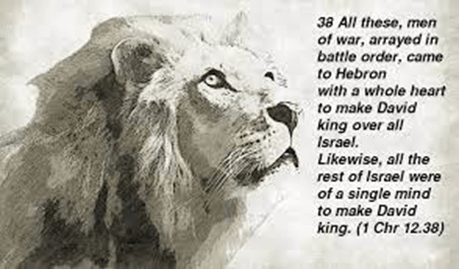
All these men of war, arrayed for battle, came to Hebron fully determined to make David king over all Israel. And all the rest of the Israelites were of one mind to make David king. They spent three days there eating and drinking with David, for their relatives had provided for them. And their neighbors from as far away as Issachar, Zebulun, and Naphtali came bringing food on donkeys, camels, mules, and oxen—abundant supplies of flour, fig cakes and raisin cakes, wine and oil, oxen and sheep. Indeed, there was joy in Israel.”

The longer Saul’s persecution of David continued, the more ridiculous it became and the more men deserted from Saul’s forces. Notice that many of the fiercest warriors who joined David were from Saul’s own tribe of Benjamin.  God was continuing to give David favor with the men of Israel; now look at the quality of the men joining David: archers using both the right and left hands to sling stones and shoot arrows; and they were Saul’s kinsmen from Benjamin; They were mighty men of valor, trained for battle, experts with the shield and spear, whose faces were like the faces of lions and who were as swift as gazelles on the mountains: These Gadites were army commanders, the least of whom was a match for a hundred, and the greatest for a thousand. These are the ones who crossed the Jordan in the first month when it was overflowing all its banks, and they put to flight all those in the valleys, both to the east and to the west.”

Recently, the term “bad ass” has come into use in America to indicate someone or something that is powerful and performs well. These guys who were joining David were definitely all bad asses, the best of the fighting men of all Israel! And these men were not merely over – muscled lunks; “they knew times and seasons and knew the best course for Israel to take.” God was moving in the hearts of the Israelites and they recognized that it was time to crown David as king.

APPLICATION: Have you ever realized that God’s timing is split – second? C.H. Spurgeon once wrote a sermon in which he said that when it was time for the Exodus of the Israelites from Egypt, nobody could delay their leaving for as much as a single second beyond the time of God’s choosing. Now God has ordered David to move to Hebron and has also moved in the hearts of all these battle – hardened soldiers so that they are gathered there to crown David as king over Israel. If these men have so much perception, why haven’t they gathered around David sooner? God has allowed these men to gather gradually, but now King Saul and his sons are dead. There is nobody left to rule Israel, apart from David. It’s time to bring in the man whom God has fitted for this day.

God knows how to throw parties! Look at all the men who turned up from all parts of Israel and the people who spontaneously provided for them. These men were all “of one mind to make David king.” Through the years, there would be many more celebrations in Israel, but this one was one of the best because God was moving in people’s hearts. But some day, God is going to throw a party that will put all other celebrations in the shade.

“Listen, I tell you a mystery: We will not all sleep, but we will all be changed—in a flash, in the twinkling of an eye, at the last trumpet. For the trumpet will sound, the dead will be raised imperishable, and we will be changed. For the perishable must clothe itself with the imperishable, and the mortal with immortality.When the perishable has been clothed with the imperishable, and the mortal with immortality, then the saying that is written will come true: “Death has been swallowed up in victory.

 “Where, O death, is your victory?
    Where, O death, is your sting?”

The sting of death is sin, and the power of sin is the law.But thanks be to God! He gives us the victory through our Lord Jesus Christ. Therefore, my dear brothers and sisters, stand firm. Let nothing move you. Always give yourselves fully to the work of the Lord, because you know that your labor in the Lord is not in vain.” (1 Corinthians 15:51 – 58)

When Jesus returns in glory as King of Kings and Lord of Lords, he will come in a cloud of blinding light with warrior angels to attend him. There will be no more death, no more sorrow, no more dark nights of the soul. Those men gathered in Hebron to crown David as king had a wonderful time, but their joy will pale in comparison with the joy of Jesus on the faces of those who love Him.

The men of Issachar knew times and seasons and knew the best course for Israel to take. Do we know the best course for our lives? Now is the time to believe on the Lord Jesus Christ! Now is the time for us to confess our sins and to acknowledge Jesus as our Lord and Savior. We can only act in the “now;” we have no other time promised to us. If the current pandemic has taught us little else, it should have taught us that any of us can sicken and die at any time. Don’t delay! Be like the men of Issachar and make right decisions. Follow Jesus!

PRAYER: Father God, thank You for loving us and for caring for us. Lord, help us to follow hard after You all the days of our lives. We do confess that we are sinners and that nothing we can do is good enough to pay for our sins. But we thank You for sending Jesus to die for us, so that we might have eternal life in heaven with You. Let all who read these words come to a saving knowledge of Your Grace. In the matchless Name of King Jesus. Amen.

SEPTEMBER 25, 2022 ANOTHER LOOK AT THE ISRAELITES PART 1 #14 1 CHRONICLES 11:10 – 47 ARE  THERE ANY MIGHTY MEN – OR MIGHTY WOMEN – LEFT?

September 25, 2022

David’s Mighty Men (2 Samuel 23:8–39)

Now these were the chiefs of David’s mighty men, who, together with all Israel, bolstered and strengthened his kingdom, according to the word of the LORD concerning Israel. This is the list of David’s mighty men: Jashobeam son of Hachmoni was chief of the officers; he wielded his spear against three hundred men, whom he killed at one time.

Next in command was Eleazar son of Dodo the Ahohite, one of the three mighty men. He was with David at Pas-dammim when the Philistines gathered there for battle. At the place with a field full of barley, the troops fled from the Philistines. But Eleazar and David stationed themselves in the middle of the field and defended it. They struck down the Philistines, and the LORD brought about a great victory.

Three of the thirty chief men went down to David, to the rock at the cave of Adullam, while a company of Philistines was encamped in the Valley of Rephaim. At that time David was in the stronghold, and the garrison of the Philistines was at Bethlehem. David longed for water and said, “Oh, that someone would get me a drink of water from the well near the gate of Bethlehem!”

So the Three broke through the Philistine camp, drew water from the well at the gate of Bethlehem, and brought it back to David. But he refused to drink it; instead, he poured it out to the LORD, saying, “Far be it from me, my God, to do this! How can I drink the blood of these men who risked their lives?” Because they had brought it at the risk of their lives, David refused to drink it.

Such were the exploits of the three mighty men. Now Abishai, the brother of Joab, was chief of the Three, and he lifted his spear against three hundred men, killed them, and won a name along with the Three. He was doubly honored above the Three, and he became their commander, even though he was not included among the Three.

And Benaiah son of Jehoiada was a man of valor from Kabzeel, a man of many exploits. He struck down two champions of Moab, and on a snowy day he went down into a pit and killed a lion. He also killed an Egyptian, a huge man five cubits tall. Although the Egyptian had a spear like a weaver’s beam in his hand, Benaiah went against him with a club, snatched the spear from his hand, and killed the Egyptian with his own spear. These were the exploits of Benaiah son of Jehoiada, who won a name alongside the three mighty men. He was most honored among the Thirty, but he did not become one of the Three. And David appointed him over his guard.

Now these were the mighty men: Asahel the brother of Joab, Elhanan son of Dodo of Bethlehem, Shammoth the Harorite, Helez the Pelonite, Ira son of Ikkesh the Tekoite, Abiezer the Anathothite, Sibbecai the Hushathite, Ilai the Ahohite, Maharai the Netophathite, Heled son of Baanah the Netophathite, Ithai j son of Ribai from Gibeah of the Benjamites, Benaiah the Pirathonite, Hurai from the brooks of Gaash, Abiel the Arbathite, Azmaveth the Baharumite, Eliahba the Shaalbonite, the sons of Hashem the Gizonite, Jonathan son of Shagee the Hararite, Ahiam son of Sachar the Hararite, Eliphal son of Ur, Hepher the Mecherathite, Ahijah the Pelonite, Hezro the Carmelite, Naarai son of Ezbai, Joel the brother of Nathan, Mibhar son of Hagri, Zelek the Ammonite, Naharai the Beerothite, the armor-bearer of Joab son of Zeruiah, Ira the Ithrite, Gareb the Ithrite, Uriah the Hittite, Zabad son of Ahlai, Adina son of Shiza the Reubenite, chief of the Reubenites, and the thirty with him, Hanan son of Maacah,

Joshaphat the Mithnite, Uzzia the Ashterathite, Shama and Jeiel the sons of Hotham the Aroerite, Jediael son of Shimri and his brother Joha the Tizite, Eliel the Mahavite, Jeribai and Joshaviah, the sons of Elnaam, Ithmah the Moabite, Eliel, Obed, and Jaasiel the Mezobaite.”

No man is an island, and no leader can function without faithful supporters. Read this list, really think about these exploits, and prepare to be amazed! There are the Three, who loved David so much that when David expressed a longing for a drink of water from the well in his home town of Bethlehem, these three men broke through the camp of the Philistines occupying the town, drew water from the well, and then fought their way back through the Philistine camp back to David. David was so moved by this act of love and devotion that he refused to drink the water but poured it out as an offering to the Lord instead.

Then there was Benaiah, son of Jehoiada, a real – life super hero. Not only did Benaiah kill two Moabite champions but he also took on a huge Egyptian bearing an enormous spear. Carrying only a club, Benaiah snatched the Egyptian’s spear away from him and killed him with it. Benaiah’s biggest achievement was taking on a lion in a pit on a snowy day. With nowhere to hide, Benaiah leaped into the pit and killed the lion, turning him into a rug!

One of the saddest pieces of information is the list of other mighty men. Notice that Uriah the Hittite is included in the list of mighty men. Yes, that’s the same man who was married to Bathsheba, the man whose death David would eventually arrange to cover up the results of his adultery. Uriah wasn’t just any old soldier; he was a true hero. But Uriah wound up being killed to cover up David’s sin. How tragic!

APPLICATION: We all need heroes and heroines! Whether we follow sports teams, entertainers, or movie heroes and heroines, we all want good men and women to conquer succeed and conquer evil. Recently, movies featuring super heroes and heroines have become incredibly popular.

If we are followers of Jesus, we are followers of the greatest super hero of all time. As the Son of God, Jesus could have remained in heaven where he was King, but he chose to live as a man. Jesus raised the dead, healed the sick, cast out demons, calmed storms on the Sea of Galilee, and even walked on water. But Jesus’ biggest achievement was when he laid down his life, shedding his innocent blood for the sins of the world. And having died in all innocence, Jesus then rose from the dead, proving conclusively that he was the master over death as well as life.

There is no fictional super hero or heroine who does not have some flaw. Superman, for example, loses his strength when exposed to Kryptonite. But for Jesus Christ, there is no such thing as Kryptonite. Jesus has defeated death and the grave once and for all. For those of us who believe in Jesus, He is our ultimate super hero and worthy of all our worship!

PRAYER: Father God, thank You for loving us and for caring for us. Lord, thank You for sending Jesus to save us from our sins. Help us to follow hard after You all the days of our lives. In the mighty and precious Name of King Jesus. Amen.

SEPTEMBER 24, 2022 ANOTHER LOOK AT THE ISRAELITES PART 1 #13 1 CHRONICLES 11:1 – 47 DON’T CHALLENGE A MAN WHOM GOD HAS CHOSEN!

September 24, 2022

1 Chronicles 11:1 – 17 “Then all Israel came together to David at Hebron and said, “Here we are, your own flesh and blood. Even in times past, while Saul was king, you were the one who led Israel out and brought them back. And the LORD your God said, ‘You will shepherd My people Israel, and you will be ruler over them.’ ” So all the elders of Israel came to the king at Hebron, where David made a covenant with them before the LORD. And they anointed him king over Israel, according to the word of the LORD through Samuel.

David Conquers Jerusalem (2 Samuel 5:6–11)

Then David and all the Israelites marched to Jerusalem (that is, Jebus), where the Jebusites inhabited the land. The people of Jebus said to David, “You will never get in here.” Nevertheless, David captured the fortress of Zion (that is, the City of David). Now David had said, “Whoever is the first to strike down a Jebusite will become chief commander.” And Joab son of Zeruiah went up first, and he became the chief. So David took up residence in the fortress; that is why it was called the City of David. He built up the city around it, from the supporting terraces to the surrounding wall, while Joab restored the rest of the city. And David became greater and greater, for the LORD of Hosts was with him.”

King David did not begin his reign in Jerusalem, but in Hebron, a city of refuge and one of the cities given to the priests. Hebron was also the city that old Caleb at age 85 took by slaughtering the giants who lived there. All of Israel came to David and proclaimed him as king, citing God’s promises to David. But Hebron was in the south of Israel, and God wanted the capital to be in Jerusalem, which was more centrally located.

The original name of Jerusalem was Jebus and the Jebusites lived there. You have to pity the Jebusites at least a little! The Jebusites were so certain that their city was impregnable that they issued a foolish challenge to David. 2 Samuel 5:6 – 10 tells the story. “Now the king and his men marched to Jerusalem against the Jebusites who inhabited the land. The Jebusites said to David: “You will never get in here. Even the blind and lame can repel you.” For they thought, “David cannot get in here.”

Nevertheless, David captured the fortress of Zion (that is, the City of David). On that day he said, “Whoever attacks the Jebusites must use the water shaft to reach the lame and blind who are despised by David.” That is why it is said, “The blind and the lame will never enter the palace.”

So David took up residence in the fortress and called it the City of David. He built it up all the way around, from the supporting terraces inward. And David became greater and greater, for the LORD God of Hosts was with him.”

Although we are more familiar with the famous water tunnel built by King Hezekiah, years later, the Jebusites already had a water shaft that brought water, perhaps from the Gihon spring, into their city. This water shaft gave the Jebusites confidence that they could easily out – last any siege as long as they had sufficient food stores to match their water supply. But the Jebusites failed to realize that their secret water shaft was well known to others, and it was the very thing on which the Jebusites were relying that led to the capture of their city.   

Did David really despise the blind and the lame? Absolutely not! Remember that later on, David sought out Jonathan’s lame son Mephibosheth and took special care of him for Jonathan’s sake. But when the Jebusites issued such a taunting challenge, David felt honor – bound to meet it.

Once in Jerusalem, David wasted no time in improving the fortifications and building up walls. The original city of David was on the east slopes of Mount Moriah, so supporting terraces were definitely necessary. But the key to David’s success was not his battle strategies but the fact that God was with him in everything he was doing.

APPLICATION: This part of David’s story is very appealing because it is early in David’s reign and he is still relying completely on God. It was God who directed David to begin his reign in the city of Hebron and it is now God who has given David and his men victory over the Jebusites. Strictly speaking, the Jebusites should never have existed at this point. When Joshua and his men were conquering Canaan, the Jebusites were one of the groups marked for destruction. The day the sun stood still for Joshua the king of Jerusalem was one of the five kings against whom Joshua was fighting. Allegedly Joshua and his men conquered the Jebusites…. However, no mention is ever made of their having conquered Jerusalem itself. Now Jerusalem has fallen to David and his forces, and this city that God has chosen since time began will now become the heart of Israel.

Those of us familiar with the rest of David’s story might read these words and sigh! We know that once David has established himself, his success goes to his head and that success serves to separate him from God. But as we are musing over David’s story, we should be careful to look at ourselves.

In the beginning, David was the neglected runt in a family of big strong handsome sons. David’s father Jesse thought so little of David that he sent David out to guard sheep and goats, exposing him to attack by lions and bears. Little did anyone realize that it was that very isolation that would cause David to turn to God in the stillness of the wilderness. It was the challenges from wild animals that forced David to learn how to fight well and to become strong. If you aren’t very big, you become an expert with a slingshot, and David was an expert! Little did David realize that every time he was aiming a stone at a lion or a bear, he was practicing for the day when he would take on Goliath and win!

The difference between King Saul and King David was that of entitlement. Saul felt entitled to his kingship, while David did not. David fully realized that only God could have chosen him, while Saul somehow believed that he deserved to be king. God tells us that David was a man after God’s own heart. Saul was not.  

Entitlement does nothing good for anybody! For those who feel entitled, sooner or later, life will hand them some horrible shocks. The worst form of entitlement is the fixed belief that if one is a “good person,” one will somehow automatically be accepted into heaven. St. Paul tells us in Romans 3:23 that “all have sinned and have fallen short of the glory of God.” All of us have a sin problem; this is why Jesus Christ had to live as a man and die a shameful death, shedding His innocent blood for the sins of the world. But forgiveness of sins is not automatic; we must truly believe that we are sinners and that we need that sacrifice for our salvation.

PRAYER: Father God, thank You for loving us and for caring for us. Lord, thank You for sending Jesus Christ to live as a sinless man and to shed His Blood to pay for our sins. Help us to realize that none of us is entitled to anything apart from the salvation that Jesus has purchased for us. Help us to follow hard after You all the days of our lives. In the matchless Name of King Jesus. Amen.

SEPTEMBER 23, 2022 ANOTHER LOOK AT THE ISRAELITES PART 1 #12 1 CHRONICLES 10:1 – 14 SAUL AND THE TRAGEDY OF SECOND – HAND FAITH

September 23, 2022

1 Chronicles 10:1 – 14 “Now the Philistines fought against Israel, and the men of Israel fled before them, and many fell slain on Mount Gilboa. The Philistines followed hard after Saul and his sons, and they killed Saul’s sons Jonathan, Abinadab, and Malchishua. When the battle intensified against Saul, the archers overtook him and wounded him.

Then Saul said to his armor-bearer, “Draw your sword and run it through me, or these uncircumcised men will come and torture me!” But his armor-bearer was terrified and refused to do it. So Saul took his own sword and fell on it. When his armor-bearer saw that Saul was dead, he too fell on his own sword and died. So Saul died together with his three sons and all his house.

The Philistines Possess the Towns (1 Samuel 31:7–10)

When all the Israelites in the valley saw that the army had fled and that Saul and his sons had died, they abandoned their cities and ran away. So the Philistines came and occupied their cities. The next day, when the Philistines came to strip the dead, they found Saul and his sons fallen on Mount Gilboa. They stripped Saul, cut off his head, took his armor, and sent messengers throughout the land of the Philistines to proclaim the news in the temple of their idols and among their people. They put his armor in the temple of their gods and hung his head in the temple of Dagon.

Jabesh-gilead’s Tribute to Saul (1 Samuel 31:11–13)

When the people of Jabesh-gilead heard about everything the Philistines had done to Saul, all their men of valor set out and retrieved the bodies of Saul and his sons and brought them to Jabesh. And they buried their bones under the oak in Jabesh and fasted seven days. So Saul died for his unfaithfulness to the LORD, because he did not keep the word of the LORD and even consulted a medium for guidance, and he failed to inquire of the LORD. So the LORD put him to death and turned the kingdom over to David son of Jesse.

The whole problem of kingship began because the Israelites rejected God as their king and demanded a human ruler. The prophet Samuel was horrified and distressed, but God told Samuel that the Israelites were not rejecting Samuel but rather rejecting God. God chose a warrior named Saul from the tribe of Benjamin, a tribe noted for its fierce warriors, to become king. Judging by appearances, Saul LOOKED like a king! Saul was tall, handsome, strong, and courageous. There was only one problem: Saul did not truly believe in the God of Israel but rather viewed God as some kind of oracle or good luck charm. Despite the fact that God chose Saul to be king, Saul never actually prayed or sought to know God for himself but depended on Samuel. Saul became a victim of his refusal to believe for himself. Second – hand faith is no faith!

Saul’s military career was one of successes interspersed with mess – ups. When Samuel ordered Saul to wait at Gilgal until Samuel arrived to make sacrifices, Saul only waited until people began to get restless and then “felt compelled” to make the sacrifices himself. God had appointed Samuel as a prophet and Samuel also served priestly functions in addition because of God’s anointing. But Saul had no such calling from God, nor had God appointed him to make sacrifices. This incident marked Saul’s first major mistake. Then God ordered Saul to completely destroy the Amalekites; however, again Saul failed to obey. At that point, Samuel told Saul that God had rejected Saul from being king and that God was giving the kingship to a man who would honor Him. That man was David, the youngest son of Jesse from the tribe of Judah.

Once Saul realized that David was to be his successor, Saul did everything he could to kill David. Despite all Saul’s schemes, Saul’s son Jonathan and David became fast friends. The longer Saul’s persecution of David persisted, the more evident it became that Saul’s reign was going to end. Eventually, Samuel died, leaving Saul with nobody who would give Saul the world of the Lord. Saul’s last mistake was to consult a female medium, even though he himself had banished mediums from the kingdom. When the woman succeeded in summoning the spirit of Samuel, Samuel told Saul that Saul and his sons would die the next day. This prediction came true.

The next day, Saul and his sons fought a hot battle against the Philistines on Mount Gilboa. With all three sons dead and blood pouring from numerous arrow wounds, Saul fell on his sword and died rather than allow the Philistines to capture him. Saul’s armor bearer did the same. The Israelite army ran away, and those living in surrounding cities also evacuated to avoid being slaughtered by the Philistines.

When the Philistines found the bodies of Saul and his sons, they cut off Saul’s head, stripping off his armor and hung both the head and the armor in the temple of Dagon. Brave men from Jabesh – gilead came to Mount Gilboa, collected the bodies of Saul and his sons, and sent them back to Jabesh, where they buried the bones under an oak tree that was a local landmark. Then the people of Jabesh mourned and fasted for seven days. Part of the reason for this fast was to honor Saul, but also the men who had handled the bodies were ritually unclean and needed to cleanse themselves. Ezra’s final comment on Saul was, “So Saul died for his unfaithfulness to the LORD, because he did not keep the word of the LORD and even consulted a medium for guidance, and he failed to inquire of the LORD. So the LORD put him to death and turned the kingdom over to David son of Jesse.

APPLICATION: What happened to Saul? Saul felt entitled! Saul assumed that being big and strong and handsome and brave was enough for God. Not once did Saul ever beg Samuel to instruct him in the ways of God. Despite the fact that God had ordered that any kings of Israel should make their own copies of the Law and study those copies for themselves, Saul never did it. Saul was great at taking charge but lousy at taking orders or being obedient. As long as things went well, Saul was fine. But whenever there was pressure from popular opinion, Saul would cave.

Several years ago, there was a famous American football player named O. J. Simpson. In the beginning, Simpson was fabulously successful as an athlete and moderately successful as an actor. Simpson’s mother was a strong Christian and had raised Simpson as a believer. But later in Simpson’s career, he lost his focus. Finally, Simpson’s beautiful wife was murdered, and it was unclear whether or not Simpson was responsible. A life with so much promise was now in ruins. What happened? Two contributing factors may have been a sense of entitlement engendered by early success, plus a failure to remain close to God.

There are very few of us who can actually handle success in a godly fashion. So many times, we lose sight of God and begin to trust in ourselves, failing to remember that it was God who brought us success in the first place. Spiritually, the only safe place for any of us to be is to get as close to God as possible. One dear friend who is now with Jesus used to pray, “Lord, help me love you more today than I did yesterday.” That’s a great prayer for all of us!

PRAYER: Father God, thank You for loving us and for caring for us. Lord, help us to follow You and not ourselves! Help us to remember that You are our Source of light and life and love. Please help us to love You more each day than we did the day before.  In the mighty and precious Name of King Jesus. Amen.

SEPTEMBER 22, 2022 ANOTHER LOOK AT THE ISRAELITES PART 1 #11 1 CHRONICLES 9:1 – 44 HOW WELL DO YOU WORK WHEN NOBODY IS WATCHING?

September 22, 2022

1 Chronicles 9:1 – 44 “So all Israel was recorded in the genealogies written in the Book of the Kings of Israel. But Judah was exiled to Babylon because of their unfaithfulness.

Now the first to resettle their own property in their cities were Israelites, priests, Levites, and temple servants.

These were some of the descendants of Judah, Benjamin, Ephraim, and Manasseh who lived in Jerusalem: Uthai son of Ammihud, the son of Omri, the son of Imri, the son of Bani, a descendant of Perez son of Judah. From the Shilonites: Asaiah the firstborn and his sons. From the Zerahites: Jeuel and 690 relatives. From the Benjamites: Sallu son of Meshullam, the son of Hodaviah, the son of Hassenuah; Ibneiah son of Jeroham; Elah son of Uzzi, the son of Michri; Meshullam son of Shephatiah, the son of Reuel, the son of Ibnijah; and 956 of their relatives according to their genealogy. All these men were heads of their families.

From the priests: Jedaiah, Jehoiarib, and Jachin; Azariah son of Hilkiah, the son of Meshullam, the son of Zadok, the son of Meraioth, the son of Ahitub, the chief official of God’s temple; Adaiah son of Jeroham, the son of Pashhur, the son of Malchijah; Maasai son of Adiel, the son of Jahzerah, the son of Meshullam, the son of Meshillemith, the son of Immer; and 1,760 of their relatives, the heads of their families, able men for the work of the service of the house of God.

From the Levites: Shemaiah son of Hasshub, the son of Azrikam, the son of Hashabiah, a descendant of Merari;

Bakbakkar, Heresh, Galal, and Mattaniah son of Mica, the son of Zichri, the son of Asaph; Obadiah son of Shemaiah, the son of Galal, the son of Jeduthun; and Berechiah son of Asa, the son of Elkanah, who lived in the villages of the Netophathites.

These were the gatekeepers: Shallum, Akkub, Talmon, Ahiman, and their relatives. Shallum was their chief; he was previously stationed at the King’s Gate on the east side. These were the gatekeepers from the camp of the Levites. Shallum son of Kore, the son of Ebiasaph, the son of Korah, and his relatives from the Korahites were assigned to guard the thresholds of the Tent, just as their fathers had been assigned to guard the entrance to the dwelling of the LORD.

In earlier times Phinehas son of Eleazar had been in charge of the gatekeepers, and the LORD was with him. Zechariah son of Meshelemiah was the gatekeeper at the entrance to the Tent of Meeting. The number of those chosen to be gatekeepers at the thresholds was 212. They were registered by genealogy in their villages. David and Samuel the seer had appointed them to their positions of trust. So they and their descendants were assigned to guard the gates of the house of the LORD—the house called the Tent. The gatekeepers were stationed on the four sides: east, west, north, and south. Their relatives came from their villages at fixed times to serve with them for seven-day periods. But the four chief gatekeepers, who were Levites, were entrusted with the rooms and the treasuries of the house of God. They would spend the night stationed around the house of God, because they were responsible for guarding it and opening it every morning. Some of them were in charge of the articles used in worship, to count them whenever they were brought in or taken out. Others were put in charge of the furnishings and other articles of the sanctuary, as well as the fine flour, wine, oil, frankincense, and spices. And some of the sons of the priests mixed the spices.

A Levite named Mattithiah, the firstborn son of Shallum the Korahite, was entrusted with baking the bread. Some of their Kohathite brothers were responsible for preparing the rows of the showbread every Sabbath.

Those who were musicians, the heads of Levite families, stayed in the temple chambers and were exempt from other duties because they were on duty day and night. All these were heads of Levite families, chiefs according to their genealogies, and they lived in Jerusalem.

The Descendants of Saul

Jeiel the father of Gibeon lived in Gibeon. His wife’s name was Maacah. Abdon was his firstborn son, then Zur, Kish, Baal, Ner, Nadab, Gedor, Ahio, Zechariah, and Mikloth. Mikloth was the father of Shimeam. They too lived alongside their relatives in Jerusalem. Ner was the father of Kish, Kish was the father of Saul, and Saul was the father of Jonathan, Malchishua, Abinadab, and Esh-baal. The son of Jonathan: Merib-baal, who was the father of Micah. The sons of Micah: Pithon, Melech, Tahrea, and Ahaz. Ahaz was the father of Jarah; Jarah was the father of Alemeth, Azmaveth, and Zimri; and Zimri was the father of Moza. Moza was the father of Binea. Rephaiah was his son, Elasah his son, and Azel his son. And Azel had six sons, and these were their names: Azrikam, Bocheru, Ishmael, Sheariah, Obadiah, and Hanan. These were the sons of Azel.

It’s likely that Chronicles 1 and 2 were originally one book compiled by Ezra, who led the first group of Israelites back from Babylon to resettle Jerusalem. The ten tribes comprising the Northern Kingdom of Israel were carried off into captivity by the Assyrians. Later, the kingdom of Judah was captured by the Babylonians and many of its citizens taken to Nineveh. But in 559 B.C., something miraculous occurred.

“In the first year of Cyrus king of Persia, to fulfill the word of the LORD spoken through Jeremiah, the LORD stirred the spirit of Cyrus king of Persia to send a proclamation throughout his kingdom and to put it in writing as follows: “This is what Cyrus king of Persia says: ‘The LORD, the God of heaven, who has given me all the kingdoms of the earth, has appointed me to build a house for Him at Jerusalem in Judah. Whoever among you belongs to His people, may his God be with him, and may he go to Jerusalem in Judah and build the house of the LORD, the God of Israel; He is the God who is in Jerusalem. And let every survivor, wherever he lives, be assisted by the men of that region with silver, gold, goods, and livestock, along with a freewill offering for the house of God in Jerusalem.’ ” So the family heads of Judah and Benjamin, along with the priests and Levites—everyone whose spirit God had stirred—prepared to go up and rebuild the house of the LORD in Jerusalem. And all their neighbors supported them with articles of silver and gold, with goods and livestock, and with valuables, in addition to all their freewill offerings.” (Ezra 1:1 – 6)

Led by Ezra, a large group of Jews did move back to Jerusalem. But how were things to be re – structured? It wasn’t simply a question of rebuilding houses and the temple; there were the duties of the priests and Levites to be re – instituted. 1 Chronicles 9 indicates those who returned to Jerusalem and describes their duties – gatekeepers, bakers, musicians, and other temple servants. The comments about these people are fascinating. The head gatekeepers also kept track of the temple treasury and were accountable for defending it. One man was singled out to bake the showbread, presumably because his skills were exemplary. Others were tasked with arranging the showbread.

Notice that the musicians stayed in the temple complex and were exempt from other duties because they were on duty day and night. Psalm 134:1 says, “Come, bless the LORD, all you servants of the LORD who serve by night in the house of the LORD!” Anyone who has ever led worship knows that it’s much easier to keep going when you have an audience. Those who conducted worship at night had an audience of One, the One True Living God.

APPLICATION: Why would Ezra list all those working in the new and much smaller temple in Jerusalem? Even though Solomon’s temple lay in ruins, worship still needed to continue. For Ezra and all those who accompanied him, their focus had to be on God and not on externals; otherwise, they would have become completely disheartened. Ezra’s lists were both ways of keeping track of everyone and also a means of encouraging the priests and Levites to be diligent in their work. Just because these people had returned to Jerusalem did not automatically guarantee that they would fulfill their assignments properly. As a matter of fact, once Ezra was no longer around, work on the temple stopped and people began building their own houses, settling farms, etc. It was this gloomy news that caused Nehemiah to beg leave and to come to Jerusalem, where he carried out further reforms.

Every supervisor knows that there are those who can be trusted to work without being closely monitored and there are those who must be watched constantly. If we are followers of the One True Living God, then everything we do should be done for His glory. No task is too menial to be dedicated to God. What is our motivation for working? Do we work as steadily without an audience as we do when someone is watching? Remember those temple musicians; they were exempt from other duties, but only because they were on duty 24/7. As believers, so are we.

PRAYER: Father God, thank You for loving us and for caring for us. Lord, help us to fulfill Your Call on our lives, whether or not we have a human audience, knowing that You are the One for whom we work. In the mighty and precious Name of King Jesus. Amen.

SEPTEMBER 21, 2022 ANOTHER LOOK AT THE ISRAELITES PART 1 #10 1 CHRONICLES 8:1 – 40 THE FAMILY OF BENJAMIN – HOW TO LOSE A KINGDOM!

September 21, 2022

1 Chronicles 8:1 – 40 “Benjamin was the father of Bela, his firstborn; Ashbel was the second born, Aharah the third, Nohah the fourth, and Rapha the fifth. The sons of Bela: Addar, Gera, Abihud, Abishua, Naaman, Ahoah, Gera, Shephuphan, and Huram.

These were the descendants of Ehud who were the heads of the families living in Geba and were exiled to Manahath: Naaman, Ahijah, and Gera, who carried them into exile and who was the father of Uzza and Ahihud. Shaharaim had sons in the country of Moab after he had divorced his wives Hushim and Baara. His sons by his wife Hodesh: Jobab, Zibia, Mesha, Malcam, Jeuz, Sachia, and Mirmah. These were his sons, heads of families. He also had sons by Hushim: Abitub and Elpaal.

The sons of Elpaal: Eber, Misham, Shemed (who built Ono and Lod with its villages), and Beriah and Shema (who were the heads of families of the inhabitants of Aijalon and who drove out the inhabitants of Gath). Ahio, Shashak, Jeremoth, Zebadiah, Arad, Eder, Michael, Ishpah, and Joha were the sons of Beriah.

Zebadiah, Meshullam, Hizki, Heber, Ishmerai, Izliah, and Jobab were the sons of Elpaal.

Jakim, Zichri, Zabdi Elienai, Zillethai, Eliel, Adaiah, Beraiah, and Shimrath were the sons of Shimei. Ishpan, Eber, Eliel, Abdon, Zichri, Hanan, Hananiah, Elam, Anthothijah, Iphdeiah, and Penuel were the sons of Shashak.  Shamsherai, Shehariah, Athaliah, Jaareshiah, Elijah, and Zichri were the sons of Jeroham.

All these were heads of families, the chiefs according to their genealogies, and they lived in Jerusalem. Jeiel the father of Gibeon lived in Gibeon. His wife’s name was Maacah, and Abdon was his firstborn son, then Zur, Kish, Baal, Nadab, Gedor, Ahio, Zecher, and Mikloth, who was the father of Shimeah.These also lived alongside their relatives in Jerusalem.

The Family of Saul

Ner was the father of Kish, Kish was the father of Saul, and Saul was the father of Jonathan, Malchishua, Abinadab, and Esh-baal.

The son of Jonathan: Merib-baal, and Merib-baal was the father of Micah. The sons of Micah: Pithon, Melech, Tarea, and Ahaz. Ahaz was the father of Jehoaddah, Jehoaddah was the father of Alemeth, Azmaveth, and Zimri, and Zimri was the father of Moza. Moza was the father of Binea. Raphah l was his son, Eleasah his son, and Azel his son. Azel had six sons, and these were their names: Azrikam, Bocheru, Ishmael, Sheariah, Obadiah, and Hanan. All these were the sons of Azel. The sons of his brother Eshek: Ulam was his firstborn, Jeush second, and Eliphelet third. The sons of Ulam were mighty men of valor, archers, and they had many sons and grandsons—150 in all.

All these were the descendants of Benjamin.”

 Tribe of Benjamin Genesis 49:27 ““Benjamin is a ravenous wolf; in the morning he devours the prey, in the evening he divides the plunder.”

Who was the tribe of Benjamin? The site https://study.com/learn/lesson/tribe-of-bejamin.html tells us this: Despite Rachel’s repeated issues with conception, she eventually gave birth to two sons. The first, Joseph, was Jacob’s favorite child, leading Jacob’s other sons to fake his death and sell him into Egyptian slavery. The second of Rachel’s sons was Benjamin. She was ill during her pregnancy with Benjamin, perhaps because of her advanced age, and died while giving birth to him. Because of her distress, she wanted to name her son ”Ben-oni,” meaning ”son of sorrow.” Jacob, wanting to ensure his son was not fated with an ill omen, chose the name ”Ben Yamin,” (Anglicized as ”Benjamin”), which means ”son of the South” or ”son of the right hand.” Although Jacob’s favorite son was Joseph, it was fairly evident that his second favorite son was Benjamin–probably because they were the two sons of his favorite wife.

 Tribe of Benjamin Genesis 49:27 ““Benjamin is a ravenous wolf; in the morning he devours the prey, in the evening he divides the plunder.” JACOB’S BLESSING

The Book of Genesis ends with Jacob blessing his 12 sons from his death bed, each becoming the head of one of the 12 tribes of Israel. After the Israelites conquered the area, each of the 12 tribes was granted an area of land in Canaan, the region on the eastern coast of the Mediterranean Sea. In the Book of Joshua in the Hebrew Bible, the Tribe of Benjamin is granted the region stretching from the Jordan River in the east right above the Dead Sea to the city of Bethel in the northwest and Jerusalem in the south.

The Benjamite territory contained major significant cities, such as Jericho and Jerusalem. The region was an ideal space for religious, trade, and agricultural purposes. Jerusalem was the holy city that, according to the Jewish tradition, was where the Jewish god Yahweh spared Isaac from being sacrificed by his father; it later became the site of the Temple and the location of the king’s palace. Though Benjamite territory was small, it was located between two of the largest territories: Ephraim, to the north, and Judah, to the south. As the tribe of the later kingship, Judah was a vast and prosperous territory that contained many of the significant cities and events of the Bible. The Tribe of Benjamin’s location bordering these areas as well as directly on the Jordan River and Dead Sea gave Benjamites vast opportunity for trade. The waterways made this territory ideal for agriculture on the eastern edge, and the mountains that cut through the middle of the region provided protection from enemies.

The tribe is best known for its warrior-like people who were skilled in archery, slinging rocks, and left-handed fighting. The tribe also controlled the major city of Jerusalem early in Jewish history and produced the first king, Saul, of the United Kingdom of Israel. Later, the Benjamites united with the Judahites to control the Southern Kingdom of Judah, and most modern-day Jews are descended from one of these tribes.”

APPLICATION: The tribe of Benjamin was small but very fierce! Tangling with someone from Benjamin would be like tangling with a buzz saw – not something recommended if you wanted to survive. God selected Saul to become the first king of Israel because Saul was a big strong warrior and he looked like a king. Saul had the chance to start a dynasty that might have ruled Israel for centuries, if only Saul had been patient. But when the Prophet Samuel warned Saul to wait for him before making any sacrifices, Saul panicked. 1 Samuel 13 tells us that Saul waited at Gilgal for seven days and when Samuel failed to appear and the people were threatening to scatter, Saul forced and made a sacrifice. Almost as soon as Saul had finished, Samuel appeared.

1 Samuel 13:13 – 14 “You have done a foolish thing,” Samuel said. “You have not kept the command the Lord your God gave you; if you had, he would have established your kingdom over Israel for all time. But now your kingdom will not endure; the Lord has sought out a man after his own heart and appointed him ruler of his people, because you have not kept the Lord’s command.”

The tribe of Benjamin might have been celebrated as the tribe of royalty. But when everything was on the line, Saul choked up and made a tragic mistake. Because of Saul’s failure, God chose David and the tribe of Judah to rule. Benjamin did continue to play a very important role in the Southern Kingdom, and when the Babylonians carried off the people of the nation of Judah, it was people from Judah and Benjamin who returned with Ezra and Nehemiah to rebuild Jerusalem.

What kind of heritage are we leaving our descendants? Will our children and grandchildren remember us as people of faith, people of virtue, and people of courage, or will they remember us as something less?

Find Us Faithful Steve Green

  1. We’re pilgrims on the journey of the narrow road,
    And those who’ve gone before us line the way.
    Cheering on the faithful, encouraging the weary,
    Their lives a stirring testament to god’s sustaining grace.
  2. Surrounded by so great a cloud of witnesses,
    Let us run the race not only for the prize,
    But as those who’ve gone before us. let us leave to those behind us,
    The heritage of faithfulness passed on thru godly lives.
  3. After all our hopes and dreams have come and gone,
    And our children sift thru all we’ve left behind,
    May the clues that they discover, and the mem’ries they uncover,
    Become the light that leads them, to the road we each must find.

Chorus: O may all who come behind us find us faithful,
May the fire of our devotion
light their way.
May the footprints that we leave,
lead them to believe,
And the lives we live
Inspire them to obey.
O may all who come behind us
find us faithful.

PRAYER: Father God, thank You for loving us and for caring for us. Lord, help us to follow hard after You all the days of our lives and to teach our children as well. Help us to remember that others are always watching us and taking their cues from our actions. Help us to reflect Your glory. In the mighty and precious Name of King Jesus. Amen.