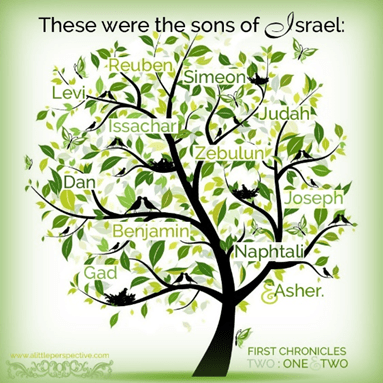
1 Chronicles 1:1 – 54 “Adam, Seth, Enosh, Kenan, Mahalalel, Jared, Enoch, Methuselah, Lamech. The sons of Noah: Shem, Ham, and Japheth. The sons of Japheth: Gomer, Magog, Madai, Javan, Tubal, Meshech, and Tiras.
The sons of Gomer: Ashkenaz, Riphath, and Togarmah. And the sons of Javan: Elishah, Tarshish, the Kittites, and the Rodanites.
The sons of Ham: Cush, Mizraim, Put, and Canaan.
The sons of Cush: Seba, Havilah, Sabta, Raamah, and Sabteca. The sons of Raamah: Sheba and Dedan. Cush was the father of Nimrod, who began to be a mighty one on the earth.
Mizraim was the father of the Ludites, the Anamites, the Lehabites, the Naphtuhites, the Pathrusites, the Casluhites (from whom the Philistines came), and the Caphtorites.
And Canaan was the father of Sidon his firstborn, and of the Hittites, the Jebusites, the Amorites, the Girgashites, the Hivites, the Arkites, the Sinites, the Arvadites, the Zemarites, and the Hamathites.
The sons of Shem: Elam, Asshur, Arphaxad, Lud, and Aram. The sons of Aram: Uz, Hul, Gether, and Meshech. Arphaxad was the father of Shelah, and Shelah was the father of Eber. Two sons were born to Eber: One was named Peleg, because in his days the earth was divided, and his brother was named Joktan. And Joktan was the father of Almodad, Sheleph, Hazarmaveth, Jerah, Hadoram, Uzal, Diklah, Obal, Abimael, Sheba, Ophir, Havilah, and Jobab. All these were sons of Joktan.
So from Shem came Arphaxad, Shelah, Eber, Peleg, Reu, Serug, Nahor, Terah, and Abram (that is, Abraham).
The Descendants of Abraham (Genesis 25:12–18)
The sons of Abraham were Isaac and Ishmael. These are their genealogies: Nebaioth the firstborn of Ishmael, then Kedar, Adbeel, Mibsam, Mishma, Dumah, Massa, Hadad, Tema, Jetur, Naphish, and Kedemah. These were the sons of Ishmael.
The sons born to Keturah, Abraham’s concubine: Zimran, Jokshan, Medan, Midian, Ishbak, and Shuah. The sons of Jokshan: Sheba and Dedan. The sons of Midian: Ephah, Epher, Hanoch, Abida, and Eldaah. All of these were Keturah’s sons.
Abraham was the father of Isaac. The sons of Isaac: Esau and Israel.
The Descendants of Esau (Genesis 36:1–19)
The sons of Esau: Eliphaz, Reuel, Jeush, Jalam, and Korah. The sons of Eliphaz: Teman, Omar, Zepho, Gatam, and Kenaz; and by Timna, Amalek. The sons of Reuel: Nahath, Zerah, Shammah, and Mizzah.
The Descendants of Seir (Genesis 36:20–30)
The sons of Seir: Lotan, Shobal, Zibeon, Anah, Dishon, Ezer, and Dishan. The sons of Lotan: Hori and Homam. Timna was Lotan’s sister. The sons of Shobal: Alvan, Manahath, Ebal, Shepho, and Onam.
The sons of Zibeon: Aiah and Anah. The son of Anah: Dishon. The sons of Dishon: Hemdan, r Eshban, Ithran, and Cheran. The sons of Ezer: Bilhan, Zaavan, and Akan. The sons of Dishan: Uz and Aran.
The Kings of Edom (Genesis 36:31–43)
These are the kings who reigned in the land of Edom before any king reigned over the Israelites: Bela son of Beor. His city was named Dinhabah. When Bela died, Jobab son of Zerah from Bozrah reigned in his place. When Jobab died, Husham from the land of the Temanites reigned in his place. When Husham died, Hadad son of Bedad, who defeated Midian in the country of Moab, reigned in his place. And the name of his city was Avith. When Hadad died, Samlah from Masrekah reigned in his place. When Samlah died, Shaul from Rehoboth on the Euphrates u reigned in his place. When Shaul died, Baal-hanan son of Achbor reigned in his place. When Baal-hanan died, Hadad reigned in his place. His city was named Pau, and his wife’s name was Mehetabel daughter of Matred, the daughter of Me-zahab. Then Hadad died. Now the chiefs of Edom were Timna, Alvah, Jetheth, Oholibamah, Elah, Pinon, Kenaz, Teman, Mibzar, Magdiel, and Iram. These were the chiefs of Edom.”
WHEW! If you are tired after slogging through all these names, you are not alone! Reading nothing but genealogies seems like a waste of time and many of us are tempted to rush through these lists, perhaps looking for a few familiar names and leaving the rest. What is the point of having all these lists anyway?
Oral genealogies are one means for people to maintain a heritage. Go to many small towns, particularly in the American South, and people can recite the generations of their families all the way back to the time when their families came to America. If you go to Africa, Asia, or the Middle East, these lists might be far longer. When Alex Haley wrote his landmark book Roots: The Saga of an American Family, he went back to the Gambia, where his ancestor was from originally. Haley consulted local men known as griots. “A griot is a West African storyteller, singer, musician, and oral historian. They train to excel as orators, lyricists and musicians. The griot keeps records of all the births, deaths, marriages through the generations of the village or family.” (https://www.seckoukeita.com/my-culture#:~:text=A%20griot%20is%20a%20West,of%20the%20village%20or%20family.
Using the fictional name Kunta Kinte for a real ancestor, Haley was able to trace his roots from the village of Jufureh, where Haley’s ancestor was born, to Kunta Kinte Island, the site of the slave fort from which slaves were taken to America. (The island was originally named James Island but was re-named Kunta Kinte Island in 2011 and is a UNESCO World Heritage site.)
Haley’s book sparked a revolution as many African Americans began investigating their own families. Despite the destruction of many records, families managed to maintain this information by oral traditions handed down through generations.
The desire to claim one’s heritage is by no means limited to one group of people. In Scotland, the term “Mc” or “Mac” refers to one’s lineage. In Ireland, the “O” as in “O’ Neil” serves a similar purpose. Examples exist throughout the world. Such names emphasize that we exist as real people, as individuals, and that we are persons of significance.
The lists in the first few chapters of 1 Chronicles serve to explain who the Jews are and where they have come from, as well as the origins of the neighboring tribes. What else is important about these lists?
God knows all our names! Many times, we wonder if we matter to anyone apart from our families and friends. But these lists are proof positive that we matter to God; after all, look at all the otherwise obscure people whose names appear on these lists. And if God knows our names, then God knows everything else about us as well. We don’t have to agonize about our significance; we matter to God! Our fingerprints, our DNA, everything about us is unique. Anyone who follows CSI programs on TV knows that DNA tracing has now become a very big deal because of its specificity. These days, prisoners who have been falsely accused are being freed when evidence is reviewed and DNA testing is carried out.
If we matter so much to God, why don’t we worship and praise Him? Why not follow the One who knows us better than we know ourselves?
PRAYER: Father God, thank You for loving us and for caring for us. Lord, help us to realize how very much You do care and how much You have done for us. You have given us life and breath. You continue to sustain us. Lord, thank You for all that You do! Help us to worship You in spirit and in truth. In the matchless Name of King Jesus. Amen.
 Burunche's Blog
Leave a comment