1 Chronicles 4:1 – 42 “The descendants of Judah: Perez, Hezron, Carmi, Hur, and Shobal. Reaiah son of Shobal was the father of Jahath, and Jahath was the father of Ahumai and Lahad. These were the clans of the Zorathites.
These were the sons of Etam: Jezreel, Ishma, and Idbash. And their sister was named Hazzelelponi. Penuel was the father of Gedor, and Ezer was the father of Hushah.
These were the descendants of Hur, the firstborn of Ephrathah and the father of Bethlehem. Ashhur the father of Tekoa had two wives, Helah and Naarah. Naarah bore to him Ahuzzam, Hepher, Temeni, and Haahashtari. These were the descendants of Naarah. The sons of Helah were Zereth, Zohar, Ethnan, and Koz, who was the father of Anub and Zobebah and of the clans of Aharhel son of Harum.
The Prayer of Jabez
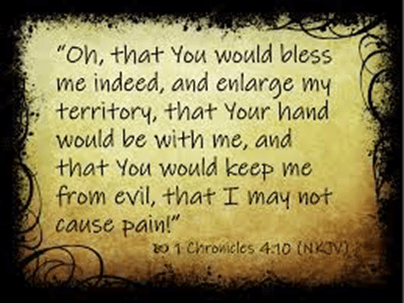
Now Jabez was more honorable than his brothers. His mother had named him Jabez, (meaning “pain” or “distress”) saying, “Because I bore him in pain.” And Jabez called out to the God of Israel, “If only You would bless me and enlarge my territory! May Your hand be with me and keep me from harm, so that I will be free from pain.” (Other versions say, “So that I might not cause pain.”) And God granted the request of Jabez.
More Descendants of Judah
Chelub the brother of Shuhah was the father of Mehir, who was the father of Eshton. Eshton was the father of Beth-rapha, of Paseah, and of Tehinnah the father of Ir-nahash. These were the men of Recah. The sons of Kenaz:
Othniel and Seraiah. The sons of Othniel: Hathath and Meonothai. Meonothai was the father of Ophrah, and Seraiah was the father of Joab, the father of those living in Ge-harashim, which was given this name because its people were craftsmen. (This name means “Valley of craftsmen.”)
The sons of Caleb son of Jephunneh: Iru, Elah, and Naam. The son of Elah: Kenaz. The sons of Jehallelel: Ziph, Ziphah, Tiria, and Asarel. The sons of Ezrah: Jether, Mered, Epher, and Jalon. And Mered’s wife Bithiah gave birth to Miriam, Shammai, and Ishbah the father of Eshtemoa. These were the children of Pharaoh’s daughter Bithiah.
Mered also took a Judean wife, who gave birth to Jered the father of Gedor, Heber the father of Soco, and Jekuthiel the father of Zanoah.
The sons of Hodiah’s wife, the sister of Naham, were the fathers of Keilah the Garmite and of Eshtemoa the Maacathite. The sons of Shimon: Amnon, Rinnah, Ben-hanan, and Tilon.
The descendants of Ishi: Zoheth and Ben-zoheth. The sons of Shelah son of Judah: Er the father of Lecah, Laadah the father of Mareshah and the clans of the linen workers at Beth-ashbea, Jokim, the men of Cozeba, and Joash and Saraph, who ruled in Moab and Jashubi-lehem. (These names are from ancient records.) These were the potters who lived at Netaim and Gederah. They lived there in the service of the king.
The Descendants of Simeon
The descendants of Simeon: Nemuel, Jamin, Jarib, Zerah, and Shaul. The sons of Shaul: Shallum, Mibsam, and Mishma. The sons of Mishma: Hammuel, Zaccur, and Shimei. Shimei had sixteen sons and six daughters, but his brothers did not have many children, so their whole clan did not become as numerous as the sons of Judah. They lived in Beersheba, Moladah, Hazar-shual, Bilhah, Ezem, Tolad, Bethuel, Hormah, Ziklag, Beth-marcaboth, Hazar-susim, Beth-biri, and Shaaraim. These were their cities until the reign of David. And their villages were Etam, Ain, Rimmon, Tochen, and Ashan—five towns— and all their surrounding villages as far as Baal. These were their settlements, and they kept a genealogical record:
Meshobab, Jamlech, Joshah son of Amaziah, Joel, Jehu son of Joshibiah (son of Seraiah, son of Asiel), Elioenai, Jaakobah, Jeshohaiah, Asaiah, Adiel, Jesimiel, Benaiah, and Ziza son of Shiphi (son of Allon, son of Jedaiah, son of Shimri, son of Shemaiah).
These men listed by name were the leaders of their clans. Their families increased greatly, and they journeyed to the entrance of Gedor, to the east side of the valley, in search of pasture for their flocks. There they found rich, good pasture, and the land was spacious, peaceful, and quiet; for some Hamites had lived there formerly.
These who were noted by name came in the days of Hezekiah king of Judah. They attacked the Hamites and Meunites there in their dwellings, devoting them to destruction even to this day. Then they settled in their place, because there was pasture for their flocks. And five hundred of these Simeonites led by Pelatiah, Neariah, Rephaiah, and Uzziel, the sons of Ishi, went to Mount Seir and struck down the remnant of the Amalekites who had escaped. And they have lived there to this day.
So many names! So many families! Reading these lists can make you feel as if you are being stoned to death with popcorn or choked with trivia. But right in the midst of all this stuff, there is a wonderful gem, the Prayer of Jabez. This prayer has been translated two different ways with two very different meanings. First of all, consider the name “Jabez.” This name sounds very much like the Hebrew term for pain or distress, indicating that this man’s mother must have suffered greatly while giving birth to him. Names are critically important! Why did Jabez’s mother give him such a horrible name? Was Jabez an unusually big baby or did he have a face presentation or a breach presentation, making delivery difficult? Did Jabez’s mother blame this innocent baby for her suffering?
The Prayer of Jabez has been variously translated in these two fashions: “If only You would bless me and enlarge my territory! May Your hand be with me and keep me from harm, so that I will be free from pain.” OR “If only You would bless me and enlarge my territory! May Your hand be with me and keep me from harm, so that I will not cause pain.” If we accept the first translation, we must consider that Jabez feared he would spend his life in pain because of his name. In giving such a name, Jabez’s mother was actually cursing him from the day she named him because she resented him for causing her pain and wished that Jabez would have pain for the rest of his life!
The alternative translation is also a good one. Having caused so much pain to his mother during his birth, Jabez is now begging God to help him so that he will not cause pain to others. While there is nothing wrong with asking God to enlarge our territories, we must consider the means by which that will happen. What should “enlarging my territory” look like? If God is in the doing, then God can enlarge your sphere of influence without causing pain to the innocent. But you cannot pray this prayer if you are demanding that you be protected from all suffering while others must suffer at your expense.
APPLICATION: What’s in a name? Quite a lot, as it turns out. When girls are named Grace or Joy, their parents are obviously wishing these attributes for them. Boys are frequently named for fathers or grandfathers with strong names such as John or James. Christian parents frequently name their children after beloved saints. Among the tribes in Ghana, children are given traditional names referring to God – God’s love, God’s faithfulness, God’s gift. But once in a while, we encounter names just as distressing as Jabez. Such names refer to trouble, death, and other terrible things. Some parents even give names borrowed from other tribes in hopes that sickness or death will somehow overlook their children.
What names are most important? Actually, there is one name for each of us that is more important than any other. Nearly two thousand years ago, God gave Saint John the visions that resulted in the Book of Revelations. In that Book, God gave specific messages to seven churches. To the church at Pergamum, God sent encouragement because they had kept the faith in the face of persecution. God said, “He who has an ear, let him hear what the Spirit says to the churches. To the one who overcomes, I will give the hidden manna. I will also give him a white stone inscribed with a new name, known only to the one who receives it.” While these messages were for those churches, they have been preserved because God uses them to speak to us today. Someday, each one of us will die. If we have chosen to follow Jesus Christ as Master and Savior, we will be with Him in heaven, and we will have new names that He will give us. Those are the names that are most important. Whatever names our parents have given us, even if they were not good ones, will not matter anymore. We will have new bodies and new names forever!
PRAYER: Father God, thank You for loving us and for caring for us. Lord, help all who read these words to surrender their lives to You, the One who loves them best and the only One who can give them an eternal name. In Your mighty and precious Name, Jesus. Amen.
 Burunche's Blog
Leave a comment