Archive for September, 2022

SEPTEMBER 20, 2022 ANOTHER LOOK AT THE ISRAELITES PART 1 #9 1 CHROICLES 7:1 – 40 REMEMBER THE MIGHTY MEN – AND WOMEN – OF VALOR!

September 20, 2022

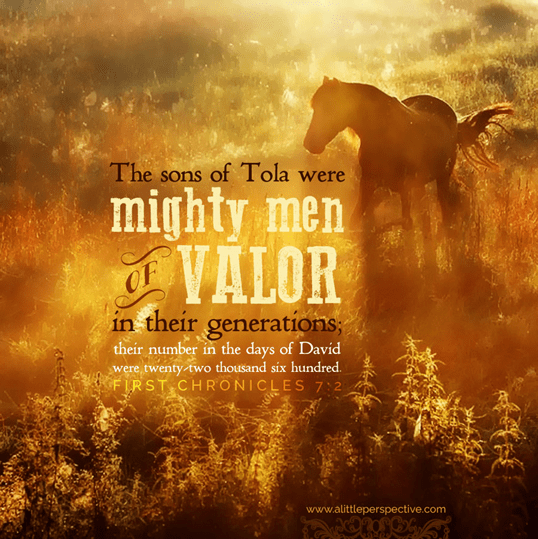
1 Chronicles 7:1 – 40 “The sons of Issachar: Tola, Puah, Jashub, and Shimron—four in all. The sons of Tola: Uzzi, Rephaiah, Jeriel, Jahmai, Ibsam, and Shemuel, the heads of their families. In the days of David, 22,600 descendants of Tola were numbered in their genealogies as mighty men of valor.

The son of Uzzi: Izrahiah. The sons of Izrahiah: Michael, Obadiah, Joel, and Isshiah. All five of them were chiefs. In addition to them, according to their genealogy, they had 36,000 troops for battle, for they had many wives and children. Their kinsmen belonging to all the families of Issachar who were mighty men of valor totaled 87,000, as listed in their genealogies.

The Descendants of Benjamin The three sons of Benjamin: Bela, Becher, and Jediael. The sons of Bela: Ezbon, Uzzi, Uzziel, Jerimoth, and Iri, heads of their families—five in all. There were 22,034 mighty men of valor listed in their genealogies.

The sons of Becher: Zemirah, Joash, Eliezer, Elioenai, Omri, Jeremoth, Abijah, Anathoth, and Alemeth; all these were Becher’s sons. Their genealogies were recorded according to the heads of their families—20,200 mighty men of valor.

The son of Jediael: Bilhan. The sons of Bilhan: Jeush, Benjamin, Ehud, Chenaanah, Zethan, Tarshish, and Ahishahar. All these sons of Jediael were heads of their families, mighty men of valor; there were 17,200 fit for battle. The Shuppites and Huppites were descendants of Ir, and the Hushites were descendants of Aher.

The Descendants of Naphtali The sons of Naphtali: Jahziel, Guni, Jezer, and Shallum — the descendants of Bilhah.

The Descendants of Manasseh  The descendants of Manasseh: Through his Aramean concubine, Asriel, as well as Machir the father of Gilead. Machir took a wife from among the Huppites and Shuppites. The name of his sister was Maacah. Another descendant was named Zelophehad, who had only daughters. Machir’s wife Maacah gave birth to a son, and she named him Peresh. His brother was named Sheresh, and his sons were Ulam and Rekem.  The son of Ulam: Bedan. These were the sons of Gilead son of Machir, the son of Manasseh. His sister Hammolecheth gave birth to Ishhod, Abiezer, and Mahlah. And these were the sons of Shemida: Ahian, Shechem, Likhi, and Aniam.

The Descendants of Ephraim The descendants of Ephraim: Shuthelah, Bered his son, Tahath his son, Eleadah his son, Tahath his son, Zabad his son, and Shuthelah his son. Ezer and Elead were killed by the natives of Gath, because they went down to steal their livestock. Their father Ephraim mourned for many days, and his relatives came to comfort him. And again he slept with his wife, and she conceived and gave birth to a son. So he named him Beriah, (sounding like the Hebrew for “tragedy” or “disaster”) because tragedy had come upon his house. His daughter was Sheerah, who built Lower and Upper Beth-horon, as well as Uzzen-sheerah. Additionally, Rephah was his son, Resheph his son, Telah his son, Tahan his son, Ladan his son, Ammihud his son, Elishama his son, Nun his son, and Joshua his son.

Their holdings and settlements included Bethel and its villages, Naaran to the east, Gezer and its villages to the west, and Shechem and its villages as far as Ayyah and its villages. And along the borders of Manasseh were Beth-shean, Taanach, Megiddo, and Dor, together with their villages. The descendants of Joseph son of Israel lived in these towns.

The Descendants of Asher The children of Asher: Imnah, Ishvah, Ishvi, Beriah, and their sister Serah. The sons of Beriah: Heber, as well as Malchiel, who was the father of Birzaith. Heber was the father of Japhlet, Shomer, and Hotham, and of their sister Shua. The sons of Japhlet: Pasach, Bimhal, and Ashvath. These were Japhlet’s sons. he sons of Shemer: Ahi, Rohgah, Hubbah, and Aram. The sons of his brother Helem:  Zophah, Imna, Shelesh, and Amal. The sons of Zophah: Suah, Harnepher, Shual, Beri, Imrah, Bezer, Hod, Shamma, Shilshah, Ithran, and Beera.

The sons of Jether: Jephunneh, Pispa, and Ara. The sons of Ulla: Arah, Hanniel, and Rizia. All these were the descendants of Asher—heads of their families, choice and mighty men of valor, and chiefs among the leaders. The number of men fit for battle, recorded in their genealogies, was 26,000.

We have just read brief genealogies of six tribes, and each time, the scribe has taken care to record the number of fighting men, calling them “mighty men of valor,” “heads of their families,” “choice.” Why these designations? If you are going to remember ancestors, remember them for something great. Few descriptions seem more praiseworthy than these. After all, who wants to say, “Oh, that was Great Grandfather Benjamin; he was a cheating wimp and a camel thief!” Courage, strength, and dedication are the qualities the recorder is admiring. Besides, in those days, if you didn’t fight well, you didn’t survive long enough to HAVE descendants!

Even though there are very few women mentioned in these lists, there are a few who are noteworthy. Look at the tribe of Ephraim. “His daughter was Sheerah, who built Lower and Upper Beth-horon, as well as Uzzen-sheerah.” In all the lists, this is the only mention of someone building cities, and this lady built three! In the tribe of Manasseh, Zelophehad is mentioned as having only daughters; however, what is not mentioned is the fact that these women were bold enough to come to Moses and Joshua and claim their father’s heritage, so that he would not be forgotten in Israel. They were granted their request, provided that they married within their tribe, and God commended these women for their bravery.

APPLICATION: For the Israelites, genealogy was important because they had to prove that they were truly Israelites and not bastard half – caste children. Without such proof, an Israelite would be barred from temple worship for up to ten generations, or perhaps even forever. These stories also served as an encouragement to succeeding generations. If Grandpa was a brave warrior, a youngster could take courage from his example. Family stories would help youngsters feel a part of something bigger than themselves.

 Most families have stories, and we miss a great deal if we do not learn them. Many Americans can point to ancestors who came from various parts of the world unable to speak more than a few words of English, but who made a better life for their children because they took risks. But there is a heritage more valuable than the suffering of immigrants, the heritage of faith and virtue.

Years ago, one man in my home village shipped cattle to the Chicago stockyards. As this fellow was waiting for the sale of the cattle to go through, he realized he had run short on funds and needed to cash a counter – check. (No ATM cards or credit cards at that time.) When this man met with a bank manager and the bank manager called the local bank with which he did business, the local banker said, “If that’s _____ standing there, then he’s good for any amount he puts on the check.” That incident took place more than seventy years ago, but the man’s reputation for honesty remains intact. 

When generations of a family have truly served the One True Living God, there is a sweetness that cannot be measured. But such a heritage can only be carried forward with prayer. When we pray for our families, we should be praying for all the generations right up to the time that Jesus returns. We should beg God to make our descendants men and women of spiritual valor, people who will swear to their own hurt and will not change despite opposition. Today, remember to pray for all your family and friends and for their future generations. We need mighty men and women of valor now more than ever!

PRAYER: Father God, thank You for loving us and for caring for us. Lord, help us to follow hard after You all the days of our lives and help us to pray for those around us, including the coming generations. In the mighty and precious Name of King Jesus. Amen.
SEPTEMBER 19, 2022 ANOTHER LOOK AT THE ISRAELITES PART 1 #8 1 CHRONICLES 6:51 – 81 WHY GIVE UP ANYTHING? WHAT’S IN IT FOR ME?

September 19, 2022

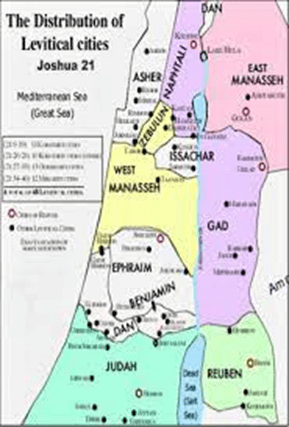
1 Chronicles 6:51 – 81 “Territories for the Levites (Numbers 35:1–8; Joshua 21:1–45)

Now these were the territories assigned to the descendants of Aaron from the Kohathite clan for their settlements, because the first lot fell to them: They were given Hebron in the land of Judah and its surrounding pasturelands. But the fields and villages around the city were given to Caleb son of Jephunneh. So the descendants of Aaron were given Hebron (a city of refuge), Libnah, Jattir, Eshtemoa, Hilen, Debir, Ashan, Juttah, and Beth-shemesh, together with their pasturelands.

And from the tribe of Benjamin they were given Gibeon, Geba, Alemeth, and Anathoth, together with their pasturelands. So they had thirteen cities in all among their families.

To the rest of the Kohathites, ten cities were allotted from the half-tribe of Manasseh. The Gershomites, according to their clans, were allotted thirteen cities from the tribes of Issachar, Asher, Naphtali, and Manasseh in Bashan.

The Merarites, according to their families, were allotted twelve cities from the tribes of Reuben, Gad, and Zebulun.

So the Israelites gave to the Levites these cities and their pasturelands. They assigned by lot the cities named above from the tribes of Judah, Simeon, and Benjamin.

And some of the clans of the Kohathites were given cities from the tribe of Ephraim for their territory: They were given Shechem (a city of refuge) with its pasturelands in the hill country of Ephraim, and Gezer, Jokmeam, Beth-horon, Aijalon, and Gath-rimmon, together with their pasturelands. And from the half-tribe of Manasseh the remaining clans of the Kohathites were given Aner and Bileam, together with their pasturelands.

The Gershomites received the following: From the clan of the half-tribe of Manasseh they were given Golan in Bashan and also Ashtaroth, together with their pasturelands. From the tribe of Issachar they were given Kedesh, Daberath, Ramoth, and Anem, together with their pasturelands. From the tribe of Asher they were given Mashal, Abdon, Hukok, and Rehob, together with their pasturelands. And from the tribe of Naphtali they were given Kedesh in Galilee, Hammon, and Kiriathaim, together with their pasturelands.

The Merarites (the rest of the Levites) received the following: From the tribe of Zebulun they were given Rimmono and Tabor, together with their pasturelands. From the tribe of Reuben east of the Jordan opposite Jericho they were given Bezer in the wilderness, Jahzah, Kedemoth, and Mephaath, together with their pasturelands. And from the tribe of Gad they were given Ramoth in Gilead, Mahanaim, Heshbon, and Jazer, together with their pasturelands.”

“GIVE UP MY LAND??? SAY WHAT???” At first, the other Israelite tribes might have felt ripped off! The list of these cities includes the pasture lands belonging to the cities – probably the best land around there. But there is no record of any protest from any of the tribes. Perhaps by this point, the other tribes realized how much work the Levites were having to do. Remember that whenever the Israelites moved, the Levites had to take down the tabernacle of meeting, pack it all up, and then carry it! These burdens were in addition to any household goods the Levites owned personally. Once the Israelites reached a new camping location, while everyone else was merely pitching their own tents, the Levites had to set up the tabernacle first before worrying about their households. The Levites had all the responsibilities of the Tabernacle, including maintenance, cleaning out ashes, etc.

God deliberately refused to assign the Levites a single area because He wanted the priests to be spread throughout Israel. Notice that God even assigned land to the priests east of the Jordan to make sure that there would be priests to minister to Reuben, Gad, and the half – tribe of Manasseh. But there was a hitch: the Levites had to depend on the generosity of those other tribes if they were to have any spot in the Promised Land to call their own.

Personally, I have always felt sorry for Caleb. Hebron was originally inhabited by giants and Caleb went in there and defeated the giants. Then, the next thing you know, God is giving the city for which Caleb and his troops have worked so hard to the priests and making it a city of refuge in addition. But somehow, we never find any record of Caleb complaining about such seeming injustice. Why? Caleb was very close to God. Perhaps God advised Caleb that He was giving Caleb the honor of the chance to offer up Hebron as a special offering to God. Give such an opportunity, Caleb would have made such an offering gladly. King David is quoted as saying, “Should I offer to God what costs me nothing?” but Caleb was of a similar spirit. Generations later, David actually ruled in Hebron before he ruled in Jerusalem. Perhaps God gave Caleb a glimpse of David as an encouragement.

APPLICATION: When God gives you something, how tightly do you hold onto it, particularly if it is something you have wanted for years? Are you willing to hold things and people lightly, so that if God asks for them back, you can let them go? Just as Caleb freely gave up the city of Hebron to become a city for the priests and a city of refuge, so we need to be willing to return God’s gifts to Him when he asks.

God’s requests to give things back to Him can come in all sorts of ways.

Parenting: Sending kids off to school: This is the time of year when kids are returning to school and parents are facing long good – byes. Will the child do well? Will he/she find good friends? What will the school environment be like?

Bereavement: the last twelve months, we have buried two beloved brothers. Both were honorable men, loving, kind, caring, and hard – working. In each case, chronic health problems finally became worse, resulting in death. It has been doubly painful because we had spent so much of our time away from family that our time with these two men turned out to be far more limited than we had hoped.

Retirement: Retirement brings new challenges in the art of letting go. If we are wise, we bow out gracefully from one arena but take the opportunity to enter other new ones. Make no mistake! In God’s economy, He will always have new assignments for you if you will only open your eyes.

Jesus’s followers were very worried about this question, and one day they came to Him for information. “Peter began to say to Him, “Look, we have left everything and followed You.” “Truly I tell you,” Jesus replied, “no one who has left home or brothers or sisters or mother or father or children or fields for My sake and for the gospel will fail to receive a hundredfold in the present age—houses and brothers and sisters and mothers and children and fields, along with persecutions—and in the age to come, eternal life. But many who are first will be last, and the last will be first.”

Peter was quite correct! Peter and Andrew and James and John had all left thriving fishing businesses to follow Jesus. Undoubtedly, these men were getting pressure from their families, who were demanding to know when this Messiah gig was going to pay off. It’s doubtful that Jesus’s answer satisfied some of those family members; however, Jesus spoke truth. For the rest of those men’s lives, they were welcomed into homes and treated as family by hundreds and thousands of people. Eventually, most of the disciples did die for their faith, but before then, they enjoyed the glorious heritage Jesus described, both on earth and in heaven.

There are no possessions that cannot be taken away from us, no bank accounts that cannot somehow be rifled. Life does not come with guarantees. Far better then, to accept Jesus’s promises and to follow Him, for if we do, we will have heavenly treasure that can never decay or be stolen. As Jim Elliott, a missionary martyr, once said, “He is no fool who gives up what he cannot keep to gain what he cannot lose.”

PRAYER: Father God, thank You for loving us and for caring for us. Lord, help us to be willing to exchange our old sinful natures for Your purity, righteousness, and holiness. Save us from ourselves, dear Lord, and clean us up, so that we will be fit to live with You in heaven forever. Amen.

SEPTEMBER 18, 2022 ANOTHER LOOK AT THE ISRAELITES PART 1 #7 1 CHRONICLES 6:31 – 50 CHOSEN TO PRAISE!

September 18, 2022

1 Chronicles 6:31 – 50 “The Temple Musicians These are the men David put in charge of the music in the house of the LORD after the ark rested there. They ministered with song before the tabernacle, the Tent of Meeting, until Solomon built the house of the LORD in Jerusalem. And they performed their duties according to the regulations given them. These are the men who served, together with their sons.

From the Kohathites:

Heman the singer, the son of Joel, the son of Samuel, the son of Elkanah, the son of Jeroham, the son of Eliel, the son of Toah, the son of Zuph, the son of Elkanah, the son of Mahath, the son of Amasai, the son of Elkanah, the son of Joel, the son of Azariah, the son of Zephaniah, the son of Tahath, the son of Assir, the son of Ebiasaph, the son of Korah, the son of Izhar, the son of Kohath, the son of Levi, the son of Israel.

Heman’s kinsman was Asaph, who served at his right hand: Asaph the son of Berechiah, the son of Shimea, the son of Michael, the son of Baaseiah, the son of Malchijah, the son of Ethni, the son of Zerah, the son of Adaiah, the son of Ethan, the son of Zimmah, the son of Shimei, the son of Jahath, the son of Gershom, the son of Levi.

On the left were their kinsmen, the sons of Merari: Ethan the son of Kishi, the son of Abdi, the son of Malluch, the son of Hashabiah, the son of Amaziah, the son of Hilkiah, the son of Amzi, the son of Bani, the son of Shemer, the son of Mahli, the son of Mushi, the son of Merari, the son of Levi.

The Descendants of Aaron

Their fellow Levites were assigned to every kind of service of the tabernacle, the house of God. But Aaron and his sons did all the work of the Most Holy Place. They presented the offerings on the altar of burnt offering and on the altar of incense to make atonement for Israel, according to all that Moses the servant of God had commanded.

These were the descendants of Aaron: Eleazar his son, Phinehas his son, Abishua his son, Bukki his son, Uzzi his son, Zerahiah his son, Meraioth his son, Amariah his son, Ahitub his son, Zadok his son, and Ahimaaz his son.”

Chosen to praise! King David himself was no mean musician or composer, so anyone whom David chose must have had extraordinary ability. How proud these men must have been as they stood in the temple praising God. And how exciting it must have been to hear the shouts of those standing in and around the temple, “Hosanna! Blessed are You, O Lord, Creator of the universe!” That heritage was one passed throughout generations. Still today, throughout the world, there are those leading praise and worship to the Living God. But wherever there is a ministry, there are always pitfalls.

The biggest pitfall to most worship leaders is the ability to tell the difference between worship and performance. True worship leads us into the spiritual throne room of God and invites the Holy Spirit to come and to abide with us. Performance, on the other hand, is person – centered; we are invited to worship the performer rather than God. Sadly, it is quite possible to begin by being a true – hearted leader of worship and to end by becoming a performer. How can worship leaders avoid this pit? Copy Cori Ten Boom’s example. Whenever someone would praise Cori, she would treat the praise like a sweet – smelling bouquet, inhale the fragrance and then offer it up to God. If someone praises a worship leader’s abilities, he or she can thank that person and then give God the glory. Praise that is hung onto rots and smells!

Face it, no worship leader ever created tongues, vocal cords, lungs, or diaphragms. God – given abilities are just that, God – given. True worship leaders know when it is time to be silent and let the Holy Spirit minister without distractions.

Maintaining the temple took a lot of work. There were Levites who carried out the more mundane tasks in the temple, and then there were those priests descended from Aaron. It was Aaron’s offspring who served in the most holy place. While such service was a big honor, it was also dangerous. One part of the priestly attire included bells on the skirts of the priest’s uniform as well as a rope tied around the priest’s ankle. If the bells stopped tinkling, it might mean that the priest had done something wrong and that God had struck him dead. At that point, the rope would serve to drag the priest’s body out of the most holy place so that nobody else would be struck dead as well!

APPLICATION: “Whew!” you might say. “I’m so glad that I am not a priest!” Wait, who told you that you weren’t? Each one of us is called to praise and to worship, not merely in church but wherever we work, wherever we live. What good is our labor if it is not dedicated to God? I am a surgeon, and before I operate, I ask God to guide me and to heal the patient completely. I plead the Blood of Jesus on my patients for complete restoration.

There is no labor that comes without a calling from God, unless it is something out of the Will of God. God has called each and every one of us to take part in His plan for the universe. If we will only ask, God will show us what He wants us to do and where He wants us to do it. God is passionately interested in you and wants you to love Him, so that your life will be complete.

PRAYER: Father God, thank You for loving us and for caring for us. Lord, please help everyone who reads these words to find their rest in You and to find their vocation, their calling in You. In the mighty and precious Name of King Jesus. Amen.
SEPTEMBER 17, 2022 ANOTHER LOOK AT THE ISRAELITES PART 1 #6 1 CHRONICLES 6:1 – 30 WHEN ALL ARE PROVING FAITHLESS, WHO WILL KEEP THE FAITH?

September 17, 2022

1 Chronicles 6:1 – 29 “The Descendants of Levi

The sons of Levi: Gershon, Kohath, and Merari. The sons of Kohath: Amram, Izhar, Hebron, and Uzziel. The children of Amram: Aaron, Moses, and Miriam. The sons of Aaron: Nadab, Abihu, Eleazar, and Ithamar.

Eleazar was the father of Phinehas, Phinehas was the father of Abishua, Abishua was the father of Bukki,

Bukki was the father of Uzzi, Uzzi was the father of Zerahiah, Zerahiah was the father of Meraioth, Meraioth was the father of Amariah, Amariah was the father of Ahitub, Ahitub was the father of Zadok, Zadok was the father of Ahimaaz, Ahimaaz was the father of Azariah, Azariah was the father of Johanan, Johanan was the father of Azariah, who served as priest in the temple that Solomon built in Jerusalem,

Azariah was the father of Amariah, Amariah was the father of Ahitub, Ahitub was the father of Zadok, Zadok was the father of Shallum, Shallum was the father of Hilkiah, Hilkiah was the father of Azariah, Azariah was the father of Seraiah, and Seraiah was the father of Jehozadak. Jehozadak went into captivity when the LORD sent Judah and Jerusalem into exile by the hand of Nebuchadnezzar. (The Babylonian captivity)

The sons of Levi: Gershom, Kohath, and Merari. These are the names of the sons of Gershom: Libni and Shimei.  The sons of Kohath: Amram, Izhar, Hebron, and Uzziel. The sons of Merari: Mahli and Mushi.

These are the clans of the Levites listed according to their fathers: Of Gershom: Libni his son, Jahath his son, Zimmah his son, Joah his son, Iddo his son, Zerah his son, and Jeatherai his son.

The descendants of Kohath: Amminadab his son, Korah his son, Assir his son, Elkanah his son, Ebiasaph his son, Assir his son, Tahath his son, Uriel his son, Uzziah his son, and Shaul his son.

The descendants of Elkanah: Amasai, Ahimoth, Elkanah his son, Zophai his son, Nahath his son, Eliab his son, Jeroham his son, and Elkanah his son.

The sons of Samuel: Joel his firstborn and Abijah his second son.

The descendants of Merari: Mahli, Libni his son, Shimei his son, Uzzah his son, Shimea his son, Haggiah his son, and Asaiah his son.

WHY WAS THE TRIBE OF LEVI CHOSEN IN THE FIRST PLACE?? It all started at Mount Sinai when Aaron caved in to popular demand and created a golden calf, copying one of the Egyptian gods. When Moses came down from the mountain, he found the Israelites engaged in an all – out orgy. Exodus 32:29 – 29: “Moses saw that the people were out of control, for Aaron had let them run wild and become a laughingstock to their enemies. So Moses stood at the entrance to the camp and said, “Whoever is for the LORD, come to me.” And all the Levites gathered around him.

He told them, “This is what the LORD, the God of Israel, says: ‘Each of you men is to fasten his sword to his side, go back and forth through the camp from gate to gate, and slay his brother, his friend, and his neighbor.’ ”

The Levites did as Moses commanded, and that day about three thousand of the people fell dead.

Afterward, Moses said, “Today you have been ordained for service to the LORD, since each man went against his son and his brother; so the LORD has bestowed a blessing on you this day.” (Some sources say “have ordained yourselves”)

The Levites separated themselves to God by paying an appalling price – redeeming Israel by sacrificing their friends and relatives at the edge of the sword. What must it have been like to be one of those Levites who moved throughout the camp, not even sparing those closest to them? Our first response might be to deny that such an act could possibly be God’s will. Why would a loving Heavenly Father order such carnage? But unless you have had close experience with the demonic, it may be difficult for you to understand.

The people who fell to the swords of the Levites did not suddenly wake up that morning and decide to have an orgy; no, these were people who had probably been secretly worshiping Egyptian gods that they had brought with them when they left Egypt. These people were idolaters waiting for any excuse to cut loose, and when Aaron caved in to their pressure, they took full advantage of the situation. If God moved the Levites to kill, then God also showed the Levites whom to kill. Had these people survived, they could have easily led the rest of the Israelites astray within a few short weeks.

These lists of Levites include the good, the bad, and the downright horrible. Among these lists are the names of the faithful who kept the temple fires lit even while paganism raged and roared just outside the temple. Some of these men taught kings the ways of God and brought revival. Some of these men were martyred for their faith. And some of these men proved to be sad disappointments, allowing pagan altars and even prostitution into God’s temple.
Later on, these lists would prove critically important for the exiles from Judah and Benjamin who would follow Ezra and Nehemiah back from Babylon to Jerusalem. To establish worship, those leaders would need Levitical priests.

APPLICATION: To be descended from Levi was both a blessing and a curse. Families of Levites were set apart and were considered as special people; but on the other hand, there were many restrictions on Levites as well. But once given such a heritage of faith, it was up to individuals to maintain it.

1 The Son of God goes forth to war,
a kingly crown to gain;
his blood-red banner streams afar:
who follows in his train?
Who best can drink his cup of woe,
triumphant over pain,
who patient bears his cross below,
he follows in his train.

2 The martyr first, whose eagle eye
could pierce beyond the grave,
who saw his Master in the sky
and called on him to save:
like him, with pardon on his tongue
in midst of mortal pain,
he prayed for them that did the wrong:
who follows in his train?

3 A glorious band, the chosen few
on whom the Spirit came,
twelve valiant saints, their hope they knew,
and mocked the cross and flame:
they met the tyrant’s brandished steel,
the lion’s gory mane;
they bowed their necks the death to feel:
who follows in their train?

4 A noble army, men and boys,
the matron and the maid,
around the Savior’s throne rejoice,
in robes of light arrayed:
they climbed the steep ascent of heav’n
through peril, toil, and pain:
O God, to us may grace be giv’n
to follow in their train.

PRAYER: Father God, thank You for loving us and for caring for us. Lord, help us to follow hard after You all the days of our lives. Help us to love You more each day than we did the day before. In the matchless Name of King Jesus. Amen.

SEPTEMBER 16, 2022 ANOTHER LOOK AT THE ISRAELITES PART 1 # 5 1 CHRONICLES 5:1 – 26 HOW TO TAKE DIVINE FAVOR FOR GRANTED AND REALLY MESS UP BIG TIME!

September 16, 2022

1 Chronicles 5:1- 2

! Chronicles 5:1 – 26 “These were the sons of Reuben the firstborn of Israel. Though he was the firstborn, his birthright was given to the sons of Joseph son of Israel, because Reuben defiled his father’s bed. So he is not reckoned according to birthright. And though Judah prevailed over his brothers and a ruler came from him, the birthright belonged to Joseph. The sons of Reuben, the firstborn of Israel: Hanoch, Pallu, Hezron, and Carmi.

 The descendants of Joel: Shemaiah his son, Gog his son, Shimei his son, Micah his son, Reaiah his son, Baal his son, and Beerah his son, whom Tiglath-pileser king of Assyria carried into exile.

Beerah was a leader of the Reubenites. His relatives by their clans are recorded in their genealogy: Jeiel the chief, Zechariah, and Bela son of Azaz, the son of Shema, the son of Joel. They settled in Aroer and as far as Nebo and Baal-meon. They also settled in the east as far as the edge of the desert that extends to the Euphrates River, because their livestock had increased in the land of Gilead.

During the days of Saul they waged war against the Hagrites, who were defeated at their hands, and they occupied the homes of the Hagrites throughout the region east of Gilead.

The Descendants of Gad

The descendants of Gad lived next to the Reubenites in the land of Bashan, as far as Salecah:

 Joel was the chief, Shapham the second, then Jaanai and Shaphat, who lived in Bashan.   Their kinsmen by families were Michael, Meshullam, Sheba, Jorai, Jacan, Zia, and Eber—seven in all. These were the sons of Abihail son of Huri, the son of Jaroah, the son of Gilead, the son of Michael, the son of Jeshishai, the son of Jahdo, the son of Buz. Ahi son of Abdiel, the son of Guni, was head of their family. They lived in Gilead, in Bashan and its towns, and throughout the pasturelands of Sharon. All of them were reckoned in the genealogies during the reigns of Jotham king of Judah and Jeroboam king of Israel.

The Reubenites, the Gadites, and the half-tribe of Manasseh had 44,760 warriors—valiant men who carried the shield and sword, drew the bow, and were trained for battle. They waged war against the Hagrites, as well as Jetur, Naphish, and Nodab.

And because they cried out to God in battle, they were helped against their enemies, and the Hagrites and all their allies were delivered into their hands. Because they put their trust in God, He answered their prayers. They seized the livestock of the Hagrites—50,000 camels, 250,000 sheep, and 2,000 donkeys. They also took 100,000 captives, and many others fell slain, because the battle belonged to God. And they occupied the land until the exile.

The Half-Tribe of Manasseh

Now the people of the half-tribe of Manasseh were numerous. They settled in the land from Bashan to Baal-hermon (that is, Senir, also known as Mount Hermon). These were the heads of their families:

Epher, Ishi, Eliel, Azriel, Jeremiah, Hodaviah, and Jahdiel.

They were mighty men of valor, famous men, and heads of their families. But they were unfaithful to the God of their fathers, and they prostituted themselves with the gods of the peoples of the land, whom God had destroyed before them.

So the God of Israel stirred up the spirit of Pul king of Assyria (that is, Tiglath-pileser king of Assyria) to take the Reubenites, the Gadites, and the half-tribe of Manasseh into exile. And he brought them to Halah, Habor, Hara, and the river of Gozan, where they remain to this day.”

 How to really mess up??? Well, consider Reuben. Reuben was the first – born of Jacob/Israel’s sons and therefore should have had all the rights and privileges accorded to that position – land, livestock, riches, and power. But Reuben proved to be unstable and unworthy of that birth right. Reuben forced Rachel’s maid Bilhah, his father’s concubine, to have sex with him. (Genesis 35:22) By this act, Reuben was forcefully demonstrating his lack self – control and his lack of respect for his father as well as his lack of respect for Bilhah, the mother of two of his brothers. Reuben was also acting as if his father was already either impotent or dead. (Since this incident took place shortly after Rachel died in childbirth, Israel was obviously not impotent.) Such an act might well have been taboo and perhaps even punishable by death for most of the pagan tribes at this time.  Just before dying, Jacob conferred Reuben’s birthright on Joseph and his two sons, Ephraim and Manasseh.

Remember the Reubenites, the Gadites, and the half – tribe of Manasseh? All these tribes had large flocks and herds. When the Israelites were approaching Canaan from the east, they came into the lands ruled by King Og of Bashan and King Sihon of the Amorites. In those days, the land was very fertile, with excellent grazing and plenty of water. With God’s help, the Israelites annihilated both of these nations. The Reubenites, the Gadites, and those from Manasseh made a deal with Moses to claim these lands as their heritage and leave their families and animals there while they helped the rest of the Israelites conquer Canaan. (You can read the story in Numbers 32.)

While this decision made perfect sense from a farming standpoint, it was risky when considering the potential for attack from the east. While the rest of the tribes of Israel took up their heritages on the west side of the Jordan, these three groups remained on the east, making it more difficult to summon help if they were attacked. Being in such a vulnerable position meant that these tribes had to be ready to defend themselves. No wonder these tribes maintained 44,760 warriors. In the beginning, all was well because these tribes were depending on God to help them. But later, these tribes turned away from the God who had helped them and reaped a bitter reward. “They were mighty men of valor, famous men, and heads of their families. But they were unfaithful to the God of their fathers, and they prostituted themselves with the gods of the peoples of the land, whom God had destroyed before them. So the God of Israel stirred up the spirit of Pul king of Assyria (that is, Tiglath-pileser king of Assyria) to take the Reubenites, the Gadites, and the half-tribe of Manasseh into exile. And he brought them to Halah, Habor, Hara, and the river of Gozan, where they remain to this day.”

APPLICATION: Reuben lost his birthright for failing to discipline himself and for failing to honor his father. Undoubtedly, Reuben had all kinds of excuses, never realizing that his selfish act was to blight his descendants for generations to come. History is littered with examples of those who missed greatness or who forfeited greatness for lack of discipline. Alexander the Great died at the age of 31, perhaps during a drinking bout. When King Agrippa was questioning the Apostle Paul, he was so moved by Paul’s story that he told Paul, “You almost persuade me to become a Christian.” (Acts 26:28) Sadly, Agrippa remained in that spiritual state, continuing to worship Roman deities.

When the tribes of Reuben and Gad and Manasseh settled in the lands east of the Jordan, they had a wonderful chance at a new start. In the beginning, these tribes relied on God, and God helped them. The Reubenites even settled as far as the edge of the desert that extends to the Euphrates River. But this story has a tragic ending. Once these tribes began relying on themselves, they gave themselves wholly over to worship of pagan gods. In a few generations, the Assyrians collected them and sent them into exile into Assyria. The ten tribes captured by the Assyrians have been referred to as the lost tribes of Israel because once in Assyria, they never returned to Israel as tribal groups. Only the tribes of Judah and Benjamin who were captured by the Babylonians eventually re – settled Israel and rebuilt the temple in a much smaller form. Truly, the tragedy of Reuben continued for generations!

What can we gain from these stories? Even in Jesus’ day, there was a saying that “the fathers have eaten sour grapes and the children’s teeth are set on edge,” indicating that a wrong decision by a father can make trouble for his descendants. Perhaps part of the reason the Reubenites were willing to settle east of the Jordan was that they realized they would have no birthright on the west side.

God honored the decisions by the Reubenites, Gadites, and the half- tribe of Manasseh. As long as these tribes followed God, he protected them and helped them in battle. But that protection ended when these people became self – confident and forgot God. We must always remember that everything we are and have comes from God. St. Paul told the Greeks in the Areopagus: “In him we live, move, and have our being.”  (Acts 17:28)

Today is the only day any of us have to make decisions! Decide today that you will follow the One True Living God completely and that you will trust in the blood sacrifice made by his Son Jesus Christ.

PRAYER: Father God, thank You for loving us and for caring for us. Lord, help us to follow hard after You all the days of our lives! Help us to trust in the salvation that you offer when we believe in the blood sacrifice Jesus has made for our sins. In the mighty and precious Name of King Jesus. Amen.
SEPTEMBER 15, 2022 ANOTHER LOOK AT THE ISRAELITES PART 1 #4 1 CHRONICLES 4:1 – 42 THE PRAYER OF JABEZ – CURSE OR BLESSING! BE CAREFUL WHEN NAMING YOUR KIDS.

September 15, 2022

1 Chronicles 4:1 – 42 “The descendants of Judah: Perez, Hezron, Carmi, Hur, and Shobal. Reaiah son of Shobal was the father of Jahath, and Jahath was the father of Ahumai and Lahad. These were the clans of the Zorathites.

These were the sons of Etam: Jezreel, Ishma, and Idbash. And their sister was named Hazzelelponi. Penuel was the father of Gedor, and Ezer was the father of Hushah.

These were the descendants of Hur, the firstborn of Ephrathah and the father of Bethlehem. Ashhur the father of Tekoa had two wives, Helah and Naarah. Naarah bore to him Ahuzzam, Hepher, Temeni, and Haahashtari. These were the descendants of Naarah. The sons of Helah were Zereth, Zohar, Ethnan, and Koz, who was the father of Anub and Zobebah and of the clans of Aharhel son of Harum.

The Prayer of Jabez

Now Jabez was more honorable than his brothers. His mother had named him Jabez, (meaning “pain” or “distress”) saying, “Because I bore him in pain.” And Jabez called out to the God of Israel, “If only You would bless me and enlarge my territory! May Your hand be with me and keep me from harm, so that I will be free from pain.” (Other versions say, “So that I might not cause pain.”) And God granted the request of Jabez.

More Descendants of Judah

Chelub the brother of Shuhah was the father of Mehir, who was the father of Eshton. Eshton was the father of Beth-rapha, of Paseah, and of Tehinnah the father of Ir-nahash. These were the men of Recah. The sons of Kenaz:

Othniel and Seraiah. The sons of Othniel: Hathath and Meonothai. Meonothai was the father of Ophrah, and Seraiah was the father of Joab, the father of those living in Ge-harashim, which was given this name because its people were craftsmen. (This name means “Valley of craftsmen.”)

The sons of Caleb son of Jephunneh: Iru, Elah, and Naam. The son of Elah: Kenaz. The sons of Jehallelel: Ziph, Ziphah, Tiria, and Asarel. The sons of Ezrah: Jether, Mered, Epher, and Jalon. And Mered’s wife Bithiah gave birth  to Miriam, Shammai, and Ishbah the father of Eshtemoa. These were the children of Pharaoh’s daughter Bithiah.  

Mered also took a Judean wife, who gave birth to Jered the father of Gedor, Heber the father of Soco, and Jekuthiel the father of Zanoah.

The sons of Hodiah’s wife, the sister of Naham, were the fathers of Keilah the Garmite and of Eshtemoa the Maacathite. The sons of Shimon: Amnon, Rinnah, Ben-hanan, and Tilon.

The descendants of Ishi: Zoheth and Ben-zoheth. The sons of Shelah son of Judah: Er the father of Lecah, Laadah the father of Mareshah and the clans of the linen workers at Beth-ashbea, Jokim, the men of Cozeba, and Joash and Saraph, who ruled in Moab and Jashubi-lehem. (These names are from ancient records.) These were the potters who lived at Netaim and Gederah. They lived there in the service of the king.

The Descendants of Simeon

The descendants of Simeon: Nemuel, Jamin, Jarib, Zerah, and Shaul. The sons of Shaul: Shallum, Mibsam, and Mishma. The sons of Mishma: Hammuel, Zaccur, and Shimei. Shimei had sixteen sons and six daughters, but his brothers did not have many children, so their whole clan did not become as numerous as the sons of Judah. They lived in Beersheba, Moladah, Hazar-shual, Bilhah, Ezem, Tolad, Bethuel, Hormah, Ziklag, Beth-marcaboth, Hazar-susim, Beth-biri, and Shaaraim. These were their cities until the reign of David. And their villages were Etam, Ain, Rimmon, Tochen, and Ashan—five towns— and all their surrounding villages as far as Baal. These were their settlements, and they kept a genealogical record:

Meshobab, Jamlech, Joshah son of Amaziah, Joel, Jehu son of Joshibiah (son of Seraiah, son of Asiel), Elioenai, Jaakobah, Jeshohaiah, Asaiah, Adiel, Jesimiel, Benaiah, and Ziza son of Shiphi (son of Allon, son of Jedaiah, son of Shimri, son of Shemaiah).

These men listed by name were the leaders of their clans. Their families increased greatly, and they journeyed to the entrance of Gedor, to the east side of the valley, in search of pasture for their flocks. There they found rich, good pasture, and the land was spacious, peaceful, and quiet; for some Hamites had lived there formerly.

These who were noted by name came in the days of Hezekiah king of Judah. They attacked the Hamites and Meunites there in their dwellings, devoting them to destruction even to this day. Then they settled in their place, because there was pasture for their flocks. And five hundred of these Simeonites led by Pelatiah, Neariah, Rephaiah, and Uzziel, the sons of Ishi, went to Mount Seir and struck down the remnant of the Amalekites who had escaped. And they have lived there to this day.

So many names! So many families! Reading these lists can make you feel as if you are being stoned to death with popcorn or choked with trivia. But right in the midst of all this stuff, there is a wonderful gem, the Prayer of Jabez. This prayer has been translated two different ways with two very different meanings. First of all, consider the name “Jabez.” This name sounds very much like the Hebrew term for pain or distress, indicating that this man’s mother must have suffered greatly while giving birth to him. Names are critically important! Why did Jabez’s mother give him such a horrible name? Was Jabez an unusually big baby or did he have a face presentation or a breach presentation, making delivery difficult? Did Jabez’s mother blame this innocent baby for her suffering?

The Prayer of Jabez has been variously translated in these two fashions: “If only You would bless me and enlarge my territory! May Your hand be with me and keep me from harm, so that I will be free from pain.” OR “If only You would bless me and enlarge my territory! May Your hand be with me and keep me from harm, so that I will not cause pain.” If we accept the first translation, we must consider that Jabez feared he would spend his life in pain because of his name. In giving such a name, Jabez’s mother was actually cursing him from the day she named him because she resented him for causing her pain and wished that Jabez would have pain for the rest of his life!

The alternative translation is also a good one. Having caused so much pain to his mother during his birth, Jabez is now begging God to help him so that he will not cause pain to others. While there is nothing wrong with asking God to enlarge our territories, we must consider the means by which that will happen. What should “enlarging my territory” look like? If God is in the doing, then God can enlarge your sphere of influence without causing pain to the innocent. But you cannot pray this prayer if you are demanding that you be protected from all suffering while others must suffer at your expense.

APPLICATION: What’s in a name? Quite a lot, as it turns out. When girls are named Grace or Joy, their parents are obviously wishing these attributes for them. Boys are frequently named for fathers or grandfathers with strong names such as John or James. Christian parents frequently name their children after beloved saints. Among the tribes in Ghana, children are given traditional names referring to God – God’s love, God’s faithfulness, God’s gift. But once in a while, we encounter names just as distressing as Jabez. Such names refer to trouble, death, and other terrible things. Some parents even give names borrowed from other tribes in hopes that sickness or death will somehow overlook their children.

What names are most important? Actually, there is one name for each of us that is more important than any other. Nearly two thousand years ago, God gave Saint John the visions that resulted in the Book of Revelations. In that Book, God gave specific messages to seven churches. To the church at Pergamum, God sent encouragement because they had kept the faith in the face of persecution. God said, He who has an ear, let him hear what the Spirit says to the churches. To the one who overcomes, I will give the hidden manna. I will also give him a white stone inscribed with a new name, known only to the one who receives it.” While these messages were for those churches, they have been preserved because God uses them to speak to us today. Someday, each one of us will die. If we have chosen to follow Jesus Christ as Master and Savior, we will be with Him in heaven, and we will have new names that He will give us. Those are the names that are most important. Whatever names our parents have given us, even if they were not good ones, will not matter anymore. We will have new bodies and new names forever!

PRAYER: Father God, thank You for loving us and for caring for us. Lord, help all who read these words to surrender their lives to You, the One who loves them best and the only One who can give them an eternal name. In Your mighty and precious Name, Jesus. Amen.

SEPTEMBER 14, 2022 ANOTHER LOOK AT THE ISRAELITES PART 1 #3 1 CHRONICLES 3:1 – 24 “ARE YOU A ROYAL? DO YOU HAVE MARKS?”

September 14, 2022

1 Chronicles 3:1 – 24 “These were the sons of David who were born to him in Hebron: The firstborn was Amnon by Ahinoam of Jezreel; the second was Daniel by Abigail of Carmel; the third was Absalom the son of Maacah daughter of King Talmai of Geshur; the fourth was Adonijah the son of Haggith; the fifth was Shephatiah by Abital; and the sixth was Ithream by his wife Eglah. These six sons were born to David in Hebron, where he reigned seven years and six months.

And David reigned in Jerusalem thirty-three years, and these sons were born to him in Jerusalem: Shimea, Shobab, Nathan, and Solomon. These four were born to him by Bathsheba daughter of Ammiel. David’s other sons were Ibhar, Elishua, Eliphelet, Nogah, Nepheg, Japhia, Elishama, Eliada, and Eliphelet—nine in all. These were all the sons of David, besides the sons by his concubines. And Tamar was their sister.

The Descendants of Solomon

Solomon’s son was Rehoboam: Abijah was his son, Asa his son, Jehoshaphat his son, Joram his son, Ahaziah his son, Joash his son, Amaziah his son, Azariah his son, Jotham his son, Ahaz his son, Hezekiah his son, Manasseh his son, Amon his son, and Josiah his son.

The sons of Josiah: Johanan was the firstborn, Jehoiakim the second, Zedekiah the third, and Shallum the fourth.

The successors of Jehoiakim: Jeconiah his son, and Zedekiah.

The Royal Line After the Exile

The descendants of Jeconiah the captive: Shealtiel his son, Malchiram, Pedaiah, Shenazzar, Jekamiah, Hoshama, and Nedabiah. The sons of Pedaiah: Zerubbabel and Shimei. The children of Zerubbabel: Meshullam and Hananiah, their sister Shelomith, and five others: Hashubah, Ohel, Berechiah, Hasadiah, and Jushab-hesed.

The descendants of Hananiah: Pelatiah, Jeshaiah, and the sons of Rephaiah, of Arnan, of Obadiah, and of Shecaniah. The six descendants of Shecaniah were Shemaiah and his sons: Hattush, Igal, Bariah, Neariah, and Shaphat.The sons of Neariah: Elioenai, Hizkiah, and Azrikam—three in all. The sons of Elioenai: Hodaviah, Eliashib, Pelaiah, Akkub, Johanan, Delaiah, and Anani—seven in all.

Knowing who their ancestors were was critically important to the Israelites. Most important of all was the burning question “Are you a royal? Can you trace your family all the way back to David?” This question became even more critical after both kingdoms went into exile, Israel into Assyria and Judah into Babylon. After Rehoboam took over as king of Israel, there were a number of different kings, some of whom ruled for only two or three months. Such ephemeral claims to royalty left the Israelites with no strong heritage from a single royal family; however, things were different in Judah, where David’s line continued to rule in some fashion until the Babylonians caried them off to Nineveh.

With very little else to feel proud about, the people of Judah clung to their heritage from David. Sadly, had these people been as concerned to love God as David did, they would never have been carried off into exile in the first place. Given the number of wives these men had, it’s quite likely that there were lots of “royals” running around who are never mentioned in these lists. Rather than pursuing righteousness, many of these people took refuge in their royal heritage to give them a sense of worth.

APPLICATION: Among the Gonjas of northern Ghana, one of the key questions is this: “Do you have marks?” Infants born to a traditional Gonja ruler are always given special scars on their faces to indicate their royal heritage. For the rest of their lives, no matter how poor or obscure these people are, they can proudly proclaim that they have marks, that they are royals.  

Things are no different in other places. Some women in America try to trace their families back to ancestors who fought in the Revolutionary War so that they can belong to the DAR, the Daughters of the American Revolution. We all long for significance in some fashion.

In 1 Peter 2:9 God tells us, “But you are a chosen race, a royal priesthood, a dedicated/holy nation, God’s special people, that you may set forth the wonderful deeds and display the virtues and perfections of Him Who called you out of darkness into His marvelous light.” If we are followers of the Living God, we have no need of facial marks or of any other physical signs to indicate that we are His. Our behavior, our conduct, will advertise our dedication to God more surely than will anything else.

1 John 3:1 says, “Behold what manner of love the Father has given unto us, that we should be called the children of God.” Those of us who worship God and who follow Him have become royals, not of our own doing, but because of the great mercy and love that God has shown us. Knowing that we have this heritage, we have no need to be ashamed of our earthly family members, for we have a heavenly family and a Heavenly Father. Even if our earthly fathers have failed or even wounded us, our Heavenly Father loves us and will be with us forever.

PRAYER: Father God, thank You for loving us and for caring for us. Lord, help us to follow hard after You all the days of our lives, that when we die, we may be with You forever. We ask this in the mighty and matchless Name of Your Son Jesus. Amen.

SEPTEMBER 13, 2022 ANOTHER LOOK AT THE ISRAELITES PART 1 #2 1 CHRONICLES 2:1 – 55 SCANDALS AMONG THE LISTS!

September 13, 2022

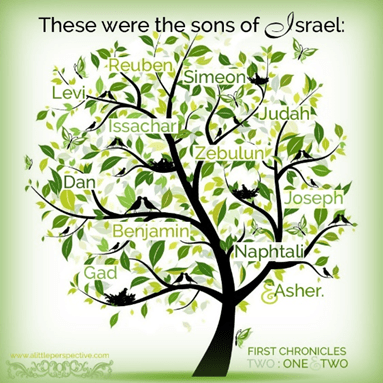
1 Chronicles 2:1 – 55 “These were the sons of Israel: Reuben, Simeon, Levi, Judah, Issachar, Zebulun, Dan, Joseph, Benjamin, Naphtali, Gad, and Asher. The sons of Judah: Er, Onan, and Shelah. These three were born to him by Bath-shua the Canaanite. Er, Judah’s firstborn, was wicked in the sight of the LORD, who put him to death. Tamar, Judah’s daughter-in-law, bore to him Perez and Zerah. Judah had five sons in all. The sons of Perez: Hezron and Hamul. The sons of Zerah: Zimri, Ethan, Heman, Calcol, and Dara —five in all.  

The son of Carmi: Achar, (the name means “troubler”) who brought trouble upon Israel by violating the ban on devoted things. The son of Ethan: Azariah. The sons who were born to Hezron: Jerahmeel, Ram, and Caleb.

Ram was the father of Amminadab, and Amminadab was the father of Nahshon, a leader of the descendants of Judah. Nahshon was the father of Salmon, and Salmon was the father of Boaz. Boaz was the father of Obed, and Obed was the father of Jesse. Jesse was the father of Eliab his firstborn; Abinadab was born second, Shimea third, Nethanel fourth, Raddai fifth,  Ozem sixth, and David seventh. Their sisters were Zeruiah and Abigail. And the three sons of Zeruiah were Abishai, Joab, and Asahel. Abigail was the mother of Amasa, whose father was Jether  the Ishmaelite.

Caleb son of Hezron had children by his wife Azubah and by Jerioth. These were the sons of Azubah: Jesher, Shobab, and Ardon. When Azubah died, Caleb married Ephrath, who bore to him Hur.  Hur was the father of Uri, and Uri was the father of Bezalel.

Later, Hezron slept with the daughter of Machir the father of Gilead. He had married her when he was sixty years old, and she bore to him Segub. Segub was the father of Jair, who had twenty-three cities in the land of Gilead. But Geshur and Aram captured Havvoth-jair, along with Kenath and its sixty surrounding villages. All these were descendants of Machir the father of Gilead.

After Hezron died in Caleb-ephrathah, his wife Abijah bore to him Ashhur the father of Tekoa.

The sons of Jerahmeel the firstborn of Hezron: Ram his firstborn, Bunah, Oren, Ozem, and Ahijah. Jerahmeel had another wife named Atarah, who was the mother of Onam.

The sons of Ram the firstborn of Jerahmeel: Maaz, Jamin, and Eker.

The sons of Onam: Shammai and Jada.

The sons of Shammai: Nadab and Abishur. Abishur’s wife was named Abihail, and she bore to him Ahban and Molid.

The sons of Nadab: Seled and Appaim. Seled died without children.

The son of Appaim: Ishi. The son of Ishi: Sheshan. The son of Sheshan: Ahlai.

The sons of Jada the brother of Shammai: Jether and Jonathan. Jether died without children. The sons of Jonathan:

Peleth and Zaza. These were the descendants of Jerahmeel.

Sheshan had no sons, but only daughters; but he did have an Egyptian servant named Jarha. Sheshan gave his daughter in marriage to his servant Jarha, and she bore to him Attai. Attai was the father of Nathan, Nathan was the father of Zabad, Zabad was the father of Ephlal, Ephlal was the father of Obed, Obed was the father of Jehu, Jehu was the father of Azariah, Azariah was the father of Helez, Helez was the father of Elasah, Elasah was the father of Sismai, Sismai was the father of Shallum, Shallum was the father of Jekamiah, and Jekamiah was the father of Elishama.

The sons of Caleb the brother of Jerahmeel: Mesha his firstborn, who was the father of Ziph, and Mareshah his second son, who was the father of Hebron. The sons of Hebron: Korah, Tappuah, Rekem, and Shema. Shema was the father of Raham the father of Jorkeam, and Rekem was the father of Shammai. 45 The son of Shammai was Maon, and Maon was the father of Beth-zur. Caleb’s concubine Ephah was the mother of Haran, Moza, and Gazez. Haran was the father of Gazez.

The sons of Jahdai: Regem, Jotham, Geshan, Pelet, Ephah, and Shaaph. Caleb’s concubine Maacah was the mother of Sheber and Tirhanah. She was also the mother of Shaaph father of Madmannah, and of Sheva father of Machbenah and Gibea. Caleb’s daughter was Acsah. These were the descendants of Caleb.

The sons of Hur the firstborn of Ephrathah: Shobal the father of Kiriath-jearim, Salma the father of Bethlehem, and Hareph the father of Beth-gader.

These were the descendants of Shobal the father of Kiriath-jearim: Haroeh, half the Manahathites, and the clans of Kiriath-jearim—the Ithrites, Puthites, Shumathites, and Mishraites. From these descended the Zorathites and Eshtaolites. The descendants of Salma: Bethlehem, the Netophathites, Atroth-beth-joab, half the Manahathites, the Zorites, and the clans of the scribes who lived at Jabez—the Tirathites, Shimeathites, and Sucathites. These are the Kenites who came from Hammath, the father of the house of Rechab.”

Again, we are confronted with a huge list of mind – numbing names and again we wonder why these lists have been preserved. But after Israel and Judah went into exile and some of the Jews returned, it was these lists that allowed those whose parents had not intermarried with Canaanites or Babylonians to prove that they were truly Jews and therefore qualified not only to remain in Israel but also to worship in the temple.

Hidden amongst these lists are all kinds of juicy stories. Take the story of Tamar, Judah’s daughter – in – law. Tamar’s husband was evil, so God killed him. Then when Judah forced his second son Onan to marry Tamar, Onan refused to impregnate her, spilling the semen on the ground because he didn’t want to raise up a son for his dead brother. This act so infuriated God that He killed Onan also. When Tamar remained without a husband, she dressed up as a prostitute and had sex with Judah. Tamar wisely collected Judah’s signet and cord and staff as pledges for when Judah learned that Tamar was pregnant, he wanted to have Tamar burned for prostituting herself. (Do note the double standard – it was fine for Judah to have sex with a prostitute but he wanted to be able to punish his daughter – in – law when he thought she had engaged in prostitution!) Tamar confronted Judah, who acknowledged that she was more righteous than he was. Perez and Zerah were the results of that intercourse.

The Rechabites, the final group, are also worthy of mention. Rechab insisted that all his descendants should maintain a Nazirite vow not to take anything made of grapes in any form whatsoever. The Rechabites herded livestock and lived in tents, only moving into the cities when they felt threatened by invaders. God used the example of the Rechabites to rebuke the nation of Judah, telling the Judeans through the prophet Jeremiah that the Rechabites obeyed their founding father while the nation of Judah refused to obey the Living God. God ordered Jeremiah to summon the leaders of the Rechabites and to then offer them wine; the Rechabites refused to drink, answering, We have obeyed the voice of Jonadab the son of Rechab, our father, in all that he commanded us, to drink no wine all our days, ourselves, our wives, our sons, or our daughters, and not to build houses to dwell in. We have no vineyard or field or seed, but we have lived in tents and have obeyed and done all that Jonadab our father commanded us.” (Jeremiah 35:8 – 10)

APPLICATION: George Santayana has told us, “Those who cannot remember the past are doomed to repeat it.” Edmund Burke in Revolution in France remarked “People will not look forward to posterity, who never look backward to their ancestors.” Centuries before Santayana or Burke, King Solomon mused that “There is nothing new under the sun.” When we refuse to learn from the mistakes of those around us or from those who have preceded us, we are setting ourselves up for disaster!

Those who compiled the Chronicles or who studied them could easily expand on these lists, recounting the stories of the failings or triumphs of their ancestors. While it might be tempting to insist that times have changed and that we are now facing stresses never before encountered by the human race, those assumptions are simply untrue. These days, we are assaulted by propaganda regarding climate change by those who refuse to acknowledge that climate change has always existed throughout the entire history of the earth. Just ask the dinosaurs! When we refuse to learn from the economic mistakes of other nations, we are preparing for failure in that sector. Just ask the people of Venezuela. The lists of such mistakes are endless and can lead to all kinds of senseless arguments.

God wants us to be wise, discerning times and seasons. If we ignore our own history or attempt to re – write it, we will never learn necessary lessons. May we allow God to open our eyes so that we will learn from the mistakes of others and will not repeat those mistakes. And may we treasure any heritage of godliness our forefathers have bequeathed to us.

PRAYER: Father God, thank You for loving us and for caring for us. Lord, help us to be wise and to learn as much as possible from our own history and from the mistakes of others. Help us to look beyond propaganda to discern Your times and seasons. In the mighty and precious Name of King Jesus. Amen.

SEPTEMBER 12, 2022 ANOTHER LOOK AT THE ISRAELITES PART 1 #1 CHRONICLES 1:1 – 54 WHY ALL THESE LISTS?

September 12, 2022

1 Chronicles 1:1 – 54 “Adam, Seth, Enosh, Kenan, Mahalalel, Jared, Enoch, Methuselah, Lamech. The sons of Noah: Shem, Ham, and Japheth. The sons of Japheth: Gomer, Magog, Madai, Javan, Tubal, Meshech, and Tiras.

The sons of Gomer: Ashkenaz, Riphath, and Togarmah. And the sons of Javan: Elishah, Tarshish, the Kittites, and the Rodanites.

The sons of Ham: Cush, Mizraim, Put, and Canaan.

The sons of Cush: Seba, Havilah, Sabta, Raamah, and Sabteca. The sons of Raamah: Sheba and Dedan. Cush was the father of Nimrod, who began to be a mighty one on the earth.

 Mizraim was the father of the Ludites, the Anamites, the Lehabites, the Naphtuhites, the Pathrusites, the Casluhites (from whom the Philistines came), and the Caphtorites.

And Canaan was the father of Sidon his firstborn, and of the Hittites, the Jebusites, the Amorites, the Girgashites,  the Hivites, the Arkites, the Sinites, the Arvadites, the Zemarites, and the Hamathites.

The sons of Shem: Elam, Asshur, Arphaxad, Lud, and Aram. The sons of Aram: Uz, Hul, Gether, and Meshech. Arphaxad was the father of Shelah, and Shelah was the father of Eber. Two sons were born to Eber: One was named Peleg, because in his days the earth was divided, and his brother was named Joktan. And Joktan was the father of Almodad, Sheleph, Hazarmaveth, Jerah, Hadoram, Uzal, Diklah, Obal, Abimael, Sheba, Ophir, Havilah, and Jobab. All these were sons of Joktan.

So from Shem came Arphaxad, Shelah, Eber, Peleg, Reu, Serug, Nahor, Terah, and Abram (that is, Abraham).

The Descendants of Abraham (Genesis 25:12–18)

The sons of Abraham were Isaac and Ishmael. These are their genealogies: Nebaioth the firstborn of Ishmael, then Kedar, Adbeel, Mibsam, Mishma, Dumah, Massa, Hadad, Tema, Jetur, Naphish, and Kedemah. These were the sons of Ishmael.

The sons born to Keturah, Abraham’s concubine: Zimran, Jokshan, Medan, Midian, Ishbak, and Shuah. The sons of Jokshan: Sheba and Dedan. The sons of Midian: Ephah, Epher, Hanoch, Abida, and Eldaah. All of these were Keturah’s sons.

Abraham was the father of Isaac. The sons of Isaac: Esau and Israel.

The Descendants of Esau (Genesis 36:1–19)

The sons of Esau: Eliphaz, Reuel, Jeush, Jalam, and Korah. The sons of Eliphaz: Teman, Omar, Zepho, Gatam, and Kenaz; and by Timna, Amalek. The sons of Reuel: Nahath, Zerah, Shammah, and Mizzah.

The Descendants of Seir (Genesis 36:20–30)

The sons of Seir: Lotan, Shobal, Zibeon, Anah, Dishon, Ezer, and Dishan. The sons of Lotan: Hori and Homam. Timna was Lotan’s sister. The sons of Shobal: Alvan, Manahath, Ebal, Shepho, and Onam.

The sons of Zibeon: Aiah and Anah. The son of Anah: Dishon. The sons of Dishon: Hemdan, r Eshban, Ithran, and Cheran. The sons of Ezer: Bilhan, Zaavan, and Akan. The sons of Dishan: Uz and Aran.

The Kings of Edom (Genesis 36:31–43)

These are the kings who reigned in the land of Edom before any king reigned over the Israelites: Bela son of Beor. His city was named Dinhabah. When Bela died, Jobab son of Zerah from Bozrah reigned in his place. When Jobab died, Husham from the land of the Temanites reigned in his place. When Husham died, Hadad son of Bedad, who defeated Midian in the country of Moab, reigned in his place. And the name of his city was Avith. When Hadad died, Samlah from Masrekah reigned in his place. When Samlah died, Shaul from Rehoboth on the Euphrates u reigned in his place. When Shaul died, Baal-hanan son of Achbor reigned in his place. When Baal-hanan died, Hadad reigned in his place. His city was named Pau, and his wife’s name was Mehetabel daughter of Matred, the daughter of Me-zahab. Then Hadad died. Now the chiefs of Edom were Timna, Alvah, Jetheth, Oholibamah, Elah, Pinon, Kenaz, Teman, Mibzar, Magdiel, and Iram. These were the chiefs of Edom.”

WHEW! If you are tired after slogging through all these names, you are not alone! Reading nothing but genealogies seems like a waste of time and many of us are tempted to rush through these lists, perhaps looking for a few familiar names and leaving the rest. What is the point of having all these lists anyway?

Oral genealogies are one means for people to maintain a heritage. Go to many small towns, particularly in the American South, and people can recite the generations of their families all the way back to the time when their families came to America. If you go to Africa, Asia, or the Middle East, these lists might be far longer. When Alex Haley wrote his landmark book Roots: The Saga of an American Family, he went back to the Gambia, where his ancestor was from originally. Haley consulted local men known as griots. “A griot is a West African storyteller, singer, musician, and oral historian. They train to excel as orators, lyricists and musicians. The griot keeps records of all the births, deaths, marriages through the generations of the village or family.” (https://www.seckoukeita.com/my-culture#:~:text=A%20griot%20is%20a%20West,of%20the%20village%20or%20family.

Using the fictional name Kunta Kinte for a real ancestor, Haley was able to trace his roots from the village of Jufureh, where Haley’s ancestor was born, to Kunta Kinte Island, the site of the slave fort from which slaves were taken to America. (The island was originally named James Island but was re-named Kunta Kinte Island in 2011 and is a UNESCO World Heritage site.)

Haley’s book sparked a revolution as many African Americans began investigating their own families. Despite the destruction of many records, families managed to maintain this information by oral traditions handed down through generations.

The desire to claim one’s heritage is by no means limited to one group of people. In Scotland, the term “Mc” or “Mac” refers to one’s lineage. In Ireland, the “O” as in “O’ Neil” serves a similar purpose. Examples exist throughout the world. Such names emphasize that we exist as real people, as individuals, and that we are persons of significance.

The lists in the first few chapters of 1 Chronicles serve to explain who the Jews are and where they have come from, as well as the origins of the neighboring tribes. What else is important about these lists?

God knows all our names! Many times, we wonder if we matter to anyone apart from our families and friends. But these lists are proof positive that we matter to God; after all, look at all the otherwise obscure people whose names appear on these lists. And if God knows our names, then God knows everything else about us as well. We don’t have to agonize about our significance; we matter to God! Our fingerprints, our DNA, everything about us is unique. Anyone who follows CSI programs on TV knows that DNA tracing has now become a very big deal because of its specificity. These days, prisoners who have been falsely accused are being freed when evidence is reviewed and DNA testing is carried out.

If we matter so much to God, why don’t we worship and praise Him? Why not follow the One who knows us better than we know ourselves?

PRAYER: Father God, thank You for loving us and for caring for us. Lord, help us to realize how very much You do care and how much You have done for us. You have given us life and breath. You continue to sustain us. Lord, thank You for all that You do! Help us to worship You in spirit and in truth. In the matchless Name of King Jesus. Amen.  

SEPTEMBER 11, 2022 SPIRITUAL BLACK HOLES PART 2 #49 2 KINGS 25:22 – 30 GEDALIAH IS MURDERED AND JUDEANS FLEE TO EGYPT

September 11, 2022

Gedaliah Governs in Judah (Jeremiah 40:1–16)

2 Kings 25:22 – 30 Nebuchadnezzar king of Babylon appointed Gedaliah son of Ahikam, the son of Shaphan, over the people he had left behind in the land of Judah.

When all the commanders of the armies and their men heard that the king of Babylon had appointed Gedaliah as governor, they came to Gedaliah at Mizpah—Ishmael son of Nethaniah, Johanan son of Kareah, Seraiah son of Tanhumeth the Netophathite, and Jaazaniah son of the Maacathite, as well as their men. And Gedaliah took an oath before them and their men, assuring them, “Do not be afraid of the servants of the Chaldeans. Live in the land and serve the king of Babylon, and it will be well with you.”

The Murder of Gedaliah (Jeremiah 41:1–10)

In the seventh month, however, Ishmael son of Nethaniah, the son of Elishama, who was a member of the royal family, came with ten men and struck down and killed Gedaliah, along with the Judeans and Chaldeans who were with him at Mizpah. Then all the people small and great, together with the commanders of the army, arose and fled to Egypt for fear of the Chaldeans.

Jehoiachin Released from Prison (Jeremiah 52:31–34)

On the twenty-seventh day of the twelfth month of the thirty-seventh year of the exile of Judah’s King Jehoiachin, in the year Evil-merodach became king of Babylon, he released King Jehoiachin of Judah from prison. And he spoke kindly to Jehoiachin and set his throne above the thrones of the other kings who were with him in Babylon.

So Jehoiachin changed out of his prison clothes, and he dined regularly at the king’s table for the rest of his life. And the king provided Jehoiachin a daily portion for the rest of his life.”

By all accounts, Gedaliah was a just and righteous man. Appointed by the Babylonians as the interim ruler, Gedaliah had gained the trust of many of the remnant left in Judah. But the king of the Ammonites hated Judah and poisoned the mind of Ishmael son of Nethaniah, one of the royal family, who must have fled to the Ammonite court to escape the Babylonians. Perhaps Ishmael assumed that the Babylonians would crown him as some kind of ruler and was insulted when Gedaliah was chosen instead. The king of the Ammonites rightly assumed that if a remnant was left in Judah, the nation might regenerate and become a threat to him again.

According to Jeremiah 41:1 – 10, Ishmael and ten men came to Gedaliah at Mizpah and ate with Gedaliah. Traditionally, breaking bread with a man prevented you from attacking him; however, Ishmael took this opportunity to kill Gedaliah, all the Jews who were with Gedaliah at Mizpah, and the Babylonian soldiers stationed there. Not content with murdering Gedaliah and his supporters in Jerusalem, Ishmael went on to slaughter seventy men from Shechem, Shiloh, and Samaria who were coming to worship the Lord in Jerusalem. Generations ago, Asa, king of Judah, had created a huge cistern in Jerusalem; now Ishmael filled that cistern with bodies. Scooping up all the rest of the people left in Mizpah, Ishmael attempted to take these people off to the Ammonites. But an army commander named Johanan attacked Ishmael, forcing him to give up his captives and flee back to Ammon.

After these disasters, those left in Judah were terrified of reprisals from the Babylonians and traveled to Egypt, ignoring warnings from the prophet Jeremiah. For centuries God had warned the Israelites not to rely on Egypt or to return to Egypt; however, they refused to listen. Eventually, the Babylonians conquered Egypt, making the disaster of Judah complete. But the memory of righteous Gedaliah lives on, honored by Tzom Gedaliah, the Fast of Gedaliah, which the Jews observe one or two days after Rosh Hashana. According to the site https://chabad.org (The confusion resulting from Ishmael’s treachery) also caused the Jews to flee to Egypt, effectively ending the prospects of Jewish settlement in the Holy Land until the return of the Babylonian exiles in the year 3390 (371 BCE).1 Thus, the Babylonian exile was absolute, and Judea was left bereft of her children.”

The Book of 2 Kings ends with a description of the eventual fate of King Jehoiachin. Even in exile, God gave Jehoiachin favor with Evil – merodach (Amel – Marduk), the new king of Babylon. Remember that Jehoiachin was an evil king; however, Amel – Marduk not only released Jehoiachin from prison after 37 years, but elevated his throne above all those of the other kings captive in Babylon. Jehoiachin exchanged his prison clothes for much better garments and dined at the royal table for the rest of his life. What happened? According to the site https://artzabox.com , “When Nebuchadnezzar died, his son Amel-Marduk (evil-Merodach or awel-Marduk) took over. He released Jehoiachin after 37yrs of imprisonment. He may have been influenced by God; sought favor with the Jews; felt compassion or Amel-Marduk may have spent time imprisoned where he befriended Jehoiachin.” Perhaps Nebuchadnezzar had imprisoned his own son, trying to avoid assassination. Perhaps during those long decades in prison, Jehoiachin finally repented and turned to the Lord.

APPLICATION: Good does not always triumph in the short – term! By all accounts, Gedaliah was a great man, and yet out of jealousy, Ishmael slaughtered Gedaliah and all those with him. There were those who tried to warn Gedaliah about Ishmael; however, Gedaliah refused to believe them. Obviously, personal ambition trumped patriotism as far as Ishmael was concerned. Eventually, Ishmael escaped back to the Ammonites, having lost two of his original ten men. Sometimes the righteous do suffer and die.

When trouble comes, whom do we trust? Where do we run? Even after Ishmael created such confusion, the Jews could still have remained in Judea as Jeremiah urged them to do. But for centuries, the Israelites had had a knee jerk reaction to trouble – to depend on Egypt in some fashion rather than trusting in God. Now, nothing had changed, and the remnant of Judah insisted on running to Egypt. Not long after that, the Babylonians invaded Egypt as well. Do we have a go – to plan that ignores God?

God’s mercy is far greater than we can possibly imagine. Jehoiachin only reigned for a few years, but he proved to be just as idolatrous as his predecessors. Certainly, Jehoiachin deserved to be carried off to Babylon and thrown into prison for the rest of his life… and yet… and yet, after Nebuchadnezzar died, Amel – Marduk brought Jehoiachin out of prison and treated him with unusual honor and kindness for the rest of his life. Only the grace of Almighty God could move a Babylonian ruler to treat the king of a small country in such a fashion.

Many times, we ask God to bless us, even though we don’t deserve it. And God graciously helps us and gives us even more than we have asked for. We don’t know if Jehoiachin was grateful to God when he was delivered from prison; however, we owe God everything. Today, while we can, let us praise God and bless Him for His mercy and grace!

PRAYER: Father God, thank You for loving us and for caring for us. Lord, help us to follow hard after You all the days of our lives. Help us to be grateful, for indeed, we owe You everything. And help us to praise You with every fiber of our beings! In the matchless Name of King Jesus. Amen.