Archive for September, 2022

SEPTEMBER 10, 2022 SPIRITUAL BLACK HOLES PART 2 # 48 2 KINGS 25:1 – 20 JUDAH FINALLY GOES INTO EXILE

September 10, 2022

2 Kings 25:1 – 20 “So in the ninth year of Zedekiah’s reign, on the tenth day of the tenth month, Nebuchadnezzar king of Babylon marched against Jerusalem with his entire army. They encamped outside the city and built a siege wall all around it. And the city was kept under siege until King Zedekiah’s eleventh year.

By the ninth day of the fourth month, the famine in the city was so severe that the people of the land had no food. Then the city was breached; and though the Chaldeans had surrounded the city, all the men of war fled by night by way of the gate between the two walls near the king’s garden.

They headed toward the Arabah, (the plain of the Jordan) but the army of the Chaldeans pursued the king and overtook him in the plains of Jericho, and all his army was separated from him. The Chaldeans seized the king and brought him up to the king of Babylon at Riblah, where they pronounced judgment on him. And they slaughtered the sons of Zedekiah before his eyes. Then they put out his eyes, bound him with bronze shackles, and took him to Babylon.

The Temple Destroyed (Jeremiah 52:12–23) On the seventh day of the fifth month, in the nineteenth year of Nebuchadnezzar’s reign over Babylon, Nebuzaradan captain of the guard, a servant of the king of Babylon, entered Jerusalem. He burned down the house of the LORD, the royal palace, and all the houses of Jerusalem—every significant building. And the whole army of the Chaldeans under the captain of the guard broke down the walls around Jerusalem.

Then Nebuzaradan captain of the guard carried into exile the people who remained in the city, along with the deserters who had defected to the king of Babylon and the rest of the population. But the captain of the guard left behind some of the poorest of the land to tend the vineyards and fields. Moreover, the Chaldeans broke up the bronze pillars and stands and the bronze Sea in the house of the LORD, and they carried the bronze to Babylon.  They also took away the pots, shovels, wick trimmers, dishes, and all the articles of bronze used in the temple service. The captain of the guard also took away the censers and sprinkling bowls—anything made of pure gold or fine silver.

As for the two pillars, the Sea, and the movable stands that Solomon had made for the house of the LORD, the weight of the bronze from all these articles was beyond measure. Each pillar was eighteen cubits tall. The bronze capital atop one pillar was three cubits high, with a network of bronze pomegranates all around. The second pillar, with its network, was similar.

Captives Carried to Babylon (Jeremiah 52:24–30)

The captain of the guard also took away Seraiah the chief priest, Zephaniah the priest of second rank, and the three doorkeepers. Of those still in the city, he took a court official who had been appointed over the men of war, as well as five royal advisors. He also took the scribe of the captain of the army, who had enlisted the people of the land, and sixty men who were found in the city.

Nebuzaradan captain of the guard took them and brought them to the king of Babylon at Riblah. There at Riblah in the land of Hamath, the king of Babylon struck them down and put them to death. So Judah was taken into exile, away from its own land.”

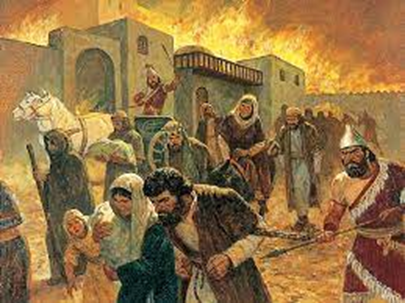
It finally happened! After centuries of warnings from God, after prophecy upon prophecy, after reforms that only lasted for a few moments, Jerusalem has finally fallen to the Babylonians. The Babylonians have built a siege wall and have starved out the citizens of Jerusalem. When the king and his men attempt to escape by night, they are hunted down on the plains close to Jericho. King Zedekiah is brought to Nebuchadnezzar, where Nebuchadnezzar pronounces judgement, slays Zedekiah’s sons before him, and then blinds Zedekiah, so that the last visual image he can remember will be watching his sons die a horrible death. Had Zedekiah not rebelled against the Babylonians, his sons would still be alive and he would not be blind; now Zedekiah has lost everything and will be carried off in shackles to Babylon.

The Babylonians collect any prominent men who might lead or organize a rebellion and slaughter them. Jerusalem is burned and all the treasures of Solomon’s temple are looted and sent to Nineveh. Most of the people of Jerusalem are carried off to Babylon, leaving only the very poor to tend the vineyards and the fields.

APPLICATION: 2 Peter 3:9 tells us, The Lord is not slow in keeping his promise, as some understand slowness. Instead, he is patient with you, not wanting anyone to perish, but everyone to come to repentance.” God has given the nation of Judah a plenitude of opportunities to repent, but its people have persisted in idolatry, murder, child sacrifice, and so many other demonic practices. King Manasseh and others have repeatedly shed innocent blood to the point that the ground is crying out to God. When God has sent prophets, they have been ignored, beaten, imprisoned, and slaughtered. Finally, God is ringing down the curtain on the nation of Judah, and the Babylonians have taken over completely.

There are a number of people in different situations, all of whom believe that they can do anything they want and then repent on their death beds. But what if something happens so suddenly that there is no time for repentance? Strokes, heart attacks, motor vehicle accidents, and other calamities can occur at any time. None of us has control over the circumstances of our death. 2 Corinthians 6:2 says, “For he says, “In the time of my favor I heard you, and in the day of salvation I helped you.” I tell you, now is the time of God’s favor, now is the day of salvation.”

For centuries, the citizens of Judah went their way, trusting that they could always turn back to God; however, the further they got from God, the less desirable repentance appeared. Eventually, those people’s hearts were so hard that they had no interest in repentance. Nothing has changed, and the same thing can happen to us. Today is the only day that we have. Now is the time to turn back to God, confess our sins, and repent.

PRAYER: Father God, thank You for loving us and for caring for us. Lord, we confess that we have sinned and are sinning and that nothing we do is good enough to cancel out that sin. Please save us and deliver us from our sins. Help us to follow hard after You all the days of our lives and to trust in You and not in ourselves. Help us to worship only You and nothing else. In the matchless Name of King Jesus. Amen.

SEPTEMBER 9, 2022 SPIRIUTAL BLACK HOLES PART 2 #47 2 KINGS 24:1 – 19 WHEN YOU’RE IN THE BOTTOM OF A HOLE, STOP DIGGING!!!

September 9, 2022

2 Kings 24:1 – 17 “During Jehoiakim’s reign, Nebuchadnezzar king of Babylon invaded. So Jehoiakim became his vassal for three years, until he turned and rebelled against Nebuchadnezzar.

And the LORD sent Chaldean, Aramean, Moabite, and Ammonite raiders against Jehoiakim in order to destroy Judah, according to the word that the LORD had spoken through His servants the prophets. Surely this happened to Judah at the LORD’s command, to remove them from His presence because of the sins of Manasseh and all that he had done, and also for the innocent blood he had shed. For he had filled Jerusalem with innocent blood, and the LORD was unwilling to forgive. As for the rest of the acts of Jehoiakim, along with all his accomplishments, are they not written in the Book of the Chronicles of the Kings of Judah?

Jehoiachin Reigns in Judah (2 Chronicles 36:9–10)

And Jehoiakim rested with his fathers, and his son Jehoiachin reigned in his place.

Now the king of Egypt did not march out of his land again, because the king of Babylon had taken all his territory, from the Brook of Egypt to the Euphrates River.

Jehoiachin was eighteen years old when he became king, and he reigned in Jerusalem three months. His mother’s name was Nehushta daughter of Elnathan; she was from Jerusalem. And he did evil in the sight of the LORD, just as his father had done.

The Captivity of Jerusalem (Lamentations 1:1–22)

At that time the servants of Nebuchadnezzar king of Babylon marched up to Jerusalem, and the city came under siege. And Nebuchadnezzar king of Babylon came to the city while his servants were besieging it. Jehoiachin king of Judah, his mother, his servants, his commanders, and his officials all surrendered to the king of Babylon.

So in the eighth year of his reign, the king of Babylon took him captive. As the LORD had declared, Nebuchadnezzar also carried off all the treasures from the house of the LORD and the royal palace, and he cut into pieces all the gold articles that Solomon king of Israel had made in the temple of the LORD. He carried into exile all Jerusalem—all the commanders and mighty men of valor, all the craftsmen and metalsmiths—ten thousand captives in all. Only the poorest people of the land remained.

Nebuchadnezzar carried away Jehoiachin to Babylon, as well as the king’s mother, his wives, his officials, and the leading men of the land. He took them into exile from Jerusalem to Babylon. The king of Babylon also brought into exile to Babylon all seven thousand men of valor and a thousand craftsmen and metalsmiths—all strong and fit for battle.

Then the king of Babylon made Mattaniah, Jehoiachin’s uncle, king in his place and changed his name to Zedekiah.”

Zedekiah was twenty-one years old when he became king, and he reigned in Jerusalem eleven years. His mother’s name was Hamutal daughter of Jeremiah; she was from Libnah.

And Zedekiah did evil in the sight of the LORD, just as Jehoiakim had done. For because of the anger of the LORD, all this happened in Jerusalem and Judah, until He finally banished them from His presence. And Zedekiah also rebelled against the king of Babylon.”

This passage can be quite confusing with so many kings in such a short time. King Josiah picked an unnecessary fight with Pharaoh Neco, dying as a result. When Jehoahaz, one of Josiah’s sons succeeded him, Neco returned, capturing Jehoahaz and taking him off to Egypt. In Jehoahaz’s place, Pharaoh Neco made his brother king and named him Jehoiakim. At this point, Babylon was the super power dominating the entire Middle East. When Babylon invaded Judah, Jehoiakim became a Babylonian vassal for three years and then rebelled. This ridiculous action caused the Babylonians to eventually return and to squish the nation of Judah like a small loathsome bug.

Jehoiakim ruled for eleven years in total and was succeeded by his son Jehoiachin, age eighteen. By this point, Nebuchadnezzar had conquered all the Egyptian territory, so Egypt could not help Judah anymore. Jehoiachin reigned a total of eight years, much of that during a Babylonian siege. When the Babylonians finally took Jerusalem, they carried ten thousand captives back to Babylon, including the royal family, the commanders, soldiers, and craftsmen. To govern Judah, Nebuchadnezzar made Jehoiachin’s twenty – one year old uncle king and changed his name to Zedekiah. Zedekiah was foolish enough to rebel against the Babylonians. It was Zedekiah’s rebellion that eventually led to Judah’s complete destruction.

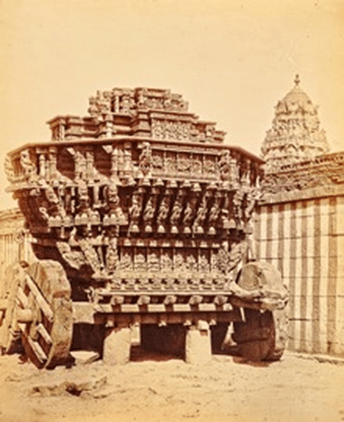
Text Box: Juggernaut cart in the Ulsoor temple complex in Bangalore, India, around 1870

Text Box: Juggernaut cart in the Ulsoor temple complex in Bangalore, India, around 1870

APPLICATION: At one time, Hindu worship in parts of India involved massive chariots that would parade through the streets bearing images of various gods. These chariots were referred to as Jagannath, a Sanskrit word that was later changed to Juggernaut in English. According to the Cambridge Dictionary, the meaning of Juggernaut is “a massive inexorable force, campaign, movement, or object that crushes whatever is in its path.” At this point in time, the Babylonians have become a juggernaut, an unstoppable force that will eventually even flatten Egypt. Rebelling against such might should seem lunacy; however, two of these weak kings in the tiny nation of Judah rebel anyway. The first rule of holes is that if you are at the bottom of one, STOP DIGGING!

Spiritually, Judah is plummeting into a morass. Josiah’s reforms have been abandoned, and his successors have whole – heartedly embraced idolatry. God is using these rebellions to attract Babylonian attention so that they will destroy Judah as a nation. Repeatedly God cites the sins of Manasseh, particularly the fact that he filled Jerusalem with innocent blood and God is unwilling to forgive.

Deuteronomy 19:10 tells us, “Lest innocent blood be shed in your land that the Lord your God is giving you for an inheritance, and so the guilt of bloodshed be upon you.” The shedding of innocent blood brings curses on a land. Not only did Manasseh murder the innocent, but all those who made child sacrifices did the same thing as well. Murdering the innocent in any form, including abortion, will bring curses on a country.

If not for Josiah, Judah’s destruction might have come even sooner. But after Josiah died, his successors worshiped demons and eventually the nation reaped the horrible result. Were there any righteous people left in Judah? Possibly. And God may well have protected the righteous; however, the persistent sins of Judah’s rulers and the bulk of the population could not be ignored.

What can we learn from the sad story of the decline of the nation of Judah? God wanted Judah to be a praise in all the earth, but its citizens insisted on worshiping demons and slaughtering the innocent. Judah was crushed by the Babylonian juggernaut and many of its citizens went into exile. No matter where we live in the world, we much pray and intercede for the nations! Only persistent and consistent intercessory prayer can prevent national disasters. The site Operation World has great prayer resources that will help you pray intelligently for all the nations of the world in a year.

PRAYER: Father God, thank You for loving us and for caring for us. Lord, we confess that we have not prayed as we should for our nation or for other nations. Lord, help us to pray as You want us to and not to give up! In the mighty and precious Name of King Jesus. Amen.

SEPTEMBER 8, 2022 SPIRITUAL BLACK HOLES PART 2 #46 2 KINGS 23:31 – 37 “CHILDHOOD IS A TERRIBLE THING TO WASTE!”

September 8, 2022

2 Kings 23:31 – 37 “Jehoahaz was twenty-three years old when he became king, and he reigned in Jerusalem three months. His mother’s name was Hamutal daughter of Jeremiah; she was from Libnah. And he did evil in the sight of the LORD, just as his fathers had done.

And Pharaoh Neco imprisoned Jehoahaz at Riblah in the land of Hamath so that he could not reign in Jerusalem, and he imposed on Judah a levy of a hundred talents of silver and a talent of gold. Then Pharaoh Neco made Eliakim son of Josiah king in place of his father Josiah, and he changed Eliakim’s name to Jehoiakim. But Neco took Jehoahaz and carried him off to Egypt, where he died. (100 talents is approximately 3.77 tons or 3.42 metric tons of silver. A talent is approximately 75.4 pounds or 34.2 kilograms of gold.)

So Jehoiakim paid the silver and gold to Pharaoh Neco, but to meet Pharaoh’s demand he taxed the land and exacted the silver and the gold from the people, each according to his wealth.

Jehoiakim Reigns in Judah (2 Chronicles 36:5–8)

Jehoiakim was twenty-five years old when he became king, and he reigned in Jerusalem eleven years. His mother’s name was Zebidah daughter of Pedaiah; she was from Rumah. And he did evil in the sight of the LORD, just as his fathers had done.”

When King Josiah took off to fight Pharaoh Neco despite Neco’s warnings, he really left Judah in a mess! Josiah was only 39 when he died, meaning that he must have fathered Jehoahaz when he was 16 years old. There are very few 16 year – olds who are qualified to be fathers, and in addition, Josiah’s father was Amon, a man so evil that his own servants murdered him. Josiah had no idea of the role of a father and undoubtedly left his son to the care of his mother.

Jehoahaz’s mother was a girl from Libnah, a city near the western seaboard of Israel. Libnah was a wealthy city that rebelled against King Jehoram of Judah; the citizens of Libnah most likely did not worship the God of Israel. Sixteen year – old Josiah probably fell in love with a physically beautiful girl without regard for her spiritual status. It is notable that some authorities claim that Josiah began to actively worship God when he was sixteen. Perhaps this young woman was Satan’s way of trying to dissuade Josiah from worshiping God. Once more, we see the horrible results when a believer becomes involved with a handsome non – believer. In this particular case, Josiah wound up as a sanctified sperm donor!

If Josiah had simply stayed home, things might have been far different for the land of Judah. Pharaoh Neco had no quarrel with Judah until Josiah insisted on attacking him, and it’s likely that Neco would have left Judah alone. But after Josiah’s death, Jehoahaz took over and reigned in Jerusalem for three months. Three months was long enough for everyone to realize that Jehoahaz was just as evil as his grandfather Amon had been. Neco was returning from Assyria and stopped in to deal with this small upstart nation that had so foolishly attacked him. Imprisoning Jehoahaz in Riblah, a town near Jericho, Neco imposed a huge levy on Judah, crowned Eliakim, a second son of Josiah, as king of Judah, and changed Eliakim’s name to Jehoiakim. “Eliakim” means “God will establish,” or “God rises.” “Jehoiakim” means “established by God.” This name change might indicate Pharaoh’s view of himself as a god with god – like powers to establish kings. Neco then carried Jehoahaz off to Egypt, where he died.  

Unfortunately, Jehoiakim proved to be just as bad as his brother. Jehoiakim’s mother was from a town close to Israel and was probably another idol worshiper. Once more, Josiah failed to teach a son the ways of the Lord and once more the nation paid dearly as a result. Jehoiakim continued the idol worship his brother had reinstituted.

APPLICATION: Absent/occupied/over – committed fatherhood! It’s been a problem ever since the human race began, and the sad story of Josiah’s sons amply illustrates the bad results. Josiah ran around the countryside destroying high places, Asherah poles, and idols of every sort. But while Josiah was busy bringing in revival, he took no thought for those little boys back at the palace. The mothers of these boys were idolaters, not believers, and so they taught their sons the ways of their religion, not of Josiah’s. It’s even possible that these women were secretly rebelling against Josiah, undermining him at the palace while he was traveling around Judah and Israel bringing in reforms.

Obviously, not everyone in Judah was happy about these reforms, even if the leaders did turn up at the temple swearing oaths. Idolatry has always been big business! In St. Paul’s day, silversmiths and others in Ephesus rioted because Paul was preaching the Gospel, undermining the business generated by the huge temple of Diana in Ephesus. It’s quite likely that in Josiah’s day, there were those who had been making lots of money from statues, veils, offerings of various kinds, etc. Evil never totally goes away; it merely goes underground for a while. Today, those worshiping various athletic teams, movie stars, etc., can purchase all kinds of fan paraphernalia to satisfy their desire for worship. It’s likely that those business people depending on idolatry simply withdrew a little, trusting that the next ruler would prove far more malleable. And they were right!

Harry Chapin brought out his song “Cat’s in the Cradle” in 1974 depicting the sadness of a father preoccupied with everything apart from his son. The words continue to haunt as they accurately depict the tragedy of a father who never has time for his son, only to realize that now his son has no time for him. May God help us, that as we read these words, we resolve to reach out to the children around us while we can and teach them the ways of God!  

“My child arrived just the other day
He came to the world in the usual way
But there were planes to catch, and bills to pay
He learned to walk while I was away
And he was talking ‘fore I knew it, and as he grew
He’d say “I’m gonna be like you, dad”
“You know I’m gonna be like you”

Chorus: And the cat’s in the cradle and the silver spoon
Little boy blue and the man in the moon
“When you coming home, dad?” “I don’t know when”
But we’ll get together then
You know we’ll have a good time then

My son turned ten just the other day
He said, thanks for the ball, dad, come on let’s play
Can you teach me to throw, I said-a, not today
I got a lot to do, he said, that’s okay
And he, he walked away, but his smile never dimmed
It said, I’m gonna be like him, yeah
You know I’m gonna be like him

Well, he came from college just the other day
So much like a man I just had to say
Son, I’m proud of you, can you sit for a while?
He shook his head, and they said with a smile
What I’d really like, dad, is to borrow the car keys
See you later, can I have them please?

And the cat’s in the cradle and the silver spoon
Little boy blue and the man in the moon
“When you coming home, son?” “I don’t know when”
But we’ll get together then, dad
You know we’ll have a good time then

 I’ve long since retired, my son’s moved away
I called him up just the other day
I said, I’d like to see you if you don’t mind
He said, I’d love to, dad, if I can find the time
You see, my new job’s a hassle, and the kids have the flu
But it’s sure nice talking to you, dad
It’s been sure nice talking to you
And as I hung up the phone, it occurred to me
He’d grown up just like me
My boy was just like me

PRAYER: Father God, help us to follow hard after You all the days of our lives and to teach our children to do so as well. Help us to realize that as parents, our first responsibility is not to a job or to our community, but to our families, to encourage them to worship You. In the mighty and precious Name of King Jesus. Amen.

SEPTEMBER 7, 2022 SPIRITUAL BLACK HOLES PART 2 #45 2 KINGS 23:21 – 30 JOSIAH BLAZES A SPIRITUAL TRAIL ACROSS THE SKY AND THEN DIES – BUT IS THIS DEATH PREMATURE?

September 7, 2022

2 Kings 23:21 -30 “The king commanded all the people, “Keep the Passover of the LORD your God, as it is written in this Book of the Covenant.”

No such Passover had been observed from the days of the judges who had governed Israel through all the days of the kings of Israel and Judah. But in the eighteenth year of Josiah’s reign, this Passover was observed to the LORD in Jerusalem.

Furthermore, Josiah removed the mediums and spiritists, the household gods and idols, and all the abominations that were seen in the land of Judah and in Jerusalem. He did this to carry out the words of the law written in the book that Hilkiah the priest had found in the house of the LORD.

Neither before nor after Josiah was there any king like him, who turned to the LORD with all his heart and with all his soul and with all his strength, according to all the Law of Moses.

Nevertheless, the LORD did not turn away from the fury of His burning anger, which was kindled against Judah because of all that Manasseh had done to provoke Him to anger. For the LORD had said, “I will remove Judah from My sight, just as I removed Israel. I will reject this city Jerusalem, which I chose, and the temple of which I said, ‘My Name shall be there.’ ”

The Death of Josiah (2 Chronicles 35:20–24)

As for the rest of the acts of Josiah, along with all his accomplishments, are they not written in the Book of the Chronicles of the Kings of Judah?

At the end of Josiah’s reign, Pharaoh Neco king of Egypt marched up to help the king of Assyria at the Euphrates River. King Josiah went out to confront him, but Neco faced him and killed him at Megiddo.

From Megiddo his servants carried his body in a chariot, brought him to Jerusalem, and buried him in his own tomb. Then the people of the land took Jehoahaz son of Josiah, anointed him, and made him king in place of his father.”

Amazing! From the time of the judges onward, the celebration of Passover has become a hit or miss thing, and mostly a miss. Even righteous King David and King Hezekiah have not observed Passover as they should. But now at age 26, Josiah is celebrating a Passover, the likes of which will never be seen again. What makes this Passover so different from those that have gone before? Josiah has cleansed the land and is continuing to do so; consequently, the Holy Spirit is able to descend in a manner previously unknown.   

Furthermore, Josiah removed the mediums and spiritists, the household gods and idols, and all the abominations that were seen in the land of Judah and in Jerusalem. He did this to carry out the words of the law written in the book that Hilkiah the priest had found in the house of the LORD.” The spiritual climate in Judah is better than it has been in years, perhaps ever since the Israelites crossed the Jordan River under Joshua. Mediums and spiritists leave the kingdom or die as prescribed in Deuteronomy. Josiah even succeeds in getting rid of the household gods, those little idols that people keep as family traditions and worship when nobody is looking. This cleansing ushers in a new spiritual era, one in which peace prevails in Jerusalem.

APPLICATION: The tragedy of Josiah is his death at age 39 in a senseless battle. How much do we value the ministries that God has given each of us? Even though Josiah has brought enormous reforms to Judah and Samaria, ultimately, he risks everything to fight a much more powerful ruler. Even the man Josiah is attacking tries to warn him to stay home, but Josiah refuses to listen. 2 Chronicles 35:20 – 21 tells us, “After all this, when Josiah had set the temple in order, Neco king of Egypt marched up to fight at Carchemish by the Euphrates, and Josiah went out to confront him. But Neco sent messengers to him, saying, “What is the issue between you and me, O king of Judah? I have not come against you today, but I am fighting another dynasty. God told me to hurry; so stop opposing God, who is with me, or He will destroy you!”

Pharaoh Neco is en route to the Euphrates River when Josiah foolishly decides to attack him. Neco actually tries to avoid a fight; however, Josiah insists and is killed. Is Josiah’s death premature, brought on by his own pride? Does Josiah value his reforms so little that he fails to consider what will happen after his death? Certainly, those kings who follow Josiah are terrible, reverting right back to idolatry. Does Josiah consult God before going out after Pharaoh Neco? Is Josiah becoming tired of reform due to an underground movement back toward idolatry? All we know is that Josiah dies at age 39 and his 23 year – old son succeeds him.

One of the biggest mistakes we can make is to view the ministries that God has given us as OUR ministries! God calls us and empowers us, providing and protecting us. Just as we have no control over that call and the beginning of our ministry, so we also have no control over the scope of the ministry, its expansion, or even when it should end. When Jezebel threatened to kill the prophet Elijah, Elijah was ready to give up and die; however, God refused to allow him to do so. Instead of Elijah winding up as a pile of bones in an obscure cave in the wilderness, God re – commissioned him and eventually took him to heaven in a fiery chariot. Big difference!

Josiah is going to die at some point; the prophetess Huldah has already informed him that God will remove him before Judah suffers its final fate. But Pharaoh Neco insists that God is sending him to the Euphrates and that Josiah should simply leave him alone; instead, Josiah refuses to listen and dies as a result. God allows Josiah to exercise free will to make this poor choice; however, I contend that dying in this fashion is not God’s best for Josiah. Were Josiah to live a few years longer, his reforms would be firmly established and the result might be a withholding of God’s retribution on Judah. But as soon as Josiah dies, his son leads the nation right back into idolatry.

Let us make sure that we not only serve God with our whole hearts but also hang in there and continue to serve Him until He chooses to take us to be with Him. Remember, God is in management; we are only in advertising.

PRAYER: Father God, thank You for loving us and for caring for us. Lord, help us to be sensitive to Your timing and to keep to Your schedule, not our own. To the praise and glory of Your holy Name. Amen.

SEPTEMBER 6, 2022 SPIRITUAL BLACK HOLES PART 2 #442 KINGS 23:1 – 20 JOSIAH REDUCES IDOLS TO RUBBLE

September 6, 2022

2 Kings 23:1 – 20 “Then the king summoned all the elders of Judah and Jerusalem. And he went up to the house of the LORD with all the people of Judah and Jerusalem, as well as the priests and the prophets—all the people small and great—and in their hearing he read all the words of the Book of the Covenant that had been found in the house of the LORD. So the king stood by the pillar and made a covenant before the LORD to follow the LORD and to keep His commandments, decrees, and statutes with all his heart and all his soul, and to carry out the words of this covenant that were written in this book. And all the people entered into the covenant.

Josiah Destroys Idolatry (1 Kings 13:1–10; 2 Chronicles 34:3–7)

Then the king commanded Hilkiah the high priest, the priests second in rank, and the doorkeepers to remove from the temple of the LORD all the articles made for Baal, Asherah, and all the host of heaven. And he burned them outside Jerusalem in the fields of Kidron and carried their ashes to Bethel.

Josiah also did away with the idolatrous priests ordained by the kings of Judah to burn incense on the high places of the cities of Judah and in the places all around Jerusalem—those who had burned incense to Baal, to the sun and moon, to the constellations, and to all the host of heaven.

He brought the Asherah pole from the house of the LORD to the Kidron Valley outside Jerusalem, and there he burned it, ground it to powder, and threw its dust on the graves of the common people. He also tore down the quarters of the male shrine prostitutes that were in the house of the LORD, where the women had woven tapestries for Asherah.

Then Josiah brought all the priests from the cities of Judah and desecrated the high places, from Geba to Beersheba, where the priests had burned incense. He tore down the high places of the gates at the entrance of the gate of Joshua the governor of the city, which was to the left of the city gate. Although the priests of the high places did not come up to the altar of the LORD in Jerusalem, they ate unleavened bread with their fellow priests.

He also desecrated Topheth in the Valley of Ben-hinn so that no one could sacrifice his son or daughter in the fire  to Molech. And he removed from the entrance to the house of the LORD the horses that the kings of Judah had dedicated to the sun. They were in the court near the chamber of an official named Nathan-melech. And Josiah burned up the chariots of the sun.

He pulled down the altars that the kings of Judah had set up on the roof near the upper chamber of Ahaz, and the altars that Manasseh had set up in the two courtyards of the house of the LORD. The king pulverized them there  and threw their dust into the Kidron Valley.

The king also desecrated the high places east of Jerusalem, to the south of the Mount of Corruption, which King Solomon of Israel had built for Ashtoreth the abomination of the Sidonians, for Chemosh the abomination of the Moabites, and for Milcom the abomination of the Ammonites. He smashed the sacred pillars to pieces, cut down the Asherah poles, and covered the sites with human bones.

He even pulled down the altar at Bethel, the high place set up by Jeroboam son of Nebat, who had caused Israel to sin. Then he burned the high place, ground it to powder, and burned the Asherah pole. And as Josiah turned, he saw the tombs there on the hillside, and he sent someone to take the bones out of the tombs, and he burned them on the altar to defile it, according to the word of the LORD proclaimed by the man of God who had foretold these things.

Then the king asked, “What is this monument I see?”

And the men of the city replied, “It is the tomb of the man of God who came from Judah and pronounced these things that you have done to the altar of Bethel.” “Let him rest,” said Josiah. “Do not let anyone disturb his bones.”

So they left his bones undisturbed, along with those of the prophet who had come from Samaria.

Just as Josiah had done at Bethel, so also in the cities of Samaria he removed all the shrines of the high places set up by the kings of Israel who had provoked the LORD to anger. On the altars he slaughtered all the priests of the high places, and he burned human bones on them. Then he returned to Jerusalem.”

Just when things look completely bleak spiritually for the nation of Judah, God sends King Josiah. How Josiah has been mentored or who has mentored him, is not recorded. But from the age of sixteen onwards for the next twenty – three years, Josiah unleashes one of the most amazing revivals in history. By this point, Jerusalem and the whole of Judah are chock full of idols, Asherah poles, high places, and every other kind of pagan worship center known to man. Samaria is full of the same kind of rubbish. Tragically, some of these unspeakable things date all the way back to King Solomon, who married foreign women and then tried to propitiate them by setting up Asherah poles and other idols.

The first thing Josiah does is to call a meeting of all the elders of Judah and Jerusalem, along with the priests, the prophets, and everyone else who is interested. Josiah himself reads all the words of the scroll Hilkiah has found, most likely the Book of Deuteronomy. Then Josiah stands by the king’s pillar and makes a covenant before the LORD to follow the LORD and to keep His commandments, decrees, and statutes with all his heart and all his soul, and to carry out the words of this covenant that are written in this book. And all the people enter into the covenant as well.

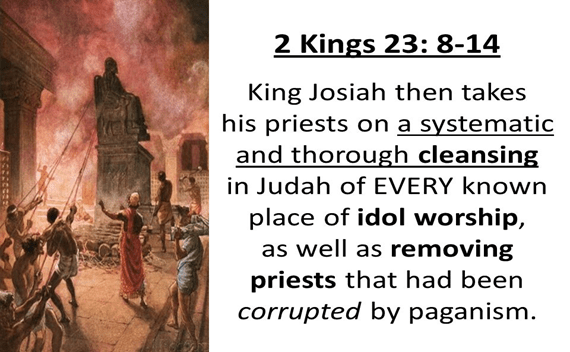
Having secured popular support, Josiah then begins cleansing, beginning with the temple in Jerusalem. Amazingly, the temple is full of articles made for the worship of “Baal, Asherah, and all the host of heaven.” Josiah has to command the priests before they will remove them. Josiah burns all these articles and carries the ashes to Bethel, where one of Jeroboam’s altars still stands. Josiah burns the Asherah pole that was in the temple, grinds it to powder, and scatters it over the graves of the common people to ensure that nobody will collect so much as an atom of the Asherah pole for further use. Next, the quarters of the male shrine prostitutes in the temple are torn down. Some kings of Judah have instituted sun worship and have created statues of horses and chariots in honor of the sun god right at the entrance to Solomon’s temple! Josiah does away with these items.

Josiah kills the priests of the high places and desecrates all of the high places, the altars on rooftops, and every other area of pagan worship, not only in Judah, but also in Samaria. Altars, Asherah poles, and every other implement of idol worship are reduced to powder and human bones are spread over the high places to desecrate them. At one point, Josiah is in Bethel and is destroying the altar Jeroboam created. Just as Josiah is about to open one tomb, the local citizens stop him, advising him that this is the tomb of the prophet who foretold Josiah’s coming.

The story is told in 1 Kings 13. Jeroboam the first has built an altar in Bethel and is starting worship. 1 Kings 13:1 – 2 “Suddenly, as Jeroboam was standing beside the altar to burn incense, there came a man of God from Judah to Bethel by the word of the LORD. And he cried out against the altar by the word of the LORD, “O altar, O altar, this is what the LORD says: ‘A son named Josiah will be born to the house of David, and upon you he will sacrifice the priests of the high places who burn incense upon you, and human bones will be burned upon you.’ ” Out of respect for the prophet, Josiah leaves his bones alone.

APPLICATION: WHAT IS THE SPEED OF DARKNESS? IT IS THE SPEED OF LIGHT, FOR DARKNESS AND LIGHT CAN NEVER EXIST IN THE SAME PLACE AT THE SAME TIME. When light enters the nation of Judah, the darkness disappears. There are several amazing things about the story of Josiah. First, there is Josiah himself; who has mentored this young man? The priests in the temple in Jerusalem have been tolerating all kinds of idolatry, so any of them is an unlikely candidate. Second, why is it that Josiah succeeds in making a clean sweep of the idols and high places when virtuous predecessors such as Hezekiah have not succeeded? Josiah studies the Word of God and gets all the leaders and most of the common people to enter into covenant to serve God whole – heartedly. None of the other kings have involved the people, nor have they confronted the people with the Word of God.

Hebrews 4:12 tells us, “For the word of God is living and active. Sharper than any double-edged sword, it pierces even to dividing soul and spirit, joints and marrow. It judges the thoughts and intentions of the heart.” The mistake the previous kings of Judah made when trying to institute reform was that they failed to study the Word of God, to invoke the Word or to expose the people to it. Those kings tried to do it all on their own and failed. Some of the high places around Jerusalem went all the way back to King Solomon and his foreign wives. Now Josiah has read only part of the Word of God to the people, and they have come under conviction.

Sometimes we fear to quote the Bible because we don’t want to overwhelm someone with Scripture. But there is a time and place in which Scripture becomes necessary if people are to turn to God. We cannot merely quote our words and convince people to change; God must do it. Our testimonies are important, but in the end, we must give God first place.

Stopped in their tracks by the Word of God! That’s what happened to the leaders of Jerusalem and Judah, and that’s why they supported Josiah. Any preaching that does not start, end, and depend on the Word of God is the spiritual equivalent of cotton candy – fluffy, full of sugar, gooey, but not nourishing. As we strive to tell others about God, let us never forget that ultimately, God is the One who must change hearts. As one of our pastor friends used to say, “We are only in advertising; God is in management.”

PRAYER: Father God, thank You for loving us and for caring for us. Lord, help us to study Your Word, to memorize Your Word, and to depend on Your Word at all times. In the matchless Name of King Jesus. Amen.
SEPTEMBER 5, 2022 SPIRITUAL BLACK HOLES PART 2 #43 2 KINGS 22:1 – 20 KING JOSIAH, THE LAST RIGHTEOUS KING OF JUDAH

September 5, 2022

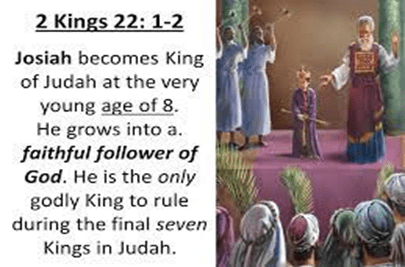
2 Kings 22:1 – 20 “Josiah was eight years old when he became king, and he reigned in Jerusalem thirty-one years. His mother’s name was Jedidah daughter of Adaiah; she was from Bozkath. And he did what was right in the eyes of the LORD and walked in all the ways of his father David; he did not turn aside to the right or to the left.

Funding the Temple Repairs (2 Chronicles 34:8–13)

Now in the eighteenth year of his reign, King Josiah sent the scribe, Shaphan son of Azaliah, the son of Meshullam, to the house of the LORD, saying, “Go up to Hilkiah the high priest and have him count the money that has been brought into the house of the LORD, which the doorkeepers have collected from the people. And let them deliver it into the hands of the supervisors of those doing the work on the house of the LORD, who in turn are to give it to the workmen repairing the damages to the house of the LORD— to the carpenters, builders, and masons—to buy timber and dressed stone to repair the temple. But they need not account for the money put into their hands, since they work with integrity.”

Hilkiah Finds the Book of the Law (2 Chronicles 34:14–21)

Then Hilkiah the high priest said to Shaphan the scribe, “I have found the Book of the Law in the house of the LORD!” And he gave it to Shaphan, who read it.

And Shaphan the scribe went to the king and reported, “Your servants have paid out the money that was found in the temple and have put it into the hands of the workers and supervisors of the house of the LORD.”

Moreover, Shaphan the scribe told the king, “Hilkiah the priest has given me a book.” And Shaphan read it in the presence of the king.

When the king heard the words of the Book of the Law, he tore his clothes and commanded Hilkiah the priest, Ahikam son of Shaphan, Achbor son of Micaiah, Shaphan the scribe, and Asaiah the servant of the king: “Go and inquire of the LORD for me, for the people, and for all Judah concerning the words in this book that has been found. For great is the wrath of the LORD that burns against us because our fathers have not obeyed the words of this book by doing all that is written about us.”

Huldah’s Prophecy (2 Chronicles 34:22–28)

So Hilkiah the priest, Ahikam, Achbor, Shaphan, and Asaiah went and spoke to Huldah the prophetess, the wife of Shallum son of Tikvah, the son of Harhas, the keeper of the wardrobe. She lived in Jerusalem, in the Second District.

And Huldah said to them, “This is what the LORD, the God of Israel, says: ‘Tell the man who sent you that this is what the LORD says: I am about to bring calamity on this place and on its people, according to all the words of the book that the king of Judah has read, because they have forsaken Me and burned incense to other gods, that they might provoke Me to anger with all the works of their hands. My wrath will be kindled against this place and will not be quenched.’

But as for the king of Judah, who sent you to inquire of the LORD, tell him that this is what the LORD, the God of Israel, says: ‘As for the words that you heard, because your heart was tender and you humbled yourself before the LORD when you heard what I spoke against this place and against its people, that they would become a desolation and a curse, and because you have torn your clothes and wept before Me, I have heard you,’ declares the LORD.

‘Therefore I will indeed gather you to your fathers, and you will be gathered to your grave in peace. Your eyes will not see all the calamity that I will bring on this place.’ ”

So they brought her answer back to the king.”

Manasseh brought terror to Jerusalem, “filling the streets with innocent blood from end to end. “(2 Kings 21:16.) Then Amon ruled for two years and compounded the damage, destroying scrolls and neglecting the altar so that the spiders took over. But somehow Amon’s son Josiah was totally different from either his father or his grandfather, copying his great grand father Hezekiah and his ancestor David. The spiritual change appears to have come during the eighth year of Josiah’s reign when he would have been sixteen years old.

There is no record of the person or persons who mentored Josiah; however, Josiah began destroying the altars of Baal when he was about twenty. When Josiah was twenty – six, he instituted the rehabilitation of the temple, and it was during that renovation that a scroll was found. Some scholars believe that this scroll was either a copy of the Book of Deuteronomy or part of it. When Hilkiah, the high priest found a scroll, he took it to Shaphan the scribe, who read it. This act might suggest that Hilkiah was illiterate; on the other hand, perhaps Hilkiah simply wanted Shaphan to act as a witness so that the two of them could submit the scroll to Josiah together. Given the warnings against idolatry in the last several chapters of Deuteronomy, such a document could be considered as dangerous as dynamite. Who knew how the king was likely to react when he learned the contents of this scroll?

Blessedly, when Shaphan the scribe read the scroll to Josiah, Josiah was horrified and tore his clothing in remorse. Josiah realized that both Israel and Judah had sinned, and that God had promised that idolatry would be severely punished. Despite all the idolatry extant, there was still a true prophetess living in Jerusalem. Huldah the prophetess advised Josiah that every word in that scroll was true and that God was about to wreak havoc on Jerusalem for their idolatry. But Huldah also informed Josiah that because Josiah feared the Lord and was grieving on behalf of his people, Josiah would die before horror was unleashed.  

Yet another part of this scripture that is significant is the honesty of the workmen who were working on the temple. Josiah told the high priest that the workmen did not need to account for the funds paid them because they were honest. It is amazing that despite the rampant corruption that had previously engulfed Jerusalem, there were still those who would handle money correctly without cheating.

APPLICATION: Things in Jerusalem had really gone downhill to the extent that not even the priests knew where the copy of the Law of Moses was. Evidently, during the reign of either Manasseh or Amon, the scrolls had been stuffed off in a corner under the spider webs. Tradition suggests that the scroll that was found did not contain the complete Torah but only the Book of Deuteronomy. And even the high priest and the scribe were not familiar with this scroll; when they read it, they were shocked at its contents. Such ignorance was a far cry from the requirements God had laid out.

It was God’s intention that every king of Israel should write out his own copy of the complete Torah so that he could study it thoroughly and use it to guide him in ruling the nation. No king of Israel or Judah ever made such a copy. The priests were supposed to teach the Law; however, by this time, they were also ignorant of it. One wonders what kind of worship was taking place in the temple, given this level of ignorance.  

The Bible is an amazing book; the more you study it, the more you learn and the more questions you have. There is always another level of understanding, and new insights to be gained from well – known verses. Psalm 119:9 – 11 tells us, “How can a young man keep his way pure? By guarding it according to Your word. With all my heart I have sought You; do not let me stray from Your commandments. I have hidden Your word in my heart that I might not sin against You.” When we study God’s Word and memorize God’s Word, it will return to us when we need guidance. The more we study the Bible, the more precious it becomes to us.

Josiah’s grief and remorse at the failings of his people was genuine. God honored Josiah by removing him before the attacks by the Babylonians. Josiah eventually died at the age of 39, but he continues to be remembered as the last righteous king of Judah.

PRAYER: Father God, thank You for loving us and for caring for us. Lord, help us to study Your Word and to hide it in our hearts. Help us also to believe Your Word as we see the truth of it worked out in our lives. In the mighty and precious Name of King Jesus. Amen.

SEPTEMBER 4, 2022 SPIRITUAL BLACK HOLES PART 2 #42 2 KINGS 21:19 – 25 KING AMON – DON’T BLINK OR YOU MISS HIM… AND YOU AREN’T MISSING MUCH!

September 4, 2022

2 Kings 21:19 – 25 Amon was twenty-two years old when he became king, and he reigned in Jerusalem two years. His mother’s name was Meshullemeth daughter of Haruz; she was from Jotbah. And he did evil in the sight of the LORD, as his father Manasseh had done. He walked in all the ways of his father, and he served and worshiped the idols his father had served. He abandoned the LORD, the God of his fathers, and did not walk in the way of the LORD. Then the servants of Amon conspired against him and killed the king in his palace. But the people of the land killed all those who had conspired against King Amon, and they made his son Josiah king in his place.

As for the rest of the acts of Amon, along with his accomplishments, are they not written in the Book of the Chronicles of the Kings of Judah? And he was buried in his tomb in the garden of Uzza, and his son Josiah reigned in his place.”

Manasseh reigned 55 years and plunged Judah into idolatry. Of course, the Judeans weren’t exactly protesting; they were going along enthusiastically, suggesting that those faithful to the Living God were in a distinct minority. After Manasseh’s death, his son Amon enjoyed a very brief reign of two years, just long enough to prove that he was a true son of his father and a vile betrayer of David’s legacy. According to Wikipedia, “The Talmudic tradition recounts that “Amon burnt the Torah, and allowed spider webs to cover the altar [through complete disuse] … Amon sinned very much.” Like other textual sources, Flavius Josephus too criticizes the reign of Amon, describing his reign in similar terms to the biblical accounts.

After reigning two years, Amon was assassinated by his servants or officials, who conspired against him, and he was succeeded by his son Josiah, who at the time was eight years old. After Amon’s assassination his murderers became unpopular with the “people of the land”, and they were ultimately killed. It was the people of the land who proclaimed Josiah as his successor; it is not clear what succession would have been anticipated by the officials who assassinated Amon. Some scholars, such as Abraham Malamat, assert that Amon was assassinated because people disliked the heavy influence that Assyria, an age-old enemy of Judah responsible for the destruction of the Kingdom of Israel, had upon him.” (In other words, Amon was being threatened or bought off by the Assyrians.)

Wikipedia continues to quote the Rabbinic literature: The fact that Amon was the most sinful of all the wicked kings of Judah (II Chron. xxxiii. 23) is brought out in the Talmud (Sanh. 103b) as follows: (Sanh. 104a) Ahaz suspended the sacrificial worship, Manasseh tore down the altar, Amon made it a place of desolation [covered it with cobwebs]; Ahaz sealed up the scrolls of the Law (Isa. viii. 16), Manasseh cut out the sacred name, Amon burnt the scrolls altogether [compare Seder Olam, R. xxiv. This is derived from the story of the finding of the Book of the Law, II Kings, xxii. 8]; Ahab permitted incest, Manasseh committed it himself, Amon acted as Nero was said to have done toward his mother Agrippina. (Many people believe that Nero had his mother assassinated.) And yet, out of respect for his son Josiah, Amon’s name was not placed on the list of the kings excluded from the world to come.

A midrashic fragment preserved in the Apostolical Constitutions, ii. 23, which appears to follow an account of the repentance of Manasseh according to a lost Jewish apocryphal writing, reads: “No sin is more grievous than idolatry, for it is treason against God. Yet even this has been forgiven upon sincere repentance; but he that sins from a mere spirit of opposition, to see whether God will punish the wicked, shall find no pardon, although he say in his heart, ‘I shall have peace in the end (by repenting), though I walk in the stubbornness of my evil heart'” (Deut. xxix. 19). Such a one was Amon, the son of Manasseh, for the (Apocryphal) Scripture says: “And Amon reasoned an evil reasoning of transgression and said: ‘My father from his childhood was a great transgressor, and he repented in his old age. So will I now walk after the lust of my soul and afterward return to the Lord.’ And he committed more evil in the sight of the Lord than all that were before him; but the Lord God speedily cut him off from this good land. And his servants conspired against him and slew him in his own house, and he reigned two years only.” It is noteworthy that this very midrashic fragment casts light upon the emphatic teaching of the Mishnah (Yoma, viii. 9): “Whosoever says, ‘I will sin and repent thereafter,’ will not be granted the time for repentance.” (In other words, Amon thought he had plenty of time to sin and then stage a death bed repentance, but his assassination made that impossible.)

Two years was plenty long enough for Amon to far exceed all the evil that his father Manasseh had already accomplished. But when the palace servants assassinated Amon, whom were they trying to bring in? Did they assume that since Josiah was only eight years old, they would be able to manipulate Josiah as someone had earlier manipulated the twelve year – old Manasseh? When “the people of the land” put those assassins to death, what was their intention? Was the execution of Amon’s assassins merely an example of continuing power plays between two different factions at the royal court?

APPLICATION: How much damage can a bad ruler do in two years? Amon serves as a perfect example of a disaster. Once more, we are reminded of Psalm 11:3 If the foundations are destroyed, what can the righteous do?”

The story of Amon serves to remind us that evil must be resisted and not tolerated. Jonathan Goforth was a Canadian Presbyterian missionary to China in the latter nineteenth and early twentieth centuries. When Goforth was considering entering a new province in China, he consulted Hudson Taylor, founder of the China Inland Mission, for advice. Taylor told Goforth, “If you want to enter that province, you must enter it on your knees.” By this, Taylor meant that any efforts to spread the Gospel in the intended area were doomed to failure unless those efforts were preceded by a great deal of prayer. Goforth took Taylor’s advice and became known as one of the greatest missionary revivalists ever to work in China.

Any efforts to resist evil must be preceded by prayer and undergirded by continuing and persistent prayer. We can use the “corners of the day” to pray – praying at stop lights while driving, praying while waiting in line at a store or waiting online for a computer interface to open, etc. Many people keep prayer lists on their cell phones or day timers. It takes very little time to move through a prayer list, especially after you have become familiar with the petitions. If you want something more organized, you can download the Operation World prayer app that allows you to pray for all the nations of the world in a year. (https://operationworld.org)

Luke 18:1 – 8 tells us, “Then Jesus told his disciples a parable to show them that they should always pray and not give up.   He said: “In a certain town there was a judge who neither feared God nor cared what people thought.  And there was a widow in that town who kept coming to him with the plea, ‘Grant me justice against my adversary.’

 “For some time he refused. But finally he said to himself, ‘Even though I don’t fear God or care what people think, yet because this widow keeps bothering me, I will see that she gets justice, so that she won’t eventually come and attack me!’ ”

And the Lord said, “Listen to what the unjust judge says. And will not God bring about justice for his chosen ones, who cry out to him day and night? Will he keep putting them off? I tell you, he will see that they get justice, and quickly. However, when the Son of Man comes, will he find faith on the earth?”

Remember what God told Hezekiah, “I have heard your prayer; I have seen your tears.” God hears our prayers and sees our tears; however, God can only move if we pray and pray so fervently that we are moved to tears on behalf of all those around us.

PRAYER: Father God, thank You for loving us and for caring for us. Lord, help us to understand that when we pray “Thy kingdom come, Thy will be done,” we are praying the most powerful prayer that we possible can. Help us to pray and to never lose heart, no matter how dark things appear to be. In the matchless Name of King Jesus. Amen.

SEPTEMBER 3, 2022 SPIRITUAL BLACK HOLES PART 2 #41 2 KINGS 21:1 – 18 KING MANASSEH MAKES A TOTAL MESS OF JUDAH!

September 3, 2022

2 Kings 21:1 – 18 “Manasseh was twelve years old when he became king, and he reigned in Jerusalem fifty-five years. His mother’s name was Hephzibah. And he did evil in the sight of the LORD by following the abominations of the nations that the LORD had driven out before the Israelites. For he rebuilt the high places that his father Hezekiah had destroyed, and he raised up altars for Baal. He made an Asherah pole, as King Ahab of Israel had done, and he worshiped and served all the host of heaven.

Manasseh also built altars in the house of the LORD, of which the LORD had said, “In Jerusalem I will put My Name.” In both courtyards of the house of the LORD, he built altars to all the host of heaven. He sacrificed his own son in the fire, practiced sorcery and divination, and consulted mediums and spiritists. He did great evil in the sight of the LORD, provoking Him to anger.

Manasseh even took the carved Asherah pole he had made and set it up in the temple, of which the LORD had said to David and his son Solomon, “In this temple and in Jerusalem, which I have chosen out of all the tribes of Israel, I will establish My Name forever. I will never again cause the feet of the Israelites to wander from the land that I gave to their fathers, if only they are careful to do all I have commanded them—the whole Law that My servant Moses commanded them.”

But the people did not listen and Manasseh led them astray, so that they did greater evil than the nations that the LORD had destroyed before the Israelites.

And the LORD spoke through His servants the prophets, saying, “Since Manasseh king of Judah has committed all these abominations, acting more wickedly than the Amorites who preceded him, and with his idols has caused Judah to sin, this is what the LORD, the God of Israel, says: ‘Behold, I am bringing such calamity upon Jerusalem and Judah that the news will reverberate in the ears of all who hear it.

I will stretch out over Jerusalem the measuring line used against Samaria and the plumb line used against the house of Ahab, and I will wipe out Jerusalem as one wipes out a bowl—wiping it and turning it upside down. So I will forsake the remnant of My inheritance and deliver them into the hands of their enemies. And they will become plunder and spoil to all their enemies, because they have done evil in My sight and have provoked Me to anger from the day their fathers came out of Egypt until this day.’”

Moreover, Manasseh shed so much innocent blood that he filled Jerusalem from end to end, in addition to the sin that he had caused Judah to commit, doing evil in the sight of the LORD.

As for the rest of the acts of Manasseh, along with all his accomplishments and the sin that he committed, are they not written in the Book of the Chronicles of the Kings of Judah? And Manasseh rested with his fathers and was buried in his palace garden, the garden of Uzza. And his son Amon reigned in his place.

Hezekiah has the distinction of being one of the few righteous kings in Judah. But when God grants Hezekiah fifteen more years of life, Hezekiah fathers a son who will be remembered as the worst and most evil king Judah ever sees. Manasseh is born three years into that fifteen – year extension, and Hezekiah dies when Manasseh is twelve years old. Now, twelve years should be enough time to groom a future king and to train him in the ways of God. But if Hezekiah makes any such attempts with Manasseh, the training fails to take.

What has gone wrong with Manasseh?

  1. Hezekiah fails to invest time in Manasseh’s training or to take him to the temple to worship. Perhaps Hezekiah views his worship as a private matter and assumes that somehow Manasseh will make the right choices when he is older.
  2. We have no idea how careful or lax Hezekiah has been in his choice of palace servants and advisors. Perhaps there have been those who have been biding their time, simply waiting for Hezekiah to die so that they can manipulate Manasseh to serve their own ends.
  3. When Hezekiah dies, Manasseh is just entering puberty, a volatile time for anyone. Given the wrong encouragement and the wrong guidance, Manasseh might be sorely tempted to plunge into every fertility cult available. Once hooked on sex, Manasseh can be easily swayed to restore all the cults that his father has tried to eliminate.
  4. Evidently, there are those in Jerusalem who have been enduring Hezekiah’s reforms without supporting them. Now that cults are freely available, leading citizens of Jerusalem are more than happy to revert. “But the people did not listen and Manasseh led them astray, so that they did greater evil than the nations that the LORD had destroyed before the Israelites.” Let’s face it, if the citizens of Jerusalem had not WANTED to become corrupt, they could have resisted and protested. As far as we can tell, the silence from God worshipers is deafening; nobody is making so much as a single peep.
  5. As a result of Manasseh’s wickedness and the compliance of the rest of Judah, God warns that He is about to “wipe out Jerusalem as one wipes out a bowl,” handing the Judeans over to their enemies.

APPLICATION:  How bad do things have to become before God says, “Enough!” Today, nations are engulfed in flood – tides of evil. Christians are being martyred in many parts of the world and countries that previously maintained high standards are beginning to resemble ancient Jerusalem under Manasseh. When we are tempted to despair, we should remember the promises of Psalm 11:3 – 7.

If the foundations are destroyed, what can the righteous do?”

The LORD is in His holy temple; the LORD is on His heavenly throne. His eyes are watching closely; they examine the sons of men.

The LORD tests the righteous and the wicked; His soul hates the lover of violence.

On the wicked He will rain down fiery coals and sulfur; a scorching wind will be their portion.

For the LORD is righteous; He loves justice. The upright will see His face.”

God is still on His throne and is still in control! We must continue to fast and pray and not to lose heart! Even in the day of the most wicked kings, there were still those who worshiped the Living God and who did not bow to the Baals or engage in Asherah worship or burn children to Molech. Let us be counted among the righteous and let us work tirelessly to tell others about the wonder, the glory, and the majesty of our God!

PRAYER: Father God, thank You for loving us and for caring for us. Lord, help us to follow hard after You all the days of our lives, even when things become difficult. In the mighty and precious Name of the Lord Jesus we pray. Amen.

SEPTEMBER 2, 2022 SPIRITUAL BLACK HOLES PART 2 #40 2 KINGS 20:12 – 21 HEZEKIAH SHOWS OFF FOR THE WRONG PEOPLE!

September 2, 2022

At that time Merodach-baladan son of Baladan king of Babylon sent letters and a gift to Hezekiah, for he had heard about Hezekiah’s illness. And Hezekiah received the envoys and showed them all that was in his treasure house—the silver, the gold, the spices, and the precious oil, as well as his armory—all that was found in his storehouses. There was nothing in his palace or in all his dominion that Hezekiah did not show them. Then the prophet Isaiah went to King Hezekiah and asked, “Where did those men come from, and what did they say to you?”

“They came from a distant land,” Hezekiah replied, “from Babylon.”

“What have they seen in your palace?” Isaiah asked.

“They have seen everything in my palace,” answered Hezekiah. “There is nothing among my treasures that I did not show them.”

Then Isaiah said to Hezekiah, “Hear the word of the LORD: The time will surely come when everything in your palace and all that your fathers have stored up until this day will be carried off to Babylon. Nothing will be left, says the LORD. And some of your descendants, your own flesh and blood, will be taken away to be eunuchs in the palace of the king of Babylon.”

But Hezekiah said to Isaiah, “The word of the LORD that you have spoken is good.” For he thought, “Will there not at least be peace and security in my lifetime?”

As for the rest of the acts of Hezekiah, along with all his might and how he constructed the pool and the tunnel to bring water into the city, are they not written in the Book of the Chronicles of the Kings of Judah? And Hezekiah rested with his fathers, and his son Manasseh reigned in his place.”

For a guy with such great spiritual discernment, Hezekiah can sure do some stupid stuff! Blinded by the glory of receiving an envoy from the great nation of Babylon, Hezekiah chooses to demonstrate how rich his little nation is. Little does Hezekiah realize that the Babylonian delegation members are tabulating everything in their heads so that when they return to Nineveh, they can inform the Babylonian king. Obscurity can be a great protection; however, by giving these envoys the grand tour, Hezekiah has amply demonstrated why Babylon should pick off the nation of Judah the next time they are in the neighborhood.

Reading the accounts of the previous kings of Judah and the way they have stripped the temple and the nation, it’s amazing that there’s anything left in either treasury. But we must remember that major trade routes run east and west and also north and south through this small area. Jerusalem is near the crossroads of these routes, and business remains good. Somehow, Hezekiah has rebuilt the finances of Judah.

Yet another mistake is that Hezekiah takes the Babylonians through the royal armory. It’s a safe bet that at least one of these envoys is a military man who can rapidly assess the fighting capabilities of Judah, given the extent of that armory. Hezekiah is guilty of a complete breach of classified information. The military leaders of Judah must be groaning in the background!

After the Babylonians have left for Nineveh, the prophet Isaiah comes to Hezekiah and asks him about this visit. “Where did these men come from?” asks Isaiah. “Oh, they came from a distant land, from Babylon,” replies Hezekiah. “And what did you show them?” Isaiah continues. “Oh, I showed them everything,” Hezekiah proclaims proudly, buffing his fingernails on the front of his royal robe as he says this. “Hoo boy!” thinks Isaiah. “We’re in trouble now.”

Then Isaiah has to lay things out for Hezekiah. “Hear the word of the LORD: The time will surely come when everything in your palace and all that your fathers have stored up until this day will be carried off to Babylon. Nothing will be left, says the LORD. And some of your descendants, your own flesh and blood, will be taken away to be eunuchs in the palace of the king of Babylon.”

If you were Hezekiah and you heard that your grandsons were going to be castrated so that they could become palace servants in the Babylonian palace, wouldn’t you be horrified? Wrong! What is Hezekiah’s response? “But Hezekiah said to Isaiah, “The word of the LORD that you have spoken is good.” For he thought, “Will there not at least be peace and security in my lifetime?”

APPLICATION: It was September 30, 1938, and Prime Minister Neville Chamberlain was returning to Great Britain after having signed a peace pact with Nazi Germany. When Chamberlain made a speech promising “Peace in our time,” the British people cheered him. These were Chamberlain’s words: “My good friends, this is the second time in our history that there has come back from Germany to Downing Street peace with honor. I believe it is peace for our time.” Then he added, “Now I recommend you to go home and sleep quietly in your beds.” As Britain slept, the German army marched into Czechoslovakia in “peaceful conquest” of the Sudetenland. The bombers did not roar over London that night, but they would come. In March 1939, Hitler annexed the rest of Czechoslovakia, and two days after the Nazis crossed into Poland on September 1, 1939, the prime minister again spoke to the nation, but this time to solemnly call for a British declaration of war against Germany and the launch of World War II.” (https://www.history.com/news/chamberlain-declares-peace-for-our-time-75-years-ago#:~:text=On%20September%2030%2C%201938%2C%20British,peace%20pact%20with%20Nazi%20Germany.)

Peace in our time! Wars have existed ever since Cane murdered Abel and ran for exile. World War I was touted as “the war to end all wars,” and yet, less than a decade later, Germany was already assembling a new and deadly Wehrmacht. (The German term “Wehrmacht” stems from the compound word of German: Wehren, “to defend” and Macht, “power, force.” Wikipedia) Only a few months after this ringing pronouncement, Chamberlain’s dream of peace lay in ruins and Chamberlain was forced to step down. Winston Churchill took over and turned the British in a completely different direction, one that saved Great Britain.

Why would any right – thinking man consider the possibility of his descendants serving as castrated palace eunuchs as desirable?  It’s very difficult to understand Hezekiah’s weak response to such a horrible prediction, unless we consider the possibility that Hezekiah has no conception of what it means to be a father. Remember that Hezekiah’s father was a horrible idol worshiper. Knowing what we do about Hezekiah’s upbringing, it’s amazing that Hezekiah has turned out to truly worship God. Perhaps Hezekiah figures that it’s better for his grandsons to survive in any fashion than to be annihilated by the Babylonians.

Sometimes current events tempt us to find a corner and hide there, away from social media, news media, and every other thing that will bring us bad news. But servants of the Living God do not have such options. God does want us to rest on a regular basis, but we are to rest so that we may rejoin the battle against evil and be more effective. In Charles Martin’s Murphy Shepherd trilogy, Murphy Shepherd is a man who helps deliver young girls and boys from sexual trafficking. At one point, Murphy Shepherd is so severely wounded that he nearly dies of the infection; when Shepherd recovers from the infection, he finds himself disheartened and unwilling to return to the work that has become his ministry. Only when Murphy’s partner shows him a series of photos of several young boys who are within hours of being trafficked does Shepherd realize that he must return, whether or not he feels like it.

There is a famous quote that says, “All that is necessary for evil to triumph is for men of good will to do nothing.” When Isaiah comes to Hezekiah with his prediction, is there anything else that Hezekiah might do? One thing that Hezekiah could do and does not is to pray on behalf of his descendants. Hezekiah is very willing to pray for himself but not willing to consider his nation or his family in his prayers. Let us not be like Hezekiah! Let us fast and pray and trust that God can and will do “far abundantly above all that we ask or think,” if we will keep thinking and asking!

PRAYER: Father God, thank You for loving us and for caring for us. Lord, help us to keep fasting and praying for the nations of the world. Help us not to become complacent, fearful, or tired. In the mighty and precious Name of King Jesus. Amen.
SEPTEMBER 1, 2022 SPIRITUAL BLACK HOLES PART 2 #39 2 KINGS 20:1 – 11 GOD HEARS YOUR PRAYERS AND SEES YOUR TEARS – YOU ARE LOVED!

September 1, 2022

2 Kings 20:1 – 11 “In those days Hezekiah became mortally ill. The prophet Isaiah son of Amoz came to him and said, “This is what the LORD says: ‘Put your house in order, for you are about to die; you will not recover.’”  Then Hezekiah turned his face to the wall and prayed to the LORD, saying, “Please, O LORD, remember how I have walked before You faithfully and with wholehearted devotion; I have done what was good in Your sight.” And Hezekiah wept bitterly.

Before Isaiah had left the middle courtyard, the word of the LORD came to him, saying, “Go back and tell Hezekiah the leader of My people that this is what the LORD, the God of your father David, says: ‘I have heard your prayer; I have seen your tears. I will surely heal you. On the third day from now you will go up to the house of the LORD. I will add fifteen years to your life. And I will deliver you and this city from the hand of the king of Assyria. I will defend this city for My sake and for the sake of My servant David.’ ”

Then Isaiah said, “Prepare a poultice of figs.” So they brought it and applied it to the boil, and Hezekiah recovered.

Now Hezekiah had asked Isaiah, “What will be the sign that the LORD will heal me and that I will go up to the house of the LORD on the third day?”

And Isaiah had replied, “This will be a sign to you from the LORD that He will do what He has promised: Would you like the shadow to go forward ten steps, or back ten steps?”

“It is easy for the shadow to lengthen ten steps,” answered Hezekiah, “but not for it to go back ten steps.”

So Isaiah the prophet called out to the LORD, and He brought the shadow back the ten steps it had descended on the stairway of Ahaz”

King Hezekiah is very sick; in fact, his doctors have warned him that he is likely to die. Hezekiah has a deep boil that cannot be drained, and in Hezekiah’s time, there are no antibiotics. Septicemia is setting in, and Hezekiah can feel himself growing weaker by the minute. Now Isaiah the prophet comes to Hezekiah, warning him to get his affairs in order because this sickness is terminal.

At this news, Hezekiah is devastated and begins to weep bitterly. Hezekiah reminds the Lord of all the times he has trusted the Lord, even when it appeared that the Assyrians were about to wipe out Jerusalem. Hezekiah is in total despair, and God has pity on him. Even before Isaiah has a chance to leave the palace grounds, the Lord turns him around and sends him back with an incredible message for Hezekiah. “‘I have heard your prayer; I have seen your tears. I will surely heal you. On the third day from now you will go up to the house of the LORD. I will add fifteen years to your life. And I will deliver you and this city from the hand of the king of Assyria. I will defend this city for My sake and for the sake of My servant David.’” WOW!

When Hezekiah hears this new message, he is understandably reluctant to believe it and asks what sign God might give him to confirm this promise. In the palace, the stairway of Ahaz serves as a sundial, so Isaiah tells King Hezekiah that God can either lengthen the shadow by ten steps or bring the shadow back ten steps that it has already descended. Hezekiah asks that the shadow be retracted by ten steps, and God immediately does this. Not only that, but God inspires Isaiah to order the palace physicians to apply a poultice of figs to the boil, bringing the boil to a head and allowing it to drain, and Hezekiah recovers. This poultice would generate heat and possibly also contain antibiotic properties that would penetrate the tissue around the boil, speeding the healing. At any rate, Hezekiah is healed and does live another fifteen years. (Note: in researching this on the internet, I found several sources that recommended this same home remedy for boils.)

APPLICATION: There are several remarkable aspects to these verses.

  1. God warns Hezekiah ahead of time that he will die. This warning suggests a close relationship between God and Hezekiah, one that has stretched over years.
  2. Hezekiah is bold enough to appeal to God on the basis of that long – term relationship.
  3. God tells Hezekiah something that all of us long to hear, “‘I have heard your prayer; I have seen your tears. I will surely heal you.”
  4. God does something for Hezekiah that he never does for anyone else in recorded history; God not only makes the sun stand still, but God reverses time so that the shadow on the steps of Ahaz goes back ten steps. It is unclear how much time this represents, but this action is obviously a miracle that only God can perform.
  5. God promises that by the third day, Hezekiah will be well enough to worship in the temple. God also promises to add fifteen years to Hezekiah’s life. Fifteen years! This sounds great; however, three years into that fifteen, Hezekiah’s son Manasseh is born. Manasseh turns out to be the most evil king Judah ever has, leading the nation into wholesale idolatry. God frequently cites Manasseh’s evil reign as the cause of Judah going into exile.

From the proclamations of Isaiah, it is clear that God has a close personal relationship with Hezekiah. But one question has always troubled me: what if Hezekiah had accepted his imminent death as God’s will and had not fathered Manasseh? Who would have succeeded Hezekiah then? Certainly, Hezekiah must have had someone who could have succeeded him. At the same time, when God granted Hezekiah’s request, He already knew that Manasseh would be born during the extension of Hezekiah’s life. God already knew all the evil that Manasseh would do and how Manasseh would totally reverse every spiritually good thing that Hezekiah had accomplished. God knew all this….. and yet, God granted Hezekiah enough years to father Manasseh and to raise him to the age of twelve.

If Hezekiah lived to see Manasseh reach the age of twelve, that should have given Hezekiah enough time to train Manasseh in the things of God. We will take up this question again when we discuss Manasseh’s reign. For now, we should take courage from God’s words to Hezekiah, “I have heard your prayer; I have seen your tears.” May all of us take encouragement from these words! God hears, God sees, and God knows.

PRAYER: Father God, thank You for loving us and for caring for us. Lord, help us to remember that You always hear our prayers and see our tears. Help us to trust You and to turn to You in every situation. In the mighty and precious Name of King Jesus. Amen.