
2 Chronicles 3:1 – 17 Temple Construction Begins (1 Kings 6:1-4)
Then Solomon began to build the house of the LORD in Jerusalem on Mount Moriah, where the LORD had appeared to his father David. This was the place that David had prepared on the threshing floor of Ornan the Jebusite. Solomon began construction on the second day of the second month in the fourth year of his reign.
The foundation that Solomon laid for the house of God was sixty cubits long and twenty cubits wide, according to the old standard. The portico at the front, extending across the width of the temple, was twenty cubits long and twenty cubits high. He overlaid the inside with pure gold. (The foundation was approximately 90 feet long and 30 feet wide (27.4 meters long and 9.1 meters wide) The old standard of measurement was a cubit equal to 18 inches or 45.7 centimeters. The new standard, a cubit of approximately 21 inches or 53.3 centimeters (the long cubit) is the basic unit of length throughout Ezekiel 40 to 48. 20 cubits is approximately 30 feet or 9.1 meters.)
The Temple’s Interior (1 Kings 6:14-22)
He paneled the main room with cypress, which he overlaid with fine gold and decorated with palm tree and chain designs. He adorned the temple with precious stones for beauty, and its gold was from Parvaim. He overlaid its beams, thresholds, walls, and doors with gold, and he carved cherubim on the walls.
Then he made the Most Holy Place; its length corresponded to the width of the temple, twenty cubits long and twenty cubits wide, and he overlaid the inside with six hundred talents of fine gold. The weight of the nails was fifty shekels of gold. He also overlaid the upper area with gold. (600 talents is approximately 22.6 tons or 20.5 metric tons of gold. 50 shekels is approximately 1.26 pounds or 569.8 grams of gold.)
The Cherubim (1 Kings 6:23-30)
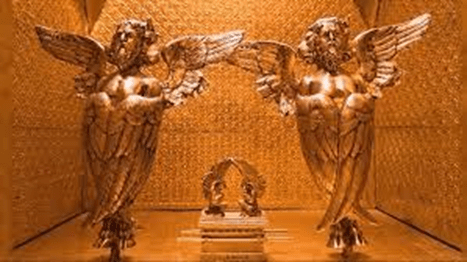
In the Most Holy Place he made two cherubim of sculptured work, and he overlaid them with gold. The total wingspan of the cherubim was twenty cubits. One wing of the first cherub was five cubits long and touched the wall of the temple, and its other wing was five cubits long and touched the wing of the other cherub. The wing of the second cherub also measured five cubits and touched the wall of the house, while its other wing measured five cubits and touched the wing of the first cherub. So the total wingspan of these cherubim was twenty cubits. They stood on their feet, facing the main room. (20 cubits is 30 feet.)
The Veil and Pillars (1 Kings 7:13-22)
He made the veil of blue, purple, and crimson yarn and fine linen, with cherubim woven into it. In front of the temple he made two pillars, which together were thirty-five cubits high, each with a capital on top measuring five cubits. (35 cubits is approximately 52.5 feet or 16.0 meters.)
He made interwoven chains and put them on top of the pillars. He made a hundred pomegranates and fastened them into the chainwork. Then he set up the pillars in front of the temple, one on the south and one on the north. The pillar on the south he named Jachin, and the pillar on the north he named Boaz. (Jachin probably means He establishes. Boaz probably means in Him is strength.)”
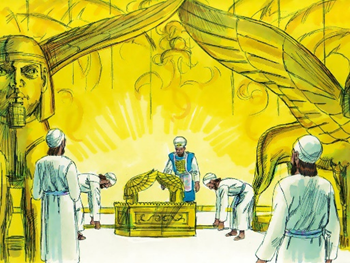
Reading the accounts of the building of Solomon’s temple, the amounts of gold and precious wood and other materials is staggering! There was nothing cheap or second – rate about this edifice; it set the standard for places of worship, perhaps for all time. Little wonder then, that when Judah fell to the Babylonians, they stripped the temple completely. Cedar, cypress, gold, precious materials – this temple had everything. What did the cherubim guarding the ark look like? Some scholars think they were more or less human figures, while others feel they had lion’s bodies with wings and human heads. One archaeologist has even portrayed the cherubim as having headdresses similar to those worn by Egyptian pharaohs; however, this is highly unlikely, since God repeatedly warned the Israelites never to return to Egypt. At any rate, this temple was truly magnificent and awe – inspiring.
APPLICATION: You might think that having an awe – inspiring temple would be sufficient to cause all of Israel to worship their wonderful God…. And you would be wrong! Despite having such a magnificent place of worship, the Israelites eventually descended into demon worship. What happened? Jesus told the Samaritan woman at the well in John 4 that “God is a spirit and they who worship Him must worship in spirit and in truth.” David had planned the temple out of his enormous love for the living God. Solomon fulfilled all David’s plans out of reverence for his father and a desire to demonstrate his power and wealth; however, Solomon’s love for God swiftly grew cold as he became sexually involved with large numbers of women who worshiped demons. David worshiped God in spirit and in truth, but Solomon eventually did not. As Solomon built an increasing number of shrines to demons in and around Jerusalem, other Israelites followed his horrible example.
One of the continuing challenges Christians face is the question of distribution of resources. Are fantastic buildings with architecturally outstanding features necessary or desirable when the building is surrounded by the poor and needy? Does the choir need expensive robes and do the church pews need to be re – upholstered with padded seats and costly materials? If the singing band or praise and worship team cuts a new CD, can that really be counted as evangelism?
The pastor of a large church was leading a congregation during an economic crisis that had impoverished many of his members. When the offerings at the Pastor’s Appreciation Sunday turned out to be quite substantial, some board members quietly suggested to the pastor that he share part of that money with church members who were suffering. Sadly, the pastor refused, stating that he was worth every bit of that money and that he deserved it! There is no record of how many people may have left the church at that point.
One of the continuing tragedies of Christianity is the tendency of church members to spend their money on themselves in the name of evangelism. Many times, those who choose to erect incredible buildings will point to Solomon’s temple for justification of their choices without any indication that they have actually sought guidance from God. Perhaps God might have wanted a much simpler building but one that would be multi – purpose, serving the community. May God help us so that we will follow His leading in all things and not develop an “edifice complex.”
PRAYER: Father God, thank You for loving us and for caring for us. Lord, help us to worship You in spirit and in truth. Help us to remember that any resources we have are actually Yours, so we should ask for Your guidance before allotting them in ways You might not approve. We ask this in the matchless Name of King Jesus. Amen.
 Burunche's Blog
Leave a comment